
Authenticating Modigliani Is Big Business. That’s Why One Expert Is Suing an Organization That Wants to Put Research Online for Free
Amedeo Modigliani is one of the world’s most expensive—and most
forged—artists. As a result, a cottage industry has sprung up among
fiercely competitive experts who offer opinions about the
authenticity of his work. Now, one of the most prominent experts is
suing a scholarly institute, claiming the organization is
unlawfully hoarding thousands of pages of original research and
archival materials—and planning to make that very valuable
information public.
Marc Restellini, a leading Modigliani scholar, has been working
on a catalogue raisonné of the artist’s work for the past several
decades—one that is due to be published by next year and poised to
argue that a significant number of previously disputed paintings
are authentic. There’s just one problem: another organization
claims it has the right to put his research online first.
Yesterday, Restellini filed a federal lawsuit in New York
against the Wildenstein Plattner Institute, an organization that
seeks to “reinvent archival research for the digital generation,”
for allegedly violating his copyright and misappropriating trade
secrets. He is asking the court to compel the organization to
refrain from publishing his research and destroy any digital
copies.
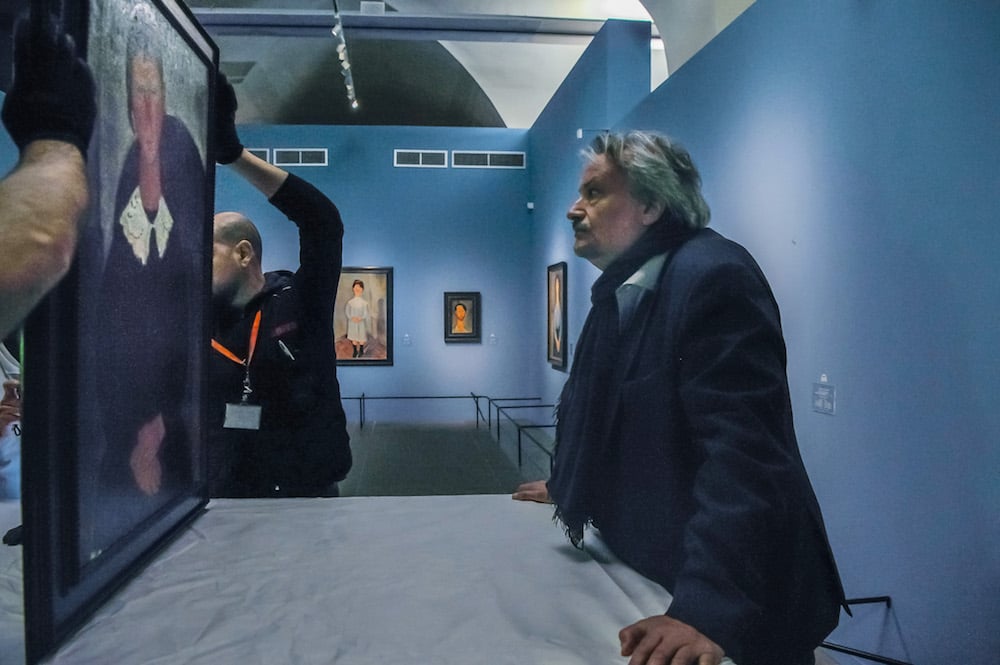
Marc Restellini at the dismantling of
“Modigliani and the Montparnasse Adventure” the show he curated in
Livoro, Italy, in 2018. Photo by Laura Lezza/Getty Images
A representative for the Wildenstein Plattner Institute did not
respond to a request for comment from Artnet News, but called the
lawsuit a “publicity stunt” in a statement to the New York
Times, adding that it was confident it had full rights to
“share its Modigliani archives with the public in furtherance of
its charitable mission.”
The legal fight has the potential to become an important factor
in the high-flying market for Italian-born Modigliani, who was
plagued with poor health until his death at 35. His works are
internationally sought-after trophies; two of his paintings sold
for more than $100 million each within the past five years at
auction.
But Modigliani’s market has long been marked by controversy,
including rampant fakes, heated debates over authenticity,
and competing catalogues
raisonnés (there have been at least five efforts to create
a comprehensive volume to date). At one point, Restellini has said
the disputes became so intense he was receiving death threats. The
ability to prove that a Modigliani is authentic is worth tens of
millions of dollars—and Restellini is concerned that
the Wildenstein Plattner Institute wants to give that
knowledge away for free.
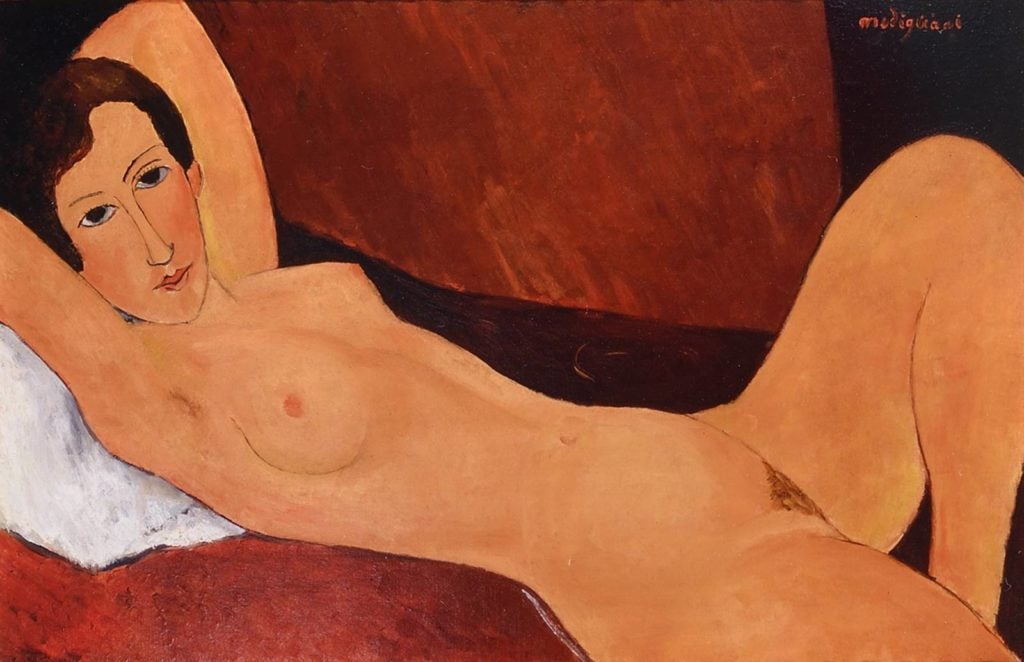
This Amedeo Modigliani, Reclining
Nude (Portrait of Céline Howard), was seized from an
exhibition in Genoa and proven to be a fake. Courtesy of the Genova
Palazzo Ducale.
The complaint quotes an online talk on March 5 in which the
director of the institute said that “scanning an entire archive and
putting it online” was a “no-brainer” and suggested that everyone
should “oppose overly restrictive applications of copyright and
intellectual property.”
The dispute’s origins stretch back to the founding of the
institute. Restellini initially began his research with the support
of a preceding entity—the Paris-based Wildenstein Institute,
founded in 1970 by prestigious art dealer Daniel Wildenstein—in
1997. After Daniel died in 2001, his son Guy, also part of the
family’s art-dealing dynasty, oversaw the institute. (Notably,
Restellini asserts he was never an employee of the institute, nor
did he receive compensation for his work; the collaboration with
Guy ended in 2014.)
In November 2016, Guy
joined forces with German collector and technology entrepreneur
Hasso Plattner to launch the Wildenstein
Plattner Institute, which aims to digitize and increase
accessibility of art-historical documents. As part of the
merger, Wildenstein gifted Restellini’s papers to the newly formed
Wildenstein Plattner Institute, according to the court documents.
But the institute never sought or obtained permission to transfer
the material, Restellini claims, nor did the original Wildenstein
Institute acquire the rights to his work.
This is particularly troubling for the scholar because he has
been working toward the long-awaited publication of his own
catalogue, now delayed further by the institute, which “has refused
to return, and to recognize Restellini’s ownership interest in, the
material,” according to the court filing. Further, Restellini
alleges that, under the guise of its nonprofit status, the
institute is trying to pass off his life’s work as its own without
any compensation or attribution.
“As the complaint demonstrates, Mr. Restellini is, and always
was, the sole author of the catalogue raisonné and the owner of all
of the underlying material associated with its authorship,” said
Restellini’s attorney, Dan Levy, in a statement. “Because the
Wildenstein Institute never had any rights in any of Mr.
Restellini’s material, it could not have transferred any rights to
the Wildenstein Plattner Institute.”
The post Authenticating Modigliani Is Big Business. That’s
Why One Expert Is Suing an Organization That Wants to Put Research
Online for Free appeared first on artnet News.
Read more https://news.artnet.com/art-world/modigliani-expert-sues-wildenstein-plattner-institute-1883370
Further reading


Leave a comment