
Berlin Art Week Offers Artistic Tributes to the Fall of the Berlin Wall on the Historic Event’s 30th Anniversary
This year’s Berlin Art Week
takes place in the midst of an important anniversary: 30 years
since the fall of the Berlin Wall. So it is not surprising that
many of the exhibitions and events kicking off this week take their
cue from the historic reunification of the city.
The Berlin art world is in a
self-reflective mood, as several institutions, project spaces, and
galleries have opted to put on Berlin-themed exhibitions that
tackle an aspect of the city’s wild, sometimes painful, and complex
recent history.
Many shows ask questions about
how the German capital has changed since 1989. What have we
learned? What was lost? And—this one is perhaps the hardest
question to answer—where is this new cultural and commercial
capital headed, exactly?

C/O Berlin, Tilman Brembs,
Goldie, (1997). © Tilman Brembs.
Many exhibitions focus on
Berlin’s dramatic post-war history. East German and pre-war
architecture serves as a poetic backdrop for events around the
city. Positions Art Fair and art berlin are again being hosted in
the historic 1930s Tempelhof Airport. At C/O Berlin, photographs
and videos celebrate Berlin’s club culture—what the venue calls the
“last big bang” of a cultural movement in Europe. In the 1990s,
clubs colonized the city’s abandoned buildings and free space. The
show inevitably includes images by Berlin club culture’s most
famous export, the photographer Wolfgang Tillmans.
At the the private space
Collection Regard,
photographer Patrick Tournebouef shows moody black-and-white images
of the Berlin Wall taken between 1988 and 1989. He went on to
document the fortified border’s transformation, slowly erased in
large part, but with some fragments now monuments of its tragic
history.
In the past decade especially,
Berlin has become the site of conflicting visions of what it should
become. (With the influx of new money, the old motto “poor but
sexy” has never seemed quite so old.) Tech start-ups are
proliferating. Previously affordable spaces that would typically
have been used by artists get swallowed up by real estate
developers.
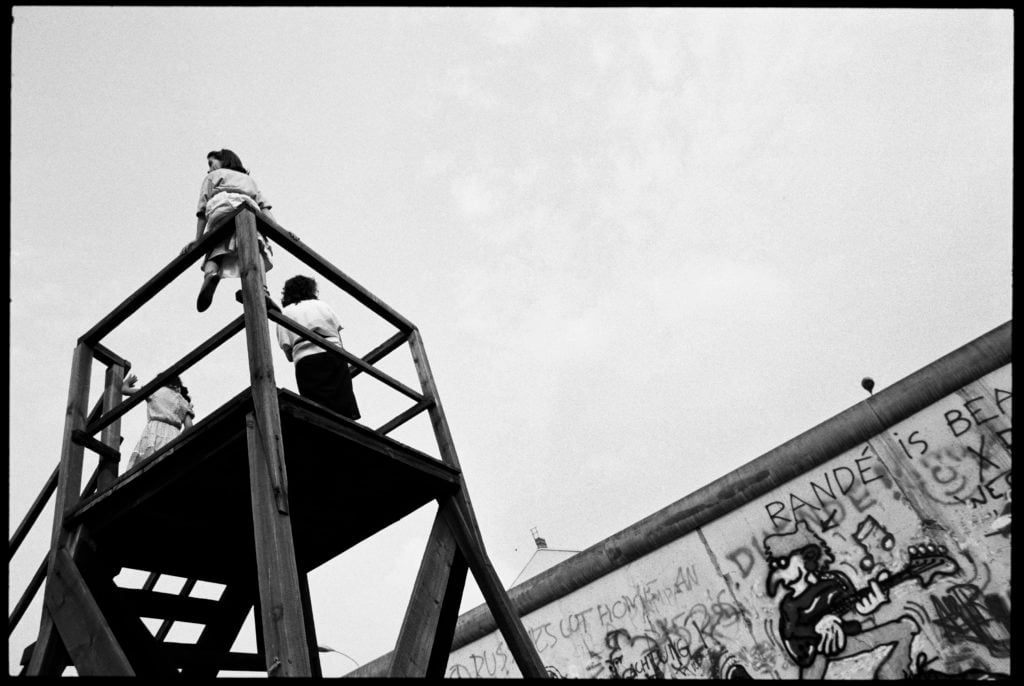
The Berlin Wall from the west,
around 1988. Collection Regard © Patrick
Tourneboeuf/Collection Regard.
“Through the Wall”
at the Gropius Bau is a
group exhibition that explores the theme of sharing lives in a divided society. Other
exhibitions face the city’s contemporary problems head on. Nearby
at the Neuer Berliner
Kunstverein, the exhibition “1989–2019: Politics of Space in
the New Berlin” looks at the housing crisis in the German capital.
It becomes clear, 30 years on, that deep divisions still exists
between Berliners, including between its artists. (A recent study revealed shockingly low pay for
artists and a housing and studio crisis.)
Off all the exhibitions and events taking place in Berlin Art
Week, the Haus der Statistik is
the most intriguing, if a little hard to read. There’s not much to
see here within the 50,000 square meters of the semi-ruined, former
East German office buildings. Its broken windows, graffiti-covered
walls, and trees taking over is a spectacle in itself.
There is a radio station, a crowd-funding bee hive, an art
installation that reacts to pigeon movements and addresses the
birds’ eventual “eviction,” as well as a conference on the future
of the building.
Haus der Statistik is an artistic response to Berlin’s
gentrification. The multifaceted art project is trying to set out
different visions for what little common space is left in Berlin,
while asking how art gestures can be transformed into
sustainable alternatives to gentrification.
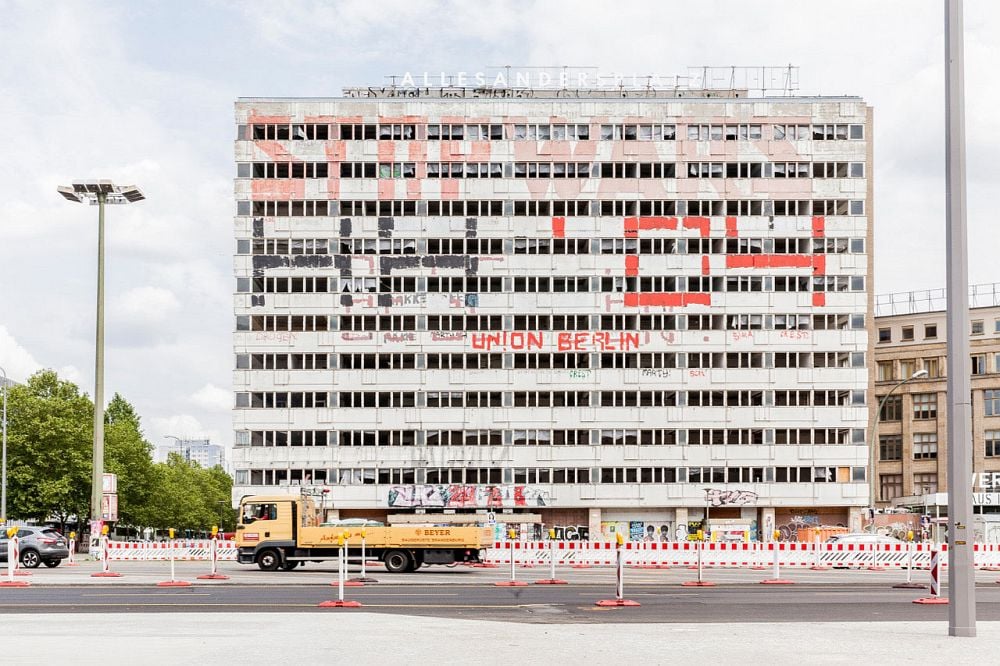
Haus der Statistik. Photo: Victoria
Tomaschko.
At the Berlinische
Galerie, artist Bettina Poutsch tries to stop time. Her
massive black-and-white photographs show time pieces around the
world set to exactly 1:55 p.m. Called World Time Clock, it is
inspired by a famous GDR-era landmark that shows time in major
cities around the globe at Alexanderplatz, a stone’s throw from the
Haus der Statistik.
But that was then, and this is
now. Tech entrepreneurs have made Berlin the Silicon Valley of
Europe. Artists and gallerists are facing exorbitant rent rises.
There is a danger that Berlin Art Week could be a collective wallow
in nostalgia. Are we learning from the past, or are we hiding in
it?
The post Berlin Art Week Offers Artistic Tributes to the
Fall of the Berlin Wall on the Historic Event’s 30th
Anniversary appeared first on artnet News.
Read more https://news.artnet.com/exhibitions/berlin-art-week-30-years-wall-1627666
Further reading


Leave a comment