
Berlin’s Senate Is Rolling Out Up to $320 Million in Emergency Grants for Freelance Cultural Workers and Artists
Berlin’s government is mobilizing to soften the blow of the
global health crisis on small cultural businesses, its freelancers,
and the city’s artists. The Berlin Senate announced today that it
would soon be offering €100 million ($107 million) in €5,000
($5,366) grants to freelance workers and small businesses in the
cultural sector. In addition, the senate is offering another €300
million ($322 million) in loans for the retail, hotel, restaurant,
and cultural industries.
The two emergency aid programs will be rolled out in phases, and
there is a chance that an additional €200 million could be
offered to freelance workers and small businesses, bringing the
total sum offered in loans and small grants to €600 million.
The grants cover a broad range of leisure industries.
Freelancers eligible for the grant program, dubbed Emergency Aid 2,
include not only arts workers, but also those in the sport, event,
and tourism sectors. The aid package for small businesses of
between five and 250 employees (called Emergency Aid 1) covers
restaurants, hotels, nightlife and events businesses, as well as
cultural enterprises, including galleries.
“Berlin is alive and great because of the commitment of its
cultural workers in all sectors,” says cultural senator Klaus
Lederer. “The cancellation of countless cultural events,” he added,
“will threaten the existence of many of them.”
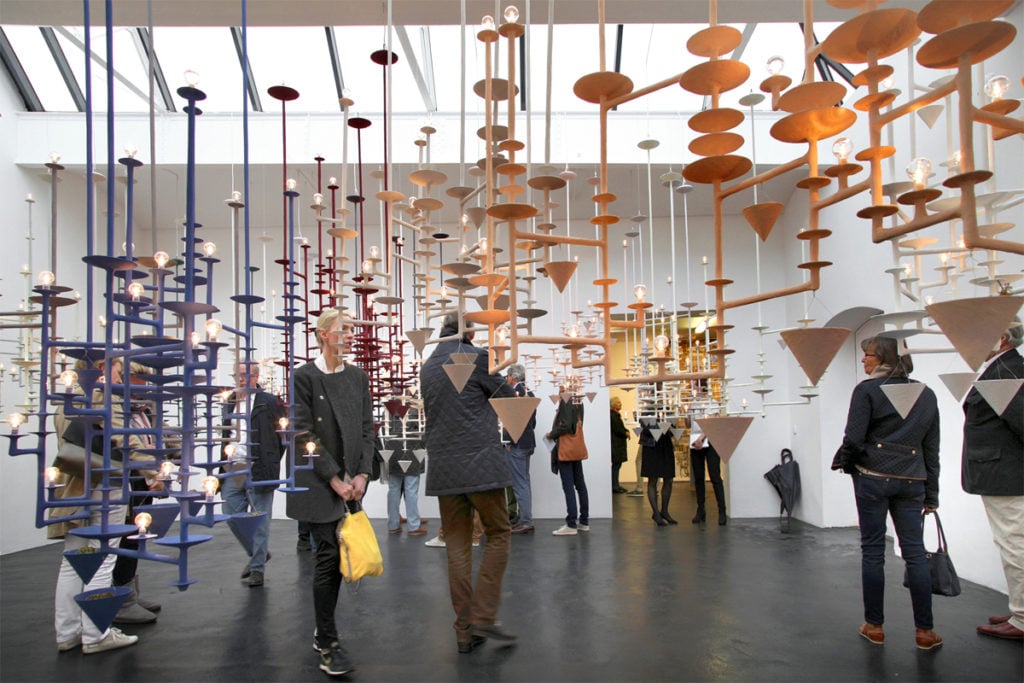
Pae White at neugerriemschneider during
Gallery Weekend Berlin 2017. The annual May event has been
postponed until September. Photo: Marco Funke, courtesy Gallery
Weekend Berlin
Different Aid for Different Needs
Businesses and self-employed people alike are facing an
uncertain future as public life has slowed to a standstill in
Germany. The latest grant and loan offerings are part of a wave of
aid packages that have been made available to keep creative
industries afloat.
In an effort to counterbalance what the government calls
“liquidity bottlenecks,” the government initially launched
so-called bridge loan applications for cultural sector on Thursday.
But soon after the initial announcement, the cultural department
was criticized for failing to address the needs of freelancers (a
category which, by definition, includes artists—8,000 of whom live
in Berlin).
In response, on Friday morning, the Senate rolled out a second
phase of emergency aid: freelancers and small businesses that
employ fewer than five people (this definition encompasses many of
Berlin’s galleries) will soon be able to seek small sustenance
micro-grants of €5,000.
“Loans are unsuitable for individual artists, because the huge
majority of us who live from hand to mouth won’t be able to pay
this money back when the situation normalizes again,” Zoë Claire
Miller, an artist and a representative for the Association of
Visual Artists in Berlin, tells Artnet News. She stresses that the
still-to-be-announced application criteria will determine how
helpful the emergency funds will be.
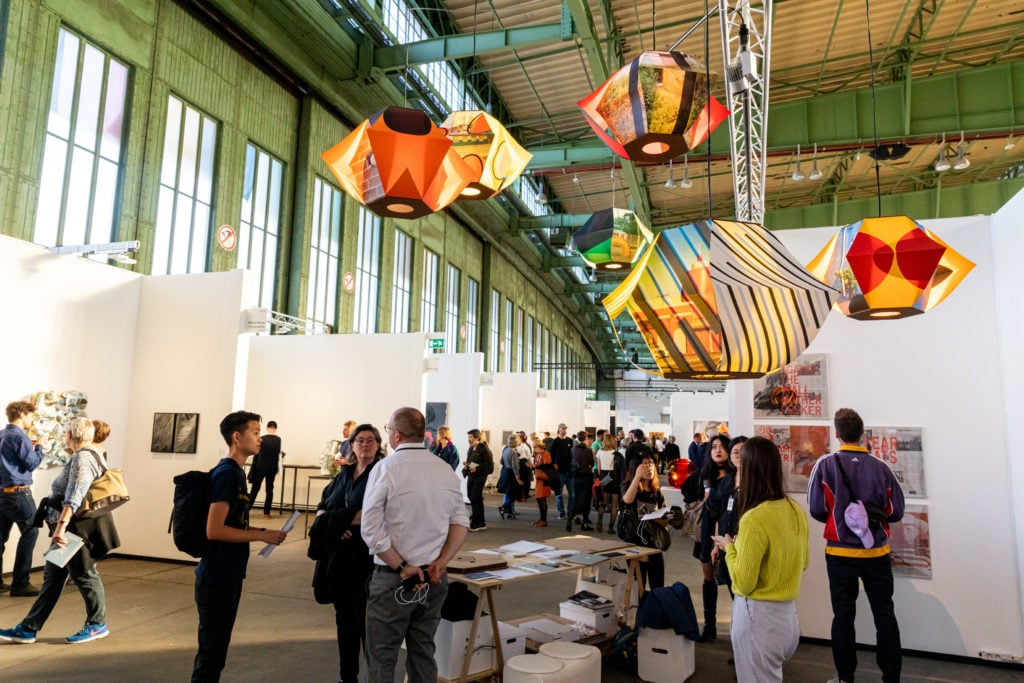
A view from the 2019 edition of Art
Berlin. © Clemens Porikys.
How Do I Get One?
So, how does one go about getting one of these bailouts? The
Berlin Senate says the application—in development now—will be
simple in order to limit the bureaucratic burden. Artists, cultural
workers, staff at small arts associations, and self-employed people
must only prove that the grant will secure their “professional or
operational existence.” The senate warned that if the government
learns that the applicant has subsidiary income that was not
reported, it will amend or withdraw the funds later.
“Berliners need help in these difficult times,” says the
senator of economy Ramona Pop. “With our emergency aid
program, we want to support solo self-employed persons,
freelancers, and small businesses with liquidity problems quickly
and without much bureaucratic red tape. We are doing everything in
our power to ensure that Berliners are able to weather this
crisis.”
The money is coming from the city’s general budget, according to
a statement. The hope is to stabilize the socioeconomic backbone of
Berlin—clubs, restaurants, tourism, and culture—while minimizing
job loss. Depending on how long the crisis takes to resolve, this
could become difficult. But Berlin’s finance head Matthias Kollatz
says the goal is to “mitigate the worst of hardships.”
The Southern state of Bavaria, one of the states hardest hit by
the outbreak, has also released a similar aid package, and Artnet
News understands that the western state of Nordrhein-Westfalen
is also planning a package.
The post Berlin’s Senate Is Rolling Out Up to $320 Million
in Emergency Grants for Freelance Cultural Workers and Artists
appeared first on artnet News.
Read more https://news.artnet.com/art-world/berlin-emergency-grants-1807644
Further reading


Leave a comment