
Boris Johnson’s Brexit Delivery Has Calmed Financial Markets in the UK. But the Art World Is Still on Edge
After
two missed deadlines and a landslide victory for UK Prime Minister
Boris Johnson’s Conservative Party, the UK formally leaves the European Union on
Friday, January 31. Whether you’re an artist, dealer, collector, or
museum director, if you are based in Britain or do business there,
you will be affected.
Precisely how remains to be seen.
For
the next 11 months, business relations between the UK and European
Union will remain as before, as a grace period sets in while politicians
hammer out trade agreements. In political jargon, this is the
transition, or implementation, phase.
Fears
of a no-deal exit from the EU—and the bureaucratic and logistical
headaches that would result—have receded for the time being, but
have not gone away entirely. If trade talks get bogged down—and few
in Brussels think that anything but an interim deal is possible by
Christmas—Johnson’s default mode is Brexit brinkmanship.
For now, many questions remain, and among the most common that
collectors are asking Freya Stewart, CEO of art lending at the Fine
Art Group, are: “Can I still move my art? What paperwork will be
required? And might I be exposed to additional taxes or duties if I
want to move art from the UK to Europe after the end of 2020?”
"background:#FFF; border:0; border-radius:3px; box-shadow:0 0 1px 0 rgba(0,0,0,0.5),0 1px 10px 0 rgba(0,0,0,0.15); margin: 1px; max-width:500px; min-width:326px; padding:0; width:99.375%; width:-webkit-calc(100% - 2px); width:calc(100% - 2px);">
View this post on Instagram
Stewart points out that there is
currently no government information on what might happen after the
transition period ends in December 2020. So for now, the new date
on everyone’s mind is January 1, 2021.
“The implications of possible changes to tax, import, and export
requirements are well documented and could be negative or positive
for the UK market, depending on which way government decisions go,”
the consultant Lucy Sollitt tells Artnet News.
She adds that Brexit may also inaugurate changes
to intellectual property, copyright, and artist resale rights
(royalties paid to artists when their work is resold). Her best
advice? “One thing everyone in the art market can do is fight for a
cultural voice in the trade negotiations.”
Sollitt suggests that artists consider, for example, advocating
for resale rights to continue after Brexit by joining campaigns
organized by bodies such as the Design and Artists Copyright Society.
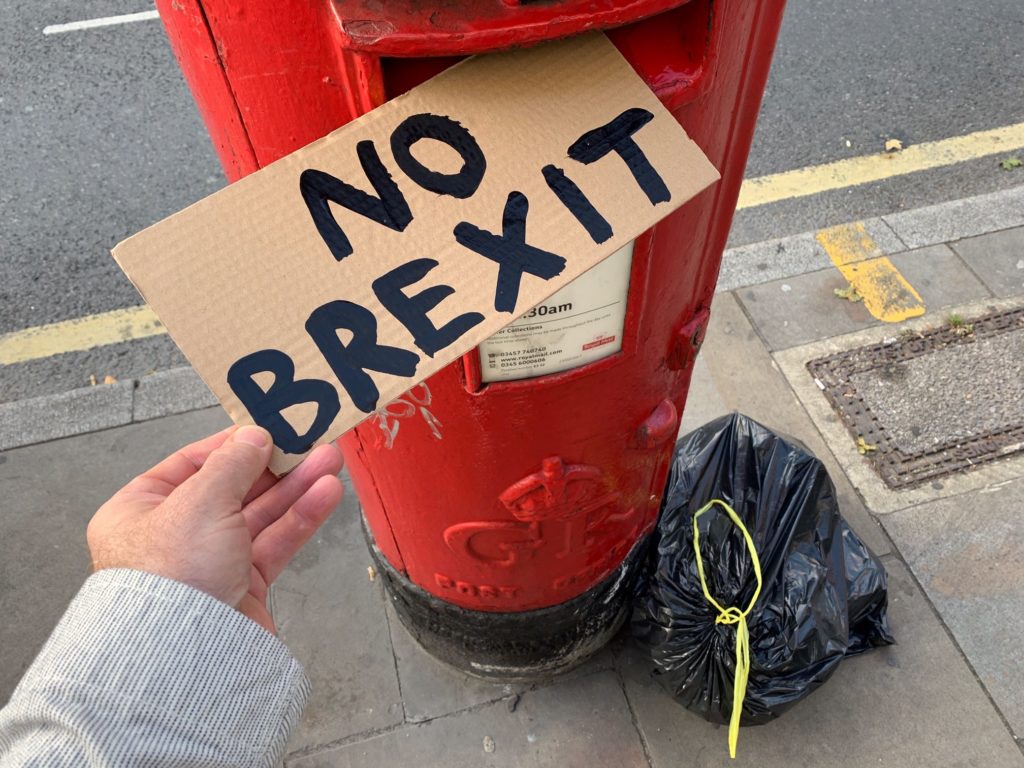
The artist Peter Liversidge’s No-Brexit
mail art series to the Prime Minister will continue. Courtesy of
the artist.
The End of Freedom of
Movement
Brexit also will radically reshape the status of British
citizens living in Europe, and European nationals living in
the UK.
All EU citizens already living
in Britain will have to register under the British government’s EU
Settlement Scheme before December 31, 2020.
Museums, galleries, and auction houses—many of which employ EU
nationals—are being advised to inform their employees to register
with the program. For London’s big
museums, which employ or sub-contract cleaning and catering staff,
many of whom are European, the government’s pledge to reduce the
number of so-called “low-skilled” migrants may make posts hard to
fill.
If you are an EU citizen who
wants to move to the UK after January 31, you will have to apply
for European Temporary
Leave to Remain status. But whatever points-based immigration
system the UK government introduces will likely make it difficult
for travelers to remain. EU citizens just visiting the UK will be
able to enter the country as they can now, and stay for up to three
months.
Any UK citizens hoping to travel abroad will need to apply for
visa waivers to enter the EU. Travelers’ visas will also need to be
valid for at least six months.
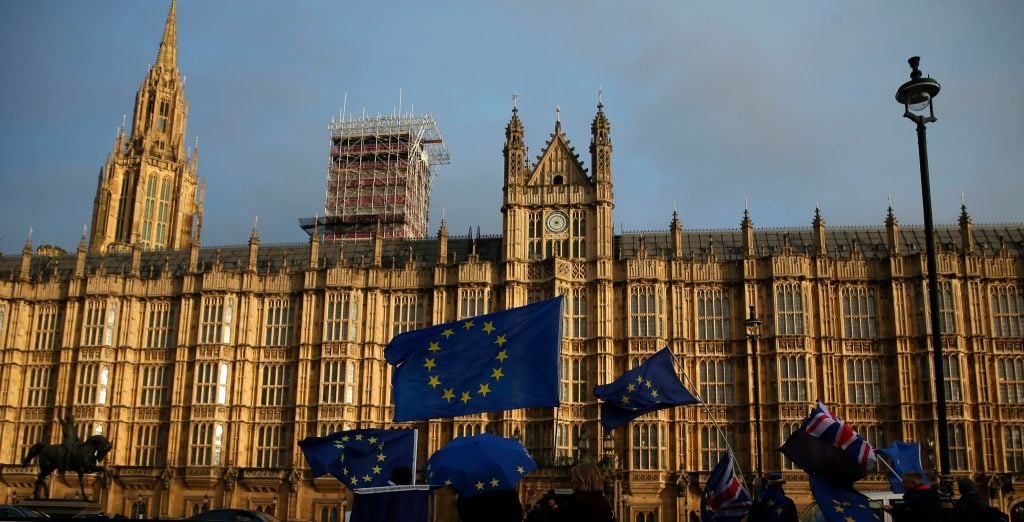
Anti-Brexit demonstrators wave Union and
EU flag outside the Houses of Parliament in central London. Photo:
Daniel Leal Olivas/ Getty Images.
An End to Uncertainty?
As the negotiations are hammered out, many in the art world hope
that pragmatism and close relations with the EU will prevail.
“There are a lot of technical issues, but they are technical,”
says leading art dealer Thaddaeus Ropac. “I am positive. I think
there is an interest on both sides to find practical and pragmatic
solutions.” And in at least some sense, Johnson’s election victory
ended some of the uncertainty that surrounded Brexit, leading to
what Stewart calls a “reassuring effect” on financial and
property markets.
“When there is positive movement in these markets, confidence
tends to filter down, leading to more transactions in other
markets, including the art market,” she says.
The February auctions in London will be the first test of
whether this will result in a bonanza of A-grade sales. The big
auction houses hope that any consigners who were reluctant in 2019
will return in 2020. But they won’t be standing down their Brexit
task forces in London any time soon.
A spokesperson for Christie’s confirms that its Brexit committee
will be convening regularly. The company will make “any necessary
adjustments to logistics following the outcome of relevant
negotiations,” Christie’s said in a statement.
Brexit has arguably benefitted Paris. David Zwirner now has a
space in the French capital, and Artnet News understands Pace is
considering a similar expansion, as is Hasuer & Wirth.
But other dealers says remaining in London now is more important
than ever. The South African Goodman Gallery opened in the
British capital last fall, despite the looming specter of Brexit.
Its director in Britain, the former artistic director of the Frieze
art fair, Jo Stella-Sawicka, tells Artnet News that “it’s more
important than ever that we continue to broaden horizons, and look
beyond socially constructed boundaries.”
The post Boris Johnson’s Brexit Delivery Has Calmed
Financial Markets in the UK. But the Art World Is Still on Edge
appeared first on artnet News.
Read more https://news.artnet.com/market/brexit-market-uncertainty-1760499
Further reading


Leave a comment