
Can a Newly Discovered Fresco of a Very Risqué Myth Help Pompeii Change Its Image? Leda and the Swan Goes on View
One year ago, archaeologists at
the Pompeii Archaeological
Park announced they had excavated a remarkably intact wall-painting
in the bedroom of a home buried under ash when Mount Vesuvius
famously exploded in 79 AD. That fresco, an erotic scene depicting
the ancient Greek myth of Leda and the Swan—in which Zeus, in the
form of a swan, seduces Leda—has been unveiled this week in
the domus
(or upper-class townhouse) where it
was found.
Pompeii is one of Italy’s
biggest tourist attractions and an archaeological marvel.
Excavations have found that first-century Pompeii was a
metropolitan place, complete with fast-food-style counter
restaurants, imported goods, and a panoply of languages
spoken.
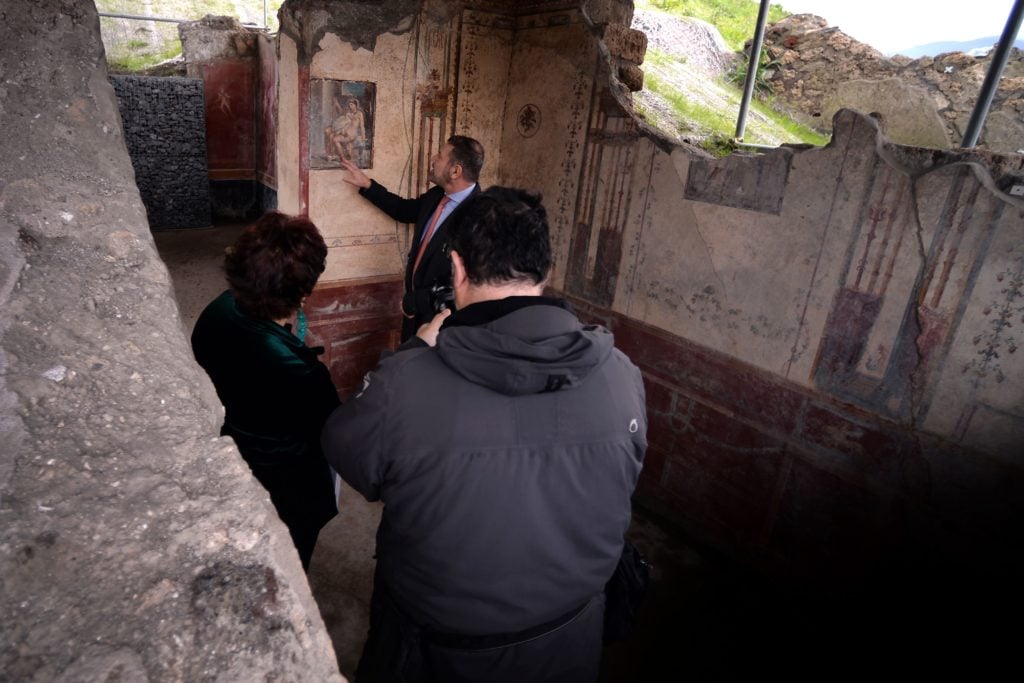
A curator at the Pompeii Archaeological
Park discusses the Leda and the Swan fresco uncovered in November
2018 in the Regio V dig site at Pompeii. Photo by Filippo
Monteforte / AFP via Getty Images.
The dig at the Regio V site, a
54-acre area in the northern part of the park, is the biggest
excavation at Pompeii since the 1960s. The dig got underway last
year, and there are expected to be several more exciting unveilings
as it progresses. It has not yet been announced exactly when the
site will be open to the public. The Great Pompeii Project, which
is the official name of the dig at Regio V, is funded by the
European Union and the Italian Government, who have earmarked over
100 million euros for the project, which was initially slated to be
completed in 2017.
Pompeii had fallen into disarray in the past. Major earthquakes
halted early excavations in the 19th century. World War II, as well
as shoddy restoration work by mafia-controlled building companies,
destroyed many important buildings through the 20th century. By
2010, only 10 sites remained open to the public (compared with the
64 that were open in 1956), and many of those were dangerously in
shambles, with wild dogs roaming the streets.
The unveiling of the Leda and the Swan fresco is perhaps a
turning point for Pompeii, which hopes to revamp its image. Several
discoveries have been made at Regio V, including an inscription
dated in October (the volcano was previously thought to have
erupted on August 24th), as well as the skeletal remains of two
women and three children, and those of a horse. Another
fresco—depicting two gladiators at battle—was found at the site
last year, in the stairwell of what archaeologists speculate was a
brothel-tavern for gladiators.
The post Can a Newly Discovered Fresco of a Very Risqué Myth
Help Pompeii Change Its Image? Leda and the Swan Goes on View
appeared first on artnet News.
Read more https://news.artnet.com/art-world/leda-swan-fresco-unveiled-pompeii-1715154
Further reading


Leave a comment