
Can a Virtual Art Fair Deliver? We Went in Search of Great Art in the Dallas Art Fair’s Online Viewing Rooms to Find Out
Considering that I have never attended the Dallas Art
Fair (or been to Dallas), it’s a surreal experience to report on
the latest edition of the fair, which, like everything these days,
has transmigrated to the virtual realm. It’s also genuinely
exciting. As someone who has toiled on the art web for more than a
decade and seen company after company champion the dream of an
accessible online art marketplace only to treat it, by and large,
as a bin for editions and B- or C-grade work, it’s fascinating to
see what a digital art fair might look like if people actually took
it seriously. And now, of course, for reasons both tragic and
terrifying, the whole art market has to take the art-sales-online
format seriously. It’s all there is right now.
This means that the Dallas Art Fairs’s online edition
(a preface to its rescheduled IRL edition in October) is full of
A-grade material, which helpfully allows you to see how the format
fares in handling A-grade material. It really makes you aware of
the capabilities and limitations of the interface in a way that
prints, editions, décor-forward work, and examples by known
quantities doesn’t. (The fair calls its online platform “online
viewing rooms,” using the format’s laughably banal, misleading, and
instantly dated term of choice that brings to mind the immortal
quote, “Roads? Where we’re going we don’t need roads!” Why rooms?)
It also makes it crystal-clear that an online art fair strips away
all pomp and circumstance of the in-person event, coming down to
the strength of the fair’s gallery relationships, the quality of
its collector mailing list, the compelling nature of its unique
brand context, and the ingenuity of its UX developer.
Misanthropes who wish they could initiate a cloaking
devise before walking into an art fair so they could bypass the
chitchat in the aisles to just look at the art, dammit, will love
this new paradigm. One can go through each of the 84 exhibitors’
displays, looking at your leisure (although there is perplexingly
no zoom function, and only a relative few dealers provided
information on each piece beyond the artist, title, year
dimensions, and, with refreshing regularity, price). Miraculously,
you might even find yourself watching a piece of video
art—something impossible in an actual art fair for anyone lacking
zen-like focus. Most astonishing of all, you can see the whole
fair, going through every single work in every display, and not be
totally zombified. (It’s probably easiest for someone accustomed to
staring at screens all day—but, hey, who isn’t?)
Do I wish I could walk around the sculptures on view,
lean in for a sideways look at a painting to admire the topography
of the impasto? Sure. Do I yearn for a VR headset that would allow
me a virtual approximation of doing those things? Eh, not really.
Would I like to envision what a work would look like, to scale, on
my own wall (a feature the upcoming virtual Frieze Art
Fair will offer)? Yes, that would be nice, because otherwise
these artworks could be postage stamps for all I know.
All this aside, the big question remains: Can I can
get a decent handle on the quality and interest value of these
works from navigating through the website?
To find out, I decided to approach the “online
viewing rooms” the same way I would a real fair, and try to seek
out the most interesting artworks on offer. If I had a question, I
would click the “inquire” button and fill out the brief form. And
just as I would take into account booth design in a convention
center, I’d give extra points for galleries that embraced the
essential characteristics of the format—i.e., who made an effort.
Because the virtual art-fair architecture used by the Dallas Art
Fair is still very much in beta—though in some ways more
user-friendly than the more tricked-out Art
Basel Hong Kong online fair that kicked off this new period—I
would seek out ingenuity and innovation over polish.
Here goes.
Dan Herschlein
The Dinner Companion, 2020
JTT (NEW YORK) & CARLOS/ISHIKAWA (LONDON)
Price: $15,000
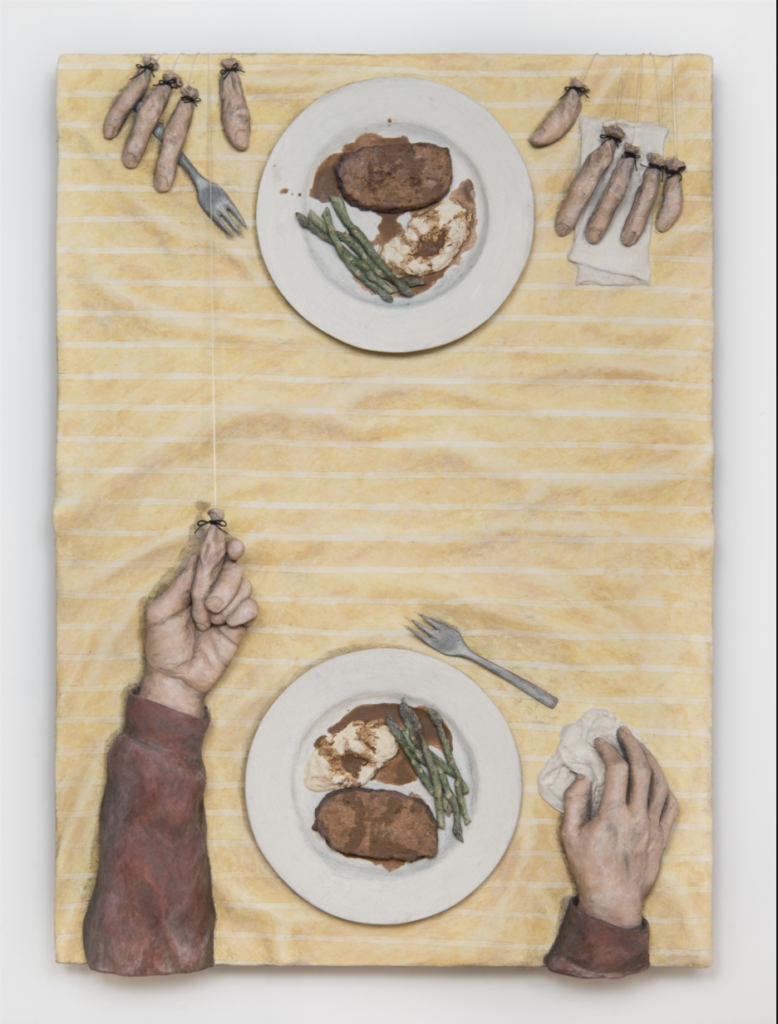
What’s this, a dual-gallery booth? Yes, the
collaborative approach that dealers began taking to sustain the
onerous costs of doing art fairs has now migrated to the virtual
realm, with these two great galleries presenting a solid selection
of work, including this wonderfully unsettling piece by the
30-year-old Brooklyn artist Dan Herschlein. A man sits at a table
and reaches out to tenderly hold one of the disembodied fingers
(either severed or crafted) of his dining companion, which is
attached to a piece of sting. The psychological weirdness of the
scene would have drawn me in regardless, but then listed
materials—which include wood, platter, epoxy, wax, and fishing
line—makes it clear it’s actually a sculptural relief, which is
more interesting still. A young rising star whose work was shown in
the New Museum’s lobby window last year, his drawings can also be
found in Matthew Brown Los Angles’s display at the fair, adding to
his buzz factor.
Fernando
Botero
Cavallo Piccolo, ed. AP2/2, 2011
Beatriz Esguerra Art (Bogotá)
Price: $580,000 (upon
inquiry)
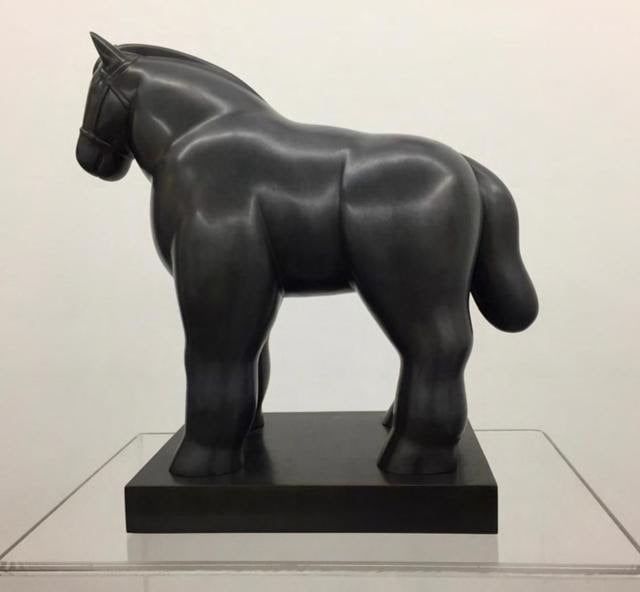 No dealer put as much effort into
their presentation as Beatriz Esguerra, who through sheer force of
will was able to recreate—and, in some ways, improve upon—the
curated fair-booth idiom by hacking the “viewing room” format. Her
“show,” called “The Colombian Angle,” features work by Fernando
Botero alongside six of his countrymen and women. To bring it
alive, she took advantage of the ability to screen videos to offer
a 3D virtual walkthrough of a rendering of the real booth,
providing a much-appreciated sense of scale and curation. She also
included the trailer to a recent Botero documentary, which is worth
watching for this quote from scholar Rosalind Krauss alone: “I
think Botero’s work is terrible. I think his work is the Pillsbury
Doughboy.”
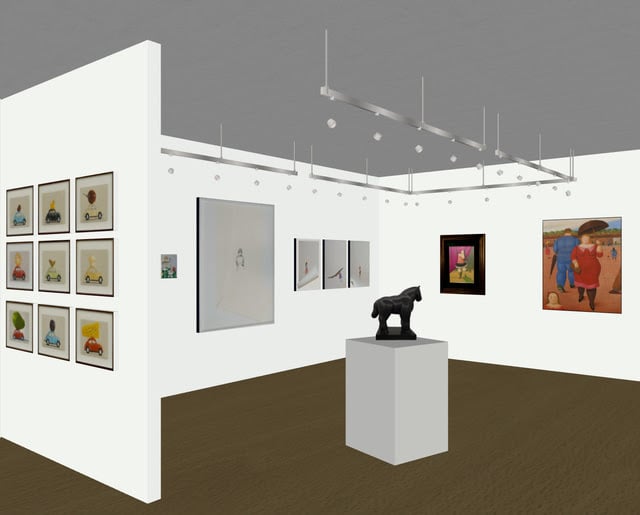
A still from the 3D booth-tour video.
Courtesy of the gallery.
But it’s not all terrible, and in fact some of his
sculpture has the kind of staying power—not to say gravitas—that
history will probably reward, while forgetting his overabundance of
chaff. For instance, this zaftig bronze horse is beautifully
proportioned and instantly recognizable as a Botero, while at the
same time recalling the grand tradition of equestrian sculpture.
Fulsome text provided alongside the sculpture (and every work in
the presentation) also shares that Botero had a sentimental
connection to horses owing to his family history. Mainly, though,
it’s an adorable horse. Very expensive? Yes. But this work will
make your house very popular.
Betty Parsons
The Moth, 1969
Berry Campbell (New
York)
Price: $180,000 (upon inquiry)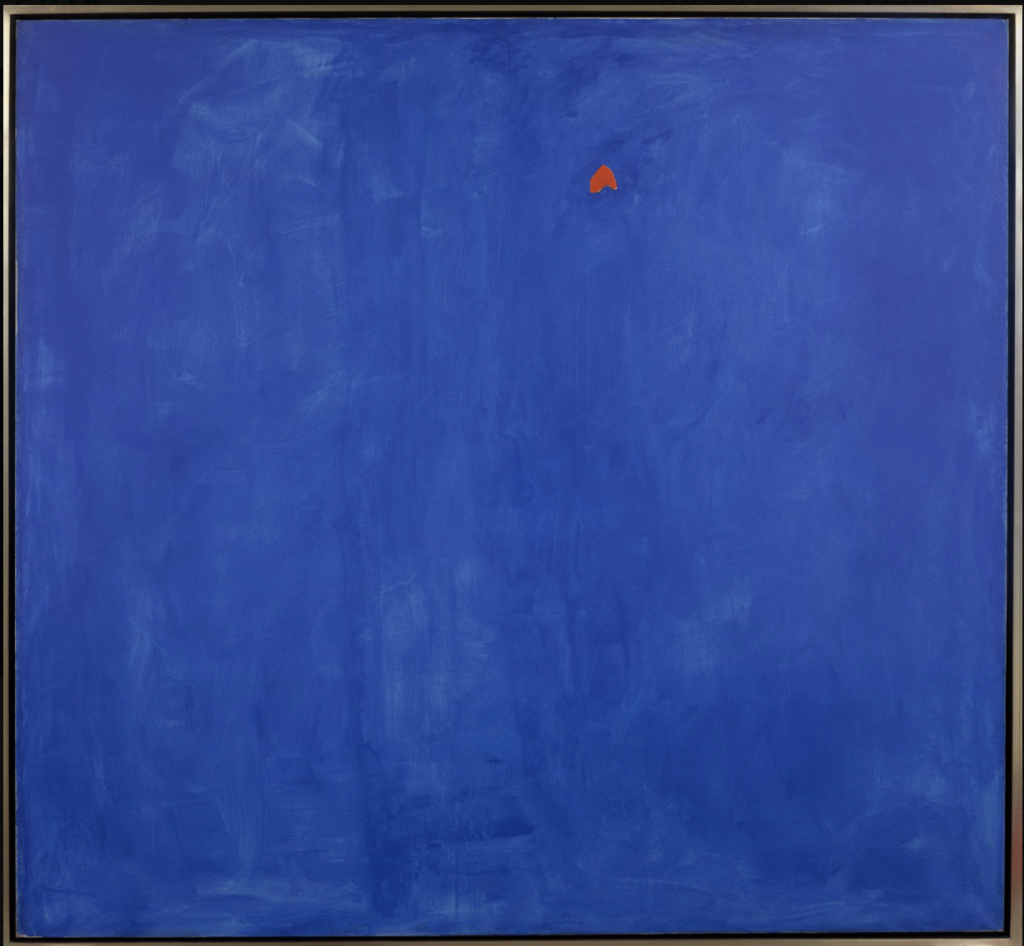
Chelsea dealers Christine Berry and Martha Campbell
did not spend quite so much time on the quiddities of the online
format, instead relying on old-fashioned connoisseurship, curation,
and an eye for sourcing work that looks better over time to put
together an excellent display anchored by female artists from the
1950s, ’60s, and ’70s. Some, like Mary Abbott, Perle Fine, Judith
Godwin, and Ninth Street Women star Grace Hartigan were
undervalued during their lifetime. Others, like Charlotte Park,
Sally Michel Avery, and Elaine de Kooning were overshadowed by
their artist husbands. One, Betty Parsons, was overshadowed by
herself—with her painting career long seen as secondary to her
illustrious run as one of New York’s top dealers of Abstract
Expressionist art.
This witty painting of a solitary red moth against a
brushy blue background plays against the pieties of AbEx orthodoxy,
being at once an abstract all-over composition that emphasizes the
picture plane and a not-very-abstract-at-all (though Fauvist)
portrait of a bug on a wall.
Jana Leo
154 Bofetadas, 2020
Benjamin Tischer/New
Discretions (New York) & Bill Arning Exhibitions (Houston)
Price: $3,000
Videos are notoriously hard to take in at an art
fair—they’re often long, you typically start somewhere in the
middle, and the choice between moving on versus spending an
uncertain amount of time for uncertain payoff usually means the
former wins. This video, at another collaborative viewing room by
Benjamin Tischer/New Discretions gallery and the curator, dealer,
and former CAM Houston director Bill Arning, doesn’t have those
issues. It’s clearly labeled as being mercifully short (just three
minutes long). It is, however, so mercilessly intense that you
might feel better considering it in a bit of privacy.
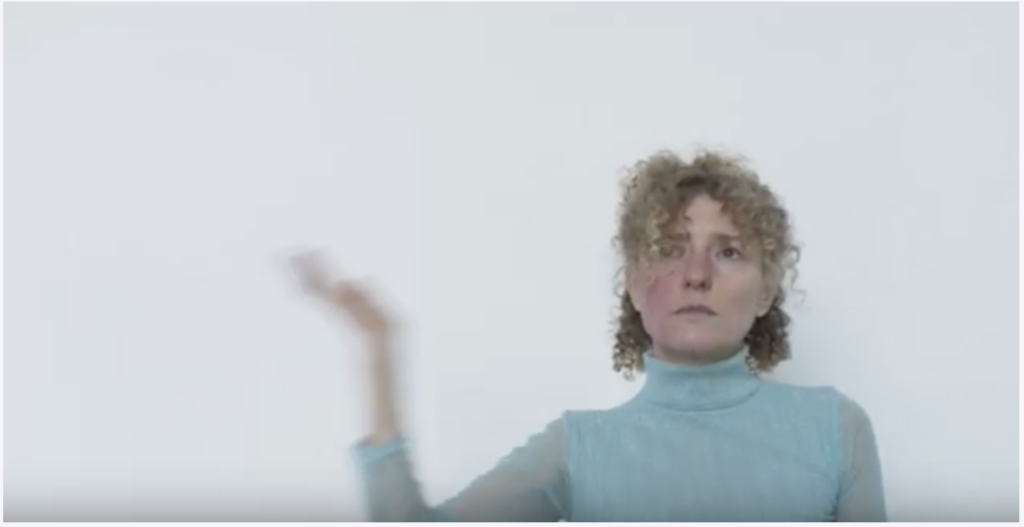
With a title that translates into “154 Slaps,” the
work shows the “Spanish polymath” Jana Leo (as the gallery
describes her) using her right hand to repeatedly slap the right
side of her face with accelerating ferocity, first leaving her
cheek red, then purple, and then, by the time she stops at minute
2:35, battered, exhausted, and sad. Created during the artist’s
Rome Prize residency, in the early days of the outbreak in Wuhan,
China, the video reflects Leo’s focus “on the relationship between
the individual and the state,” she writes in an accompanying
statement. “Person A is the passive subject, the ordinary citizen,
and Person B is a leader/state, one who thinks in realistic and
abstract terms…. There is [a] lethal form in which the relationship
between the individual and the state is twisted: the lack of care….
One clear example is a mayor or a president who take no action to
protect a city or a country…. This video can be used as an
illustration of what every one of these politicians should do to
themselves after stepping down.” It’s a resonant point, viscerally
made.
Austin Lee
Lion and Girl, AP1, 2020
Carl Kostyál
(London)
Price: $90,000 (upon inquiry)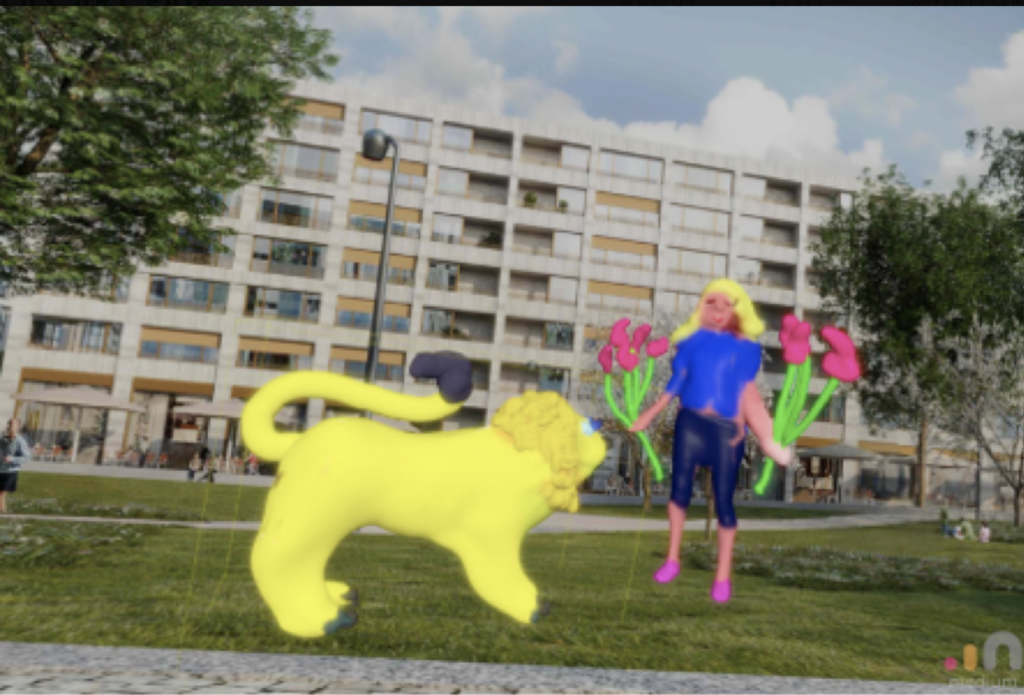
You might not get too far trying to sell a doodle of
an as-yet-unmade artwork at a traditional fair—but on the internet,
anything goes! Here, the London dealer Carl Kostyál presents a
computer drawing of a sculptural pair by the sought-after young New
York artist Austin Lee, which is visualized plopped on lawn of some
kind of residential complex. A look at the accompanying label
reveals that this is a work in progress, to be executed in aluminum
and car paint, at a scale a little larger than life-size.
There is a story behind this doodle. The artist
favors getting his sculptures fabricated at the Vaghi Foundry in
Saronno, Italy, where Kostyál has a home, and the cast aluminum was
originally going to be sent to Dallas prior to the in-person
edition of the fair, where Lee would paint it and deliver it to a
client who had bought an edition through the Dallas art advisor
Adam Green. Then the lockdown happened, throwing these plans to the
wind, and the sculpture remains in Saronno, waiting to be finished
after civilization resumes.
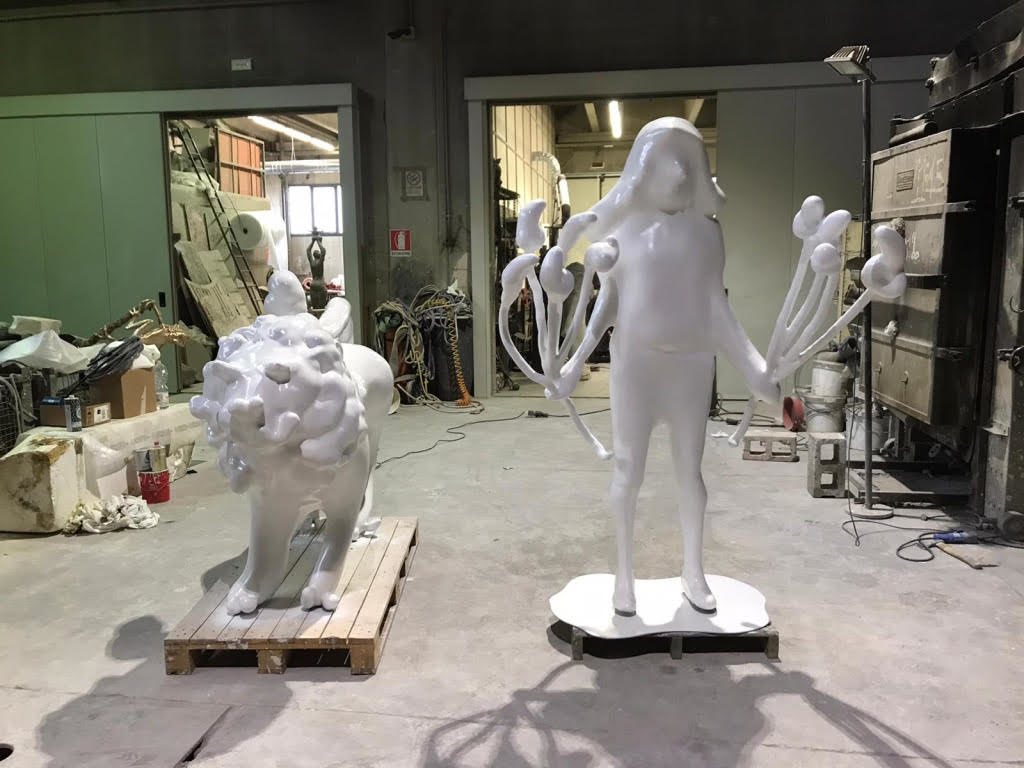
A view of the artwork in progress at the
Vaghi Foundry in Saronno, Italy. Courtesy of the gallery.
The tantalizing lesson here is that, in this virtual context, a
sketch and a finished artwork are tantamount to pretty much the
same thing—though anyone who has bought a Jeff Koons
on spec knows: caveat emptor. However, with the right
guardrails, something like this could go a long way in reducing
risk for a gallery when it comes to fabrication, and shipping
costs, allowing art to be sold on-demand.
Beverly
Pepper
Hosea, 1977
James Barron Art
(Kent, Connecticut)
Price: $250,000 (upon
inquiry)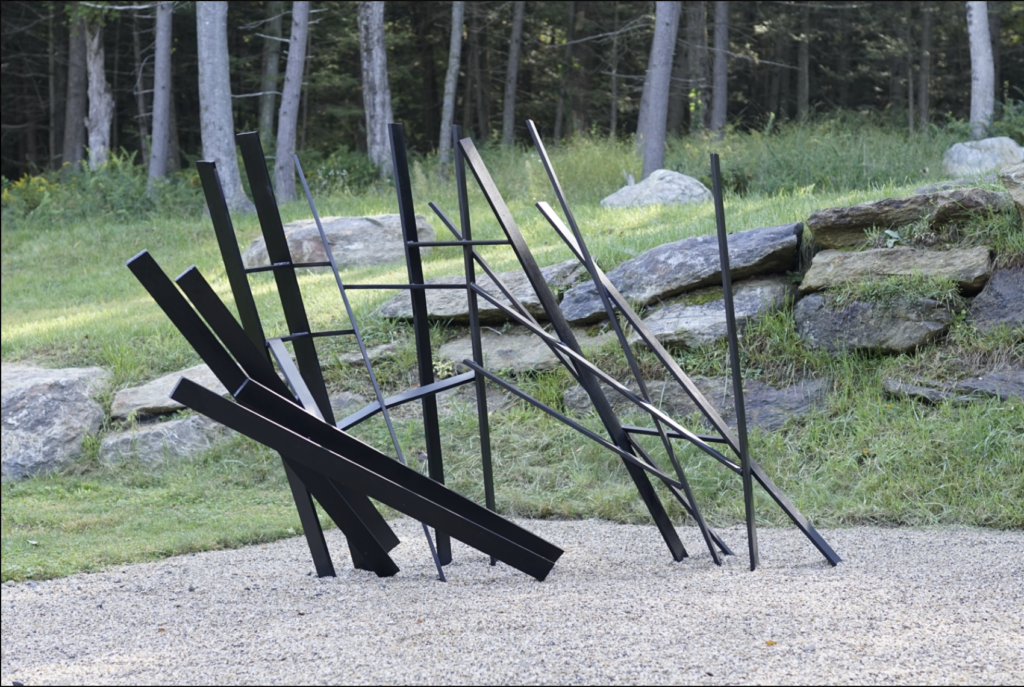
Speaking of outdoor sculptures, the dealer James
Barron used his display to present several knockout works by the
late artist Beverly Pepper, including this stunner. A work of
welded, powder-coated steel that adroitly monumentalizes a state of
collapse, it comes from a prime period of the long career of the
artist, who was remembered as “one of the most powerful of
her generation” when she died at 97 this February.
This is one of six “Web” sculptures that Pepper
created in 1977, and two of them are now on permanent display at
the artist’s sculpture garden in Todi, Italy, where she spent the
second half of her life. Seen on the floor of a convention center,
bathed in artificial light, this work might look dated, out of
place and time. Seen outdoors, in its natural habitat, as it is in
this image, it looks timeless.
Alfredo Ramos
Martínez
Vendedoras de Frutas, c.
1937
Louis Stern Fine Arts (Los Angeles)
Price: $750,000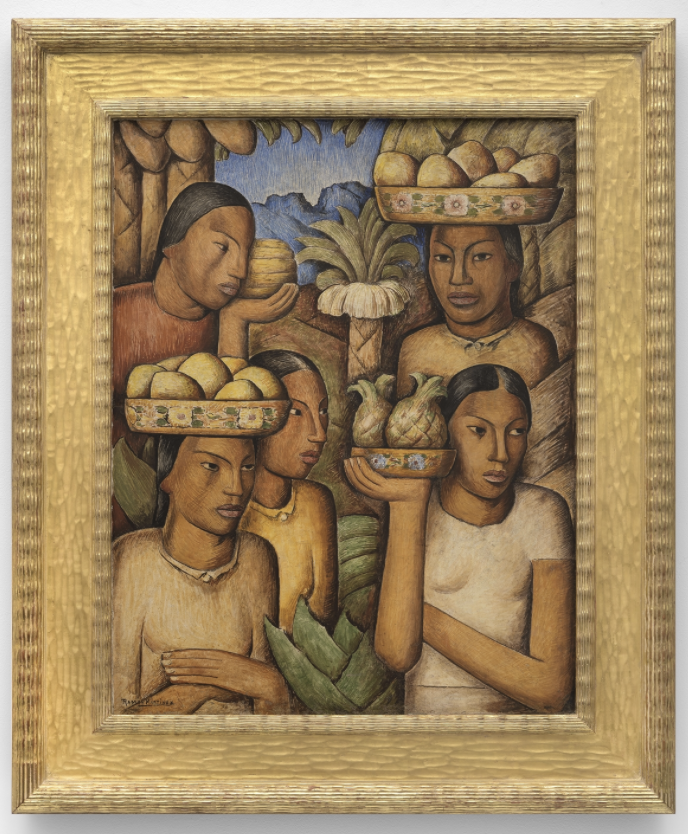
Context is key for an art fair, with an event’s brand
overlaying a curatorial framework on a more or less random
assortment of artworks. Art Basel is the best, Frieze is
intellectual/critical, TEFAF is for connoisseurs, etc. For other
fairs with a less established identity, regional geography becomes
the selling point, and the Dallas Art Fair’s proximity to the
US-Mexico border incentivizes dealers to bring work by Latinx and
Latin American artists—something that has bubbled over into the
virtual edition.
In that vein, it makes sense that one of the marquee
works of the fair would be this group portrait by Alfredo Ramos
Martínez. A painter who traveled to Paris in the 1920s and returned
to Mexico to spread the gospel of modernism, Martínez was an
influential artistic force as the head of Mexico City’s Academy of
San Carlos, where he aligned himself with student protestors who
wanted to throw out antique pedagogical methods to focus on life
and the new. Now sometimes called the father of Mexican modernism,
he is best known for his portraits of female fruit- and
flower-sellers, who offer up a distinctly Mexican vision of
pulchritude, with emphatic lines and rich earth tones.
Martínez is currently getting a wave of new
attention, and one of his portraits, of a woman bearing a basket of
calla lilies on her back, is the promotional image of the Whitney Museum’s
now-shuttered “Vida Americana: Mexican Muralists Remake American
Art” exhibition. Showing five rather annoyed-looking women who
appear as if they are process of being mansplained, this painting
isn’t as joyful as some of his more famous ones—which have sold for
up to $4 million at auction—but it’s undeniably masterful, and a
piece of art history.
The post Can a Virtual Art Fair Deliver? We Went in Search
of Great Art in the Dallas Art Fair’s Online Viewing Rooms to Find
Out appeared first on artnet News.
Read more https://news.artnet.com/market/8-best-artworks-of-the-dallas-art-fairs-online-viewing-rooms-1838598
Further reading


Leave a comment