
Comedian Hannah Gadsby’s New Netflix Special Doubles as an Unorthodox Art-History Lecture. We Decode the References Here
The comedian Hannah Gadsby opens her new Netflix
special, Douglas, by setting expectations low for her
first major project after last year’s earth-shattering, boundary-busting
Nanette. Gadsby knows she’s got a tough act to follow,
and instead of attempting another gut-wrenching blow-by-blow of her
personal trauma (which, she notes, she’s fresh out of), she
proceeds to give viewers something they did not know they needed: a
contemporary feminist analysis of art history.
The former art history major embraces exactly what her critics
accused her of doing in Nanette: turning the comedy
special form into a lecture. “You want a lecture?” she asks. “I’ll
give you a fucking lecture.” And so she does, like only an art
history major can.
Below, we break down the best art-historical references in
Gadbsy’s new special. Cue the slides.

Still from “Hannah Gadsby: Douglas” on
Netflix, 2020.
On the Renaissance
Gadsby begins with a series of rapid-fire images that anyone who
has taken an introduction to art history course is familiar with:
Michelangelo’s The Creation of Adam,
Raphael’s The School of Athens… sensing a theme here?
Why, yes, these are artists of the Renaissance, and, yes, they are
also the names of the Teenage Mutant Ninja Turtles!
The sewer-dwelling gang is something of a bugbear for Gadsby,
and rightfully so, as she explains that they are not, in fact,
turtles, but tortoises. And, for that matter, if you’re going to
name a group of turtles after Renaissance masters, why not check on
your historical accuracy?
Gadsby is right: the High Renaissance, she reminds us, took
place between 1500 and 1520 (though some scholars argue that it
began in 1490), a time when Michelangelo, Raphael, and Leonardo
were at the height of their careers, painting masterpieces left and
right. But where is the final member of the quartet, Donatello?
Plot twist: he died in 1465.
“He does not belong in their street gang,” she says, noting that
if we’re going to teach young kids with a nod to artistic
continuity, the least we could do is fact check.

Still from “Hannah Gadsby: Douglas” on
Netflix, 2020.
On the Depiction of Men and Women in Art
Gadsby distills Raphael’s famous
fresco The School of
Athens (1509–11) as an illustration of “all the men
who named all of the things,” highlighting in particular the
presence of Pythagoras (who named all the triangles). If you, like
Gadsby, are wondering what all of the women were doing while the
men were naming things, the answer, according to her read of art
history, is “standing around in groups of three, naked, waiting for
men.”
For evidence, look no further than these depictions of undressed
trios: Raphael’s The Three
Graces (1504–5); Charles-André van
Loo’s The Three Graces (1763); Jan Brueghel
the Younger and Frans Wouters’s Three Graces With a
Basket of Flowers (1635); and Peter Paul
Rubens’s The Three Graces (1630–35). “Dancing
naked in groups of three in the forest is the number one hobby of
women of all time,” Gadsby says.

Depictions of Three Graces by
artists over the course of history, courtesy Wikimedia Commons.
She calls particular attention to Rubens’s take on the Graces,
since she notes some tension in the embrace of the two women on the
left, likely caused by the presence of a certain gauzy fabric in an
uncomfortable spot.

Peter Paul Rubens, The Three
Graces (1630–35). Courtesy of Wikimedia Commons.
“It’s worth pointing out at this juncture that this is not an
accidental photograph,” she points out. “What this is is a
painting, which makes this”—she points to the central figure’s
rear—”a decision, a decision that a man made and spent time
on.”
On the Top Sexist Art Historical Tropes
Toward the end of the special, Gadsby returns to the art-history
lecture format to revisit a few other sexist tropes, including, in
her words, the second most popular hobby among women (other than
gathering naked in groups of three): being chained to rocks.

Various versions of Andromeda chained to
a rock by Annibale Carracci and Domenichino, (1597); Rembrandt (ca.
1630); Rodin (1887); and Giorgio Vasari, (1570–75). Courtesy
Wikimedia Commons.
She also points out art history’s many scenes of men enjoying
showers of breast milk…

Left, Master I.A.M. van Zwolle’s The
Lactation of St. Bernard (1470–85) and Alonso Cano’s St.
Bernard and the Virgin (1645–52). Courtesy of Wikimedia
Commons.
…and of course, the all-time classic: nude women frolicking
amongst a bevy of fully suited men.

Gustav Courbet’s The Painter’s
Studio (1855), featuring a nude woman amongst a room full of
clothed men. Courtesy Wikimedia Commons.
On the Opportunity to See Ourselves in
Art
The broader special revolves around the impact Gadsby’s recent
autism diagnosis has had on her ability to see her own life
experiences—and the unorthodox way she thinks—through a new lens.
For her, having autism is a lot like being the only sober person at
a party full of drunks and feeling perpetually out of place—much
like the black-swathed woman depicted in Giotto’s The
Meeting at the Golden Gate (1304–6), who pulls up her cloak in
discomfort in the face of serious PDA.
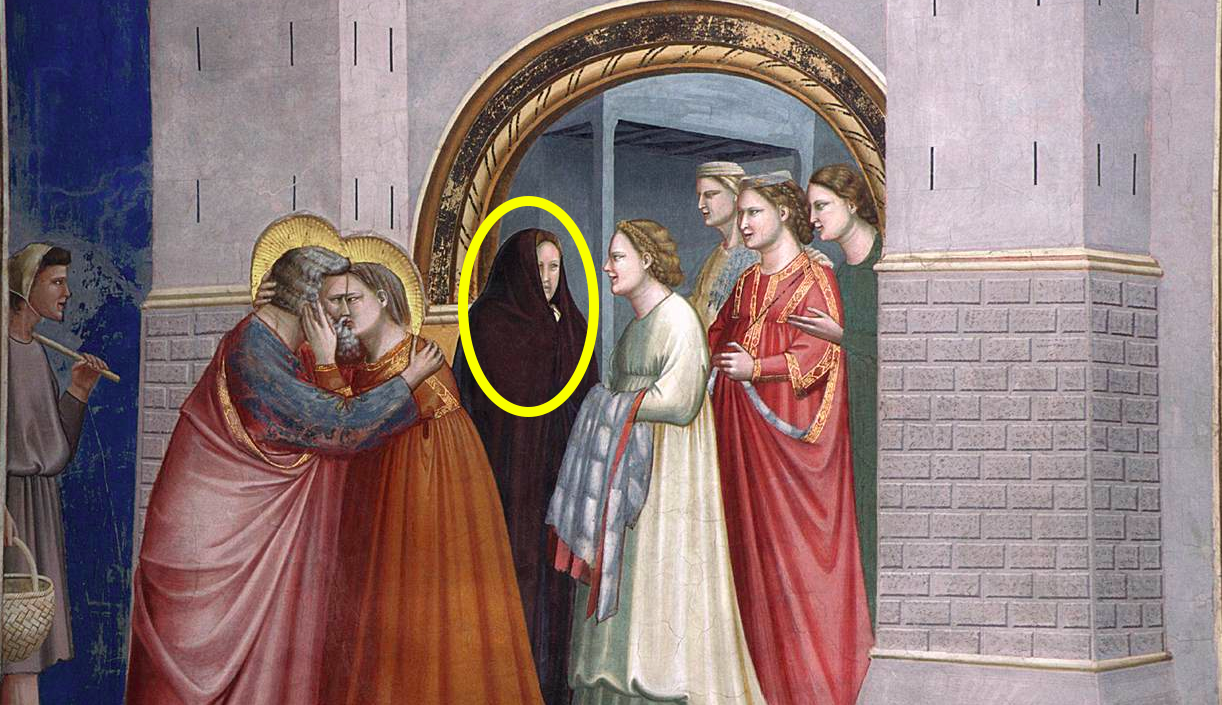
Giotto’s The Meeting at the Golden
Gate (1304–06), featuring a woman Gadsby identifies
with.
Despite a few “gimme” jokes that poke fun at the gigantic babies
that predated any real understanding of perspective and the
prevalence of disembodied genitals that pepper art history, the
takeaway from Gadsby’s sophomore special is that even when art
history seemingly has no bearing on the present day, understanding
how stereotypes and beauty ideals have persisted over the centuries
does, in fact, have merit—and for Gadsby at least, the ability to
see art differently has formed the foundation of a pretty special
career.
The post Comedian Hannah Gadsby’s New Netflix Special
Doubles as an Unorthodox Art-History Lecture. We Decode the
References Here appeared first on artnet News.
Read more https://news.artnet.com/art-world/hannah-gadsbys-douglas-art-history-explainer-1876869
Further reading


Leave a comment