
Condo Founder Vanessa Carlos Thought Collaboration Could Save Small Galleries. It Hasn’t Been That Simple
Imagine a world without art
fairs.
That was more difficult to
picture a few weeks ago than it is today, after scores of events have been
postponed or canceled amid a global health emergency. But four
years ago, one adventurous, imaginative gallerist—Vanessa
Carlos—was already envisioning an alternative to the merry-go-round
of art fairs that have been draining artists’ studios (not to
mention ballooning carbon emissions) for more than a
decade.
The result was the gallery-share
initiative Condo. Since 2016, Condo has grown into a global but
still bootstrapped endeavor that allows a dealer to mount a show in
a gallery in a different city for a month at a time. When the
initiative first emerged in 2016, the idea was hailed as
the potential savior for small galleries whose bottom lines were
being drained by pricey art-fair participation, with no guarantee
that their investment would pay off.
“I didn’t set out to save
anyone,” Carlos, now 35, says in an interview with Artnet News at
her London gallery, Carlos/Ishikawa. “I think what was nice and
took me by surprise was that the art world at large felt very
engaged with this idea of collaboration.”
Despite high hopes, Condo has not transformed businesses—it is
too subtle a concept for that. But it has injected a spirit of
collaboration, hope, and novelty into the industry at a time when
many felt trapped on a hamster wheel of art fairs.
“I’m deeply interested in power
structures,” Carlos says, adding that she sees the gallery-share
model as an almost “feminine” way of selling: It subverts the
patriarchal, capitalist machinations of the art fair, instead
privileging “quality” interactions that can lead to substantial
relationships—as well as sales that go down at a
Frieze or a Basel. Carlos says she feels validated when fellow
dealers come up to her and tell her, “Condo works!”
Outside the Box
Thinking outside the box is natural for the São Paulo-born,
London-based gallerist. She started out studying fine art believing
it to be “a vehicle for human connection,” and then took jobs at
London galleries with reputations for good—and, critically, not
obvious—taste, including Stuart Shave Modern Art and the
Approach. The transition into the business world was
instinctive. “I got into it because if we have to monetize
things we like to spend time with in order to spend that time with
them then that was the natural progression,” she says.
Carlos opened her own gallery somewhat spontaneously in 2011,
after a childhood friend told her she needed to invest in a
business in order to get a visa. Since then, the space has become a
reliable hub for inventive art by international names, many of whom
would go to become regulars on the biennial circuit, such as
Korakrit Arunanondchai, Oscar Murillo, and Evelyn Taocheng Wang.
(Before it was common practice, she and David Zwirner shared
representation of Oscar Murillo, whom she began working with well
before he became a big name, and continues to work with today.)
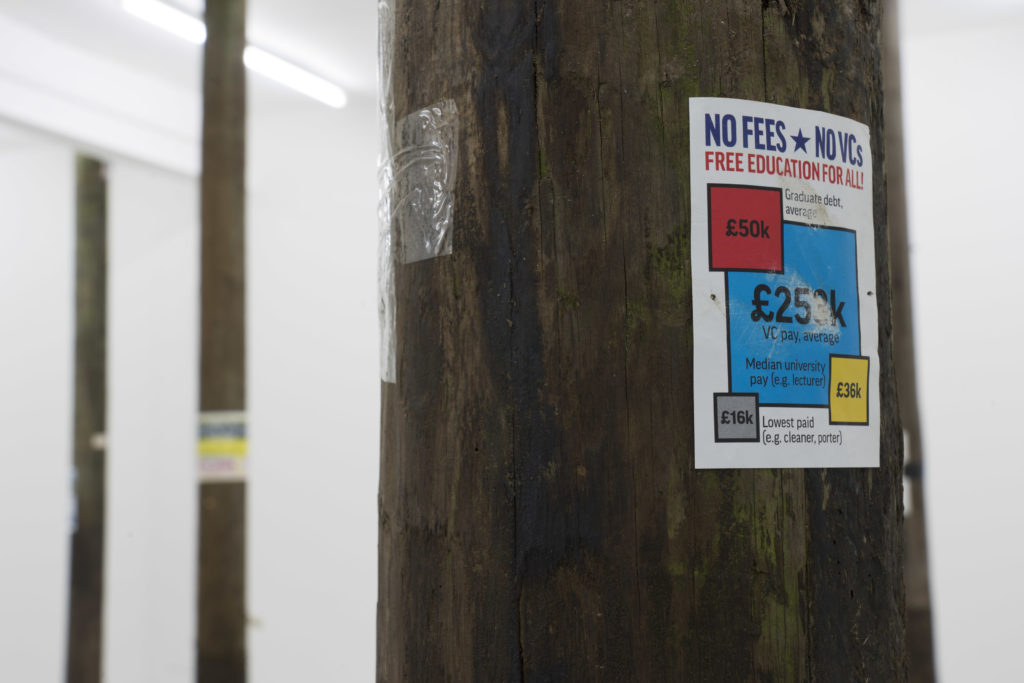
Installation view, “LLoyd Corporation:
Person to Person” at Carlos/Ishikawa during Condo London 2020.
Image ©Lloyd Corporation 2020, courtesy the artists and
Carlos/Ishikawa, London.
The artists she is interested in are united by a sense of
experimentation—not committed to any one medium, they will often
dabble in performance, object-making, and other ways of working. So
perhaps it makes sense that Carlos was among the first to decide
that the art-fair structure—which forces dealers to reduce their
artists’ work to its most easily commodifiable form—was
untenable.
“The art world is increasingly
this microcosm of the structure of the world at large that I find
very oppressive,” Carlos says. “Fast-forward ten years, and ultimately what
happens is that the art suffers. You wonder, why is the art so
uninteresting and commercial?”
Unlike art fairs, participating in Condo is free. Visiting
galleries only pay $750 into a pot, which covers the party and the
designer fees and maps.
Has Condo saved every small-to-midsize gallery? No. But Carlos
says she never intended for it to. By design, the initiative is not about immediate
gratification, a quick influx of cash. It is about building
relationships outside of a sterile booth—between gallerists,
collectors, and visitors.
“I would like to think that if
you do Condo it means you can skip a few mediocre fairs,” she says.
“But you’ll always have to do Basel.”
Bigger Isn’t Always Better
In the four years since its
inception, Condo has found new participants (bigger galleries such
as Sadie Coles, and Maureen Paley are now regulars) and expanded to
launch editions in New York, Shanghai, Mexico City, and her
hometown of São Paulo. (It has also spawned copycats everywhere
from Warsaw to Tokyo).
Originally, Carlos intended to
have one edition per region in Asia, North America, South America,
the Middle East, and Africa (the right opportunity has yet to
materialize for the latter two). She often gets proposals to launch new
editions, but doesn’t go for it unless it feels like an exchange
that could bring value for everyone. While some might
see it as a bit of an exclusive club, she explains: “I didn’t want to have a million Condos
and for it to be this other exhausting thing.”

Installation view, “LLoyd Corporation:
Person to Person” at Carlos/Ishikawa during Condo London 2020.
Image ©Lloyd Corporation 2020, courtesy the artists and
Carlos/Ishikawa, London.
The initiative is not a huge operation, and Carlos tries to keep
a lid on the number of participants. The London edition is
organized by Carlos and her existing gallery team, and other
editions are also run by the organizing gallery and their
team. “I think the biggest
limitation about it is that if you scale it up, you really lose
something,” she explains. “People are always thinking bigger is
better. But what is lost?”
Despite all that, Carlos is in
talks to stage a Condo in Berlin. “I didn’t really have an interest
in doing another big Condo in Europe, and especially not Berlin
because there’s too much going on there already.” But when a
leading German gallery approached her saying the city needed it,
she was ready to listen. (It is important to note that Carlos was
speaking before the public health situation escalated, and the
plans for the Berlin edition are now on hold.)
Collaboration
In the years since Condo took
off, collaboration has become a buzzword at all levels of the
market. Just last month, news broke that Pace, Gagosian and Acquavella
would team up to sell the $450 million
estate of Donald Marron.
Mega-galleries have also agreed to allow star artists like Avery
Singer and Nicolas Party hold onto their smaller dealers after
joining with the big guys.
“I think that because the system
is becoming so extreme, they’re realizing more what they lose when
they just get immersed into this corporate situation,” Carlos says,
although she stresses that she thinks there is a “long way still to
go to make that a fully functional system.”
Other trends of which Carlos was an early adopter are playing
out more widely on the market. After recognizing a “technology blindspot” in
the art world, Carlos developed a Condo app last year. While around 1,000 users are signed
up, the dealer admits it hasn’t really taken off.
She suspects it fell flat mainly
due to the existence of more widely adopted, sophisticated social
networks. “Even if you do a specialized app like that, it’s very
hard to compete with Instagram,” she says. She hopes Basel, which
has invested in its own app, might be better positioned to move the
needle when it comes to technology in the art world. (While Art
Basel is a big business in the art world, it is still a
small-to-midsize business compared to Instagram.)
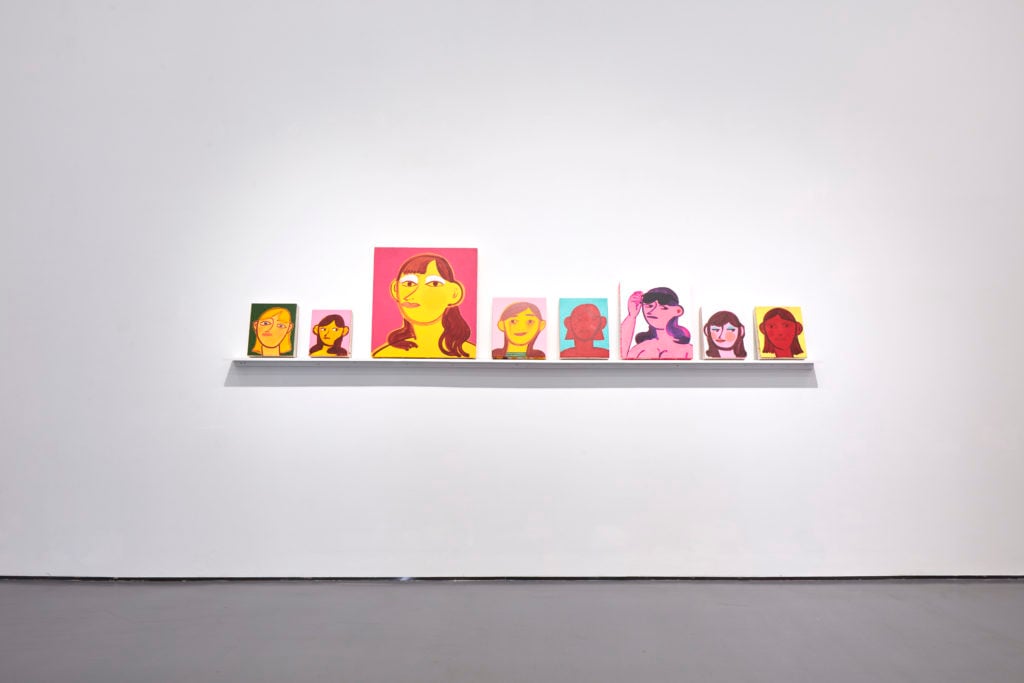
Installation view “All the Girls” (2018)
at Condo Shanghai. Courtesy of the artist, Koppe Astner, Glasgow
and Soy Capitan, Berlin at AIKE Gallery, Shanghai.
Elsewhere, she is experimenting
with an online viewing room for her own gallery in anticipation of
potentially opening up a project space in New
York. “New York is so
important, and I have a few artists who are not represented there,”
she says. She is working on an idea with the gallerist Tobias
Czudej, but the project is still just a seed, and Carlos doesn’t
want to take too big of a risk.
“It’s so hard to have a stable
gallery, and I don’t want New York to be a financial burden on me
here,” Carlos says. “So we decided to fundraise in advance.” The
pair will only open in New York when they have a pool of money
large enough to run it for a couple of years even if they didn’t
make any sales.
She doesn’t want an external
backer or to take money away from her existing business, but could
see it turning into a permanent space down the
line. Like everything
else she does, the Condo founder wanted to ensure this project
could be done “in the most free, independent way
possible.”
The post Condo Founder Vanessa Carlos Thought Collaboration
Could Save Small Galleries. It Hasn’t Been That Simple appeared
first on artnet News.
Read more https://news.artnet.com/art-world/vanessa-carloss-condo-interview-1803369
Further reading


Leave a comment