
Critics and Curators Are Finally Coming Around to the Riotous Pop Paintings of Peter Saul. So Why Is the Market Still Lagging Behind?
Peter Saul doesn’t fall into any of the easy categories that
often define an artist’s trajectory.
He isn’t being rediscovered per se, nor is he
underappreciated. He’s not really making a comeback, and he’s not a
newfound influencer.
Instead, Saul is a mix of all of the above. And he may be
undervalued, too.
At the age of 85, the artist, who has frequently been overlooked
over the course of his six-decade career, just wrapped up a
retrospective, “Peter Saul: Pop, Funk, Bad
Painting, and More,” at the Musée des Abattoirs, a modern and
contemporary art museum housed inside a former slaughterhouse
in Toulouse.
And that’s not all.
In New York, he is now the subject of “Peter Saul: Crime and Punishment” (February
11–May 31) at the New Museum, his first-ever museum survey in the
city. (Owing to the artist’s prolific nature, there is virtually no
overlap between the exhibitions when it comes to works on
view.)
The American show has already commanded glowing reviews
from Peter Schjeldahl in the New Yorker and Holland
Cotter in the New York Times,
and the latter called it a “well timed” and “critically acidic
dirty bomb of a show.”
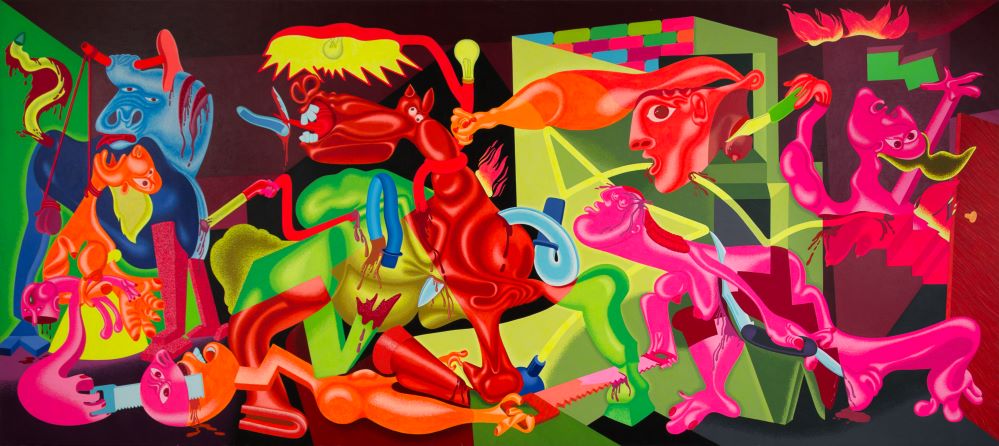
Peter Saul, Saul’s Guernica
(1974). Image courtesy Hindman Auctions, Chicago.
Playing Catch-Up
Given the enthusiastic reception, some may wonder what took so
long, especially considering how long the artist has been
active.
“Peter Saul has had many lives, and, in a sense, many
rediscoveries,” says Massimiliano Gioni, the curator of the
New Museum show.
Paul McCarthy, Mike Kelley, and Raymond Pettibon were “looking
at him as a patron saint” in the 1980s and ’90s, Gioni says. And
more recent up-and-comers such as Nicole Eisenman and Dana
Schutz are now looking up to him as well.
But his work has never been especially palatable to wider
audiences.
For decades, Saul’s unflinching,
satirical, Mad magazine-style approach to
political corruption, sexual violence, wartime atrocities, and
capital punishment has shocked and confounded his audiences.
His mashups of riotous, Day-Glo colors; his grotesque,
cartoonish figures; and his brazen depictions of graphic brutality
and violence are not, altogether, a recipe for widespread popular
success. “Saul’s effrontery,” Schjeldahl even admitted, “has
long driven fastidious souls from galleries, including me years
ago.”
“Peter Saul’s work makes you see the world through the eyes of
the hater,” says Adam Lindemann, the owner of the Venus Over
Manhattan gallery, the artist’s primary representative. (The
dealer, who was exposed to Saul as a child through his friendship
with the son of the late Chicago dealer Allan Frumkin, took
over representation of Frumkin’s estate six years ago.)
“In a sense, the absurdity and horror of all these different
things that he’s painting also allows you to laugh about them. It
provides an escape valve as a way to deal with them, but it was
never painted to decorate or to adorn the homes of
the bourgeoisie.”
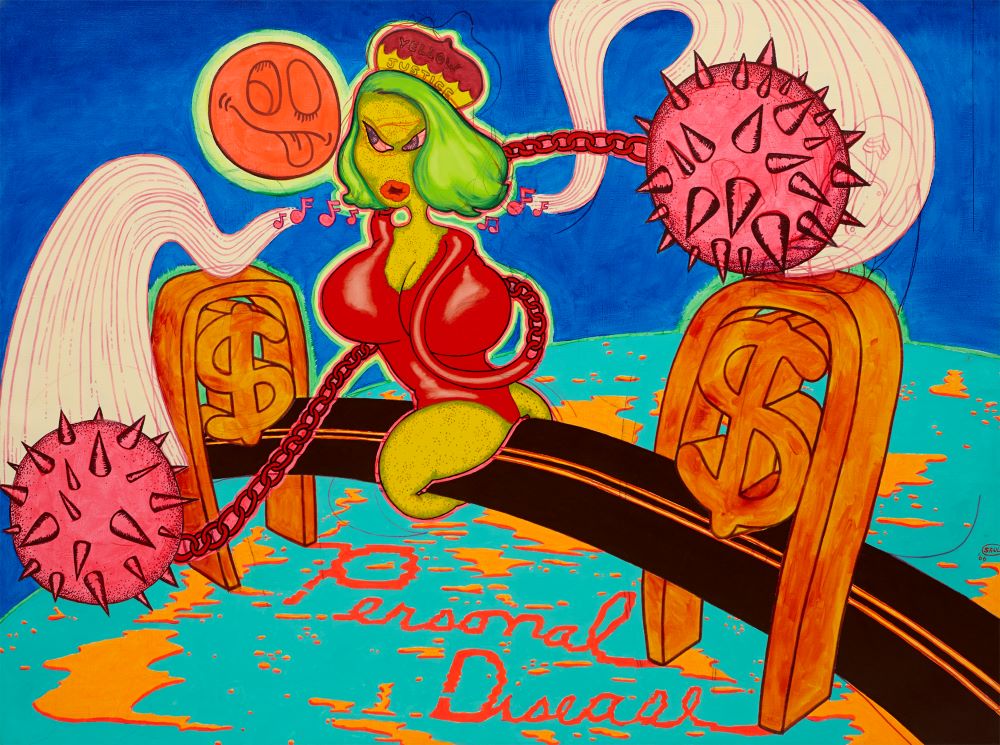
Peter Saul, Personal Disease
(1966), © 2020 Peter Saul / Artists Rights Society (ARS), New York.
Courtesy Venus Over Manhattan, New York.
Among Saul’s best-known subjects are the American war in
Vietnam; the vilification of activist and writer Angela Davis
for her association with the Black Panthers; and Ronald Reagan’s
disastrous (to Saul) two-term run as governor of California.
“Peter has been making crazy presidential paintings throughout
most of his life,” Gioni says. “Sadly, it’s perfectly in time with
the world we live in.”
The New Museum show even includes his take
on Washington Crossing the Delaware (1975), a cheeky
take on the image. “Saul’s 1995 parody keeps the elements more or
less in place—but mostly, vertiginously, less,” writes
Schjeldahl. “That boat is doomed.”
Notably, the painting comes from the collection of Brian
Donnelly, aka KAWS—and it isn’t the only one lent by the street
artist and market darling to the exhibition. Eleven other works
from his collection (out of 60 works on view) are present at
the New Museum. Another big Saul collector, Andy Hall, has
lent 13 works.
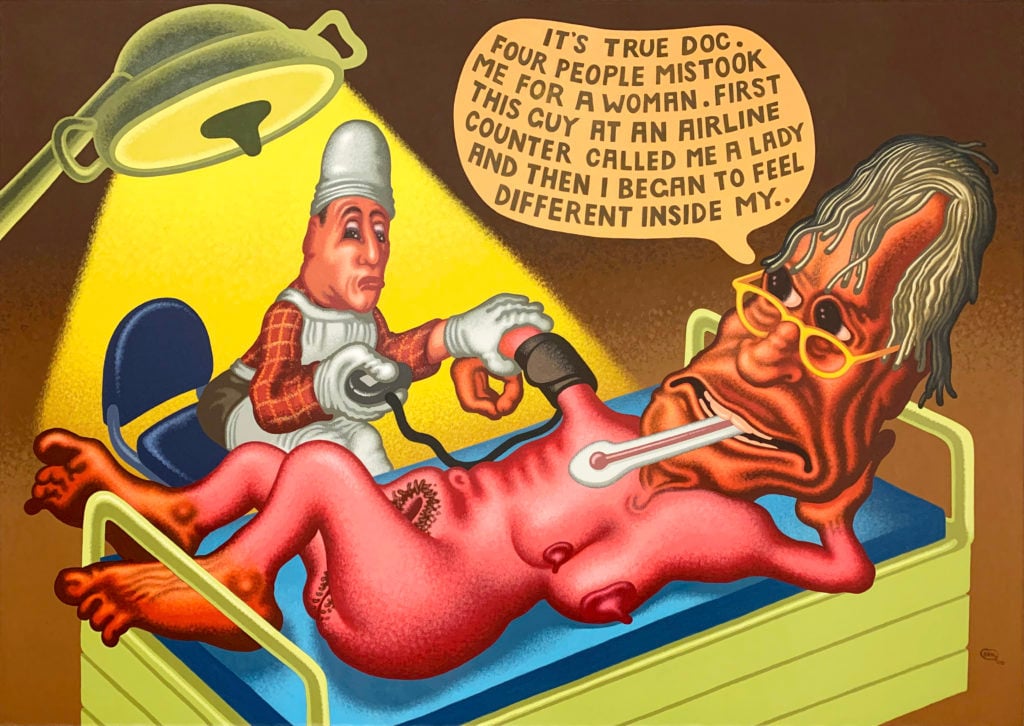
Peter Saul, Self Portrait As a
Woman from the private collection of KAWS & Julia Chiang.
A Lagging Market
Indeed, the list of lenders and supporters to the show reads
like a who’s who of high-profile institutions and cognoscenti, from
the Metropolitan Museum of Art, the Whitney Museum, and the
Hirshhorn, to lead supporters like Almine Rech and Lindemann.
But even though the work is now striking a chord with a broader
audience and finding critical and institutional support, the market
is far less hot on Saul than it is on his peers and even the much
younger artists who count themselves as his admirers.
According to the Artnet Price Database, Saul’s current record at
auction is $575,000, set in Chicago at Leslie Hindman in 2016 for
Saul’s Guernica (1974), his take on Picasso’s epic 1937
painting.
The second-highest price of $457,500 was achieved at Christie’s
Paris in December 2013 for Mad Doctor (1964), followed by
$338,500 for Ice Box (1963) at Christie’s New York in
2012. Of the 223 works cited by the Artnet Price Database, only 13
examples, most from the 1960s and ’70s, sold for prices above
$100,000.
Zachary Wirsum, a Postwar art specialist at Leslie Hindman, says
that because of Chicago dealer Allan Frumkin’s longtime
support of the artist, works tend to concentrate in Chicago and the
Midwest. Saul’s Guernica, for example, came from
an estate in St. Louis, and its size and art-historical subject
matter generated a lot of enthusiasm.
“Collectors really like his work,” Wirsum says, estimating
that he has been involved in the sale of roughly half a dozen
Saul works. “It’s rare to see people parting with them.”
But the market is not especially steep.
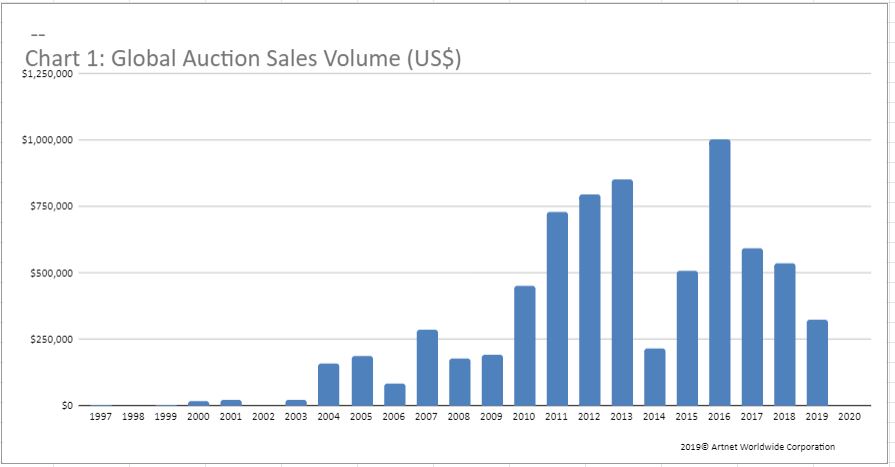
Source: Artnet Price Database
“You can get an excellent painting for $400,000,” said
Michael Baptist, a Postwar and contemporary art specialist at
Christie’s. “Compared with other artists, that is not that much
money.”
Market activity tends to follow a pattern: single works emerge
from private collections and get quickly snapped up by buyers who
already own Saul works in depth. That consolidation means that
fewer works come up for sale, Baptist says.
Nevertheless, he says that inquiries have been on the rise,
especially in private sales ahead of the New Museum show.
“Collectors who had not been paying attention are now coming and
asking about Saul, which is a good sign.”
Another thing that may boost the Saul market is the overall
growth of interest in figurative art in recent years, as well as
the contemporary political climate.
“He is maybe America’s best figurative political
painter,” Baptist says. “His depictions of Trump don’t come
off as something of the moment. When you see them in the context of
his other political paintings, it looks fresh and fits so well into
his art.”
The post Critics and Curators Are Finally Coming Around to
the Riotous Pop Paintings of Peter Saul. So Why Is the Market Still
Lagging Behind? appeared first on artnet News.
Read more https://news.artnet.com/market/peter-saul-art-market-1783794
Further reading


Leave a comment