
Danish Collector Jens Faurschou Is Opening a Private Museum in Brooklyn—and He Doesn’t Care If You Have Fun There
Seasoned art dealer and collector Jens Faurschou did not make
the decision to open a branch of his foundation in New York
lightly, even though he has already been through the process twice
before in other cities.
“We’ve done it for many years in Copenhagen, for many years
in Beijing, and thought, ‘Now, we dare to try New York,’” the
soft-spoken Faurschou told Artnet News ahead of this weekend’s
opening of his sprawling ground-floor space in Greenpoint,
Brooklyn, a former shoe factory converted into a sleek art venue by
architect Markus Dochantschi.
In recent years, New York has become home to a number of private
museums dedicated to the collections of wealthy tycoons, from
J. Tomilson Hill’s space in
Chelsea to the Brant Foundation in the
East Village. Faurschou, however, has a far lower profile
in the United States than the others, and prefers to let his art
collection—full of blue-chip names but also impractical
installations with political themes—speak for itself. And in
contrast to private museums that quickly become Instagram magnets,
the Faurschou Foundation’s inaugural display avoids relying
too heavily on eye candy, offering a more balanced visual diet.
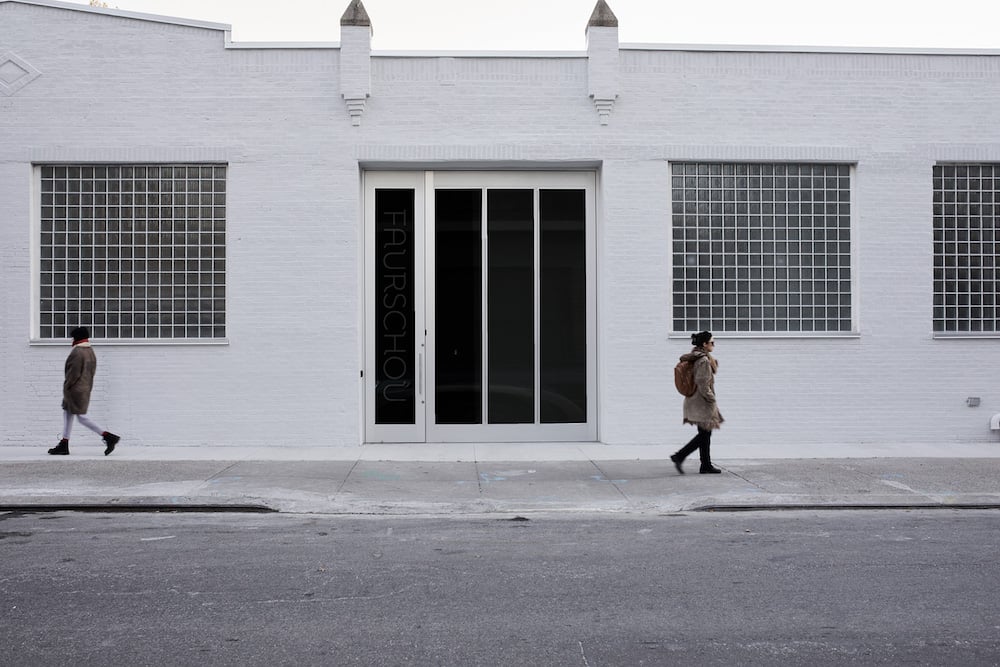
Faurschou New York in Greenpoint
Brooklyn. Photo by Ed Gumuchian ©Faurschou Foundation
Faurschou, who made his money selling international contemporary
art in his native Denmark and established his eponymous foundation
in 2011, did not even know where Greenpoint was when he set out to
open in the city. But after opting out of other New York City
spaces, such as one in Harlem that did not offer a ground-floor
option, he found the industrial space in the fast-changing,
gentrifying neighborhood to be just what he was looking for.
“We went out and found this building and I was amazed,” he said.
“If you take an Uber, it’s quicker than going from Chelsea to Upper
East Side or Midtown. Then we started to look around the area and
it’s lovely. It has its own life with a lot of great small
restaurants and shops.”
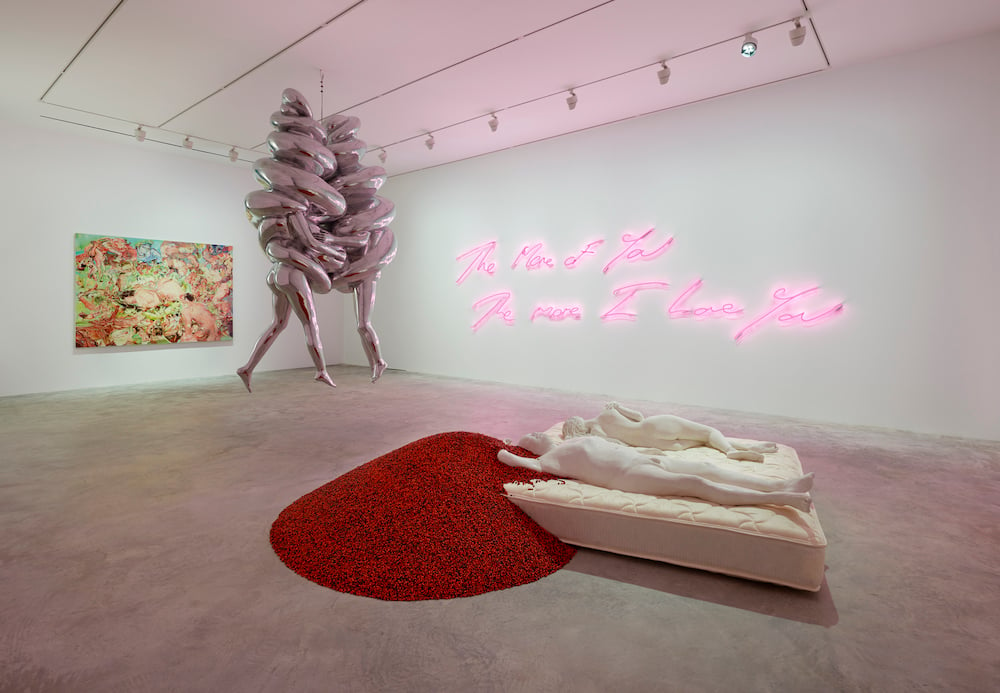
Installation view of the exhibition “The
Red Bean Grows in the South”, Faurschou New York, 2019. Clockwise:
Cecily Brown, Louise Bourgeois, Tracey Emin, Ai Weiwei. Photo by
Tom Powel Imaging, © Faurschou Foundation
Making His Mark
In a city with seemingly endless art options, the next hurdle
for Faurschou was to figure out how to stand out. New York
represents “a big challenge because we have to do something
where we show who we are and what we can do,” he said. He and his
team—a small operations staff in New York, plus his wife Masha and
his three children at home—decided to debut with a group exhibition
that would offer a sampling of the artists in the collection.
The result is a thought-provoking and often startling show of
international all-stars titled “The Red Bean Grows In The South,”
which touches on topics ranging from the notion of longing to
political passions and the desire to break free from
repression.
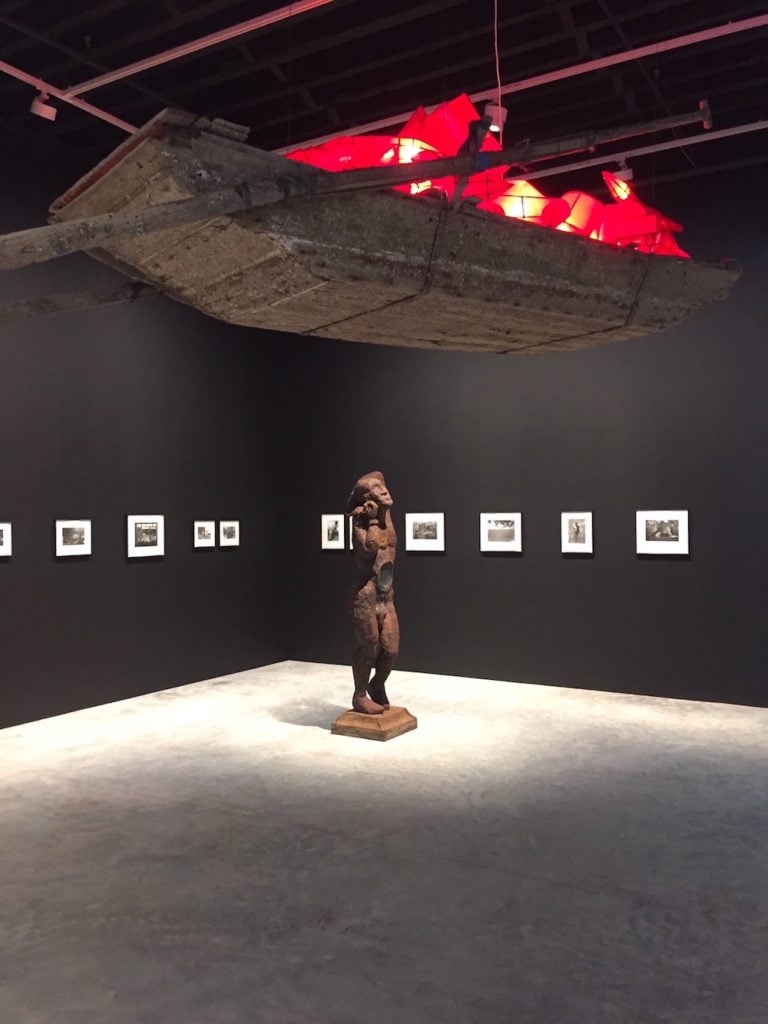
Installation view at Faurschou
Foundation with work by Cai Guo-Qiang (ceiling), Alison Saar and
photos by Danh Vo. Photo by Eileen Kinsella.
With work by roughly 17 artists including Ai Weiwei, Georg
Baselitz, Louise Bourgeois, Cai Guo-Qiang, Tracey Emin, Edward and
Nancy Kienholz, Yoko Ono, and Danh Vo, the show also reflects what
Faurschou says is a core part of the foundation’s identity: a
longstanding relationship with China and a desire to engage Western
audiences with important ideas from the region.
According to the catalogue essay, the inaugural presentation
revolves around “themes of violence, war, politics, idealism,
escapism, desire, hope, dreams and memory,” which would sound like
a lofty goal were it not so seamlessly executed here.
Faurschou says the display came together somewhat organically.
The first pairing seemed somewhat random at first: Georg Baselitz’s
painting Mit Roter Fahne (With a Red Flag) (1965), which
depicts a humiliated soldier returning home from war with a
diminutive head and tattered uniform, and Paul McCarthy’s
monumental CSSC Frederic Remington Charles Bronson
(2014–16), which shows the eponymous film star with an outsize
cowboy hat riding what appears to be a disintegrating mashup of a
melting saddle and a tangled mess of horse legs and hooves.
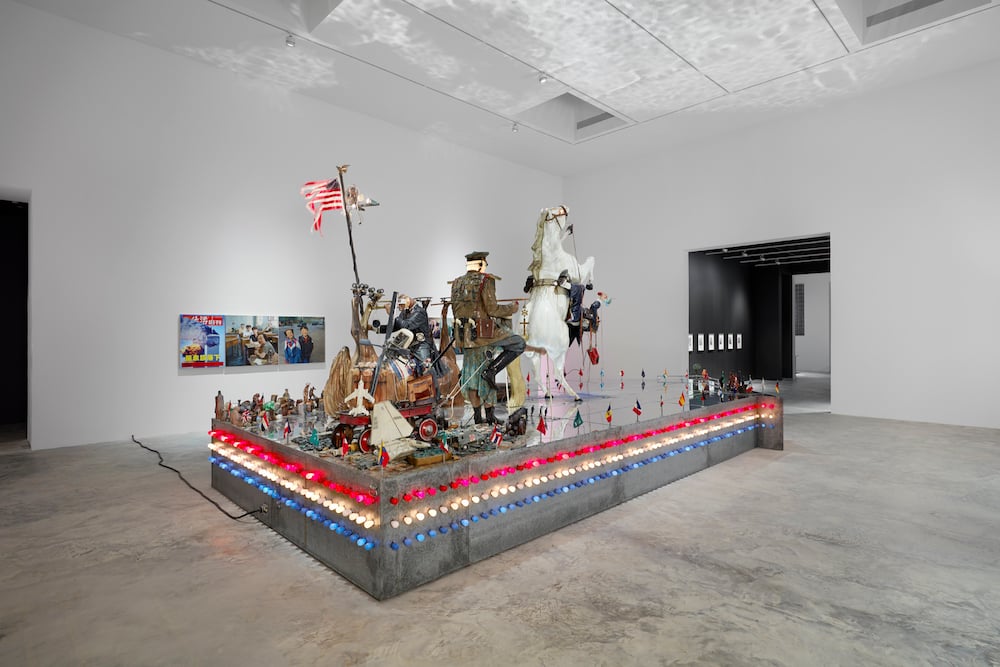
Edward and Nancy Reddin Kienholz. The
Ozymandias Parade (1985). Image courtesy the Faurschou
Foundation
“You would never really think of putting them together but it
just worked—you have this hero coming back from the war and you
have Charles Bronson on a horse where the whole structure is
falling apart,” Faurschou said. “Maybe even more surprising
for me is that [together] they have such strong visual impact.
That’s very important.”
Curating by Instinct
This is classic Faurschou—he brings years in the art business to
bear on his choices, but he is also willing to let serendipity and
instinct take its course. When installing one prominent gallery,
for example, where Cai Guo-Qiang’s A Boat with Dreams
(2008) hovers from the ceiling above Alison Saar’s haunting
life-size sculpture Dying Slave (1989), Faurschou said,
“We are missing something.”
It so happened that his son Christian had just returned from a
visit to the National Gallery of Denmark to
see an exhibition of the work of Danh Vo, who often explores
cultural history and the meaning of artistic collaboration in his
work. “You need these prints,” he told his father. The body of work
presented photos taken by Joseph Carrier, a counterinsurgency
specialist in Vietnam from 1962 to 1973 who later became a close
friend of the artist. By the time he was forced to leave Vietnam by
American authorities because he was gay, Carrier had produced a
substantial photographic archive, which he later bequeathed to
Vo.
On a whim, Faurschou called up Vo, and the artist happened to be
in Denmark. The rest, as they say, is history. Vo’s
work, Photographs of Dr. Joseph M. Carrier 1962–1973
(2010), now lines the perimeter of Saar and Cai’s gallery.
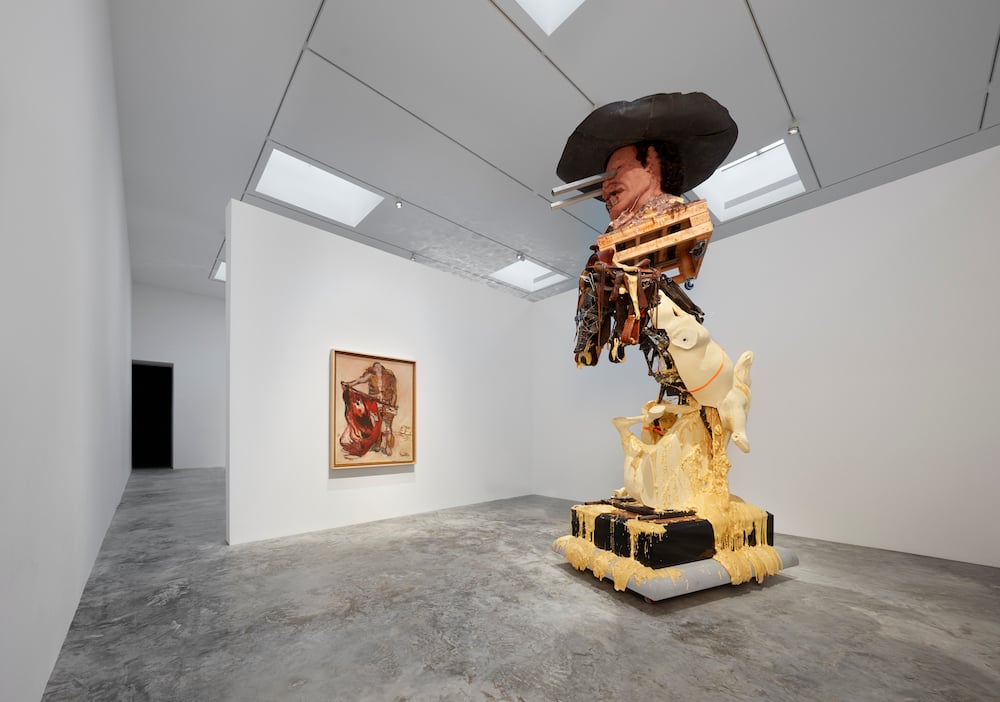
Installation view of “The Red Bean Grows
In the South” at the Faurschou Foundation with work by Georg
Baselitz and Paul McCarthy. Photo by Tom Powel Imaging, © Faurschou
Foundation.
“Then I got excited,” Faurschou recalled. “There’s a
connection between the rooms all kind of
getting together.” Look no further than rooms like one
featuring Yoko Ono’s devastating video Happy Xmas (War is
Over) (1971/2003), a compilation of disturbing images that run
counter to the iconic John Lennon song. It hangs above a large
sculpture of menacing bent saws by Robert Rauschenberg, another
artist who was horrified by the Vietnam War, titled Lurid
Attack of the Monsters from the Postal News (August
1875).
Also immediately visible from the entrance is Edward and
Nancy Kienholz’s massive installation The Ozymandias
Parade (1985), which brings together objects the couple
collected from flea markets across Europe. (The work is perhaps the
only major installation by the couple on view in the city, as they
have not been well collected by New York museums.)
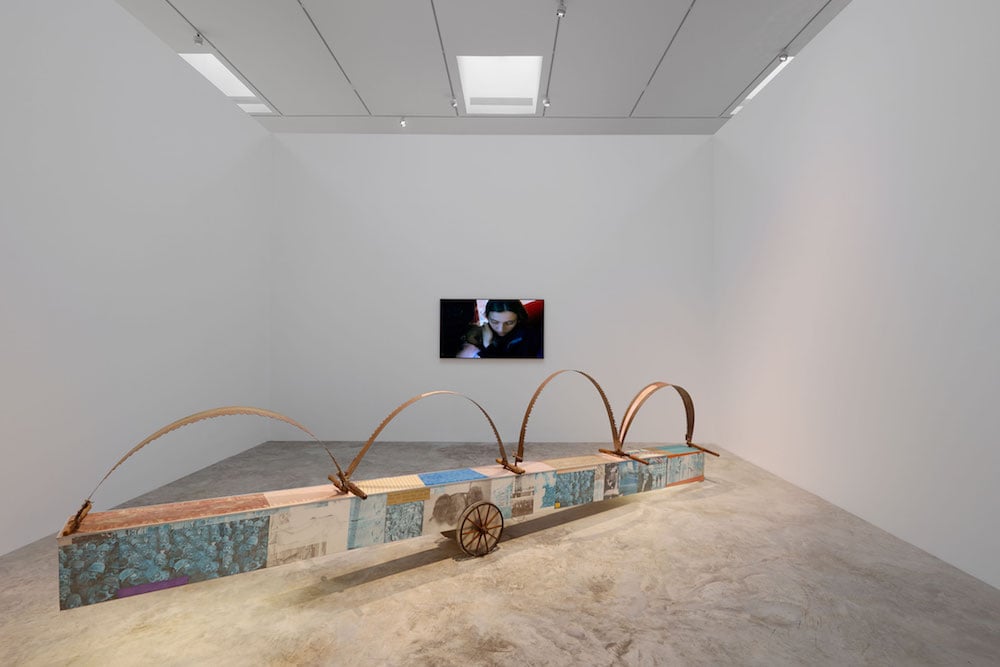
Installation view of “The Red Bean Grows
In the South” at the Faurschou Foundation with work by Yoko Ono and
Robert Rauschenberg. Photo by Tom Powel Imaging, © Faurschou
Foundation.
Going forward, Faurschou is planning roughly two exhibitions a
year. Just don’t expect the kind of hit-parade Instagram bait you
might find at other institutions. “I hope
with this exhibition that it makes you think. It’s not just to go
in and say, ‘This was beautiful. This was fun,’” Faurschou said. “I
think it digs deeper. And I think we live in a time where its
really important that people don’t live on the surface.”
The post Danish Collector Jens Faurschou Is Opening a
Private Museum in Brooklyn—and He Doesn’t Care If You Have Fun
There appeared first on artnet News.
Read more https://news.artnet.com/exhibitions/faurschou-foundation-stunning-new-space-brooklyn-1733544
Further reading


Leave a comment