
Do You Find Europe’s Grand Public Fountains Charming? Kara Walker’s Spectacular Turbine Hall Commission May Change That
You can hear it before you see
it. The sound of rushing water fills Tate Modern’s vast Turbine
Hall in London. As you round the corner, you encounter its source:
an enormous fountain at the far end of the space, designed by the
American artist Kara Walker.
The highly anticipated
monumental work—the fifth annual Turbine Hall commission
underwritten by Hyundai Motor Company—is an indictment of the
violent history of the British Empire and, more pointedly, of the
way that history is memorialized and sanitized in public
sculpture. At the press preview, Walker noted that monuments
have a tendency “to get some of the story wrong or embellish
different parts of the story.”
The sweeping work is modeled
after the Victoria Memorial in front of Buckingham Palace, an
homage to Queen Victoria that was funded in part by proceeds from
goods sent over from West Africa. Called
Fons Americanus,
Walker’s scaled-down version—the
40-foot-tall work is about half the size of the original—presents
an alternative reading of this and other memorials to the British
Empire, foregrounding the racist and violent history that underpins
them and injecting it with a shot of her characteristic dark
humor.
Walker said she had been
“perversely moved” by the grandeur of colonial-era monuments and
European baroque constructions like Rome’s Trevi Fountain when she
first came to Europe as an art student. “It really is very jarring
if you think about… what that is built on the backs of,” she
said.
Installation view of Kara Walker’s
Turbine Hall Commission 2019, Fons Americanus. ©Tate
photography, Photo by Matt Greenwood.
Her interest in interrogating
Europe’s colonial-era monuments coincides with a similar dialogue
underway in the United States over the fate of Confederate
monuments. In the US, Walker noted, this debate has “unearthed the
racisms and cruelties that have lived fairly quietly under the
surface for quite some time.” (Kehinde Wiley’s towering figure
on horseback, recently unveiled in New
York’s Times Square, offers a stateside echo of this
conversation.)
“I think that the Confederate
debate has been interesting in that it really makes me feel that
the US is a very young country,” Walker continued. “It has only
been really recently that there has been this concerted national
conversation about what those monuments are, how they got there,
and what they mean.”
An Origin Story
The water in Walker’s fountain
evokes both primordial beginnings and the transatlantic slave
trade, which brought the ancestors of many African Americans to the
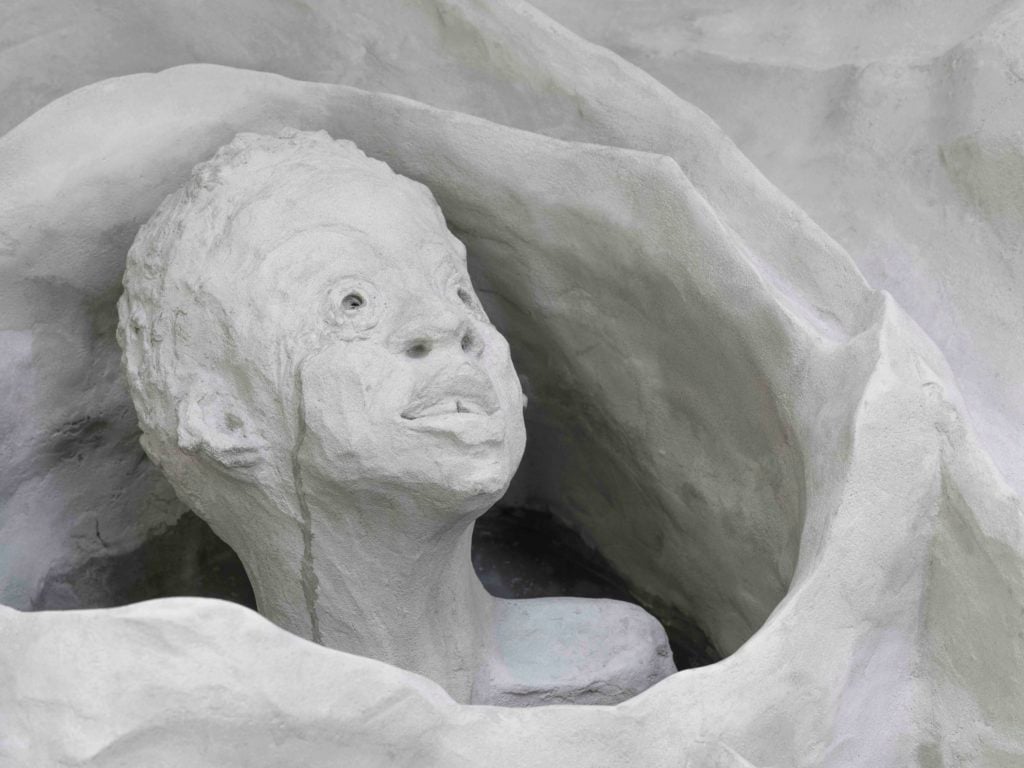
US. The sculpture is topped with an African Venus figure,
inspired in part by a slave propaganda image,
The Voyage of the Sable Venus
from Angola to the West Indies, which celebrated and romanticized the
traumatic Middle Passage. Twin streams of water pour from her
breasts, with a third sprouting rather gruesomely from a gape in
her neck. As usual, Walker does not shy away from the
grotesque.
On the front of the fountain,
given pride of place, is a sea-captain figure. He is a composite of
different characters from history and fiction, all of whom started
out as freedom fighters but whose legacies were complicated by
their hunger for power: Toussaint Louverture, the leader of the
Haitian Revolution; Emperor Jones, the titular character in
a Eugene O’Neill play; and civil-rights advocate Marcus
Garvey.
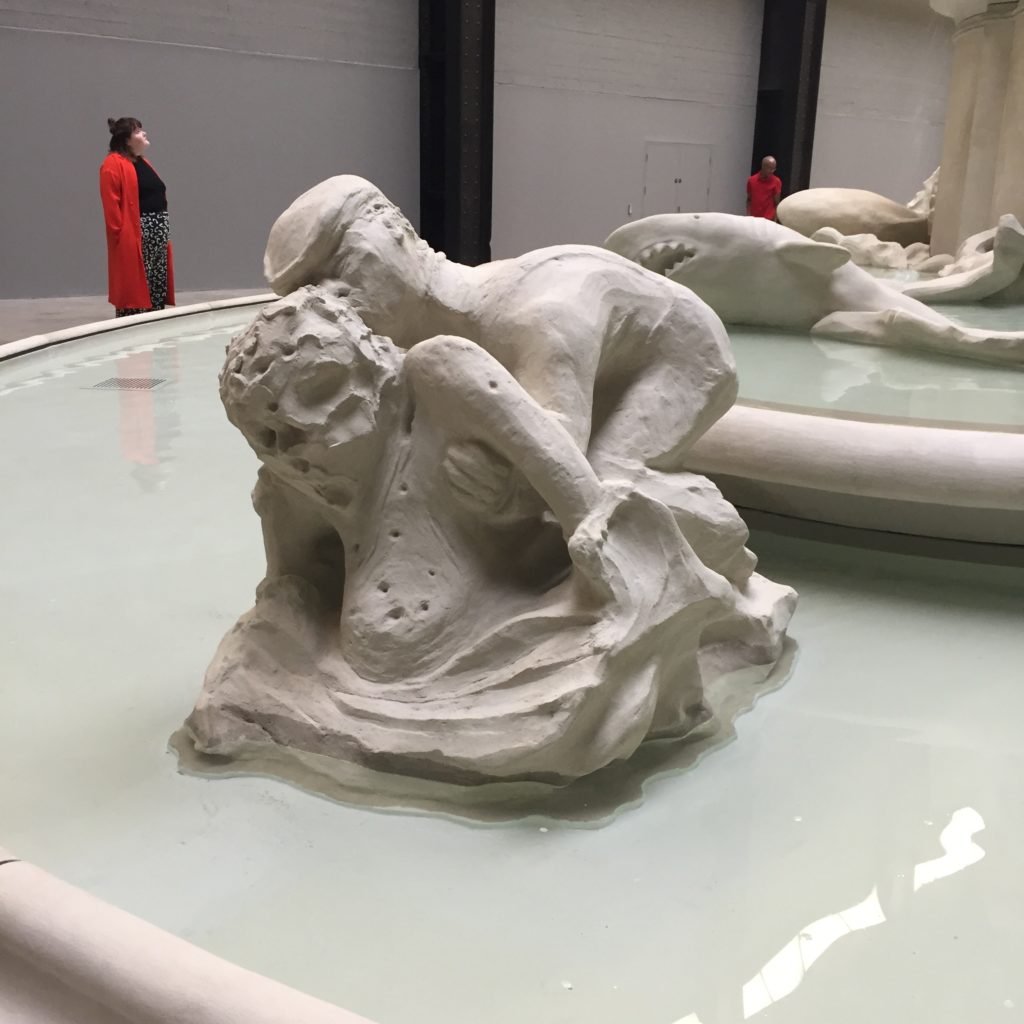
Installaton view of Kara Walker’s
Fons Americanus (2019). Photo by Naomi Rea.
The piece is so loaded with
art-historical and cultural references that you could teach an
entire college history course without leaving Turbine Hall. A Venus
shell doubles as a well of tears that references Bunce Island in
Sierra Leone, a base for European slave traders where tens of
thousands of Africans were brought before being forced into slavery
in the North American colonies of South Carolina and
Georgia.
Other references include JMW
Turner’s 1840 Slave Ship, a painting that memorializes an
episode from 1781 in which slavers threw people from a boat headed
for Jamaica in order to collect insurance money; Damien Hirst’s formaldehyde shark; John
Singleton Copley’s celebrated maritime painting, Watson
and the Shark (1778); and even Kanye West (whose name, K.
West, is reproduced on a boat drawn from Winslow Homer’s 1899
painting Gulf
Stream). Snorkeled and goggled mermaids splash around a
lynching tree; nearby, a male figure lifts up a barely discernible
human figure whose visage is a reference to the mangled face of
Emmett Till.
Excavating Histories
In both form and content, the
sculpture aims to challenge our understanding of monuments as fixed
and true. The work is made from jesmonite (a mix of acrylic and
cement) over cork, as opposed to the bronze and marble of the royal
monument that inspired it. Curator Clara Kim explained that the
fountain was deliberately given a rough finish so that it would
appear to be in the process of being formed or
eroded.
“These are histories that have
not been recognized properly, and histories that are continuing to
be explored,” Kim said. “She is challenging the language of
monuments themselves, the fact that they do represent power and
domination, and subverting that language of how one represents
history, and specific moments in history.”
Installation view of Kara Walker’s
Turbine Hall Commission 2019, Fons Americanus. ©Tate
photography, Photo by Matt Greenwood.
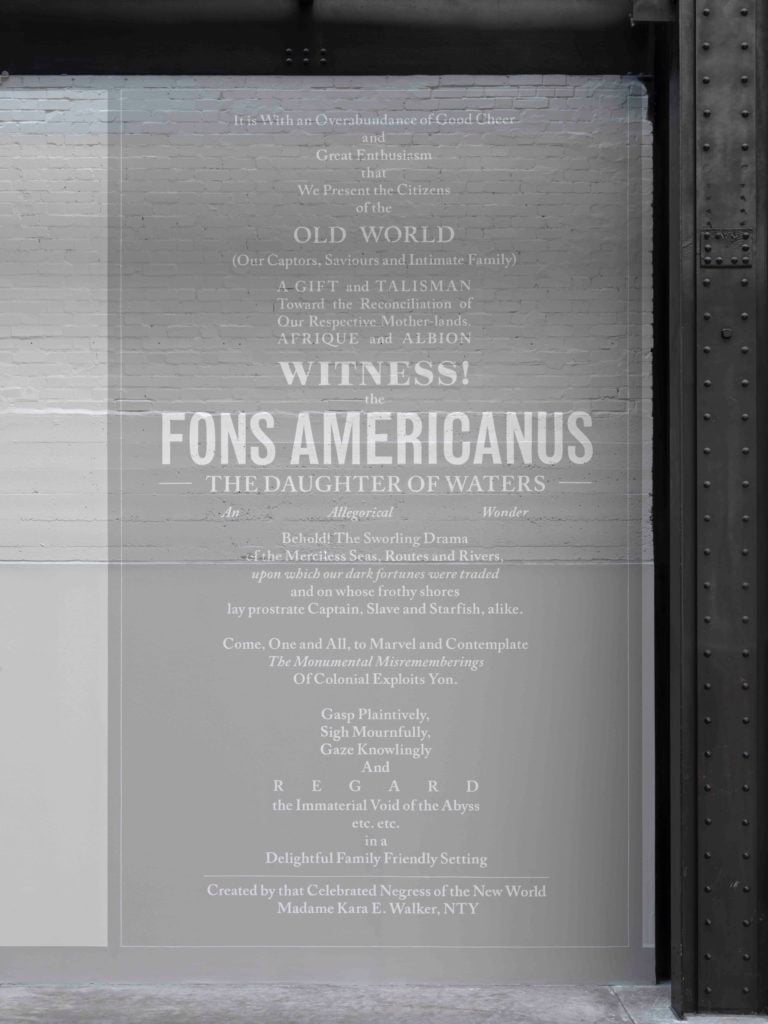
The full title of the work—which
reads like a poem—is painted on the wall (see above). Like the full title for her
most recent gallery exhibition in New York, the text resurrects and
subverts the language of 19th-century runaway slave posters and
advertisements for freak shows. But the title also draws on Latin,
a language used to communicate something so old that, we imagine,
it must be unquestionably true.
“She was interested in an origin
story so she turned to a Latin name for it, in the way that a lot
of monuments reference and weave together Greek and Roman mythology
as the origin of a culture of a nation,” Kim said. “Hopefully, it
will lead others to go out into the streets of London and see these
monuments, and think about why they’re really there.”
“Kara Walker: Fons
Americanus” will be on view in Tate Modern’s Turbine Hall from
October 2 through April 5, 2020.
The post Do You Find Europe’s Grand Public Fountains
Charming? Kara Walker’s Spectacular Turbine Hall Commission May
Change That appeared first on artnet News.
Read more https://news.artnet.com/exhibitions/kara-walker-turbine-hall-tate-modern-1665289
Further reading


Leave a comment