
Fragments of the Dead Sea Scrolls Previously Thought to Be Blank Are Actually ‘Treasures’ With Extremely Faded Text, Scholars Discover
Researchers at the University of Manchester have discovered
hidden messages on what were believed to be blank fragments of the
famed Dead Sea Scrolls. Only by peering at the ancient leather
artifacts through a magnifying glass did the faint traces of Hebrew
lettering appear.
“Frankly, since all these fragments were supposed to be blank
and had even been cut into for leather studies, I also thought I
might be imagining things,” admitted Joan Taylor, the King’s
College London professor who first spotted the invisible text, in a
statement from the Network for the Study of
Dispersed Qumran Cave Artefacts and Archival Sources. “But then
it seemed maybe other fragments could have very faded letters
too.”
Taylor was examining the fragments at the university’s John
Rylands Library in collaboration with Marcello Fidanzio of the
Faculty of Theology of Lugano, and Dennis Mizzi of the University
of Malta as part of a study funded by the Leverhulme Trust.
In the 1950s, the 51 fragments, which were excavated from
the Qumran caves, were gifted by the Jordanian government to Ronald
Reed, a leather expert at the University of Leeds. Presumably
blank, they were considered all but worthless, and ideal for
chemical testing and other scientific analysis.
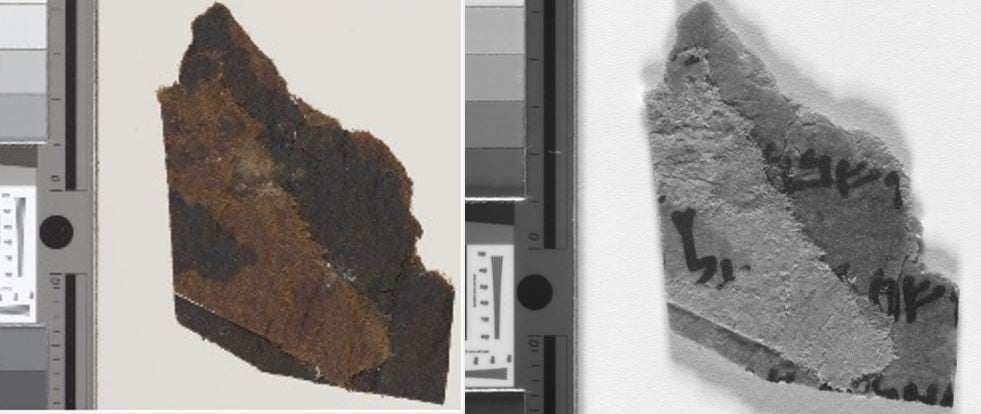
The hidden text on one of the University
of Manchester’s Dead Sea Scroll fragments as revealed through
manification on the left and multispectral imaging on the right.
Photo courtesy of the University of Manchester.
Luckily, Reed only shaved off a few millimeters of the material
to complete his work, leaving the artifacts largely intact. The
University of Manchester received the Reed Collection as a donation
in 1997, including the fragments, which had languished in storage
for decades.
After examining them under the magnifying glass, the researchers
took multispectral imaging photographs of both sides of all the
fragments and found that four of them featured readable
Hebrew/Aramaic text. Some of the other pieces also showed traces of
letter formations.
The most substantial fragment is believed to feature biblical
text from Ezekiel (46:1–3), with the word Shabbat, or Sabbath,
clearly legible. It contains 15 or 16 letters arranged in four
lines. Another piece contains sewn thread, and appears to be from
the edge of a parchment scroll.
The find contrasts with a cache of 70 supposed Dead Sea Scroll
fragments that came on the market after 2002. Those artifacts
now appear to be
forgeries; a high-profile group of them ended up in the
collection of the Museum of the Bible in
Washington, DC, and were recently revealed to be fakes
thanks to a battery of scientific tests.
Meanwhile, Manchester’s “properly-excavated, less sensational…
turned out to be the real treasures,” University of
Iowa classics and religious studies associate professor Robert
Cargill, who wasn’t involved in the study, told Smithsonian
Magazine. “Unlike the repeated scandals being
reported at the Museum of the Bible, this discovery within the
collection of the John Rylands Library is a reassuring success
story about the use of new technological approaches in
archaeology.”
The discovery makes the University of Manchester the only UK
institution to own authenticated textual fragments of the
2,000-year-old Dead Sea Scrolls. Shepherds found caches of 1,000
ancient Hebrew manuscripts in the Qumran caves, in the desert north
of the Dead Sea, in 1946. The research team will publish more
information about the previously unknown texts in a forthcoming
report.
The post Fragments of the Dead Sea Scrolls Previously
Thought to Be Blank Are Actually ‘Treasures’ With Extremely Faded
Text, Scholars Discover appeared first on artnet
News.
Read more https://news.artnet.com/art-world/dead-sea-scrolls-reveal-invisible-text-1865685
Further reading


Leave a comment