
Global Auction Sales Fell 76 Percent Last Month as the Coronavirus Battered Markets, But Demand Is Steady for Lower-Priced Items
We’ve seen the art market
stumble, slump, and tumble—but what happens when it stops
cold?
The answer, according to an analysis by the Artnet Price Database examining worldwide auction
results from March 2020, the first full month of the coronavirus
era, is bracing: sales volume collapses, average prices
shrink, and collectors hoard their goods.
To get a sense of what may be in
store as the global lockdown continues, we broke down the results to see what segments
of the market have been hit hardest—and to see which ones may
continue to prosper.
“Deals will get done,” said one
dealmaker, who, like others we spoke to for this story, asked to
remain anonymous to avoid being blamed for spooking the market.
“But they will get done at a different level.”
Takeaway 1: Total sales are down—way down.

Auctioneer Jussi Pylkkanen at Christie’s
postwar and contemporary sale in London in February 2020. Courtesy
of Christie’s.
Fine-art auction sales plummeted
75.8 percent in March 2020 compared to the same month in 2019,
according to the startling analysis. Last month, auction houses
around the world sold a total of $227.6 million worth of fine art,
down from $939.3 million in March 2019. The slump is even more
dramatic considering that sales totaled $1.2 billion in March
2018.
On the one hand, that shouldn’t
come as a huge surprise—many lucrative March sales, like the Asia
Week series in New York, were cancelled or rescheduled for later
this year. But the amount of money generated at auction last month
still fell considerably faster than the total number of sales held,
suggesting that sellers may have opted to hold onto their more
valuable objects amid the global upheaval, even as the sales
themselves continued. Buyers also appear not to have
been keen to shell out
for pricey works while the stock market was yo-yoing erratically
for much of the month. All told, the number of sales held in March
2020 dropped only 26 percent from March 2019; the number of lots
offered also fell by about a quarter.
The true test of the market’s
health will come at the end of June,
when most of the marquee auctions have been rescheduled. Many
market players are already bracing for impact.
“By the end of 2020, we’ll be
lucky if sales were half of what they were last year,” said one
analyst.
Takeaway 2: For the works that are
coming to auction, demand is steady.

Sotheby’s auctioneer Oliver Barker sold
David Hockney’s The Splash (1966) to a Sotheby’s Los Angeles
specialist for £23.1 million ($30 million) in February 2020. Photo
by Michael Bowles/Getty Images for Sotheby’s.
Here is one comforting sign for
the market: the sell-through rate for artworks sold at auction
actually rose slightly in March 2020, to 66.8 percent, compared
with March 2019, when 64.7 percent of works that hit the block
found buyers. Some insiders see the sell-through rate as the only
reliable way to gauge the health of the demand side of the market,
since other stats—like total sales or lots offered—are more a
reflection of fluctuations in supply. The sell-through rate has
remained relatively consistent annually (between 64 percent and 68
percent) since 2013.
But the average price of an
artwork sold at auction last month tumbled 68 percent compared to
March 2019, from $34,856 to $11,191. So the demand reflected is for
smaller-fry material, which is unlikely to sustain the market over
the long term.
The good news, however, is that
while collectors may not be in the mood to spend much, auction
houses are astutely meeting buyers where they are. And in a market
as sentiment-driven as the one for art, that could stave off a
catastrophic implosion—at least for the time
being.
Takeaway 3: Lower-priced work is where the action
is.
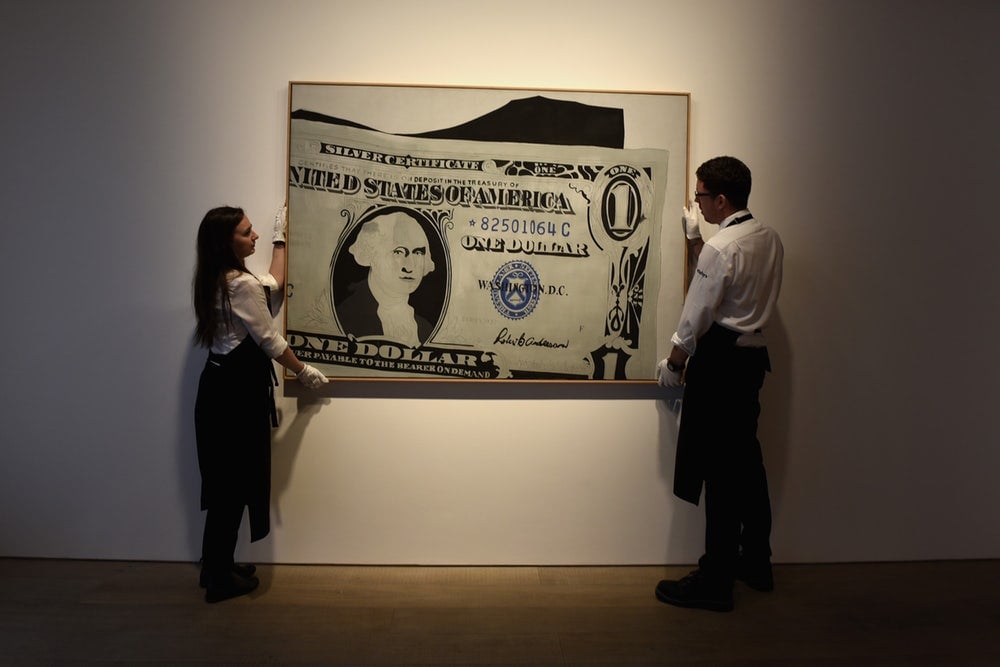
Andy Warhol’s signed dollar bill ahead
of auction at Sotheby’s. Courtesy of Sotheby’s.
Data from recessions past shows
that the top end of the market tends to dry up first and most
dramatically, while the lower end stays afloat for
longer.
In 2009, when the Great
Recession’s impact was most deeply felt in the art market, the
number of pieces consigned worldwide with a low estimate between $1
million and $10 million dropped almost 60 percent from 2008, to
just 443. And the number of works consigned with a low estimate of
$10 million or higher dropped nearly 75 percent, to just 12.
(Broadly similar but less severe declines occurred in the 2016
downturn.)
Although the June sales will be
the next test of this theory, similar trend lines are already
starting to appear. Total sales were down in every price bracket
last month, but the high end was most deeply affected. Fine-art
sales in the range of $1 million to $10 million were down a
whopping 90.8 percent compared to March 2019, while the
$100,000-to-$1 million segment of the market declined 70.9 percent.
Brackets that showed the smallest declines in the same period were
under $10,000 (down 26.5 percent) and $10,000 to $100,000 (down 53
percent).
Of course, this dynamic has as
much, if not more, to do with supply than demand, since
higher-value sales were cancelled last month and others were pushed
online, where lower-priced work is easier to sell and more
attractive to buy. The lower echelons of the market are also the
friendliest for new buyers who might be dabbling in auctions for
the first time while bored at home. (Sotheby’s and Christie’s have
both reported that almost 40 percent of the winners in their March
and early April online sales were new customers; Artnet’s own April
prints and multiples auction drew 50 percent first-time
buyers.)
“You’re not going to see a ton
of new buyers for Hirst ‘Spot’ paintings, but you will in that
up-to-$20,000 bracket among folks who are decorative buyers,” one
art advisor said.
Asked to predict how the market
will shift in the next few months, another dealmaker was frank: “I
just think total value is going to drop significantly.” He noted
that a client who owns a painting worth north of $10 million had
been holding out for a big price—until the pandemic
hit. “As of last week,
that client was willing to sell for a correction price.”
The post Global Auction Sales Fell 76 Percent Last Month as
the Coronavirus Battered Markets, But Demand Is Steady for
Lower-Priced Items appeared first on artnet News.
Read more https://news.artnet.com/market/art-market-auction-analysis-march-2020-1848597
Further reading


Leave a comment