
‘Have Faith That What You’re Trying to Do Matters’: Dealer Sukanya Rajaratnam on How the Late Artist Alma Thomas Inspires Her Work
“From One Woman to Another,” a
five-part series co-produced by artnet News and Mark Cross,
features intimate, candid conversations between eminent women at
the pinnacle of the art industry and a mentor or protégé of their
choosing, paired with original photography by David
Lipman.
In the first installment of the
series, artnet News’s Noor Brara interviewed art dealer Sukanya
Rajaratnam about the late artist Alma Thomas, whose writings and
work have guided Rajaratnam in her life and career.
Sukanya Rajaratnam is a force to be
reckoned with. A partner at Mnuchin Gallery, where she’s worked for
over a decade, Rajaratnam has become one of New York’s most
influential art dealers, overseeing the gallery’s high-level
institutional sales and the organization of landmark exhibitions
for such artists as Cindy Sherman, David Hammons, Sam Gilliam, and
Ed Clark.
While the art world is familiar with
her fluency in all subjects of contemporary art, few know that
Rajaratnam was 18 years old when she first laid eyes on an artwork,
or that she left a lucrative, upwardly mobile job in the financial
sector to pursue an unpaid internship at Christie’s after she
realized that art was her calling. Perhaps even fewer in the
industry can fathom that, when she left her family home in her
native Sri Lanka to attend college at the University of Cambridge,
she also left behind a civil war.
For Rajaratnam, the unsung African
American abstract painter Alma Thomas has been a guiding light,
with her work containing “great healing power.” Just before the
close of a retrospective survey of Alma Thomas’s work that
Rajaratnam organized at Mnuchin Gallery’s palatial Upper East Side
space, we spoke to the art dealer about how the artist’s legacy has
guided her over the years and informed the arc of her career
trajectory—even though Thomas herself passed away four decades ago,
in 1978.
Tell me about how you first
became drawn to a career in the art world. Was there a moment, or
an encounter, that inspired you to enter the field?
I have a little bit of an unusual
trajectory with art, because I didn’t start working in the industry
until I was much older. I grew up in Sri Lanka during the Civil
War, so I wasn’t really exposed to any art—I was mostly
homeschooled, and even that was sporadic. There were large gaps in
my education, including art, which was considered almost a luxury
then.
My first encounter with art happened
at the age of 18, which is probably much older than for any other
dealer you might speak to. It was while I was at Cambridge. The
university’s Fitzwilliam Museum had this large sculpture by Henry
Moore on the lawn. It was from his Surrealist period, of a woman
transmuted into an almost crustacean-like form, broken up. I didn’t
even know who Picasso was at the time—that’s how ignorant I was.
But this sculpture got my attention, because it was unlike anything
I had ever seen. I was studying economics, so art history wasn’t
even in my purview, but it did something to me; I was trying to
constantly rearrange the pieces because they didn’t quite fit in my
linear, mathematical mind. I was trying to understand how this all
came to be. So I started going to the museum, and I started going
to London to see shows. Coming across that one sculpture started a
long love affair with art.
After graduating I came to New York,
where, because I was trained as an economist, I did the obvious
next step: I became an investment banker. I did that for five
years, but I knew that my calling was in art. Then I met someone at
Christie’s, and after many, many conversations about the art world
and how to enter it—I think I wore them out, quite honestly—they
said to me, “You know, if you really love this, you can become an
intern and see if you like it, and if you’re any good at it, it
might turn into something.”
So you accepted an internship at
your advanced stage in our career?
Yes, I took the unpaid internship
and, along with it, a massive leap of faith. I left a well-paying
job, which I knew I could do well, to do something that didn’t pay
at all, and which I really didn’t have any kind of academic or
professional preparation for. This was in 2005. The postwar and
contemporary art market was just in its ascendance, and I learned
about it all through my internship at Christie’s. I started writing
the evening sales catalogue from cover to cover—that became my job
and my master’s program, essentially. For every highly valuable
artwork that came through the door, I would have to research it
from scratch and write about it for the catalogue. I loved doing
the research, and that became the foundation that I then built
upon.
How long did you do that
for?
I did that for three years, and then
I was ready to be in a different part of the art world. So I
interviewed here [at Mnuchin Gallery]. That was 11 years ago. I
started as a junior salesperson. I hadn’t sold anything until that
point, so it was also a leap of faith on Robert Mnuchin’s part. I
remember him saying to me, “You don’t know anything about art. I’m
going to take a chance on you.” And 11 years later, here I
am.
That’s a great
story.
I think it’s encouraging for people
who don’t have an affluent or even a typical—I hate to use the word
“typical”—background, because if you’re aspiring to be in the art
world, or to be an art dealer, you can sometimes feel like you have
to come from a collecting family or an affluent family. But you can
enter the world of art at a much later point in life and still
succeed.
You’ve chosen Alma Thomas as your
mentor for this project, which is a really interesting choice given
that she passed away many years ago. What is it about her, as an
artist and as a person, that you feel so connected
to?
I came across Alma Thomas in 2015
when I read an article saying that the White House had recently
acquired a painting of hers called Resurrection—which is
also the title I chose for our show—and the Obamas had hung it in
the old family dining room. It was one of these things that sort of
registered, but I didn’t think about it too much. Then, a year
later, the Alma Thomas exhibition at the Studio Museum in Harlem
opened. Because I remembered the article, I went to see the show.
That was the first time I really encountered her work in any depth,
and when I started reading about her I realized she was born a
century ago, in 1891—she called it the “horse and buggy days.” She
lived through this enormous modernization of society.
Coming from a very conservative
society in Sri Lanka, where college wasn’t a given for me, I’m very
interested in the restrictions that women have faced through the
ages. It was probably because of the civil war that I was even
allowed to go away for college. I am Tamil, and the idea was that
I’d get married and have children; had things not gotten so bad, I
think that’s the path I would have taken. So I’ve always been
interested in how women have shaped their futures when things were
not straightforward, and I love the turn of the century because,
regardless of whether you were black or white, it was a turning
point for women, when technology was changing and jobs were opening
up. And then you head into the First World War, when all the men
went away, and more and more opportunities started becoming
available for women in the workforce. They started to become the
agents of their own futures.
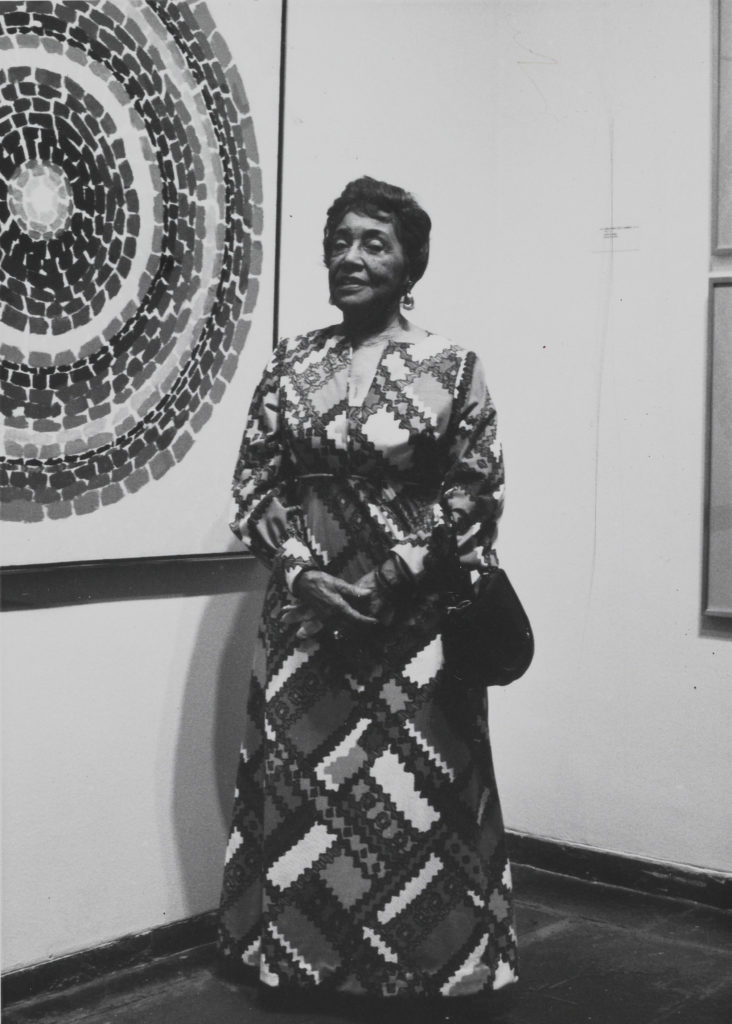
Photograph of Alma Thomas at Whitney
Museum of American Art exhibition opening, 1972 / unidentified
photographer. Alma Thomas papers, circa 1894-2001. Archives of
American Art, Smithsonian Institution.
When you couple this with race, as
in Alma’s situation, it creates the really profound set of
boundaries that she faced. When I saw the Studio Museum show, all
this started hitting me, and I started reading about her and her
life. More than anything, I thought her story was incredibly
powerful because she was combatting not only racism and sexism, but
also ageism and health issues—she didn’t start painting until she
was 69, after retiring from being a public high school teacher.
Oftentimes she had terrible bouts of arthritis, and she had to tie
her paintbrushes to her hands. That’s why her paintings have these
short brushstrokes—it’s because she couldn’t physically make a
wider range of movement. She was this incredible person who
overcame so much, but her attitude is what really struck me. She
was always positive.
From my own experience, what has
driven me—and I’m not proud of this—is really anger. In Alma’s
case, she was completely aware of all the bad situations around
her, but she said, “I’m going to deal with this as positively as I
can, and from a place of love.” She was very bright. She wanted to
become an architect. That was so completely out of the question, so
she ended up becoming a teacher in Washington, DC, and channeled
all that ambition not into bitterness or resentment but into
helping children appreciate art, which she did for 30 years. She
was really committed to that. And when she began painting, it was
always with the idea that it wasn’t about her life, or her past, or
any kind of oppression that she may have faced. Making art, to her,
was about beauty and joy and love.
But circling back to why I chose her
as my mentor, it’s because I think it’s really important to tell
this story, because our actions have so many unexpected
consequences, and some of them are really profound and good. The
fact that I read this article about her painting hanging in the
White House and that led me to see the Studio Museum show, which
led me to doing three years of research on Alma, which lead me to
putting on this show, which I hope will allow a whole new audience
to see and understand the power of this woman—that’s why
representation, even on the smallest level, matters. As gallerists,
we have a really a significant platform. And it’s incredible how
many collectors who have asked who Alma Thomas is. They have no
idea. This is where what we do really has implications.
I wrote down a quote of hers,
which is, “Through color, I have sought to focus on beauty and
happiness rather than on man’s inhumanity to man.” It seems to get
to the crux of how you described her outlook on life. Why do you
think she was able to get to this place of peace, when anger was so
available to her?
There are a few stories to draw on
here. Alma had hearing difficulties, and her mother told her that
it was because, when she was in utero, the mob came to lynch her
father. This was in Columbus, Georgia; they lived on a hill, and
they were quite prosperous. At the sound of the mob, her mother
felt fearful, and the sound of these men coming to get Alma’s
father apparently had such an impact on the unborn baby Alma that
she blocked out sound. There’s another story about her family:
before they crossed the river into Washington, Alma’s mother told
her and her sister to shake the sand out of their shoes, because
“they were never going back to that place again.” These are stories
that resonate with me because that’s how I felt when I left Sri
Lanka: “I’m not going back again.”
The way Alma dealt with all of that
is very spiritual, transcendental, and positive. She was just a
superior person, in many ways. She overcame so much with such
generosity. Also, a lot of African American artists at the time—at
the height of the civil rights movement—were expected to paint
paintings that had clear content, and in fact were criticized for
painting abstraction. Her choice to paint abstract was far more
profound than painting about racial difficulties. That was an
active choice. And the lesson for me, both in her art and from her
as a person, is that life is always an act of choice, no matter
what happened to you in the past.
What do you hope that people make
of her paintings themselves in your survey?
I want to stress that aside from all
this, Alma is a fantastic artist who hasn’t been given her due yet.
That’s what I’m hoping to correct with this show. At the end of the
day, we are an art gallery, so it has to be about the art,
primarily. She has long been grouped into the Washington Color
School because she was a part of that circle, along with Morris
Louis, Kenneth Noland, Sam Gilliam, and Gene Davis. She was well
known to them, they respected her greatly, and she had gatherings
with them. However, her paintings could not be more different from
theirs. For one thing, they’re easel paintings, at the end of the
day; for another thing, she was painting with a brush, so none of
their pouring or staining comes into play. She was a colorist, but
she wasn’t a Color Field painter or a Color School artist—I think
that’s an important distinction to make. It’s been a convenient
classification, until now.
Secondly, Alma began painting in
1959, coming out of an AbEx school of thought, a year before she
retired professionally as an educator. But she came to New York and
went to all the gallery shows even as a schoolteacher, so she was
incredibly educated, and would have been aware of all the
concurrent movements. As a result, yes, she starts out as an AbEx
painter, and yes, her stripes and circles come from a vocabulary of
seeing Kenneth Noland or Gene Davis, but to me her work is also
about the repetition of the brushstrokes and the grid of
Minimalism. It was her way of positioning herself not quite within
either movement, but doing her own thing. That makes her really
singular, and I’m hoping people appreciate that. Why shouldn’t she
be thought of along the lines of an Agnes Martin, a Bridget Riley,
or a [Yayoi] Kusama? She and Kusama have an affinity that may not
be immediately legible, but these are still the artists that are
more akin to her, on the whole.
Another person I’ve been thinking
about lately is Georgia O’Keeffe, whose life ran parallel to
Alma’s. Both of them saw incredible changes in society and
technology in their lifetimes. O’Keeffe is truly recognized as
being a pioneering American modernist—why isn’t Alma recognized for
being a pioneering postwar abstractionist? Alma also made some very
deliberate life choices. She never got married; she was very
independent. Both were independent, strong women.
Do you have any personal theories
on her life choices?
I’ve actually thought that somebody
should write a script about Alma’s life—I think the movie-going
public would be fascinated by her story. But her personal life is
still a bit of a mystery. We found a diary entry that she wrote:
“Once upon a time, it was said, ‘Don’t die having a ‘Ms.’ on your
tombstone.’ I feel very proud of having maintained my ‘Ms.’ I say
that Ms. stands for all the jackasses I missed in my life.”
It’s hilarious. And there’s more where that came from. I think she
could have a massive cultural moment.
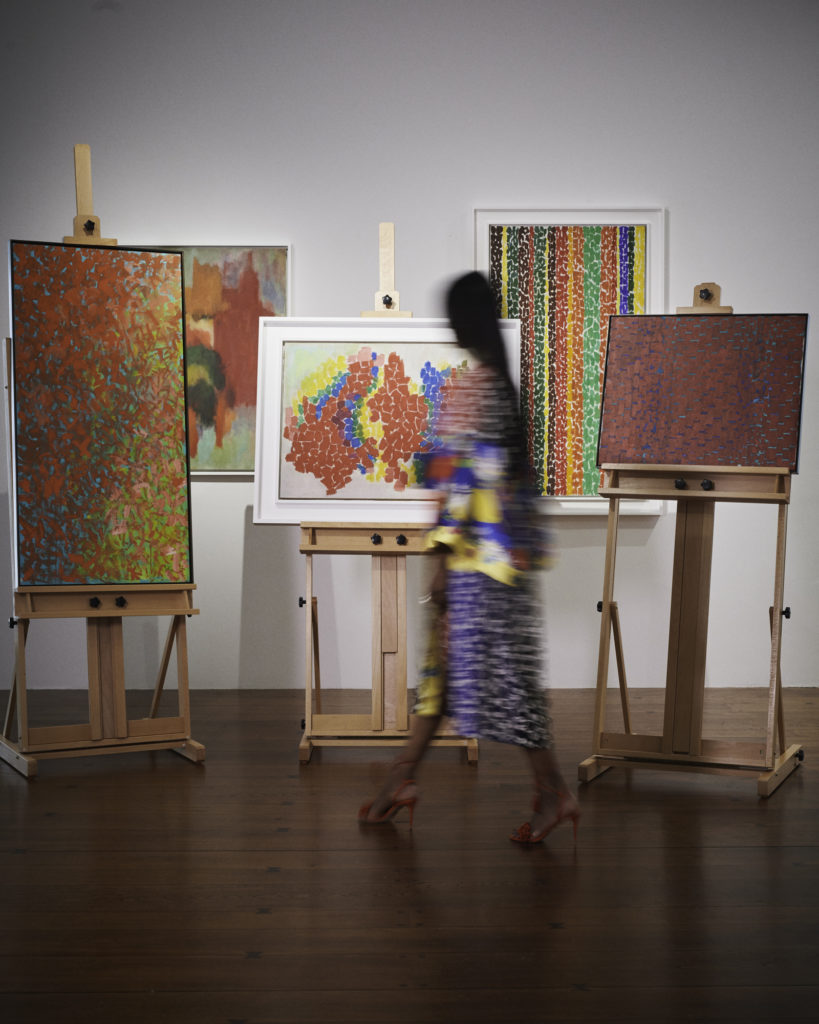
Sukanya Rajaratnam surrounded by Alma
Thomas’s works at Mnuchin Gallery. Photo by David Lipman.
Bringing all this into the
present, from your own experience and what you’ve gathered from
Alma, what advice do you have for young women about what they can
do to succeed in this industry?
I think it’s daunting when you first
enter—“lonely” is the word, really. I’m very sensitive to these
young women, because my generation had very little to model on. We
kind of had to make our way, and some of us are actively trying to
make it a friendlier place for young women, and make sure we are
available for them to approach us. I feel very strongly about that.
It’s been quite male-dominated, as we all know.
I would reach out to all the more
established women and say, “Make yourself available,” because
everyone needs someone at some point. To the young women, I would
say we’re all moving in a direction where there’s no “right” path.
Especially in an industry like this—you’ve got to forge your own,
so don’t be afraid of taking some chances. You’re going to fail
sometimes, but having courage is important. That’s another thing I
learned from Alma. She just didn’t care what people thought—which
is wonderful. She had a deep conviction for what she was doing as a
teacher and as an artist and she never questioned herself. So
that’s what I would say to women: have conviction.
Do you have any thoughts on the
elusive concept of work–life balance, which women these days are
constantly being asked about?
That’s a really hard question—it’s
something I struggle with every day. I have a nine-year-old son
whose name is Aditya, which means the sun in Sanskrit; he was born
on the summer solstice. I don’t totally know how to answer this… I
hope what I’m doing is the right thing, but I don’t know. Everyone
has to make that choice. As an art dealer, you’re expected to do so
much, especially with travel, and there’s no way around it, really.
I wish there were. But, again, women judge themselves much more
harshly, in this regard. Men have demanding jobs, but they don’t
question, “Is my child suffering as a result of this?” Women always
do. And that’s going to take a long time to change. I hope that I’m
modeling behavior that encourages my son to see women as equals.
That’s what I hope to accomplish.
What’s one thing that you would
like people to know about engaging with art,
generally?
I’d like them to do it more often.
Going back to Alma, it’s not just her artistic brilliance that has
had this impact on me, it’s her personality. Art can open you up to
realizations about yourself, which is ultimately our purpose on
this planet. For me, I chose Alma as a mentor because she’s shed so
much light on how I’ve approached things in the past, and how I
hope to change things. She’s really a beacon for me.
Photographer: David Lipman
Art Director: Yulu Serao
Stylist: Melena Lipman
Hair: Yoichi Tomizawa
Makeup: Yinna Wang
The post ‘Have Faith That What You’re Trying to Do Matters’: Dealer
Sukanya Rajaratnam on How the Late Artist Alma Thomas Inspires Her
Work appeared first on artnet News.
Read more https://news.artnet.com/woman-to-woman/1680670-1680670
Further reading


Leave a comment