
Here Are the 10 Most Incredible Archaeological Finds of the Past Decade, From ‘Spanish Stonehenge’ to the ‘Mona Lisa of Dinosaurs’
Archaeologists are improving our understanding of the ancient
world at a pace that feels more rapid than ever. Technological
advances are accelerating our discovery of prehistoric
civilizations, extinct species, and other mysteries of bygone
eras.
Last year alone saw the
discovery of the world’s oldest known
shipwreck, dating to the time of ancient Greece, and what may
be the world’s oldest known figurative art, the 40,000-year-old
cave paintings identified via a new method of flowstone
dating. And just this past week, archaeologists announced
that the Lovers of Modena,
two skeletons romantically preserved arm-in-arm, are actually both
men. We’re even learning new things about good old Tut, like the
fact that the boy king’s dagger was likely made from
a meteorite.
And although we may not have yet topped historic discoveries
like King Tut’s tomb, famously uncovered by Howard Carter in 1922,
or Heinrich Schliemann’s excavation of the mythical city of Troy in
1870, there have still been many mind-blowing archaeological finds
in the past decade. Here are our top 10.
The Lost City of
Tenea
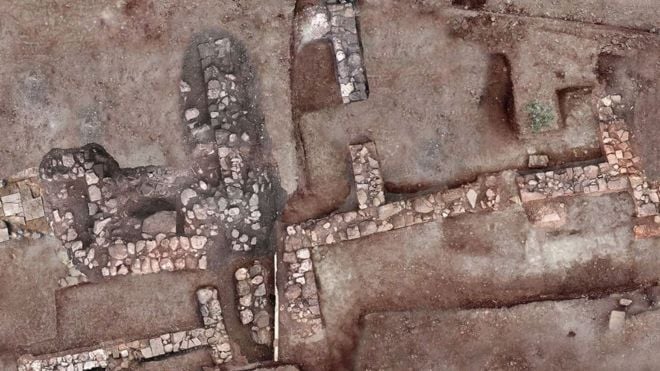
An aerial shot of the ruins of the lost
city of Tenea. Photo courtesy of the Greek Culture Ministry.
Last fall, Eleni Korka, one of Greece’s leading
archaeologists, finally discovered the site of Tenea, a city
founded by the Trojans following the Trojan War and built by
prisoners of war. The discovery, in the Peloponnese region of
southern Greece, marked the end of Korka’s decades-long search
in the area, begun back in 1984.
Over the past year, about 200 coins have been found on the site,
an extraordinary number that demonstrates the wealth of Tenea,
which was mentioned in ancient texts including the legend of
Oedipus. Korka’s team of archaeologists believes the city, once
home to 10,000 people, was raided by the Visigoths and, some 200
years later, by the Slavs before being abruptly abandoned. As
excavations continue, they expect to find additional homes,
temples, and the city marketplace, or agora.
“It’s like an iceberg and we’re just hitting the tip,” Korka’s
colleague Konstantinos Lagos told the BBC. “It’s going to
keep giving interesting findings for the next 100 years.”
Spanish
Stonehenge
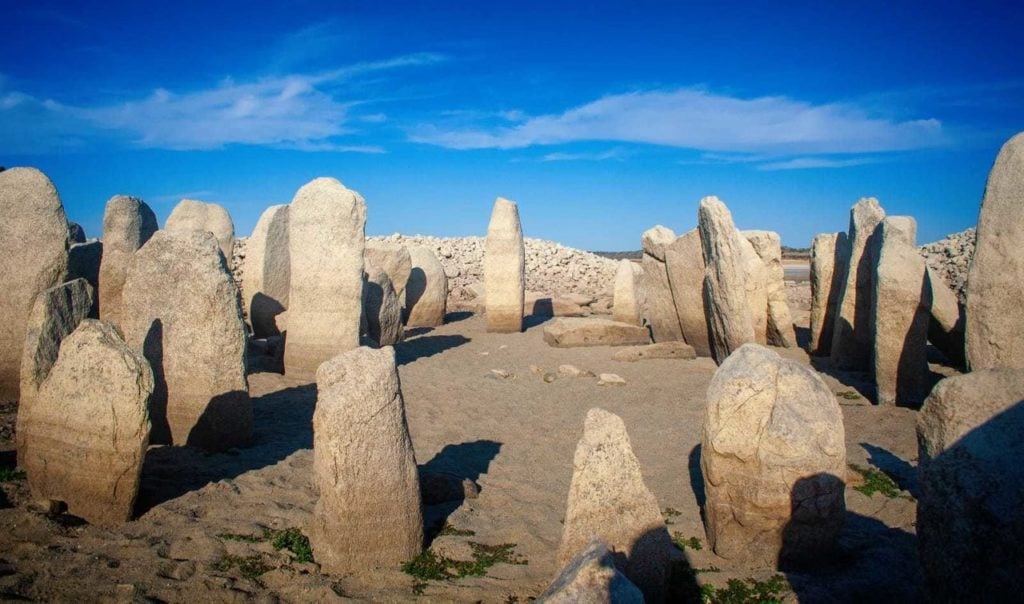
Photo of the Dolmen of Guadalperal.
Courtesy of Ruben Ortega Martin, Raices de Peraleda.
Long submerged beneath the waters of the Valdecañas
Reservoir, the Dolmen de Guadalperal, better known as the
Spanish Stonehenge, was made newly visible this summer as drought
struck Spain’s Extremadura region.
The Dolem de Guadalperal consists of about 100 monolithic
stones, some reaching as tall as as six feet, and is 7,000
years old. The site has been underwater since the government built
the reservoir in 1963.
“Like Stonehenge, [the megaliths] formed a sun temple and burial
ground,” local resident Angel Castaño told the Local. “They
seemed to have a religious but also economic purpose, being at one
of the few points of the river where it was possible to cross, so
it was a sort of trading hub.”
1,000 New Ancient Maya
Sites
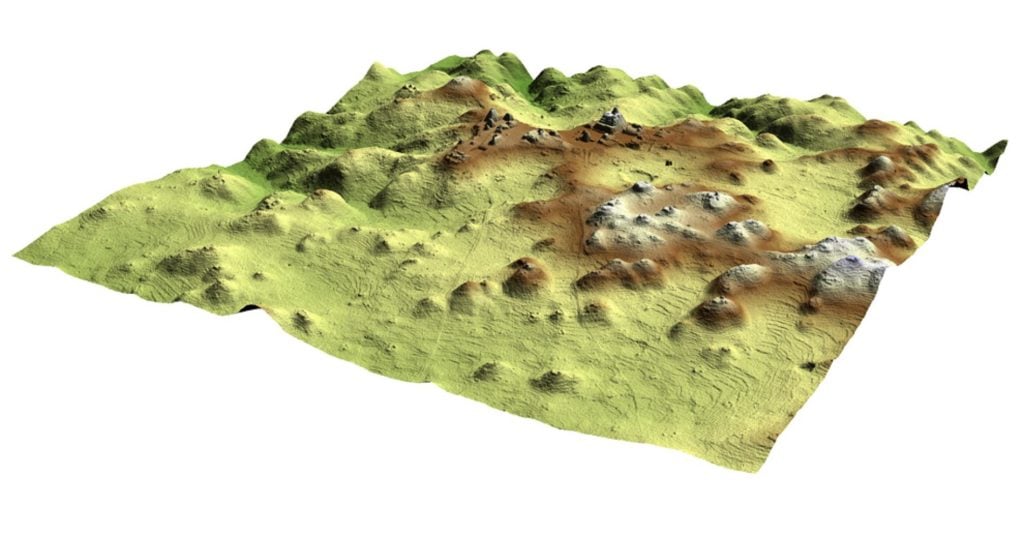
A LiDAR scan of Caracol, a Maya city in
Belize. Image courtesy of University of Central Florida Caracol
Archaeological Project.
One of the most shocking revelations of the decade came in 2018
when archaeologists in
Guatemala announced that thousands of
unknown Maya structures hidden in the jungle had been
revealed thanks to a new technology—planes from the National Center
for Airborne Laser Mapping equipped with high-tech Light Detection
and Ranging (LiDAR) mapping tools. In an instant, the LiDAR takes
topographical readings, creating three-dimensional maps of the
earth’s surface that would take years to plot on foot.
Maya archaeologists have always had difficulty navigating the
dense tropical undergrowth, which obscures the ancient ruins and
makes it impossible to see most Maya structures beyond a few feet
away when on the ground. That’s especially true when it comes to
the networks of low roadways, causeways, and irrigation systems
that were discovered en masse thanks to the LiDAR.
“LiDAR is showing us things that we never would have been able
to see with 100 years of research—and we have 100 years of research
under our belts already, so it’s not like that’s hyperbole,”
archaeologist Marcello Canuto, who helped oversee the LiDAR
initiative from Pacunam, told artnet News.
The Hidden Palace of
Ramesses II
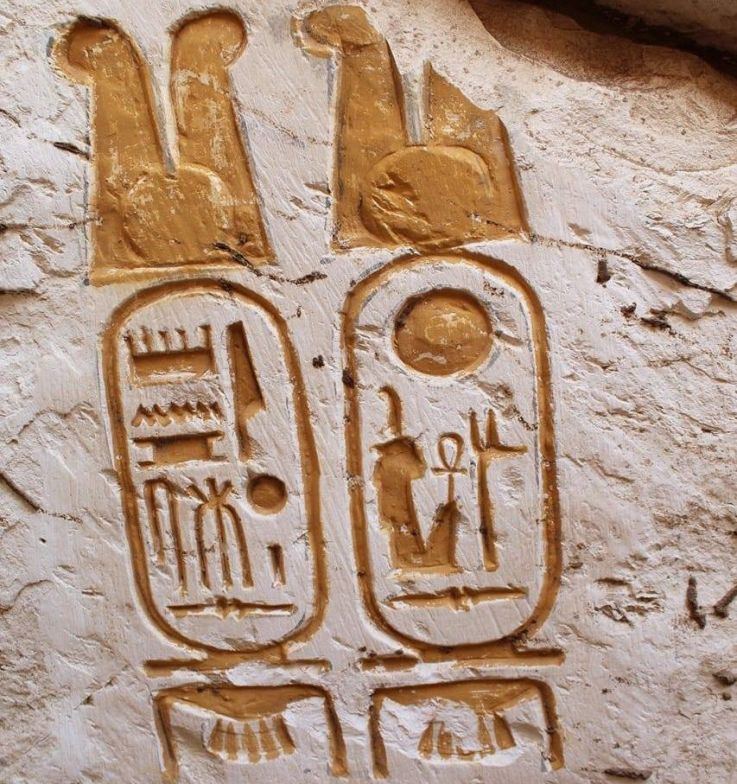
Special hieroglyphic symbols denote the
name of Ramesses II at a previously undiscovered palace at the
ancient site of Abydos. Photo courtesy of Egyptian Ministry of
Antiquities.
In March, an excavation team from New York University announced
that a previously unknown palace has been discovered next to the
Temple of Ramesses II in the ancient Egyptian city of Abydos.
Archaeologists thought they had found the full temple 160 years
ago, until the stone walkway leading to the adjoining building, a
secret royal palace marked with the cartouche of Ramesses II, was
uncovered.
Previously, the prevailing theory was that Abydos, home to a
temple and burial ground, was mainly used for ceremonial
purposes. “The fact Ramses II required a palace at Abydos also
reveals that he didn’t just order a new temple at the site but was
spending enough time there to warrant such accommodation,” NYU
professor Joann Fletcher told Newsweek. “To
have a building in which people lived their lives is always a
fascinating thing to find.”
Buried Treasure in
an Ancient Greek Tomb
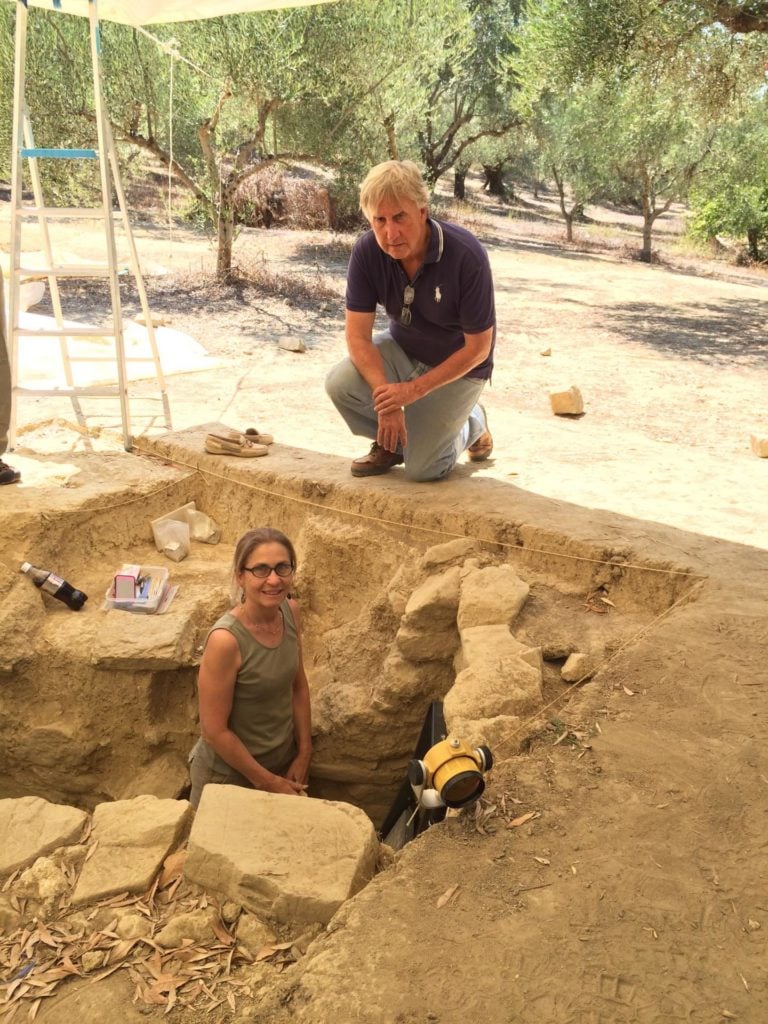
Excavation leaders Sharon Stocker and
Jack Davis have worked in the Pylos region of Greece for 25 years.
Photo courtesy of the University of Cincinnati.
A husband-and-wife team from the University of Cincinnati was
digging near the ancient Palace of Nestor, in the town of Pylos on
the southwest coast of Greece, when they literally unearthed buried
treasure: a cache of bronze weapons, gold and silver cups, and
hundreds of precious and semiprecious beads of amethyst, carnelian,
amber, and gold.
“It was surreal,” one of the archaeologists on the dig, Flint
Dibble, told Smithsonian
Magazine. “I felt like I was in the 19th century.”
Aside from its incredible wealth, the remarkable tomb offers new
insights into the roots of European culture, and about links
between the ancient Mycenaean society on mainland Greece and the
Minoans on the island of Crete. The two cultures were likely
intertwined, together giving birth to what we think of as Western
civilization.
The Oldest Human Jawbone
Outside of Africa
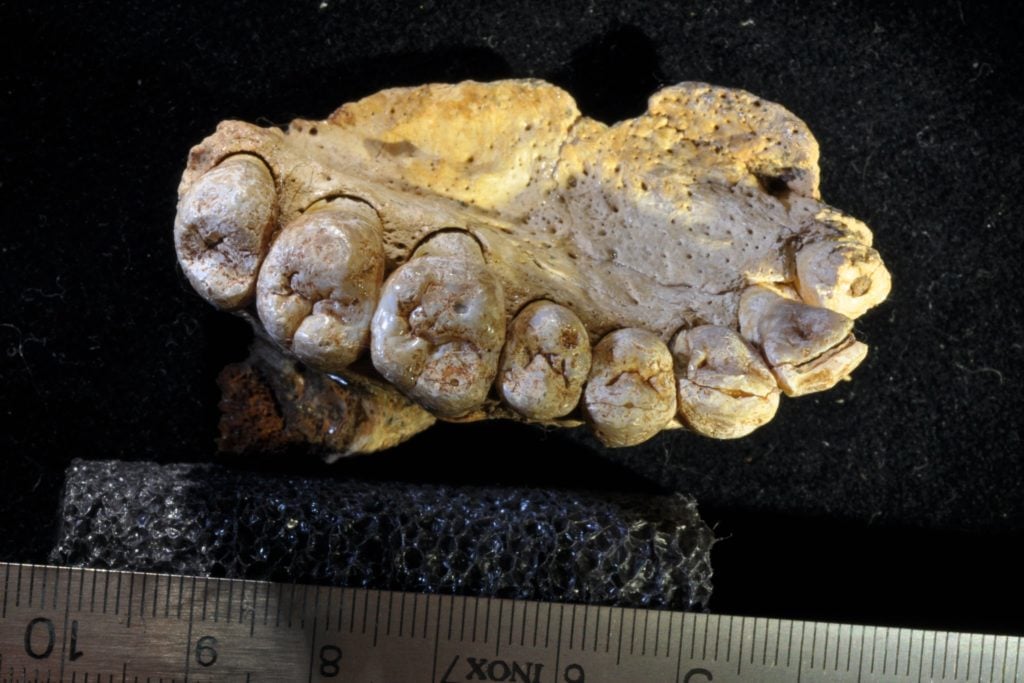
This fossilized human jawbone was
discovered in Israel, suggesting that Homo sapiens first migrated
out of Africa at least 50,000 years earlier than previously
thought. Photo by Gerhard Weber, courtesy of the University of
Vienna.
A human jawbone unearthed by a team from Tel Aviv University in
Misliya Cave on Israel’s Mount Carmel in Israel offers new evidence
that humans migrated beyond Africa some 50,000 years earlier—or
more—than previous research had led experts to believe.
The fossil was discovered in 2002 by a freshman on his first
archaeological dig, but news of its significance was only announced in 2018. The
archaeologists dated burnt flint flakes that were also found in the
cave to 250,000 to 160,000 years old, far earlier than the other
evidence of modern humans outside of Africa, which places their
earliest migration at 120,000 years ago.
The jawbone “looked so modern that it took us five years to
convince people, because they couldn’t believe their eyes,” said
Mina Weinstein-Evron, an archaeologist on the project from the
University of Haifa, told the New York
Times.
Germany’s 10
Million-Year-Old Teeth
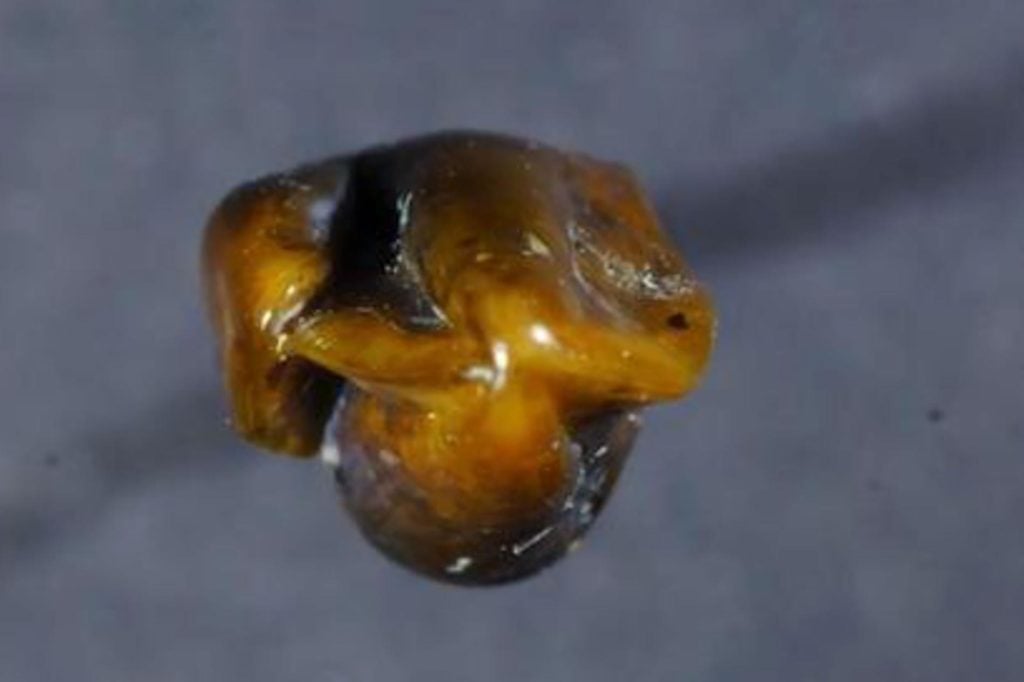
Researchers say that this tooth—recently
discovered at a fossil site in Germany—is the upper left canine of
an ancient Eurasian primate. (From this angle, the canine’s tip is
jutting outward.) Photo courtesy of Herbert Lutz.
This one is controversial. In 2016, archaeologists in
Eppelsheim, Germany, discovered two 9.7 million-year-old teeth.
They weren’t exactly human, but they bore a close resemblance to
the teeth of Lucy, the famous fossil of Australopithecus
afarensis, an early ancestor of homo sapiens. These teeth were
four million years older than Lucy, the oldest species of hominins,
the subfamily including human, extinct humans, and their immediate
ancestors.
But National
Geographic was quick to warn against sensationalizing
the find by describing it as evidence that mankind originated in
Europe, rather than Africa. (Newsweek proclaimed the
fossils “could rewrite human history.”) The teeth may belong to an
extinct hominoid primate only distantly related to humans—or
to an entirely different type of species, possibly even a ruminant
animal. More research is definitely needed for this fascinating
discovery.
“We want to hold back on speculation. What these finds
definitely show us is that the holes in our knowledge and in the
fossil record are much bigger than previously thought,”
said study leader Herbert Lutz, the deputy museum director of
Germany’s Mainz Natural History Museum, to ResearchGate. “It’s a
complete mystery where this individual came from, and why nobody’s
ever found a tooth like this somewhere before.”
Mummified
Dinosaur
While digging at a Canadian mine one
day in 2011, a worker was shocked to discover an almost perfectly
preserved 110 million-year-old nodosaur specimen. Paleontologists
are used to uncovering the fossilized bones and teeth of ancient
dinosaurs, but it is much less common for the skin and other soft
tissue to survive for millions of years. Here, the bones aren’t
even visible, because the flesh, heavy body armor, and scaly skin
remains intact.
After 7,000 hours of painstaking work by a fossil preparator,
the incredible find, weighing 2,500 pounds and measuring 18 feet
long, was unveiled at the Royal Tyrrell Museum of
Palaeontology in Alberta, Canada, in 2017. Unexpectedly, analysis
of the skin showed shading that indicates that the plant-eating
nodosaur, despite its size, used camouflage to conceal itself from
predators.
“It will go down in science history as one of the most beautiful
and best-preserved dinosaur specimens,” said the museum’s Caleb
Brown in a statement, calling the
nodosaur “the Mona Lisa of dinosaurs.”
The post Here Are the 10 Most Incredible Archaeological
Finds of the Past Decade, From ‘Spanish Stonehenge’ to the ‘Mona
Lisa of Dinosaurs’ appeared first on artnet News.
Read more https://news.artnet.com/art-world/10-incredible-archaeological-finds-1653145
Further reading


Leave a comment