
Hidden Away for 50 Years, an Astonishing Collection of Classical Art Owned by a Secretive Italian Family Will Finally Go on a World Tour
An astonishing collection of
Greek and Roman sculptures is about to go on view in Rome after
being hidden for decades. The private collection, which rivals
those in the world’s great museums, has been stuck in storage for
half a century until its aristocratic owners reached a landmark
agreement with the Italian government. The deal has paved the way
for a world tour of highlights of the collection.
The Torlonia Collection is one
of the most important collections of classical sculpture still in
private hands. Only a few people have ever glimpsed the 620 works
in storage. Even the
co-curator of the exhibition, veteran art historian and former
director of the Getty Research Institute in Los Angeles, Salvatore
Settis, had never seen the sculptures in person before taking on
the job.
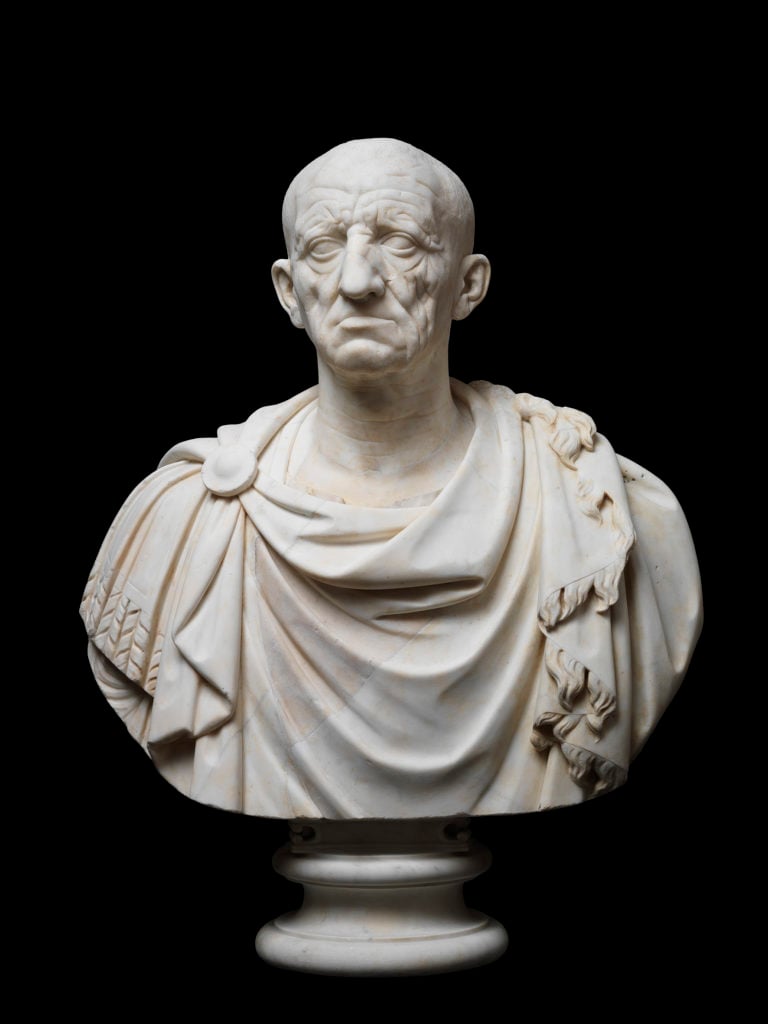
Torlonia Collection, Vecchio da
Otricoli, ©Fondazione Torlonia. Photo by Lorenzo de Masi.
Settis tells Artnet News that
his first visit to see the collection was “surprising, rewarding,
and promising beyond belief.” Settis is co-curating the
exhibition with archaeologist Carlo Gasparri, who has been working
on it for years. They
have chosen 96 statues, which will go on view in April at the the
Palazzo Caffarelli in Rome. The new exhibition venue in the city’s
Capitoline Museums has been modernized by the architect David
Chipperfield.
The Rome exhibition will be the
first leg of a world tour. The foundation has not announced which
museums in the US and Europe could host the collection. After the
tour, the collection is due to go on show in a new Torlonia Museum
in Italy.
A Collection of Collections
The Torlonia family built a vast
fortune during the 18th and 19th centuries through administering
the Vatican’s finances. Their collection is the stuff of legend
among art historians because the family has kept it private for so
long. Most experts only know it from a 19th-century
catalogue.
In 1875, then Prince Alessandro
Torlonia set up a private museum, making the collection visitable
by special appointment at a former granary on the Via della
Lungara. But it has been largely inaccessible since it was put into
storage by one of his successors after World War
II.
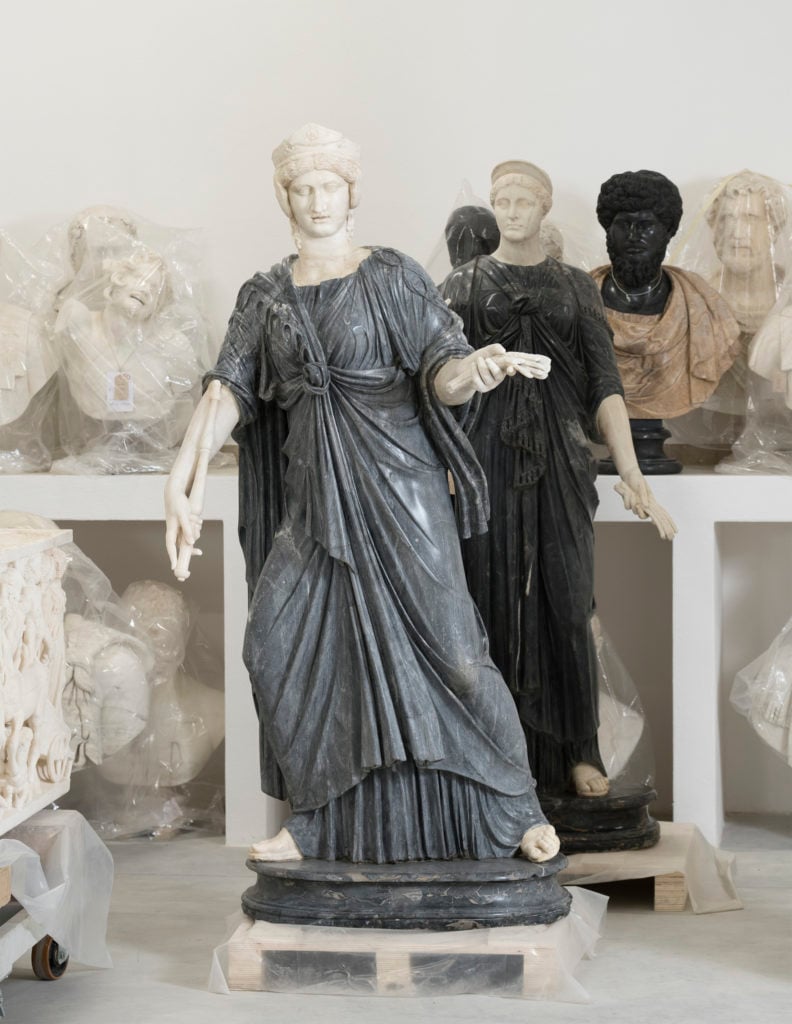
Torlonia Collection, group with Isis.
©Fondazione Torlonia. Photo by Lorenzo de Masi.
The bulk of the collection was
assembled by acquiring entire collections from other Italian
aristocratic families in financial straits. Other pieces were
excavated on the Torlonia family’s own land. Settis and Gasparri
explain that the exhibition will focus on how it is a “collection
of collections.”
“Those collections, in turn, had
within them a significant number of works from earlier collections,
dating back to 16th-century Rome,” the curators explain. “What we
will put on show, therefore, is not just a representative selection
from the Torlonia Collection, but also a cross-section of the
history of collecting antiquities in Rome from the 16th through to
the 19th centuries.”
New Discoveries
Before going on display, the
sculptures have been researched and cleaned. Their conservation,
which is supported by the Italian luxury brand Bulgari, has
revealed new insights into classical sculpture.
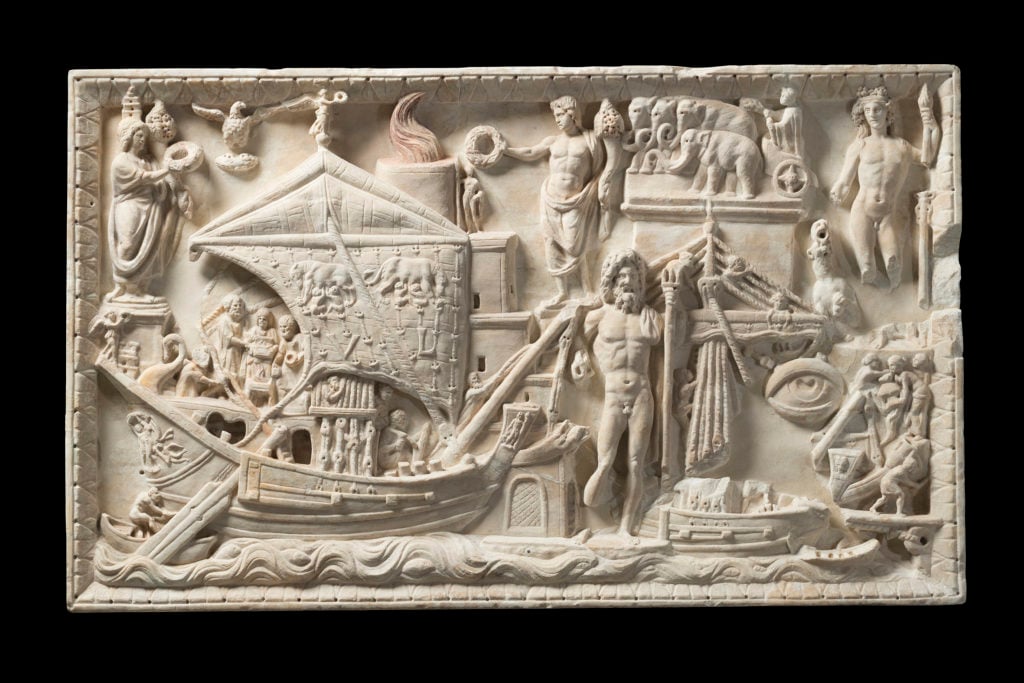
Torlonia Collection, Relief with a scene
of Porto, ©Fondazione Torlonia. Photo by Lorenzo de Masi.
The conservator charged with
overseeing the project, Anna Maria Carruba, has been working on the
sculptures since 2016. She tells Artnet News that
a marble relief
depicting a harbor still has traces of its original painted
surface. Classical
sculptures were often brightly painted, but it is rare to find
evidence of the original pigments which usually fade over time, and
were sometimes cleaned off by collectors who preferred pristine
surfaces. Carruba explains that traces of original pigments
include: “Blue for the sea, red for the fire of the lighthouse, and
green and yellow on the frame.”
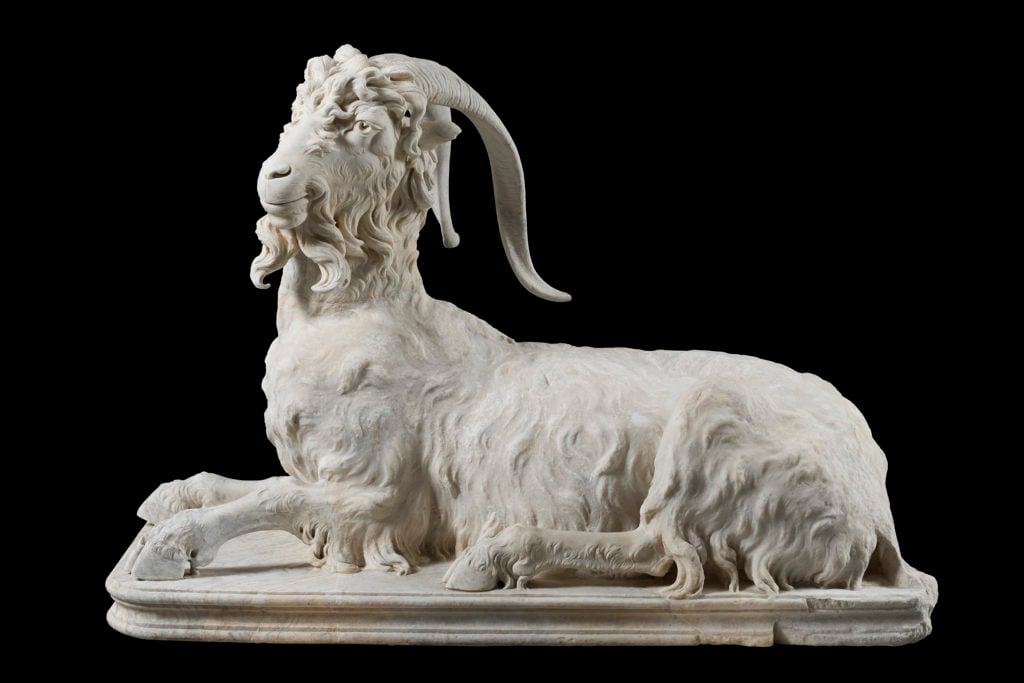
Torlonia Collection, Statue of a resting
goat, ©Fondazione Torlonia. Photo by Lorenzo de Masi.
Carruba says that recording
historic interventions was her most challenging task, although some
of them are significant in their own right. The celebrated Baroque
sculptor Gian Lorenzo Bernini restored a Greek statue of a resting goat, for
example.
An Historic Deal
The Italian government has long
wanted to increase access to the storied
collection. For 40
years politicians been trying to convince the family to put the
collection on public display but they have had difficulties finding
a venue. Three separate museum projects were discussed but nothing
came of them.
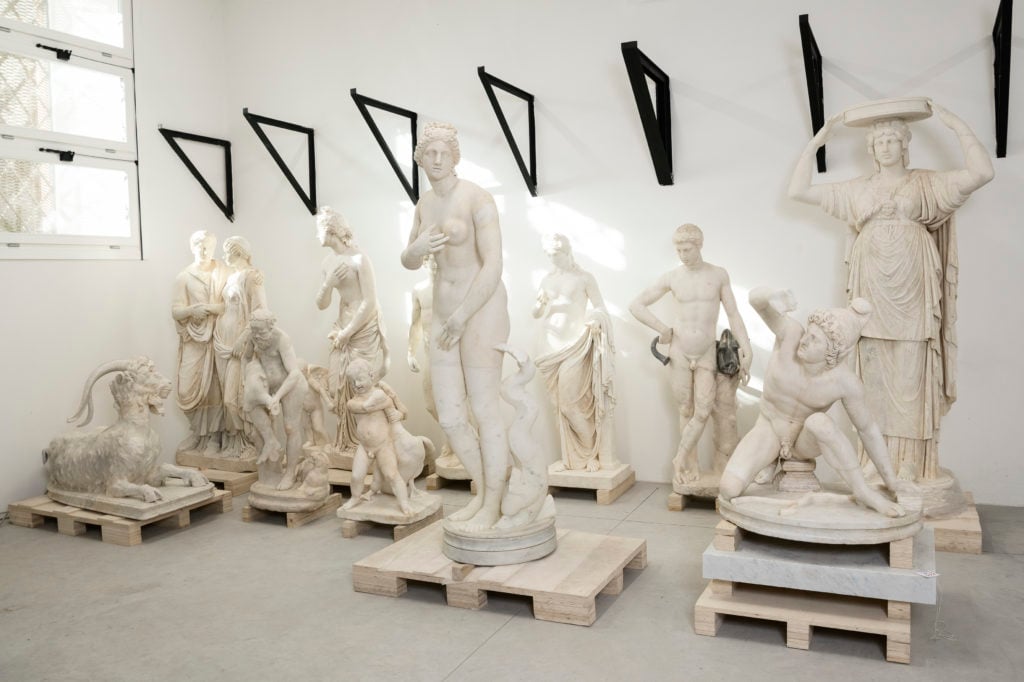
Torlonia Collection, Invitation to
dance. ©Fondazione Torlonia. Photo by Lorenzo de Masi.
In 2014, the head of the family,
Alessandro Torlonia, established a foundation to manage the
collection and, in 2016, a year before he died, the aristocrat
finally signed an agreement with the Italian government. Culture
Minister Dario Franceschini hailed the agreement as “the fruit of
authentic collaboration between the public and private spheres in
the interests of culture.” The foundation is now run by Torlonia’s
grandson, Alessandro
Poma Murialdo.
“The Torlonia Marbles.
Collecting Masterpieces” will be on view April 4 2020 through
January 10, 2021 at the Palazzo Caffarelli in Rome.
The post Hidden Away for 50 Years, an Astonishing Collection
of Classical Art Owned by a Secretive Italian Family Will Finally
Go on a World Tour appeared first on artnet News.
Read more https://news.artnet.com/exhibitions/torlonia-collection-rome-world-tour-1753788
Further reading


Leave a comment