
Hong Kong’s Galleries Urge Art Basel Not to Cancel, Calling Western Criticism of the Problem-Plagued Fair ‘Myopic’
The saga unfolding around Art Basel Hong Kong has taken yet
another turn with a newly published letter expressing support for
the fair and emphasizing the continued resilience of the city’s
cultural sector, despite “often myopic and narrow coverage or
comments from abroad.”
Signed by the board of directors of the Hong Kong Art Gallery
Association (HKAGA)—comprised of 45 galleries across the city—the
letter, which was released to media on January 31, touches on the
lived reality of those working in Hong Kong and the struggle to
exhibit art throughout the anti-extradition bill protests and, more
recently, the outbreak of the coronavirus.
The letter also points to a deeper divide between Hong
Kong-based galleries, many of which rely on Art Basel Hong Kong to
connect them to a global audience, and the blue-chip international
dealers who have become increasingly vocal about their
dissatisfaction with fair organizers and their disease with the
fair itself in the current climate.
Fair organizers “have been sensitive and considered in their
understanding of Hong Kong and its unique positioning,” the letter
states. “Throughout the past seven months of political upheaval,
our galleries have worked hard to host openings, symposiums, talks,
and other events for artists, collectors, and visitors. Despite
constant changes in traffic flow, government mandates, and
collective fatigue, these programs have been well received and
attended. Culture and the arts hold a special place within the city
and we know the arts will continue to thrive here.”
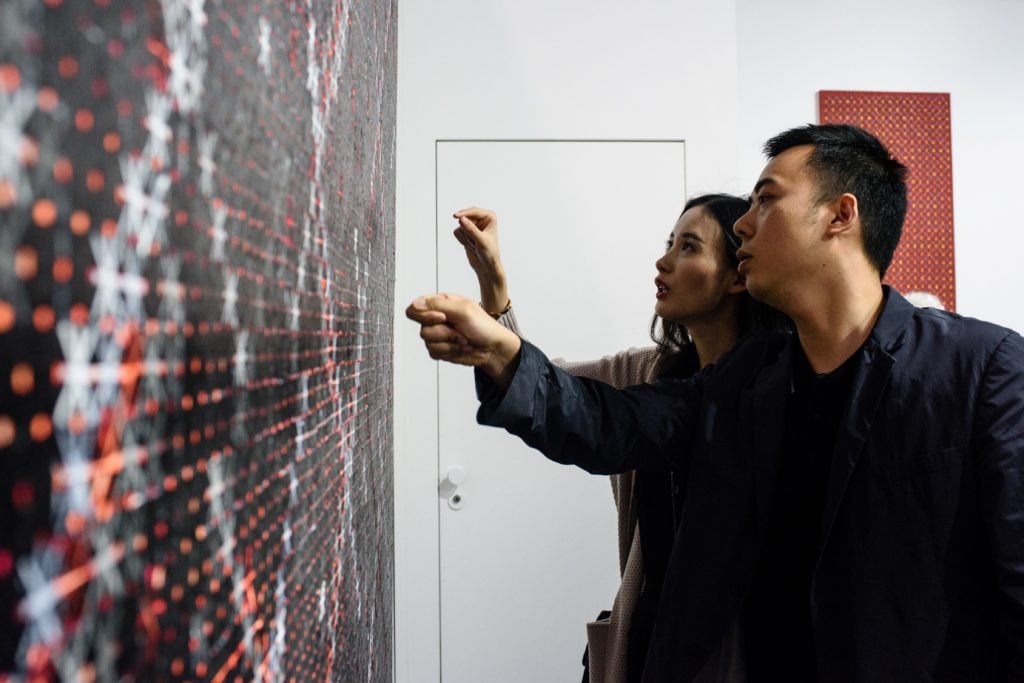
Chinese investment banker Huang
Xiaoshuai, 26, and his wife, Wei Mengyuan, in front of their newly
acquired painting Appearance of Crosses 2016-12 by Chinese
artist Ding Yi at Art Basel in Hong Kong in 2017. (ANTHONY
WALLACE/AFP via Getty Images)
Culture Clash?
The statement appears to be a response to the publication of two
recent letters addressed to Art Basel Hong Kong leadership, Adeline
Ooi and Marc Spiegler.
The first, signed by 24 international art dealers including
stalwart fair participants Blum & Poe and Lisson Gallery, expressed concerns
over the political situation in Hong Kong and fears of
censorship while making
several demands of organizers, including a 50 percent reduction in
booth fees. (The dealers noted that “many of our artists are
unwilling to have their work shown at the fair” because
participation in a territory under threat of increased Chinese
control is not “consistent with their core belief in the freedom of
expression.”)
Two weeks later, as the coronavirus began to spread through the
region, London dealer Richard Nagy—who was not one of the
signatories of the original letter—called for
“decisive leadership” to cancel the “fatally wounded”
fair.
Several members of the arts community in Hong Kong have been
riled by the demands and the tone of these letters, with some
criticizing the signatories for propagating false information
regarding freedom of speech in Hong Kong and exploiting the
political crisis.
“When I was in the US and Europe over the summer, I saw that the
news is very skewed, first with the protests, and now with the
coronavirus,” said Katie de Tilly, founder of the Hong Kong gallery
10 Chancery Lane, who is frustrated with sensationalist reporting
in international media. (This type of coverage has also been linked
to the sudden rise of
xenophobia or “yellow peril” around the globe.)
“With the health concerns, we
should definitely take precautions, but if you look at the
statistics and what’s going on in Hong Kong, it’s not that scary
right now,” she added.
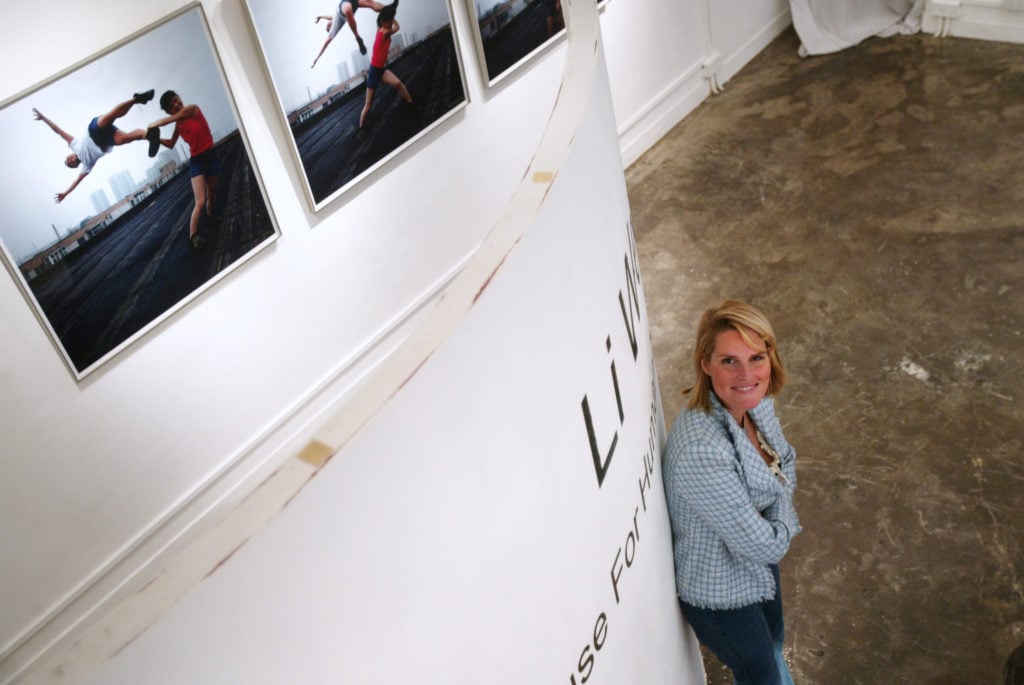
Katie de Tilly, the director of 10
Chancery Lane Gallery, in 2006. (Photo by Jonathan Wong/South China
Morning Post via Getty Images)
Fabio Rossi, co-founder of the
HKAGA and founder of Rossi & Rossi gallery, cites a different
issue: that the galleries who signed the first letter did not reach
out to him or the HKAGA to inquire about the situation on the
ground first.
“So, to me, a lot of what was said is from the position of an
outsider,” he said. “I think it was unfortunate that some people
might just be looking for an excuse to receive a higher
discount—which I do understand, as we are all in business—but I
also feel that what was said was from a very hypocritical
perspective. Many of these galleries also have spaces in and have
shown their artists in mainland China—I’m interested to know, are
they as concerned about censorship with their own exhibitions?”
Bracing for Cancellation
The cancellation of Art Basel Hong Kong would be a blow to the
region’s galleries, many of which cannot justify the cost of
participating in other international fairs and rely on ABHK’s
commitment to representation and diversity in order to enhance the
international profile of Asian art.
“I do hope it goes ahead,” said de Tilly. “It is the only fair
with such a large focus on contemporary art from the Asia Pacific.”
Like many local dealers, her gallery has planned a high-profile
presentation for the fair: a two-artist booth featuring work by the
Hong Kong performance and conceptual artist Frog King and female
Chinese installation artist Xiao Lu.
Similarly, Blindspot Gallery has recruited local curator Ying
Kwok to organize a show at its Wong Chuk Hang space in conjunction
with its Art Basel booth, which will include work by Hong Kong
artists Trevor Yeung and Lam Tung Pang.
“I understand the fear in Hong Kong [around the coronavirus],
given our experience with SARS,” said Mimi Chun, founder of
Blindspot Gallery and membership director of the HKAGA. “But I
think it will be a pity if the fair gets cancelled, as it is a
highly anticipated local art event. From my knowledge, quite a few
galleries have the same feeling.”
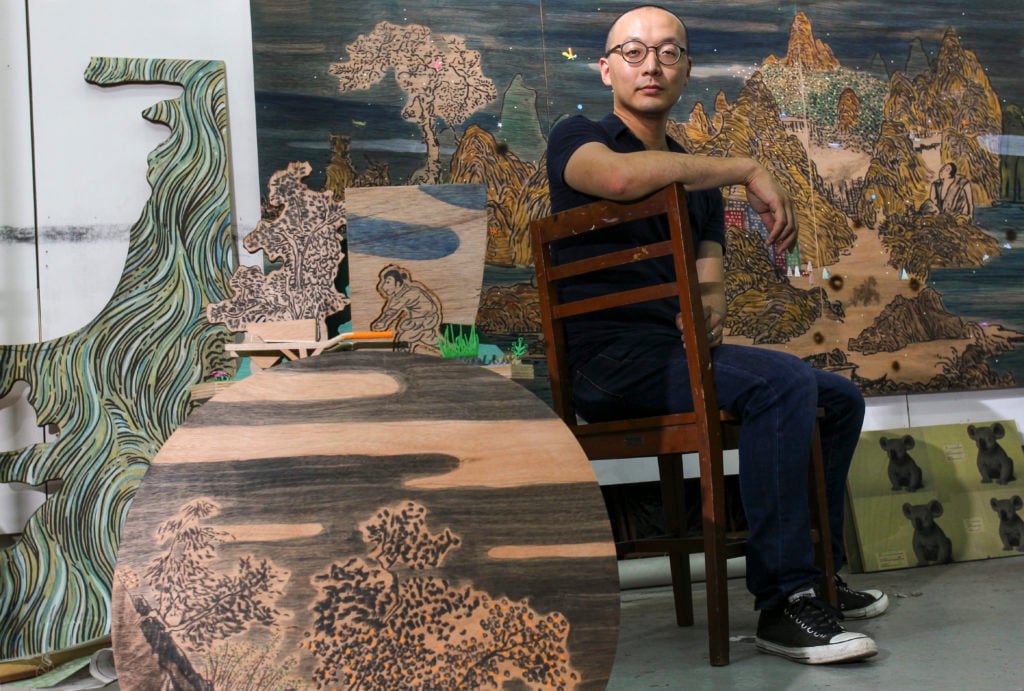
Artist Lam Tung-pang, whose works will
be shown at Blindspot Gallery’s booth at Art Basel Hong Kong.
(Photo by May Tse/South China Morning Post via Getty Images)
Even galleries with a more international reach, such as Ben
Brown Fine Arts, which has spaces in London and Hong Kong,
recognize the impact of the fair within the region. “To be blunt,
there’s no other fair here that has the international depth or the
quality of work that Art Basel does,” said Amanda Hon, the
gallery’s managing director.
In comparison to the furore over Art Basel Hong Kong’s decision
to cancel or proceed, there has been relatively little discussion
surrounding other major concurrent commercial art events, such the
spring sales at Sotheby’s Hong Kong (March 17–18) and the Art
Central fair (March 17–22), which will host 77 galleries—the
majority of which are from the Asia-Pacific region—this year. As of
yet, none of these events has been cancelled or postponed.
“The main loss for a Western gallery is financial, but for us,
there is also the major loss of missing the moment of an
international gathering of collectors and curators.” Rossi said.
“But if the fair is cancelled, I think we will all try to support
each other and make sure that the conversation about art stays
alive. I think at the end of the day, we are partners in this.”
Hon echoed that can-do sentiment. “We’re just going to make the
most out of the situation,” she said. “All of us have put so much
time and energy and dedication into the city to help it to grow. We
have to continue.”
The post Hong Kong’s Galleries Urge Art Basel Not to Cancel,
Calling Western Criticism of the Problem-Plagued Fair ‘Myopic’
appeared first on artnet News.
Read more https://news.artnet.com/market/hong-kong-galleries-art-basel-hong-kong-1766706
Further reading


Leave a comment