
How a New Generation of Native American Street Artists Is Leaving Its Mark Across the United States
Ten years ago, an illegal street sign helped put Indian Alley on
the art-world map.
In 2010, Los Angeles-based artist Wild Life installed an
imitation street marker above the city-sanctioned sign for Wendin
Place in LA’s Skid Row. His sign renamed the street “Indian
Alley, Property of the People,” a play on official signage (which
would normally say “Property of Los Angeles”).
Renaming the street after an already existing nickname, Wild
Life kicked off a movement to make the area’s Native American
history visible with site-specific murals and graffiti created
exclusively by Native artists.
For years, this alley in a notoriously impoverished area
adjoined the offices of United American Indian Involvement, an
organization helping Native people fight homelessness and
addiction. By the time Stephen and Jodi Ziegler, owners of the
These Days art gallery, moved into a nearby building in 2008, the
organization had relocated, but its presence was still
ingrained.
“This is a very special place for me, and I consider it sacred
ground,” Stephen Ziegler tells Artnet News. “There was no
romanticism about it. It was a filthy, crime-ridden alley that a
lot of people died in, and overdosed in, and drank themselves to
death in, and were killed in. There’s not a grandiose, proud,
Indian-feather-headdress cliché [feeling] to it. To me, this place
represents the result of genocide, and the lowest [place] that a
people can end up.”
After doing some research on the area’s past, the Zieglers
invited a group of artists to create murals on a building they own
in the alley, and other projects have blossomed since. In
2018, Native artists Jaque Fragua and River Garza created a
mural charting all of Los Angeles’s original village names.
“I just saw it as a very educational thing for people, to
remember that this was someone else’s land,” Ziegler says of
the mural.
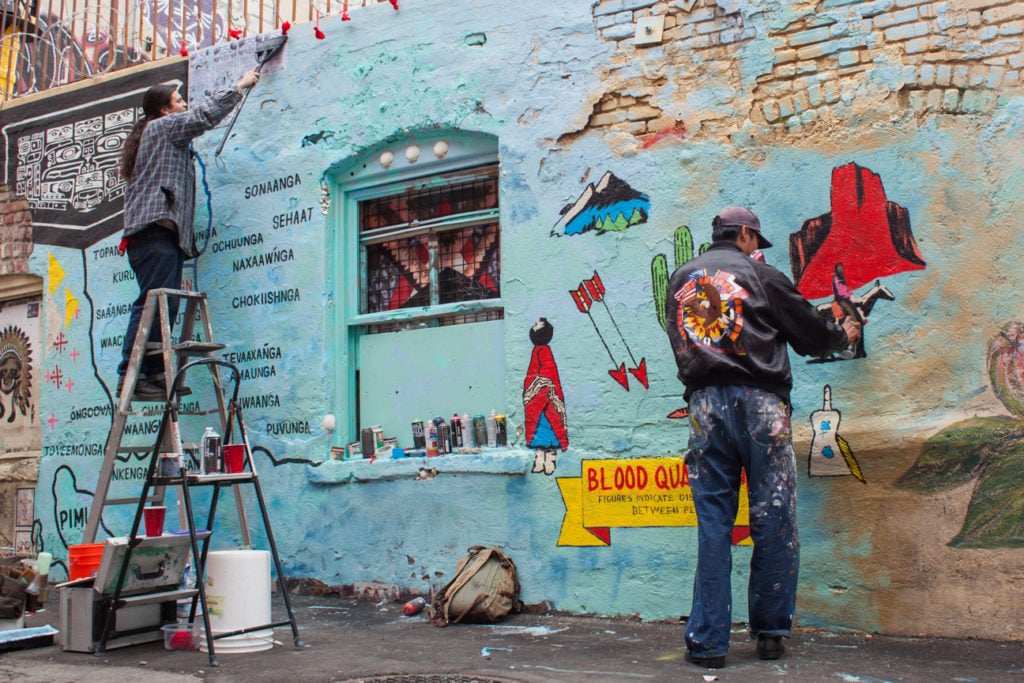
River Garza and Jaque Fragua collaborate
on a mural in LA’s Indian Alley, 2018. Photo by Stephen
Ziegler.
Beyond the Urban Landscape
Indian Alley is the rare urban site that concentrates such art.
But elsewhere, Native American artists are creating murals, outdoor
artworks, and graffiti that is often informed by their heritage,
but does not always include typical iconography.
“I don’t feel the desire to include eagle feathers and things
like that,” says Cheyenne Randall, a Seattle-based artist of
Sioux Lakota descent. “I like to do whatever I want to do, and then
if you want to call it Native artwork, you can, because I’m Native
myself.”
To make his works, Randall Photoshops tattoos onto vintage
photographs of Hollywood stars and musicians. The finished images
are then enlarged, printed, and wheat-pasted outside. In similar
works where Randall depicts Native people, the idea, as he
explains on his website, is to emphasize “the fact that Native
America was and is still here.”
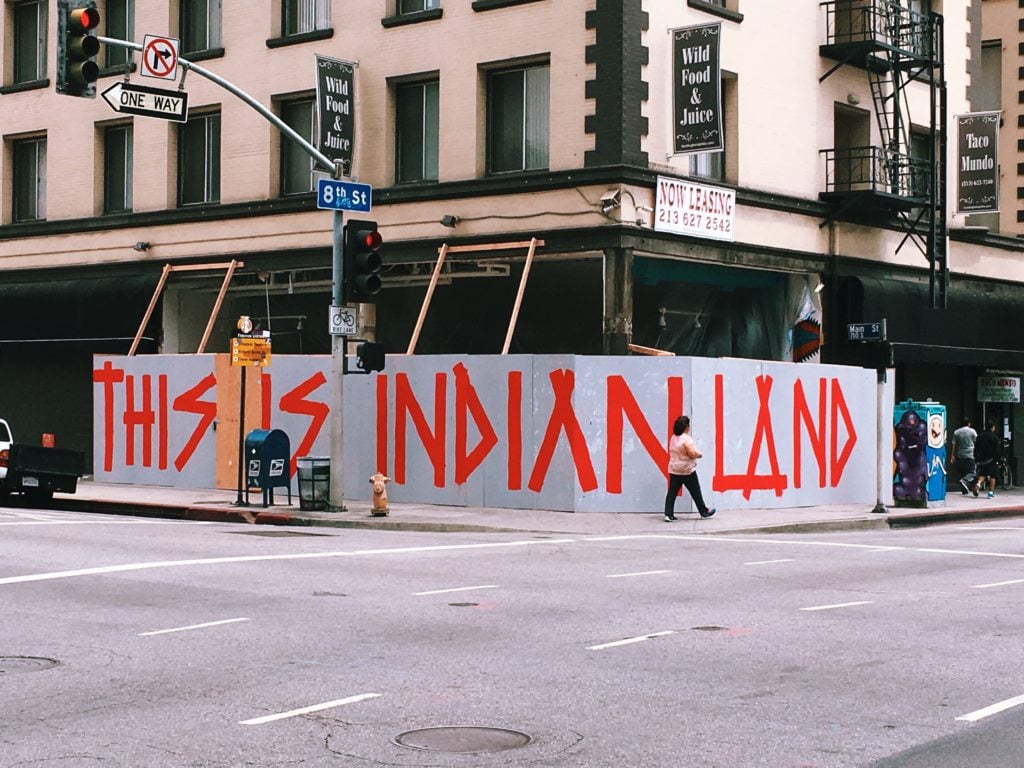
Jaque Fragua, This is Indian
Land (2016).
For others, like Fragua, making art outdoors is an inherently
indigenous act. Fragua grew up in Jemez Pueblo, the last
Towa-speaking community in the United States—a town not far from
the Petroglyph National Monument, where art depicting people,
animals, and geometric figures dates back thousands of years.
“I see graffiti as a primordial art form of mark-making that
started on caves and rocks as petroglyphs or pictographs,” Fragua
says. “The language is a bit different in modern times, but
the spirit of visual storytelling is still there.”
In 2016, Fragua got a flurry of press attention when
he graffitied “This Is Indian Land” on a temporary construction
wall in LA. But around half of his public artworks have been made
on reservations outside of big cities, where he appropriates
abandoned highway billboards.
“Billboards and signs that market commercial activity pollute
the psyche and perpetuate toxic social environments,” he says. He
creates what he calls “interventions” in their place, writing
messages—”Sacred” and “Stop Coal,” among others—that are relevant
to the people who live there.
“Agency is imperative for Native Americans, more than ever,”
Fragua says. “Any contribution for our people from our own people
is a positive step forward.”
Together with other indigenous artists, including Randall,
Fragua took part in an organization called Honor the Treaties,
which aimed to amplify the voices of indigenous communities by
having artists collaborate with Native advocacy groups to broadcast
their messages to wider audiences. Among the issues that Honor the
Treaties addressed were environmental destruction, illegal mining,
and land rights.
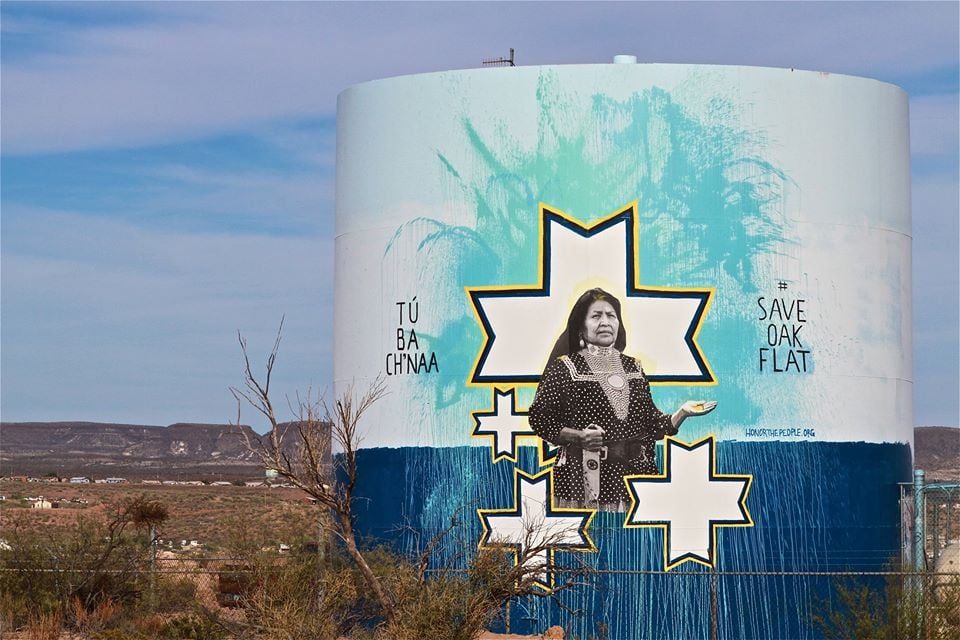
Tommy GreyEyes, Save Oak
Flat (2014).
To protest the development of a proposed copper mine at Oak
Float, a sacred site in Arizona long used for Apache coming-of-age
ceremonies, Honor the Treaties brought together Tommy GreyEyes, a
Navajo Nation artist, with members of the San Carlos Apache
tribe. The artist enlarged a photo of an Native woman with a
knife and wheat-pasted it onto a water tank across from the only
grocery store in the area. “Everyone saw it,” he recalls. “The text
on the image read, Tu ba Ch’naa, which means water is life.”
“We were able to share our message in a way that touched people
who would otherwise be unaware of the issues,”
he says. “In a lot of ways, using street art to convey
these messages helped to propel ideas to become actual
movements.”
Meanwhile, on GreyEyes’s own reservation in northern Arizona, a
series of outdoor artworks by both indigenous and non-Native
artists from across the United States relate the history of the
region and its people. Collectively called the Painted Desert
Project, the program was initiated in 2009 by Chip Thomas, a family
doctor who has lived and worked around the reservation for over 30
years.
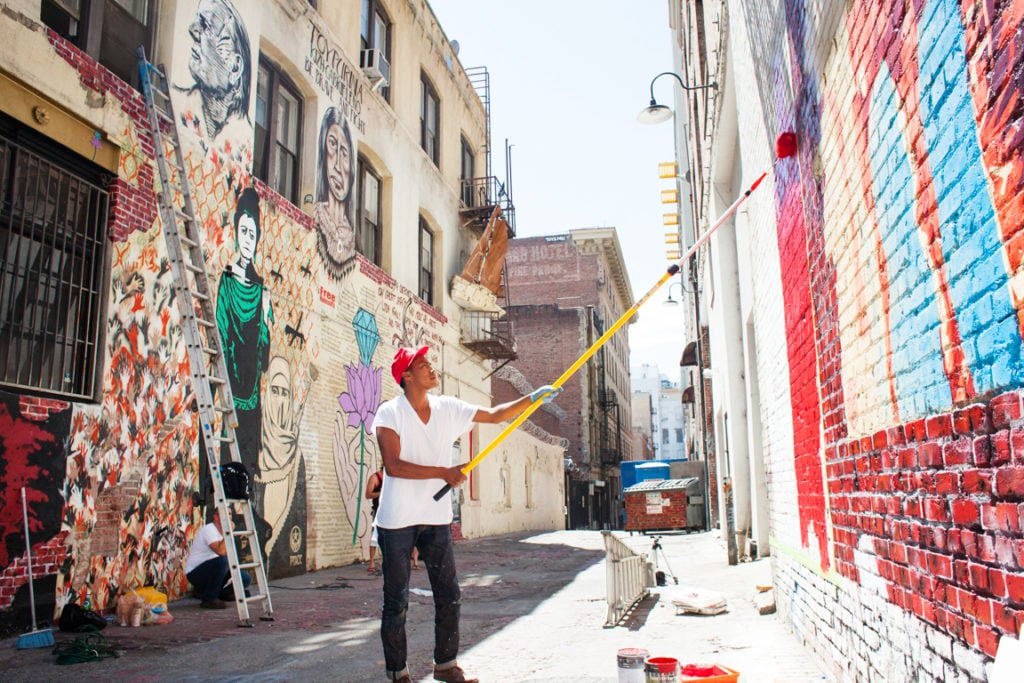
Indian Alley. Photo by Stephen
Ziegler.
Some indigenous artists, including Fragua, feel that only Native
American artists should be permitted to make work on these
reservations. But GreyEyes says collaborations are
opportunities.
“I got to influence my colleagues by sharing parts of the Navajo
way,” he says. “I saw my colleagues honoring the ways of Navajos
through their art.”
For now, the Painted Desert Project and Indian Alley appear to
be the only places where Native American-made murals are being
concentrated.
“I wish there were more public spaces like that,” Randall
says.
“There’s not really anything else in the country,” Ziegler adds.
“In this whole country, with all these people, why isn’t there
more?”
The post How a New Generation of Native American Street
Artists Is Leaving Its Mark Across the United States appeared
first on artnet News.
Read more https://news.artnet.com/art-world/native-american-street-art-1757085
Further reading


Leave a comment