
How Did Frida Kahlo Feel About New York? She Despised Its ‘Scumbag Millionaires’ But Loved the ‘Magnificent’ Metropolitan Museum of Art
In November 1931, Frida Kahlo and her husband Diego Rivera
traveled to New York for the opening of Rivera’s exhibition at the
Museum of Modern Art. The following excerpt from the book
Frida in America: The Creative Awakening of a Great Artist
recounts the artist’s experience in the American city.
While in New York, [Frida Kahlo] experienced the huge disparity
between the wealthy and the poor.
On the one hand, in her short time in this city she’d been
surrounded by millionaires, socializing in their spacious homes,
partaking of food and drink served by the hired help. On the other
hand, she told her mother: “Witnessing the horrible poverty here
and the millions of people who have no work, food, or home, who are
cold and have no hope in this country of scumbag millionaires, who
greedily grab everything, has profoundly shocked [us].” Frida and
Diego even visited a homeless shelter, where they saw people “sleep
like dogs in a pen.” The experience inspired Diego to portray this
grim reality in a painting called Frozen Assets, where
bodies are placed side by side as if in a morgue, hidden away
beneath the cranes of industry.
What Diego’s painting doesn’t show is the dearth of shelters for
the large numbers of people in need—1.2 million people across the
country had lost their homes in the first few years of the
Depression. In New York, roughly 2,000 homeless people wandered the
streets.
For some New Yorkers, the only way to survive was to build their
own shacks out of wood or bricks. Soon encampments began popping up
in various parts of the city. The most notorious was known as
“Hoover Valley,” named after President Herbert Hoover. This
shantytown, comprising seventeen shacks, was set up in Central Park
north of Belvedere Castle in the area known today as the Great
Lawn. Although the unemployed men in Hoover Valley had been
arrested in July 1931, by wintertime even the wealthy residents of
the new Fifth Avenue and Central Park West apartments didn’t
protest when the men returned. As weather conditions and the
economy deteriorated, a modicum of sympathy appeared among the
affluent. But Frida didn’t hear much of it from the well-to-do
people with whom she interacted. And even Diego, she told her
mother, had started to “hate this country a little.”
Although the apparent contradictions between Diego’s attitudes
about the rich and his behavior toward his capitalist patrons
didn’t seem to bother him, the issue weighed on Frida’s mind:
“Unfortunately, he has to work for these filthy rich asses.” And
she acknowledged, “I have no choice but to put up with them since
they are the ones who buy paintings.”
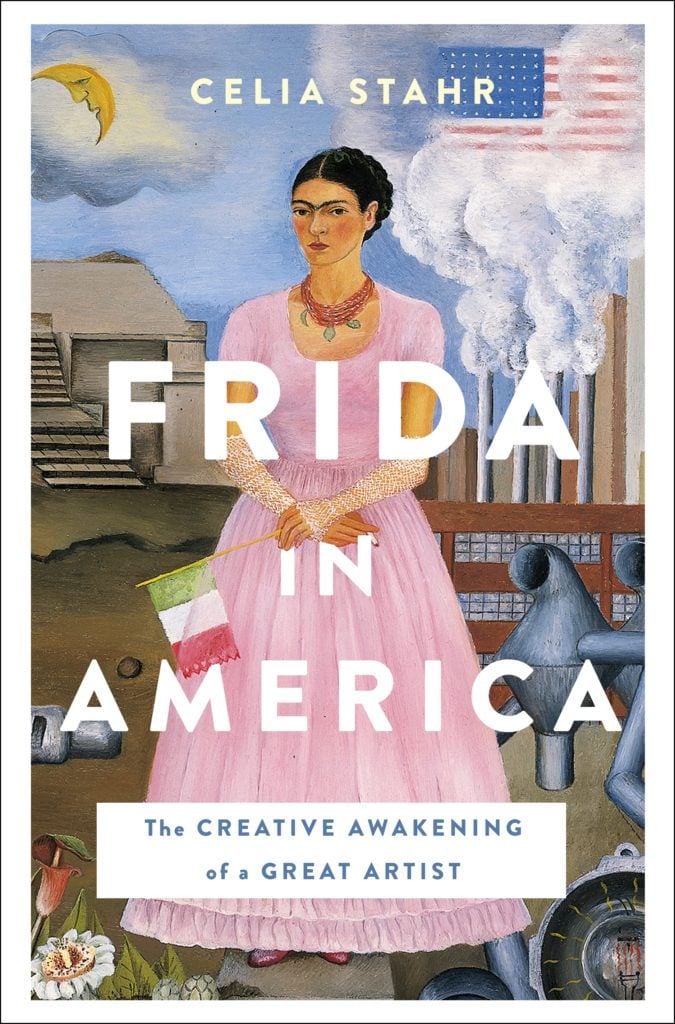
The cover of Frida in
America (2020) by Celia Stahr.
Frida felt more at home surrounded by art. Within the first week
of exploring this “huge” city that seemed as if it could swallow
her up, she found her way to the Metropolitan Museum of Art,
located on Fifth Avenue at East 82nd Street. She was immediately
drawn to the Egyptian section, with its re-creation of a tomb
“brought from Egypt stone by stone,” some bas-reliefs, “magnificent
sculptures from 4,000 and 6,000 years before Christ,” household
objects, and costumes, she wrote. She also marveled at the “Greek
archaic period, 3,000 years before Christ,” and the “Christian,
Roman, and Etruscan art.” She told her mother that she found “very
good copies of the mosaics from St. Mark’s in Venice” and saw some
of the best art from the Medieval and Renaissance periods, as well
as “originals by the Italian Primitive painters, German painters,
and French Modern painters.” She enthused: “It’s very interesting
and one can learn a lot of new things.” Frida was also thrilled to
see some original Goya paintings—“You have no idea how he painted.”
She spent hours exploring the museum, her energy never waning.
Frida was spellbound when she came upon El Greco’s View of
Toledo. This oil-on-canvas landscape, which foregrounds green
rolling hills and a small lake, pulls the eye up to meandering
hills topped with gray-blue buildings, ultimately leading the
viewer to a dynamic blue, gray, and white sky. It’s a typical El
Greco sky, filled with jagged, apparitionlike light and dark
clouds, a quality Frida would draw on in later paintings such as
The Two Fridas (1939). She found the colors “the most
wonderful” she’d ever seen. El Greco had painted his feeling of
this Spanish city, and Frida responded with an exuberance that
buoyed her state of mind.
A little over a month later, Frida created her own landscape.
This watercolor, painted in thin washes of greens, browns, grays,
and blacks, is a bird’s-eye view of Central Park as seen from her
window. Like El Greco, she too placed a body of water in the
foreground, with sinuous lines moving through the grass and hills,
directing the eye up to buildings in the background.
Frida’s landscape, however, is dotted with bare trees that stand
naked, while El Greco’s is filled with dark evergreens, showing the
constant vibrancy of nature throughout the seasons, emphasized by
the dazzling green layers of oil pigment. In Frida’s view of
nature, the park, like the rest of New York, possesses both a quiet
beauty and a distant isolation.
From Frida in America: The Creative Awakening of a
Great Artist by Celia Stahr. Copyright © 2020 by the author and
reprinted by permission of St. Martin’s Publishing Group.
The post How Did Frida Kahlo Feel About New York? She
Despised Its ‘Scumbag Millionaires’ But Loved the ‘Magnificent’
Metropolitan Museum of Art appeared first on artnet
News.
Read more https://news.artnet.com/art-world/how-did-frida-kahlo-feel-about-new-york-1797942
Further reading


Leave a comment