
How Eileen Gray, the ‘Mother of Modernism,’ Navigated a Post-War World That Did Not Look Kindly Upon Women Architects
The enigmatic Irish-born
architect and designer Eileen Gray tiptoes a curious historical
line between obscurity and cult legend, all depending on whom you
ask.
On the one hand, she has been
called the “Mother of Modernity,” a name given to her by Cloé
Pitiot, a leading scholar of Gray’s life and work and the curator
of “Eileen Gray:
Crossing Borders,” which
recently opened at the Bard Graduate Center
Gallery.
Gray lives up to the lofty
sobriquet in ways few others could. As one of just
a handful of women who
practiced architecture professionally before World War II, and as a
part of the Modernist
architectural movement, she stood toe-to-toe with the likes of Le
Corbusier, Mies van der Rohe, and Walter Gropius.
And though she is often compared
to designers Charlotte Perriand and Ray Eames, their careers
took off decades after Gray’s had flourished, as Nina
Stritzler-Levine, director of Bard Graduate Center Gallery, is
quick to point out.
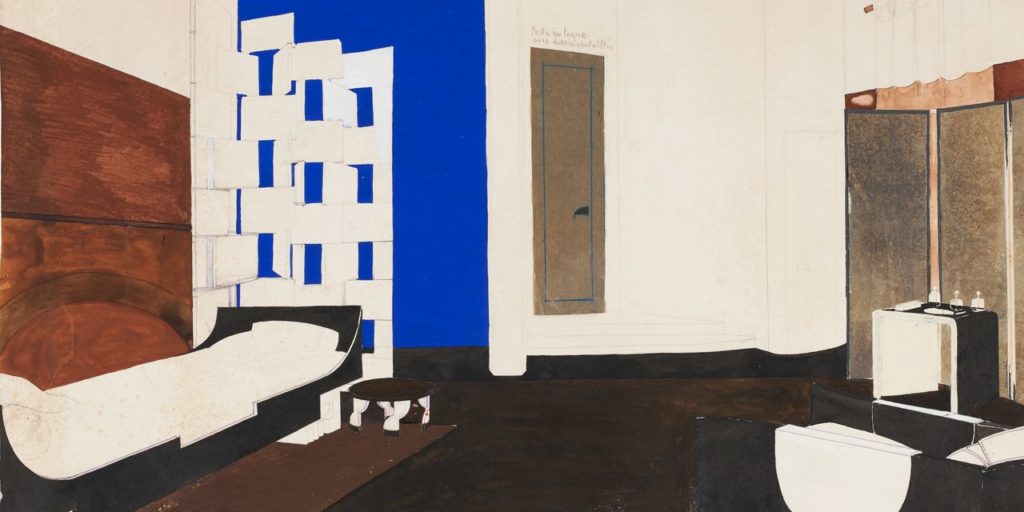
Eileen Gray, Drawing for Boudoir de
Monte Carlo (1923). Courtesy of Musée des Arts Décoratifs, Paris.
Photography by Christophe Dellière.
Yet despite her singular legacy,
Gray has remained surprisingly unknown outside niche architecture
and design circles.
The Bard exhibition, then, is a
long-overdue look at one of Modernism’s great talents. It is the
first show devoted to Gray in the United States since the Museum of
Modern Art’s “Eileen Gray, Designer” was held 40 years ago, in
1980.
The current
show presents the
striking diversity of her abilities through 200 pieces of
furniture, architectural drawings and models, and textiles, some of
which have never been shown before.
Pitiot, who curated the seminal
exhibition “Eileen Gray” at the Centre Pompidou in 2013
(it traveled to
the Irish Museum of Modern
Art in Dublin in 2014), presents seven years’ worth of new research
in the new show. And that research, assembled with the help of
curator Jennifer Goff of the National Museum of Ireland
and Stritzler-Levine, has been assembled through a Herculean effort.
That’s because Gray didn’t
believe in preserving her papers; in fact, she destroyed much of
her own correspondence and materials because “she wanted her
private life to remain private,” Pitiot said.
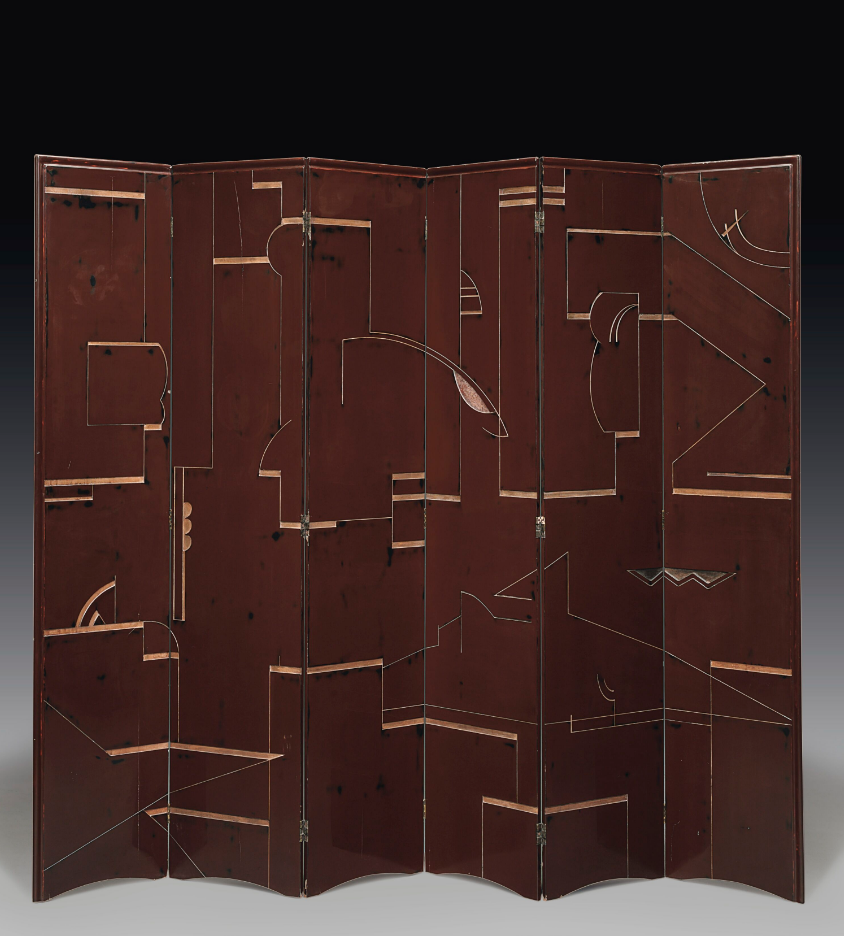
Eileen Gray, Lacquered Wood Screen
(circa 1921–23). Courtesy of Kelly Gallery and Stephen
Kelly, New York.
Many of the show’s new
discoveries emerged from hours spent digging through the archives
of her friends and contemporaries, including Auguste Rodin, fashion
designer Jacques Doucet, dancer Loïe Fuller, and occultist Aleister
Crowley.
What emerges is a picture of a
multi-hyphenate and daring talent—and a woman who was intentionally
elusive and fearless, but nevertheless subject to the biases of her
day.
Born in 1878 to an upper-class
family, Gray studied at the Slade School of Design in London before
moving to Paris to study at the Académie
Julian. An early, rare
drawing of a nude female figure in the show speaks to her artistic
training, and to the fact that her understanding of the structure of the body
informed her highly specified approach to furniture.
She soon met the artist Seizo
Sugawara, with whom she would study the art of traditional Japanese
lacquerware, and later, after establishing a weaving workshop with her friend Evelyn
Wyld that employed up to eight women at a time, she would operate
the Galerie Jean Désert, a Parisian purveyor of Modernist interior
decor, from 1921 to 1930.
There, she also showed examples of Modern art, making her an early
woman gallerist, too.
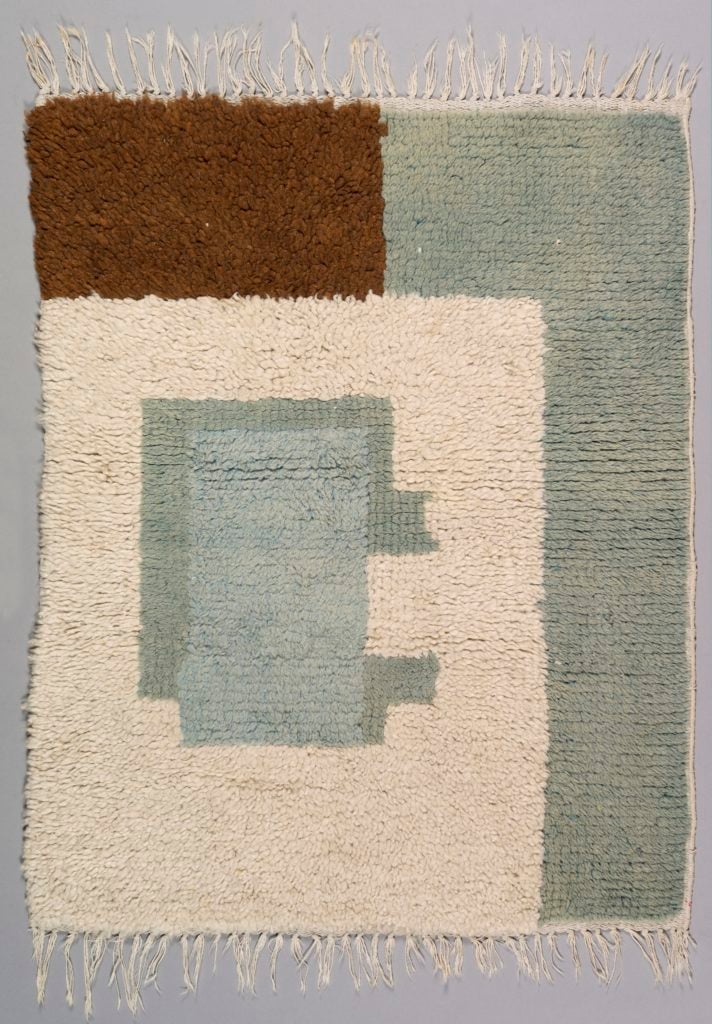
Eileen Gray, Rug (circa
1922-24). Courtesy of Galerie Jacques De Vos.
Gray often included riddles in
her designs and titles, and her store’s name is evidence of
that: Jean Désert is in
part a tribute to her lover, the Roman architect Jean Badovici, as
well as to the terrains of North Africa, which she
adored.
But the name is also an aptly
employed male pseudonym that allowed Gray to navigate her
proprietorship with disguised ease, a detail that reveals how Gray
operated. “When people would come into the shop asking for Jean
Désert, she would say he wasn’t in today,” Pitiot
remarked.
When she turned to architecture
with the encouragement of Badovici, she brought to
it her unique
sensuality, which prized the individual. “She created a very human architecture,” Pitiot
said. “Even if the design is the same, there are
differences.”
Pitiot points to
two seemingly identical
chairs with a slight difference: one has squared legs and the
other’s are rounded. Other designs included her Fauteuil Non
Conformist chair, with one raised arm, for smoking, and one sloped
arm to allow for easy turning while chatting.
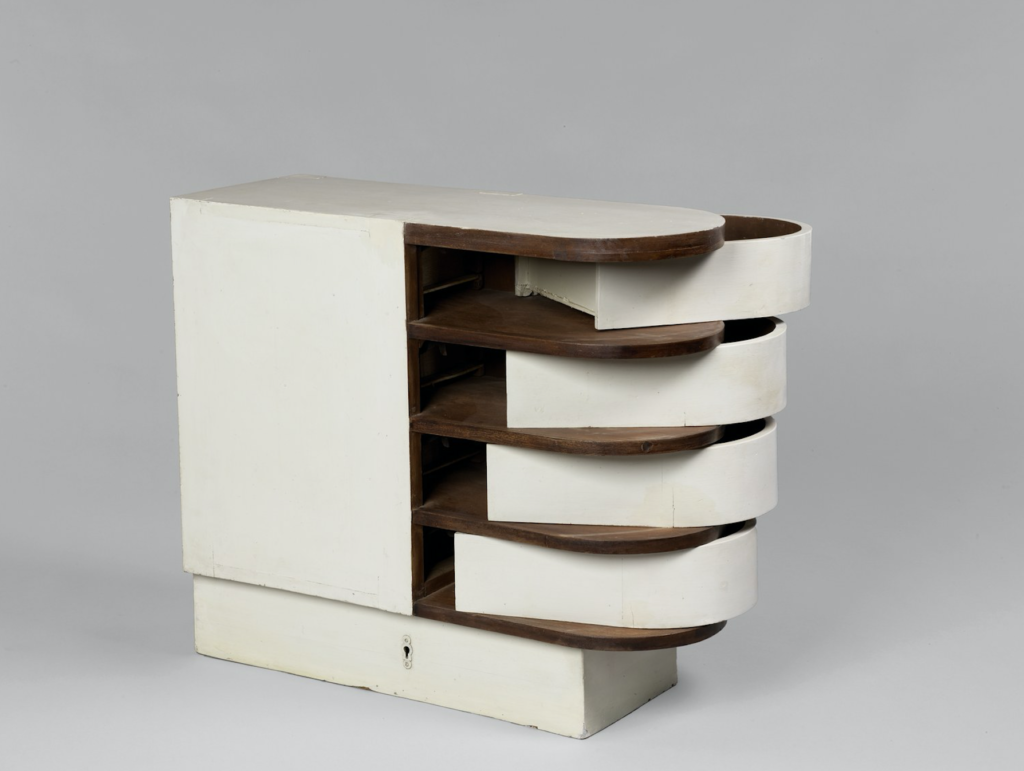
Eileen Gray, Dining room serving table
(1926-29). Courtesy of Centre Pompidou, Musée national d’art
moderne. The table has a disguised back set of drawers for
valuables.
Her designs were defined by their
specificity, but also by their multi-functionality and Gray’s
awareness of the preciousness of space. One of her works is
a rounded serving
cabinet (better to bump into a soft edge than a sharp one) with a
disguised set of drawers at its back, for keeping valuables;
another is a camping tent with a built-in bed and dining
table.
This lyricism won her
enthusiasm—she designed for the Maharaja of Indore, celebrated
courtier Jacques Doucet, and famed milliner Juliette Lévy—but it
also inspired jealousy.
Her masterpiece first
architectural project, E1027 (1926–29), a pristine white villa on the Southern coast of
France designed as a seaside abode for a couple, so obsessed Le
Corbusier that he situated himself upon it quite literally,
building up the land surrounding it with his own brightly colored
edifices.
When Gray moved away from the
villa after a split from Badovici, Corbusier infamously painted the
bare walls of the building with riotously colored frescoes,
despite the fact that Gray had explicitly designed them to be
bare. (To make matters worst, Le Corbusier painted them in the
nude).
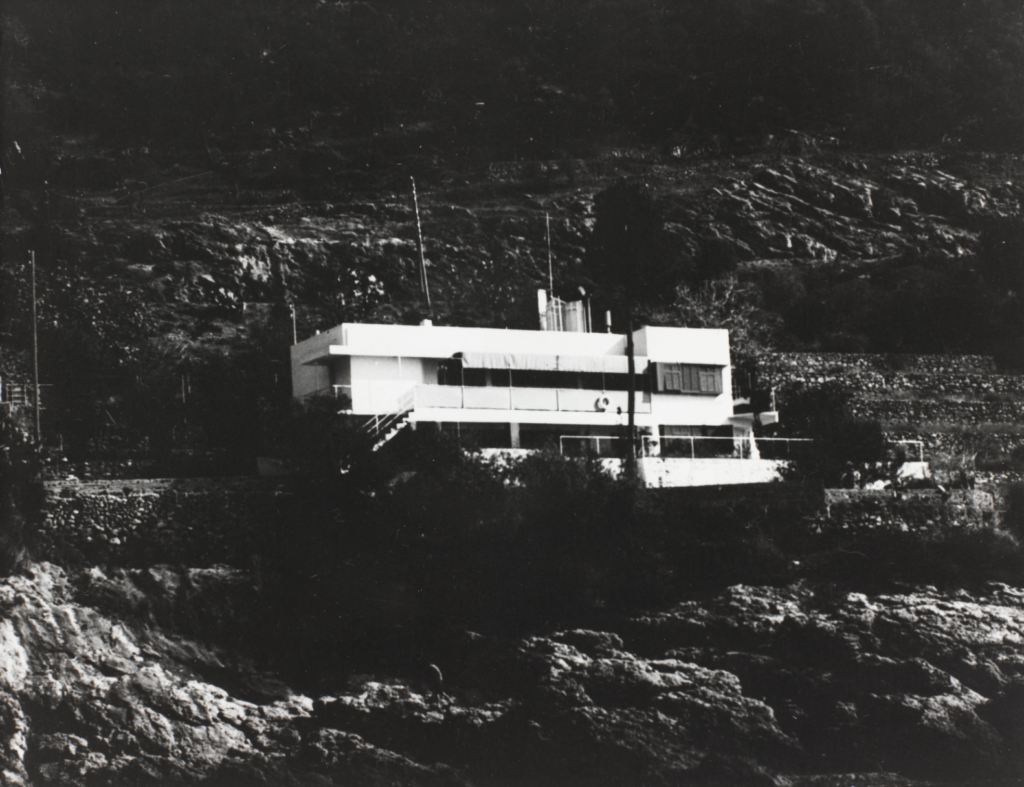
View of the south façade of E 1027 from
the sea, Roquebrune-Cap-Martin, unknown date. Courtesy of the
Centre Pompidou, Bibliothèque Kandinsky, Paris, and Fond Eileen
Gray.
“By the time architectural
interest emerged in E1027, Badovici and Corbusier had seemingly
written [Gray] out of her own project,” Goff, the National Museum
of Ireland curator, said.
Yet despite the insult, Gray
carried on, seemingly undeterred, and
designed Tempe à Pailla
(the second of her three homes), a retreat in the French
hills in which she synthesized her living and work spaces
into complete harmony.
At the time, she
was 54 years old. (She
would live until 1976, when she died at age 98.)
“What is remarkable about Gray is
that she was underestimated, but never looked back,”
Strizler-Levine said. “She just kept moving forward.”
“In her 80s, she was considering
whether or not to get a motorcycle,” Strizler-Levine said. “She had
so much spirit, and no fear.”
“Eileen Gray: Crossing Borders” is on view at
the Bard Graduate Center Gallery, located at 18 West 86th Street,
New York, through July 12, 2020.
The post How Eileen Gray, the ‘Mother of Modernism,’
Navigated a Post-War World That Did Not Look Kindly Upon Women
Architects appeared first on artnet News.
Read more https://news.artnet.com/exhibitions/eileen-gray-crossing-borders-bard-graduate-center-1793298
Further reading


Leave a comment