
How Gen Z Meme-Makers Are Becoming Political Warriors + Two Other Illuminating Ideas From Around the Web
Every week, we scan the media for interesting conversations
about art. This week: the odd mutations of political meme culture,
artists reckon with Chile’s political crisis, and assessing Rube
Goldberg as an artist.
“Rhizome Raw Episode 5:
Ultra Rare Recording of Rhizome Engaging in Praxis,” featuring
Joshua Citarella, Rhizome.org
In recent years, starting with his cult text “Politigram and the
Post-Left,” the New York artist Joshua Citarella has been digging deep into
the political youth subcultures of social media and their
astonishingly febrile twists and rapid mutations.
If you’ve got an hour and forty minutes to spare, it’s worth
your while to check out this new podcast with Citarella and
Rhizome’s Michael Conner and Aria Dean, which recaps an event at
the New Museum in which auto-didact Gen Z meme-makers discussed the
political potential of their work.
The podcast offers an eye-opening look into Gen Z
radicalization and how digital cultures have unfolded in an age of
increasingly unavoidable political and ecological anxiety.
One of Citarella’s arguments is that, compromised though they
are, there is no way to get rid of the social media platforms we
currently have in the near term. So trying to figure out how the
affordances of these platforms shape young people’s worldviews is
key. As Dean points out, the rapid flow of information has led to
some astonishingly sophisticated examples of self-taught
political theory in ways that are unexpectedly outside traditional
academic patterns.
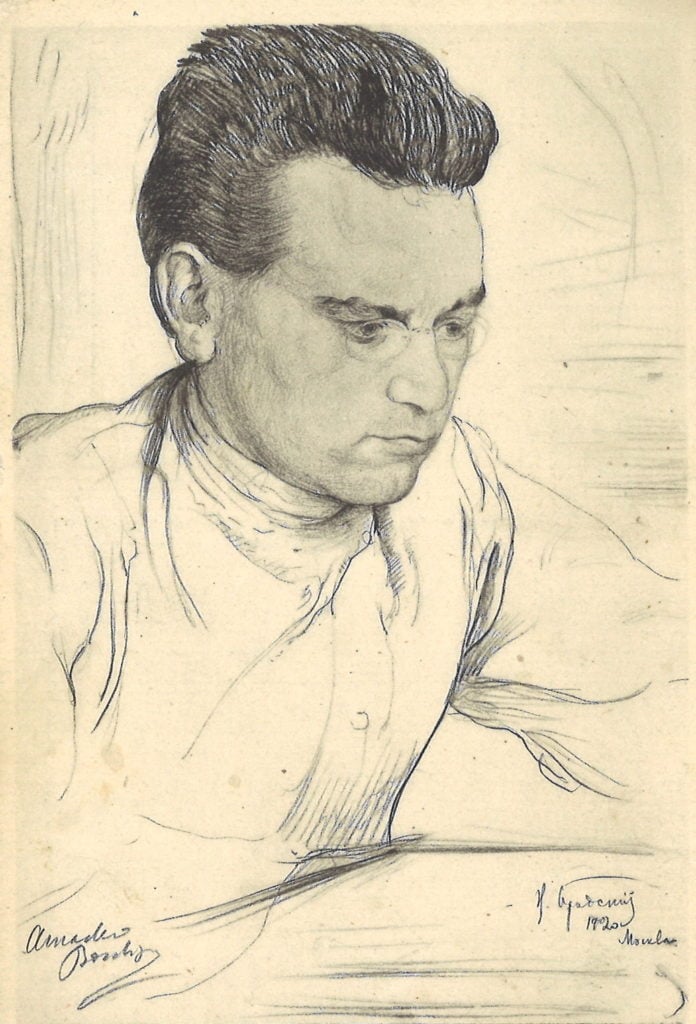
A 1920 drawing of Amadeo Bordiga by
Isaak Brodsky.
We’re in deep political-theory nerd territory now, but as an
example of the new intellectual landscape, the podcast mentions
that Italian Marxist Amadeo Bordiga is a hot radical reference,
while Antonio Gramsci—the Italian Marxist of choice for generations
of academics, until his ideas were watered down to the glib
suggestion that “culture is a field of struggle”—is nowhere to be
found.
Bordiga is most remembered as a classic “ultra-left” figure with
an inflexible, sectarian line. Gramsci was the thinker of
alliance-building who advocated spreading influence among blocs of
forces through practical leadership in action.
So what’s behind Bordiga’s newfound cachet? The podcast suggests
that it’s due to a deeply felt sense of crisis in the face of
massive institutional inertia. But I wonder if it has more to do
with the atomizing affordances of social media, which shape the
terrain in favor extreme phrase-making over the organizational
alliance-building of Gramsci.
Just a thought! At any rate, there’s actually a hopeful current
to the conversation with the suggestion that the meme warriors
Citarella has been tracking—one of whom phones in to Rhizome’s
podcast—seem to be moving from online info-wars into more organized
politics. It’s fascinating.
“Kema todo; esto es arte,”
Ignacio Gatica and Jessica Briceño Cisneros,
Terremoto
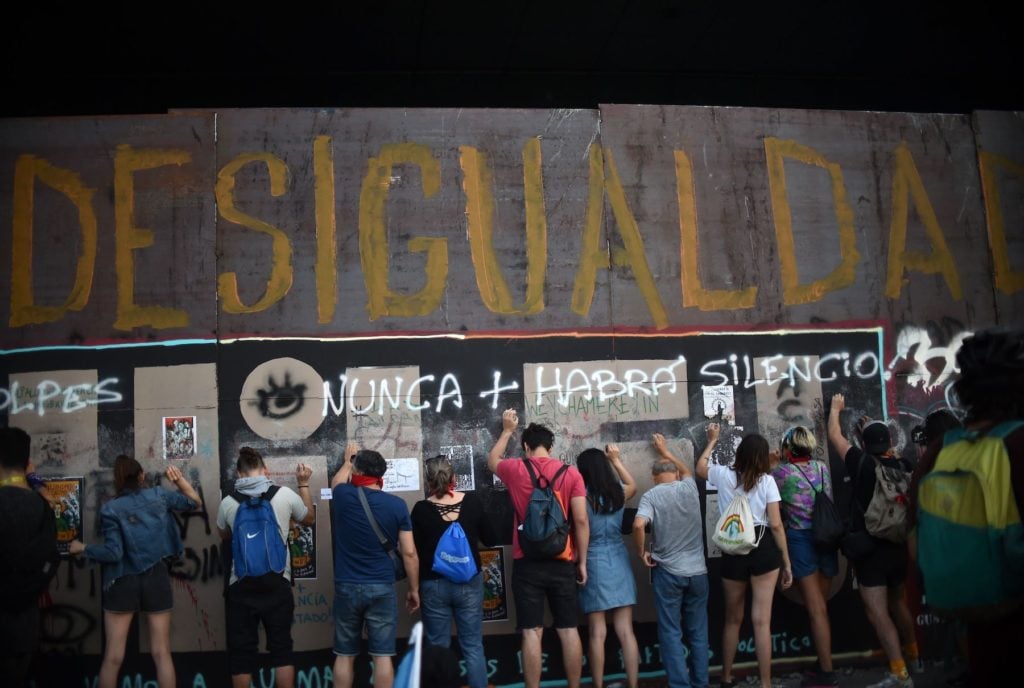
Demonstrators during a protest demanding
social reform from Chilean President Sebastian Pinera in Santiago
on November 12, 2019. Photo by Rodrigo Arangua/AFP via Getty
Images.
Chile has been in the throes of an epoch-shaping political crisis
since last year. It’s
more than worth your time to read this brainy, heart-felt exchange
of letters (published in the Mexico-based art
mag Terremoto), which begin with a discussion of how
omnipresent political graffiti has transformed the landscape of the
country.
The epistolary exchange gives a lived-in sense of how artists,
navigating mass movements, shift the stakes of art-making.
“Unfortunately for the museum,” artist Ignacio Gatica writes,
“what’s happening on the outside, and now literally on its outer
walls, is once again more interesting than what’s happening inside
of it.”
“Foolish Questions” by
Art Spiegelman, New York Review of Books
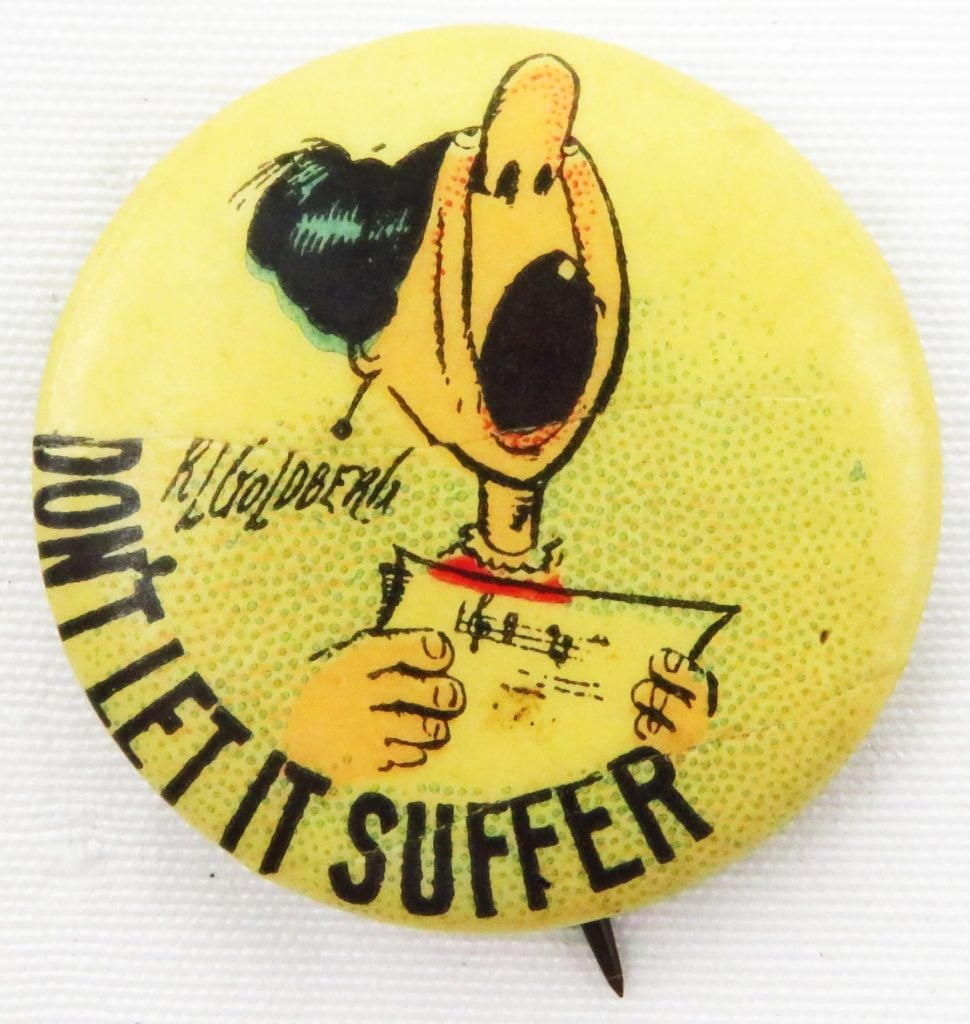
Anti-suffrage button with a Rube
Goldberg cartoon satirically depicting a singing woman. Photo by
Ken Florey Suffrage Collection/Gado/Getty Images.
A slightly lighter read: Maus author Art Spiegelman
gives a thorough walkthrough of the life and art of Rube Goldberg,
whose work was recently seen at the Queens Museum.
Goldberg’s delightfully over-elaborate contraptions turn out to
have been part of an international mini-movement of machine-age
absurdism. (Goldberg, it also turns out, was anti-New Deal and
pro-McCarthy).
Stick around for the end of the article, which gives an overview
of the history of the “screwball” comic genre through Spiegelman’s
characteristically keen sense of its dangers and delights.
The post How Gen Z Meme-Makers Are Becoming Political
Warriors + Two Other Illuminating Ideas From Around the Web
appeared first on artnet News.
Read more https://news.artnet.com/opinion/rhizome-meme-makers-1787829
Further reading


Leave a comment