
How Hans Haacke’s Rise Coincided With the End of 1960s Activism and the Birth of Corporate Museum Sponsorship
This is the first part of a two-part review of “Hans Haacke: All Connected” at
the New Museum in New York.
In six decades of work, Hans Haacke has aimed to make art that
is, above all, relevant to the issues of his day. Quite clearly, a
retrospective of his work couldn’t come at a more relevant
time.
The list of artists that the New Museum summons to contribute to
the catalogue of Haacke’s show gives an idea of the kind of
influence he wields: Tania Bruguera, Daniel Buren, Jeremy Deller,
Sam Durant, Maria Eichhorn, Olafur Eliasson, Andrea Fraser,
Renée Green, Sharon Hayes, Thomas Hirschhorn, Carsten Höller, Park
McArthur, Walid Raad.
More generally, the issues Haacke has become known
for—highlighting colonialism, exploitation, and museums’
entanglement with power—are all newly explosive in a moment
when institutions are under newly intense
criticism. He is considered one of the pioneers of the
self-scrutinizing genre of art known as “institutional critique.”
What does the history of his work tell us about how these issues
became part of the art mainstream?
As an entry point, I can start with a misunderstanding about one
of his most famous works.
Shapolsky et al Manhattan Real
Estate Holdings, A Real Time Social System as of May 1,
1971 is a classic of politically minded conceptualism,
and a centerpiece here, laid out in all its dry documentary glory
on the walls of the New Museum’s biggest fourth-floor gallery. Via
diagrams and photos of properties, it presents an account of the
dealings of a particularly infamous real estate company, gleaned by
the artist from public records.
Famously, it was censored (along with two other works) from a
solo show by the then-35-year-old Haacke in 1971 at the Guggenheim
in New York. Museum management found it too much like journalism,
and not enough like art. A curator was fired for expressing
solidarity, the art world rallied, and the controversy ratified
Haacke’s legend as an exemplar of speaking truth to power.
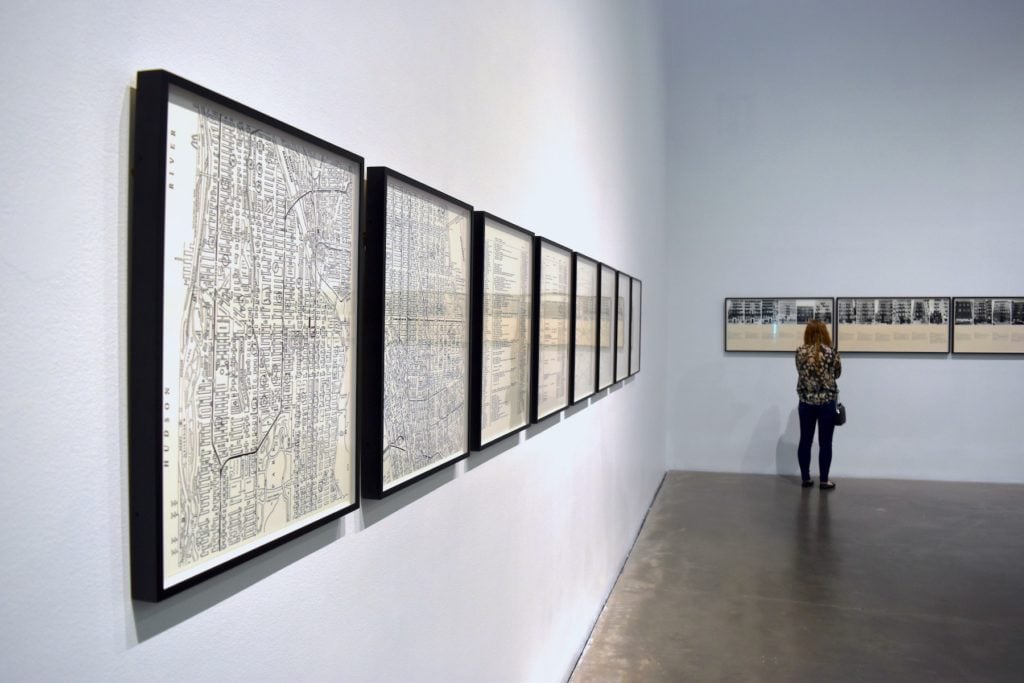
Hans Haacke, Shapolsky et al
Manhattan Real Estate Holdings, A Real Time Social System as of May
1, 1971 (1971). Image: Ben Davis.
But here’s where it tips over into “Mandela Effect”
territory: I vividly remember being taught that the reason
that Shapolsky et al was censored was because
Haacke had deliberately made a work about one of the museum’s own
trustees. Indeed, this misreading is pervasive enough that the wall
label, written by Haacke himself, rebuts it: “Many commentators
assumed that the trustees of the Guggenheim Museum had links to the
Shapolsky real estate group. There is no evidence to support such
suspicions.”
Which means that what was, for me at least, the most famous work
of “institutional critique” was actually not a work of
institutional critique at all.
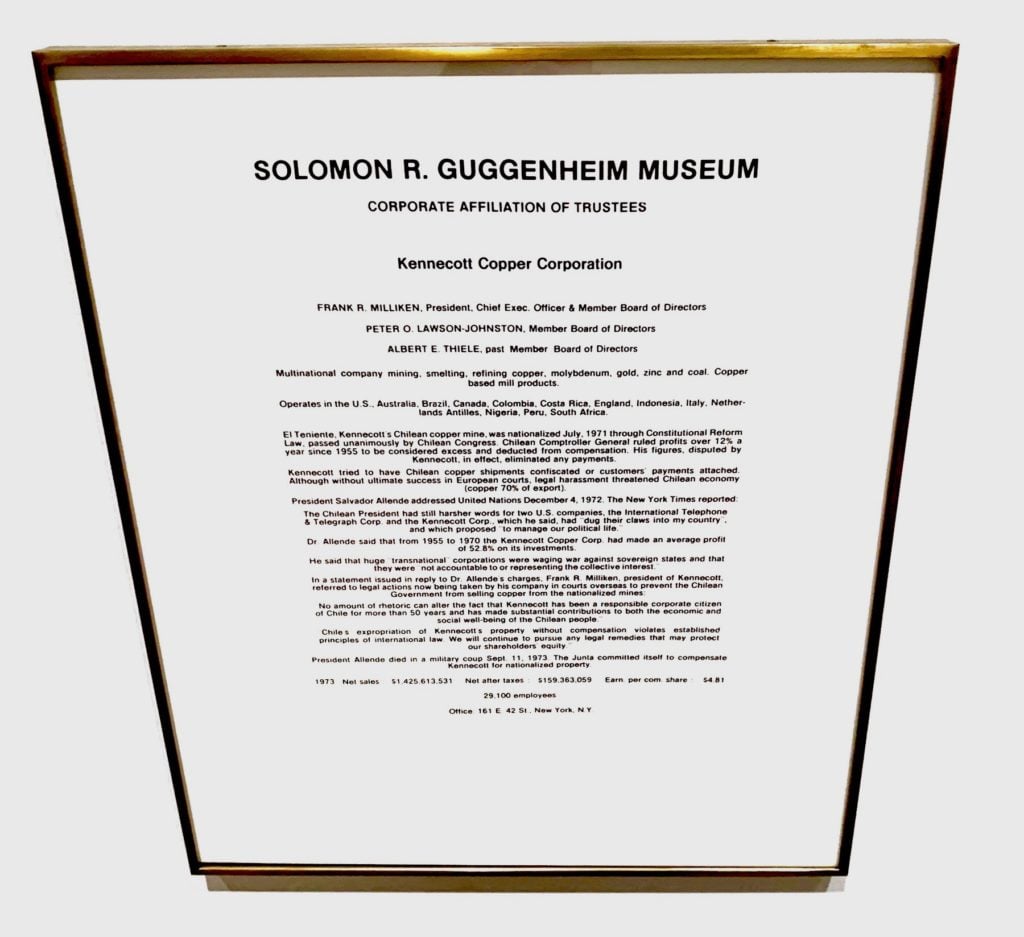
Panel from Hans Haacke, Solomon R.
Guggenheim Museum Board of Trustees (1974). Image: Ben
Davis.
Perhaps my teachers were conflating Shapolsky et
al with another work, Solomon R. Guggenheim
Museum Board of Trustees (1974), another presence in the
show, one floor down. Hailing from a few years later, this laconic
series of panels taxonomized the powerful men of that era’s
Guggenheim board. It specifically pointed out their ties to the
copper industry in Chile, where the US had backed the
ultra-right-wing Pinochet dictatorship to overthrow socialist
president Salvador Allende, deemed a threat to US interests.
Sometimes, critics have
misremembered that Solomon R. Guggenheim Museum Board
of Trustees was meant to be shown at the Guggenheim,
which would have made it classic-type “institutional critique.”
This, too, is false.
The work came out of Haacke’s reaction to the earlier museum
censorship. But it was debuted at a commercial space, Stefanotty
Gallery, in a show called “Live!” in early 1974, a few months after
the September 1973 coup in Chile.
Despite the industry of writing on Haacke and the (to me)
undeniable example he has set as a vigilant, astringent presence in
art circles, this false art-historical memory makes me suddenly
wonder if I have correctly comprehended what his example has meant
at all.
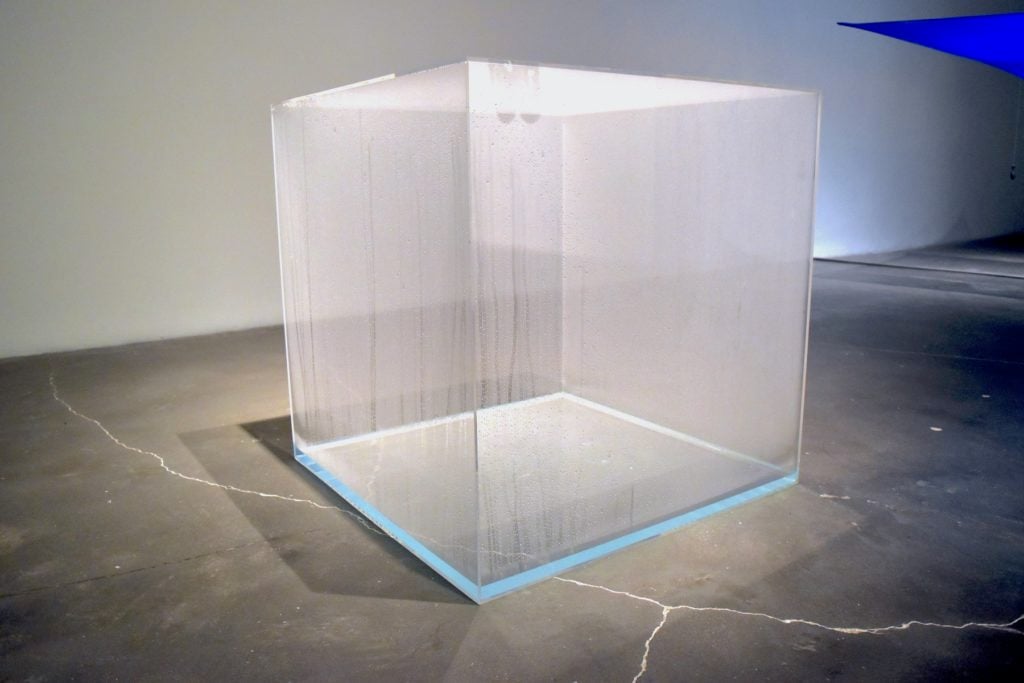
Hans Haacke, Condensation Cube
(1963–65). Image: Ben Davis.
The End of Easy Solutions
Head down to the second floor galleries of the New Museum show,
which survey Haacke’s earliest 1960s works, to get a sense of the
tenor of the progressive, experimental art scene of that
decade.
Coming out of the technologically inspired arts of the Zero
Group in Germany and the brainy industrial fetishism of New York
Minimalism, these early Haacke works are all about insinuating
dynamic systems into sculpture: most
famously, Condensation Cube (1963–65), a deadpan
Plexiglas box that contains moisture and sweats on the inside based
on the conditions of the galleries.
Other works introduce activity in different ways: Blue
Sail (1964–65) or Wide White
Flow (1967–2008) use air to animate planes of
fabric; Ice Stick (1966) and Floating
Ice Ring (1970) experiment with cooling elements to
create evolving sculptural objects out of ice; Grass
Grows (1967–69) is a large hill of dirt studded with
living grass; Wave (1964–65) is a hanging Plexi
container that you can move, activating the water within.
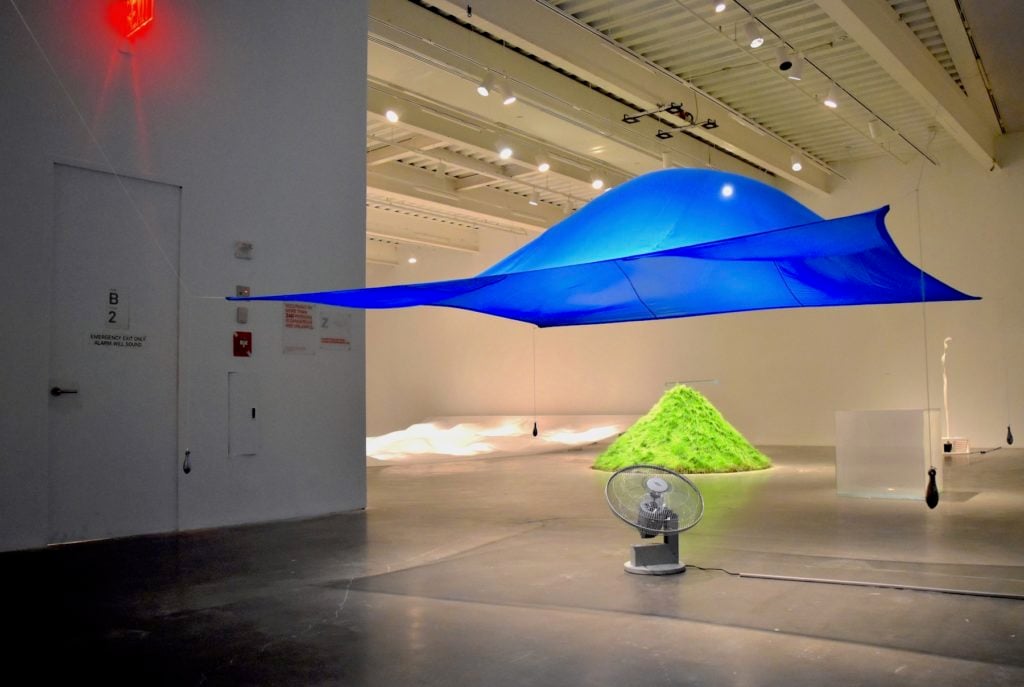
Hans Haacke, Blue Sail
(1964–65). Image: Ben Davis.
These each look like science-project art, didactic exhibits
displaced from the classroom and now teaching an unclear lesson.
What was “radical” about them was how they invited participation
and dynamic consciousness. Against the background of the priestly
cult of contemplation of the reigning formalism, this felt like a
vital, revivifying project at the time.
Haacke’s turn from exploring physical systems to social
systems—and by extension, the webs of politics and economics around
him—was influenced by his readings in the now-obscure, then-trendy
field of systems theory. But more importantly, it was spurred by
the cataclysmic events of the late ‘60s: specifically, the
assassination of Martin Luther King, Jr. in 1968 and the nationwide
urban revolts in black communities across the country that
followed, sometimes known as the Holy Week Uprising or simply “the greatest
wave of social unrest since the Civil War,” with scores of cities
affected, dozens killed, and tens of thousands arrested.
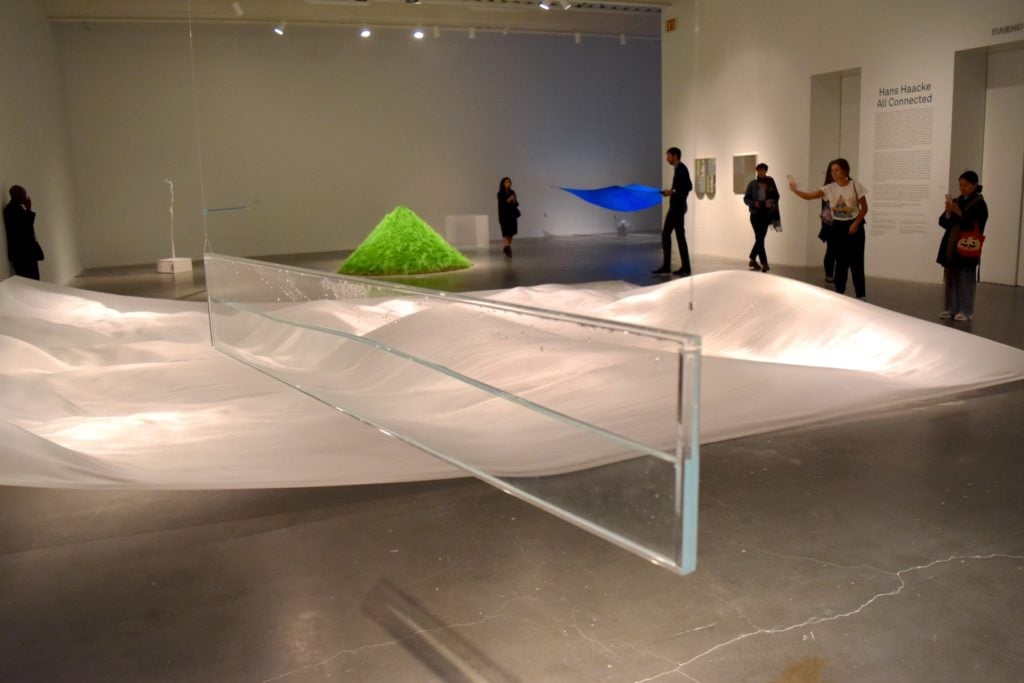
Hans Haacke, Wave (1964–65).
Image: Ben Davis.
“No cop will be kept from shooting a black by all the
light-environments in the world,” Haacke wrote to systems theorist
Jack Burnham in a soul-searching private letter days after King’s
assassination. Setting aside the antiquated vocabulary, the phrase
makes clear how current events had forced the question of
solidarity to the surface, and created a crisis of relevance for
art.
Sometimes Haacke has been caricatured as caring only about some
kind of disembodied economic critique, but Shapolsky et
al was very specifically about slumlords. Its laborious
taxonomy of economic interests is almost too on the nose as an
illustration for the famous verdict of the Report of
the National Advisory Commission on Civil Disorders (aka the
Kerner Report), also released in ’68: “What white Americans have
never fully understood—but what the Negro can never forget—is that
white society is deeply implicated in the ghetto.”
![Hans Haacke, <em> Shapolsky et al Manhattan Real Estate Holdings, A Real Time Social System as of May 1, 1971</em> (1971) and [front] Hans Haacke, <em>Circulation</em> (1969). Image: Ben Davis.](https://news.artnet.com/app/news-upload/2019/10/haacke-circulation-1024x683.jpg)
Hans Haacke’s Shapolsky et al
Manhattan Real Estate Holdings, A Real Time Social System as of May
1, 1971 (1971) in the background
with Circulation (1969) on the floor in front. Image:
Ben Davis.
important formation of artist-led activism that sprang up in 1969
to address all kinds of political issues in museums, protesting for
artists’ rights and against high-culture elitism, ties to war
profiteers, and blindness to women and non-white artists.
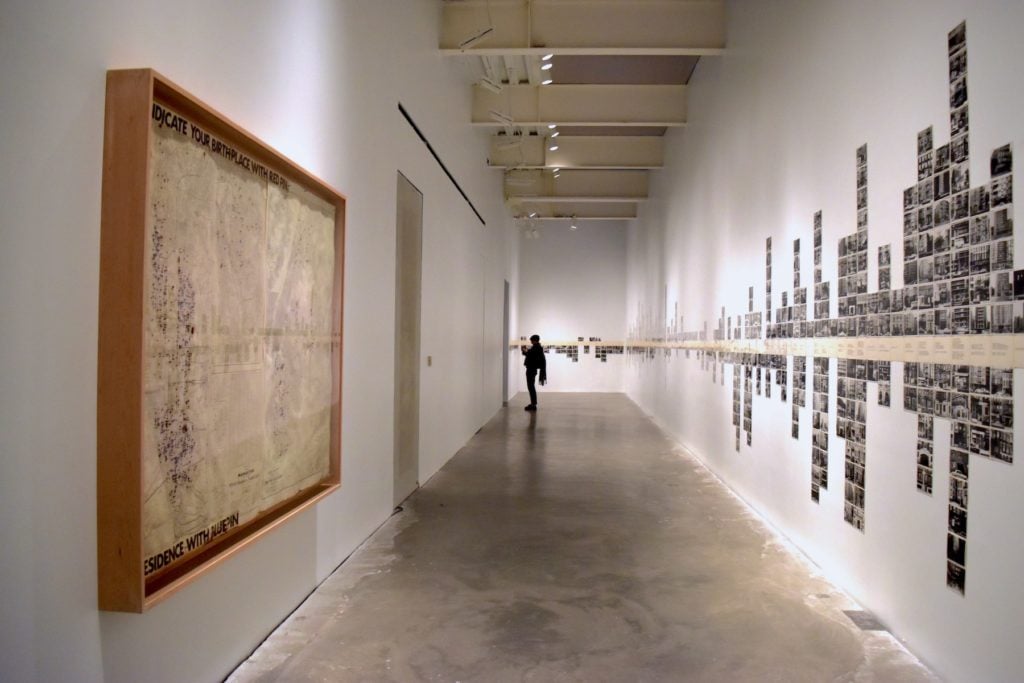
Hans Haacke, Gallery-Goers’
Birthplace and Residence Profile (1968–71). Image: Ben
Davis.
The New Museum show includes a number of Haacke’s
artwork-cum-survey projects from this time, which were shown in
museums and commercial galleries. Gallery-Goers’ Birthplace and
Residence Profile (1968–71) asked visitors to the Howard Wise
Gallery to mark where they lived on a map. Haacke then photographed
their homes and displayed the results, clustered by the specific
streets where they lived, thus showing the audience’s confinement
to certain, mainly elite enclaves.
The presentation of documentary evidence in Gallery-Goers’
Birthplace and Residence Profile unmistakably presages
Shapolsky et al. Such gestures of art as
citizen-journalism or citizen-sociology, you can easily see,
express a new loss of faith in the universality of aesthetic
experience. Haacke lays out just how narrow the gallery’s audience
was. It was “an extremely select audience which recruits from the
ranks of the college-educated middle and upper-middle
classes,” he would write. “The professionally uncommitted
public of the gallery can hardly be suspected of representing ‘the
proletariat’ or the mythical ‘man in the street.’”
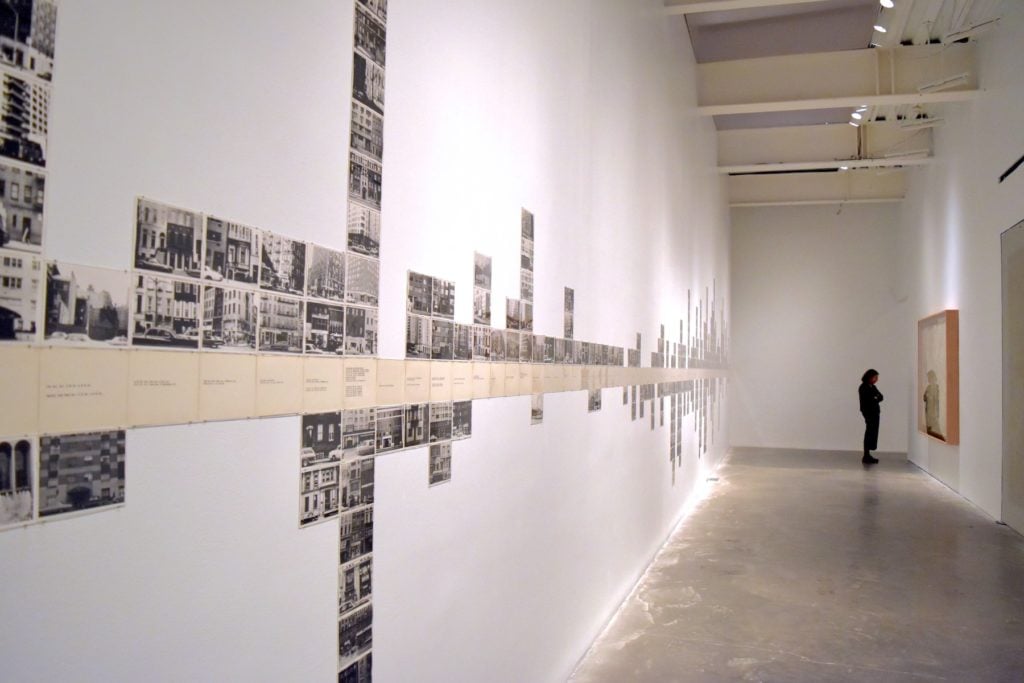
Hans Haacke, Gallery-Goers’
Birthplace and Residence Profile (1968–71). Image: Ben
Davis.
The Arrival of Critique
The rudiments of what would later become “institutional
critique” coalesced around what Haacke called his “first really
political work,” the MoMA-Poll of 1970. Activists in and
around the Art Workers Coalition had been protesting MoMA for
(among other issues) the institution’s connection to the
Rockefeller family, with its ties to the war machine that was
savaging Vietnam. Nelson Rockefeller was both on the board of
trustees of the museum and governor of the state, making the
coincidence of political and cultural power particularly
glaring.
Joseph Kosuth, one of the progenitors of Conceptual art, once
said that the movement’s de-mythification of high culture made it
the “art of the Vietnam War era.” MoMA was eager both to mollify
protestors and to maintain its status as the bellwether of the
cutting edge, and so it organized an exhibition titled
“Information,” which surveyed the experiments of recent artists
with communications media. It is remembered as an important stop in
the canonization of Conceptualism.
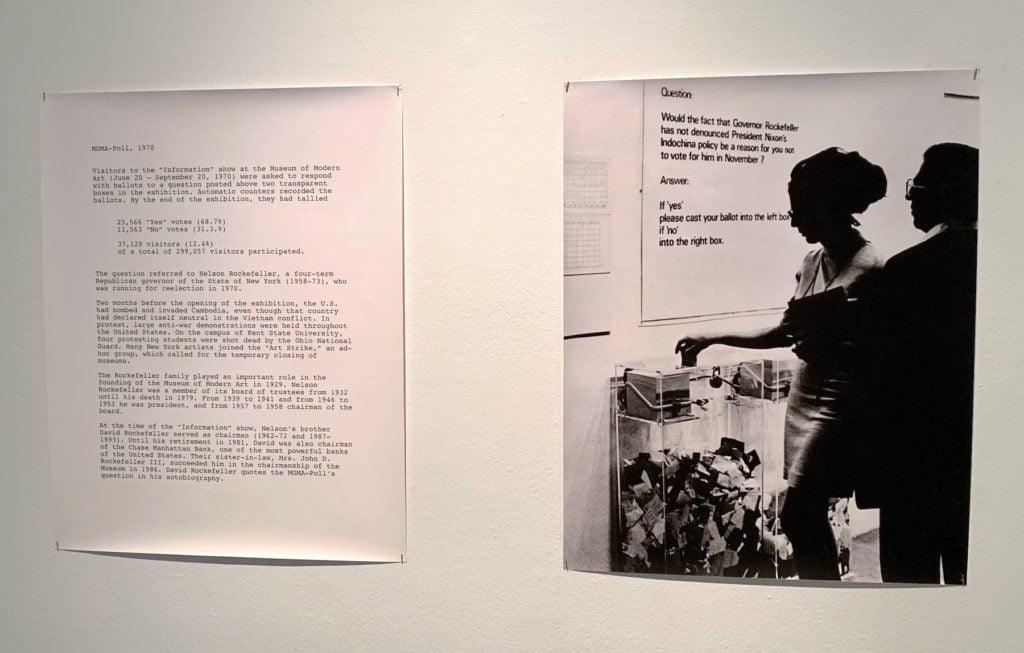
Images from Hans Haacke,
MoMA-Poll. Image: Ben Davis.
It was in that context that Haacke presented MoMA-Poll,
a clear box that asked museum visitors to vote on a question
(“Would the fact that Governor Rockefeller has not denounced
President Nixon’s Indochina policy be a reason for you not to vote
for him in November?”) with color-coded ballots, displaying the
results.
Some around the Art Workers Coalition objected to Haacke’s
participation in the show as collaboration. His contribution did
ruffle feathers inside, though: The museum director recalled
getting a call from Governor Rockefeller demanding that it “kill
that element of the exhibition.” (The director talked Rockefeller
down by saying that the museum was a forum for free speech, and
arguing that Rockefeller would look intolerant and cause a scandal
if he censored it.)
In the end, 25,566 people at MoMA’s “Information” show voted
against Rockefeller, and 11,563 expressed support. (He went on to
win handily in the
November election.)
Rear-Guard Action
This behind-the-scenes scuffle presaged the open protests around
the censorship of Shapolsky et al a year later (and it may
explain why Shapolsky et al is misremembered as a
work of “institutional critique”). This is how Haacke’s
openly political, art-as-agitation approach set a new standard in
the museum, testing the limits of what was permissible.
Yet there is a way to think of “institutional critique” as a
retreat, rather than an advance.
Making political art in and about the museum was not,
after all, the only model of engaged artmaking available; another
model would be making art whose destination was outside the museum,
and whose audience was not the art crowd, but social movements. At
Martha Rosler’s recent Jewish Museum show, I was delighted to learn
that her most famous series of works, the collages called “Bringing
the War Home,” produced in precisely the same period of
anti-institutional art agitation of 1967–72, were not
originally meant for gallery display. They were meant to be
distributed as photocopies at anti-Vietnam War demonstrations and
in underground newspapers.
This latter type of engagement requires, however, a robust
milieu of sustained activist movements to be connected to. In fact,
Haacke’s evolution came at just the time when those movements were
peaking. A month after the Guggenheim censorship, the May Day
Protests in Washington, DC, marked the apex of the anti-war
movement, with record arrests.
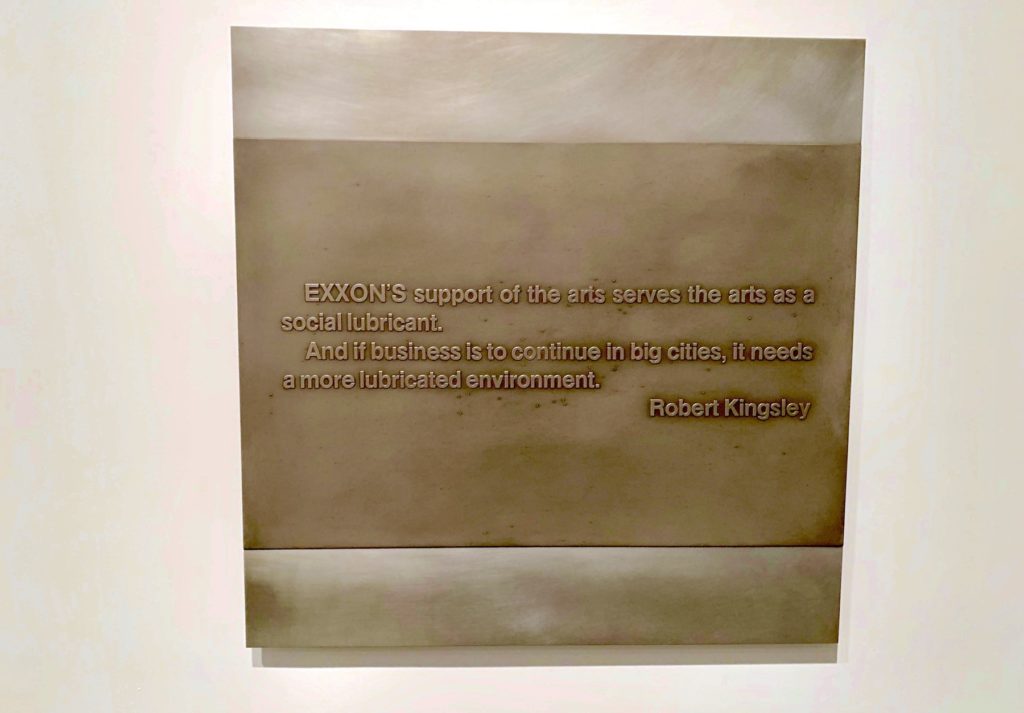
One panel from Hans Haacke’s On
Social Grease (1975). Image: Ben Davis.
By the time Haacke made On Social Grease, in 1975, for
a solo show at the commercial John Weber Gallery, the reality that
the ‘70s would be a long period of decline and retrenchment and
splintering for progressive forces had set in. That same year,
Joseph Kosuth was declaring in the journal Fox that the radical
experiments of Conceptual art had been neutralized by the
system.
On Social Grease presents museum-style plaques
ironically memorializing quotes from corporate types on the cynical
reasoning behind company sponsorship of art. “Although not
perceived at the time by the public,” Haacke explains in a New
Museum wall label, “corporate art collecting and sponsorship of art
exhibitions by large corporations developed in the early 1970s at a
scale and with an impact hitherto unknown.”
This is the very interesting paradox of “institutional
critique”: at the very moment the museum was politicized by Haacke
as a new kind of platform, the museum was also depoliticized and
taken over by a corporate agenda.
Arriving at the same moment, they are two sides of the same
coin. Populist demands for access to art meant that museums were
now being framed as mass institutions in a new way, with new
funding demands placed on them to create mass-appeal shows.
Meanwhile, the era’s anti-establishment, anti-corporate sentiment
sent companies looking for the humanizing PR that art sponsorship
could provide. (In 1969, James Wines had coined the term “plop art”
for the sudden trend of public sculptures popping up in public
space, as an effort to soften the public face of business and
government with art.)
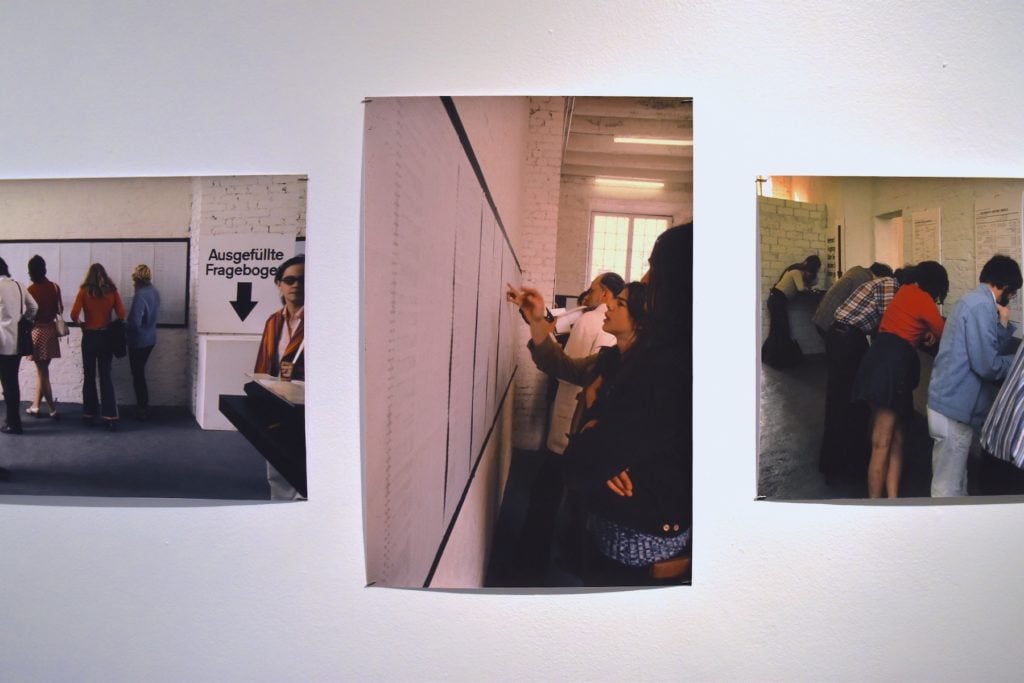
Photos from Hans Haacke’s documenta
Poll. Image: Ben Davis.
As it coalesced into a genre, “institutional critique” came to
be seen as a critical form of artistic engagement by the 1980s,
when Haacke got his first mid-career retrospective, “Unfinished
Business,” also at the New Museum, with catalogue essays by
thinkers like Rosalyn Deutsche and Fredric Jameson. By 1988,
historian Benjamin Buchloh declared Haacke the absolute
exemplar of the radical artist in Art in
America—just as progressive energies were routed in the
streets, and a recharged conservatism was triumphant in both
economy and state.
That sketch fits a certain understanding of the fallout of the
1960s. Boltanski and Chiapello’s The New Spirit of
Capitalism (and much other scholarship) identifies a
rift between the “social critique” and the “artistic critique” that
became increasingly wide as time went on. The argument is that the
powers-that-were came to embrace some demands for cultural change
as a kind of bait-and-switch maneuver, simultaneously rolling back
or suppressing demands for deeper systemic change.
Thus, the elite spaces of culture and the academy became more
open to a rhetorical (and sometimes actual) radicalism, while the
economy and politics became more cutthroat and extremist. That was
the social compromise. (Haacke’s MoMA-Poll is a reminder
that the “Rockefeller Republicans” were
never quite so progressive as they seemed to be—nevertheless, the
name stands for a breed swept away by the New Right.)
Haacke’s own work shows how eccentric and isolated the art
context actually was. Without connections to wider social,
political, and economic change, it could only remain
stranded. The obsession with art’s internal politics of
“institutional critique” (from On Social Grease onwards)
is more a tortured, soul-searching admission of that isolation than
it is a role model of what art can be.
Where this actually took Haacke’s art in the 1980s and beyond,
however, is a meaty enough topic for its own essay.
The post How Hans Haacke’s Rise Coincided With the End of
1960s Activism and the Birth of Corporate Museum Sponsorship
appeared first on artnet News.
Read more https://news.artnet.com/opinion/hans-haacke-new-museum-part-1-1695606
Further reading


Leave a comment