
How Is Art Basel’s Experiment With Online Sales Going? Early Indications Suggest Mega-Galleries Are Making Out Just Fine
In the opening moments of Art Basel Hong Kong’s VIP preview of
its online viewing rooms on Wednesday—the fair’s virtual solution
to its canceled physical fair in the city—art dealer Iwan Wirth
said he immediately received texts from clients complaining that
they couldn’t access Hauser and Wirth’s viewing room via the fair
website.
“That was my first interaction when I realized the website was
live,” said Wirth. From his office in Somerset, England, he started
returning calls and sending additional links, and “that’s when I
saw we sold the Jenny Holzer.” The silver, wall-hung
piece, XX 8 (2015), with an asking price of $350,000,
went to a buyer from the Middle East. (Another work, by Paul
McCarthy, sold to a buyer quarantined in France after testing
positive for the virus.)
“Now, are these new collectors? No,” says Wirth. “We know them
and they are seasoned collectors.” But he was still pleased with
the results given that the gallery had no pre-sales, he
says. Through both its own digital platforms and the Basel
viewing rooms, the gallery also sold works by Josef Albers (for
$600,000), Pipilotti Rist (for $140,000), and several pieces by
Paul McCarthy. As of publication time, a US buyer had a hold
on a major Philip Guston painting.
Responding to questions about the technical glitch, a
representative for Art Basel told Artnet News: “As to be expected
with a new digital initiative, we experienced some technological
difficulties. In the first hour, the servers became overwhelmed by
the number of users and the site went down briefly, (for 25
minutes). Thankfully, our technical teams were able to restore it
quickly, and we’ve since received terrific feedback from both
gallerists and collectors about their experience with the
platform.”
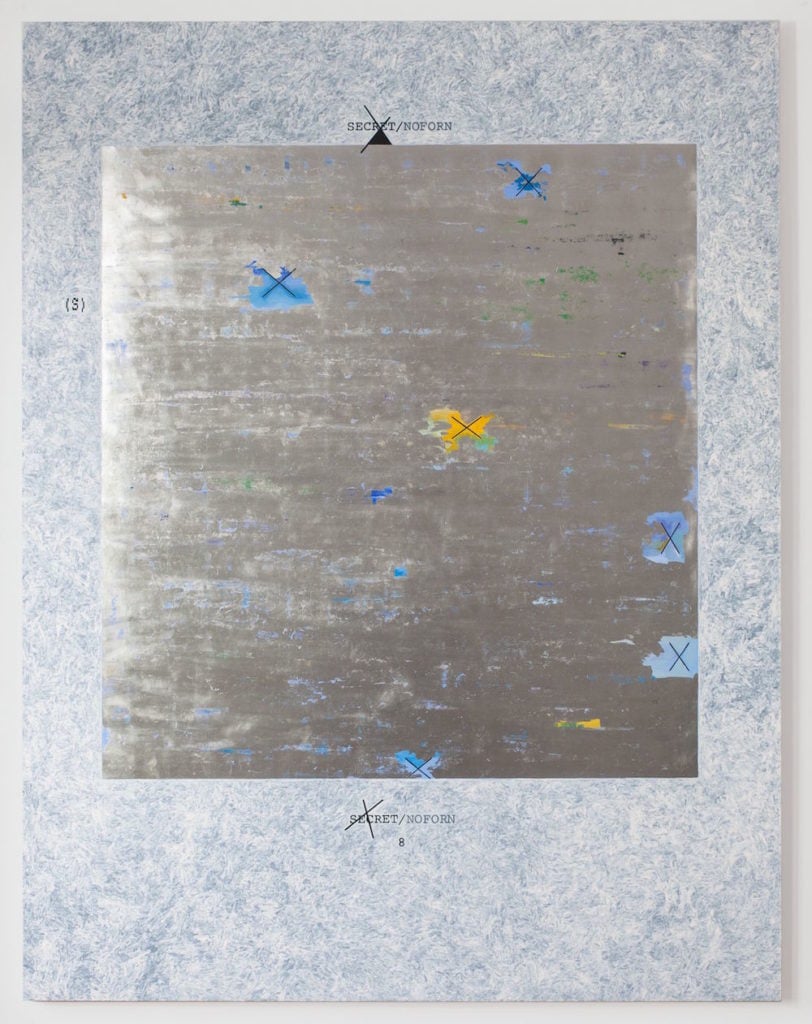
Jenny Holzer, XX 8 (2015). Image
courtesy of the artist and Hauser & Wirth.
Gagosian Gallery also reported robust sales despite the
less-than-ideal conditions. “On the one hand we sell art every day
via JPEG so there is nothing particularly out of the ordinary and
it’s why the shift to this medium has been inevitable,” said
Gagosian director Sam Orlofsky. “That said, the social, political,
and economic climate right now is what is uncertain. In the face of
such a difficult environment, the fact that people are still
willing to make such a large commitment has been a pleasant
surprise.”
By Friday, the gallery reported six sales ranging from $260,000
to $1.3 million (€1.2 million). Georg Baselitz’s
painting The other side of the oil stain (2019) went
for €1.2 million, Mary Weatherford’s Splendor in the
Grass (2019) for $750,000, Tetsuya Ishida’s Derelict
Building Worker’s Chair (1996) for $500,000, Zeng
Fanzhi’s Untitled (2019) for $450,000, Jennifer
Guidi’s An Instance of Becoming (2019) for
$300,000, and Jia Aili’s Youth and
Ultramarine (2019) for $260,000.

Mary Weatherford,
Splendor in the Grass (2019)
©️ Mary Weatherford. Photo: Fredrik Nilsen Studio. Courtesy
Gagosian.
“While you never want to extrapolate from a few data points, it
appears that China is getting back to business sooner. In other
words, the places that were affected first with the virus and are
now on the downside of the curve, may be returning to some
semblance of business sooner,” Orlofsky said. “A lot of our
purchasers were from the Far East.”
David Zwirner Gallery’s early preview sales included paintings
by Mamma Andersson for $400,000, Lucas Arruda for $100,000, Marlene
Dumas for $2.6 million, Luc Tuymans for $2 million, Noah Davis
for $360,000, and Liu Ye for $500,000. The gallery said that the
inquiries on opening day broke down to: 23 percent from the United
States, 46 percent from Asia, and 31 percent from Europe.
But while mega-galleries, like Hauser & Wirth, David Zwirner,
and Gagosian are so far reporting relatively robust sales at high
prices in the online viewing rooms, feedback from smaller and
mid-size galleries has been more quiet. Some sources told Artnet
News that gallery owners with their own digital platforms such as
theirs were better placed to handle the fair’s opening and make
sales amid the website’s problems.
“We’ve received very strong feedback from our exhibitors; many
small and mid-sized galleries have been using our platform as an
opportunity to explore the concept of an online viewing room and to
connect with new potential buyers, while larger blue-chip galleries
have benefited by cross-promoting their own digital platforms,”
said Art Basel director Marc Spiegler in a statement. “And while
nothing can replace the experience of visiting an art fair in
person, our VIPs across the globe were also excited to view more
than 2,000 exceptional artworks in one digital space.”
San Francisco’s Jessica Silverman Gallery sold two paintings and
two sculptures by Woody De Othello, priced between $14,000 and
$18,000. “We haven’t had any technical glitches with the
online viewing room, although the internet has been sluggish due to
the sheer volume of people working online from home,” Silverman
said.
“At this difficult moment, when the physical and economic health
of the entire world is under threat, I am grateful for the
opportunity of a platform constructed and endorsed by Art Basel,”
Silverman said. “We are working hard to keep our artists’ studios
afloat by offering collectors works that keep things in perspective
and remind them of the human big picture.”
The post How Is Art Basel’s Experiment With Online Sales
Going? Early Indications Suggest Mega-Galleries Are Making Out Just
Fine appeared first on artnet News.
Read more https://news.artnet.com/market/art-basel-hong-kong-online-viewing-rooms-1810584
Further reading


Leave a comment