
How the Filmmakers Behind ‘The Goldfinch’ Built Near-Perfect Replicas of the Met and the Dutch Masterpiece at the Story’s Heart
The long-awaited film
adaptation of Donna Tartt’s Pulitzer Prize-winning 2013 novel
The Goldfinch hit theaters this
weekend, bringing in an underwhelming $2.6 million to finish eighth
at the box office. Translating the nearly 800-page novel to the big screen
seems to have proved something of a challenge for director John
Crowley, who has faced a number of highly critical reviews since
the film’s release.
When artnet News ran into one of the movie’s actors, Luke
Wilson, at the opening party for New York’s Pace Gallery last week
and we mentioned this article, he pleaded with us to “be nice.”
(The main complaints have been about the picture’s 149-minute
runtime and what’s been characterized as excessive fidelity to the
book.) Ansel Elgort, Nicole Kidman, Jeffrey Wright, and Finn
Wolfhard also star.
The movie, which centers on the diminutive Dutch Golden Age
masterpiece The Goldfinch (1654) by Carel Fabritius,
has been highly anticipated in the art world. The novel’s
protagonist, 13-year-old Theo Decker (played by Oakes Fegley as a
child and Elgort as an adult), encounters the painting with his
mother—who considers it her favorite work of art—on a visit to the
Metropolitan Museum of Art the day it is targeted by a deadly
terrorist attack. Theo survives, but his mother does not.
In the chaos that follows the bombing, an explosion-addled Theo,
urged by the last words of a dying old man, ends up
taking The Goldfinch with him.
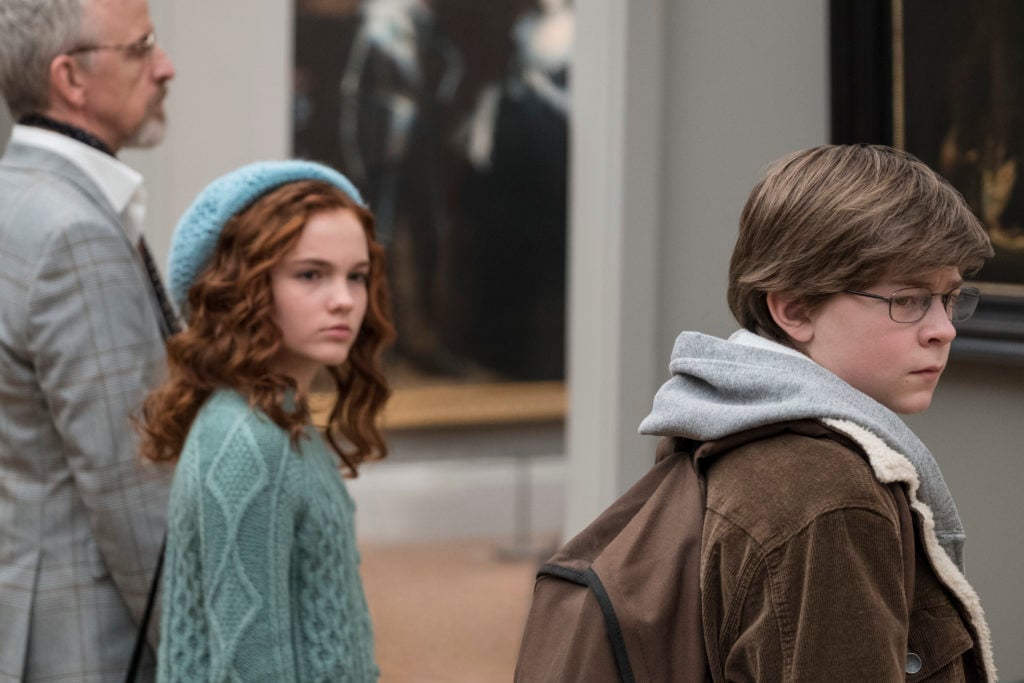
Robert Joy as Welty, Aimée Laurence as
young Pippa, and Oakes Fegley as young Theo Decker in The
Goldfinch. Photo by Macall Polay, ©2018 Warner Bros.
Entertainment Inc. and Amazon Content Services LLC.
It turns out that the painting also survived an explosion in
real life, when a Dutch gunpowder store blew up and killed
32-year-old Fabritius and destroyed almost all of his
art. “One of the only things that survived, like a miracle,
was that little bird,” Theo marvels in the film.
So how does the movie stack up in terms of its art-world
accuracy? Here’s how the filmmakers recreated the works of art that
appear on set, and how they shot the scenes at the Met.
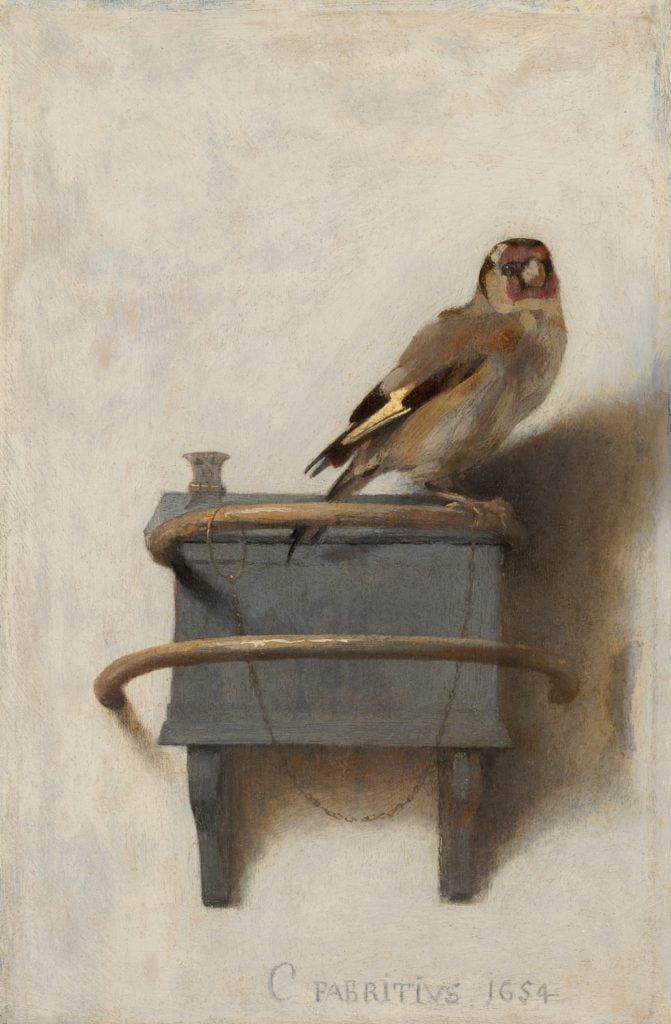
Carel Fabritius, The Goldfinch
(1654). Courtesy of Mauritshuis Royal Picture Gallery, The
Hague.
Replicating a Masterpiece
The Goldfinch actually belongs to the Mauritshuis
museum in The Hague, Netherlands. One of only a handful of extant
works by Fabritius, the painting was chosen by Tartt in part
because the little-known master represents a link between Rembrandt
van Rijn, his teacher, and Johannes Vermeer, likely his pupil.
The painting that appears on screen is a replica. (In 2013,
during a two-year restoration project, The
Goldfinch traveled to New York for
an exhibition at the Frick Collection that serendipitously
opened the month of the book’s release, but it hasn’t been loaned out
since.)
“The museum used a 3-D scanner to scan the surface and then
rebuilt the painting in layers to scale. I admit, I was doubtful. I
thought, ‘This is going to look like a bad reproduction,’ but when
they held it up to the real painting, I was extremely impressed by
how close they were,” production designer K.K. Barrett said in a
statement. “For some shots, we blew it up digitally and then a
scenic artist overpainted it to give it exactly the same
brushstrokes and textures we could see in the print.”
In fact, all of the paintings in the exhibition Theo visits are
reproductions, made from high resolution images licensed from
museums including the Met, the Mauritshuis, and the Rijksmuseum in
Amsterdam. To convincingly depict more than 80 historic works,
including masterpieces such as The Anatomy Lesson by
Rembrandt—also at the Mauritshuis—the graphic and scenic
departments used photographic paper, creating textured prints.
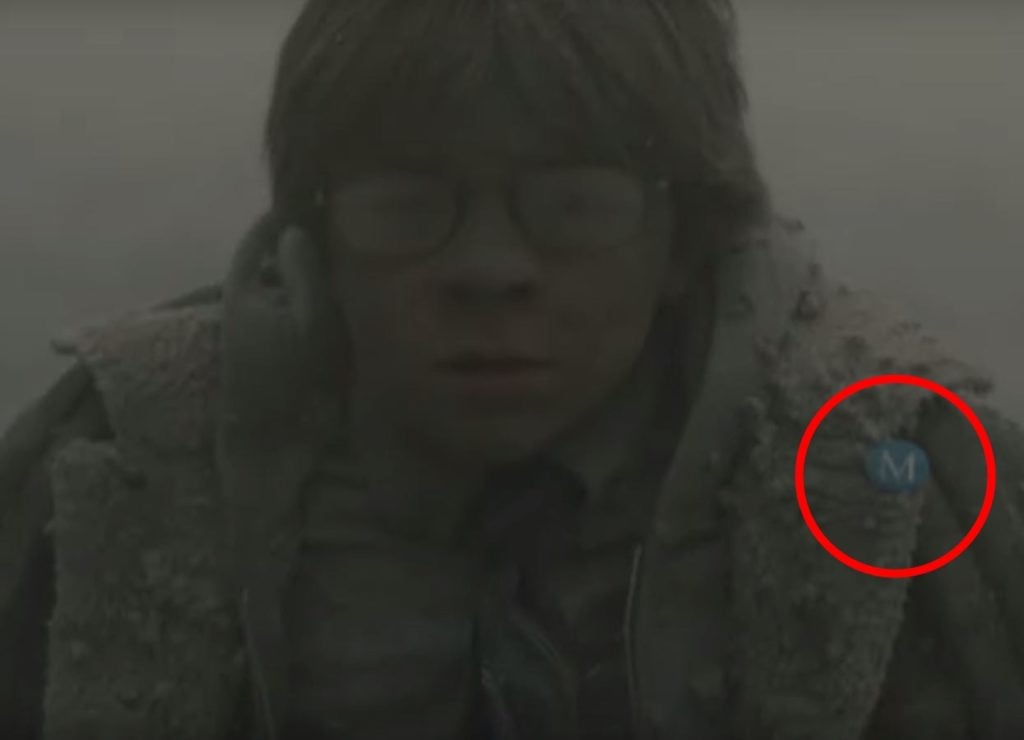
Screen capture from The
Goldfinch trailer, with Metropolitan Museum of Art admission
badge highlighted.
Replicating the Met
As for the Met itself, you might be surprised to discover that
most of the scenes set at the museum were actually filmed in a
warehouse in Yonkers, where the crew built a perfect replica of the
galleries. The museum “took us under their wing and gave us
access to their curators who showed us how to put together an
authentic-looking art exhibit of our own,” said executive producer
Mari Jo Winkler-Ioffreda in a statement. The museum also dug into
its stash of old metal buttons, phased out in 2013, for the
occasion.
Because the Met galleries had to be destroyed on camera, the
filmmakers never considered shooting there. Instead, there is just
one scene of the facade shot on location, as Theo exits the
building post-bombing, into the pouring rain. At the preview
screening, artnet News ran into a few background actors exchanging
notes on their experience: “we had fake rain being dumped on us
from 3 a.m.,” said one extra.
“We started at crack of dawn on a Sunday morning,” Ken Weine,
the museum’s vice president for external affairs, told artnet
News. But by opening time, “it was as if it never
happened.”
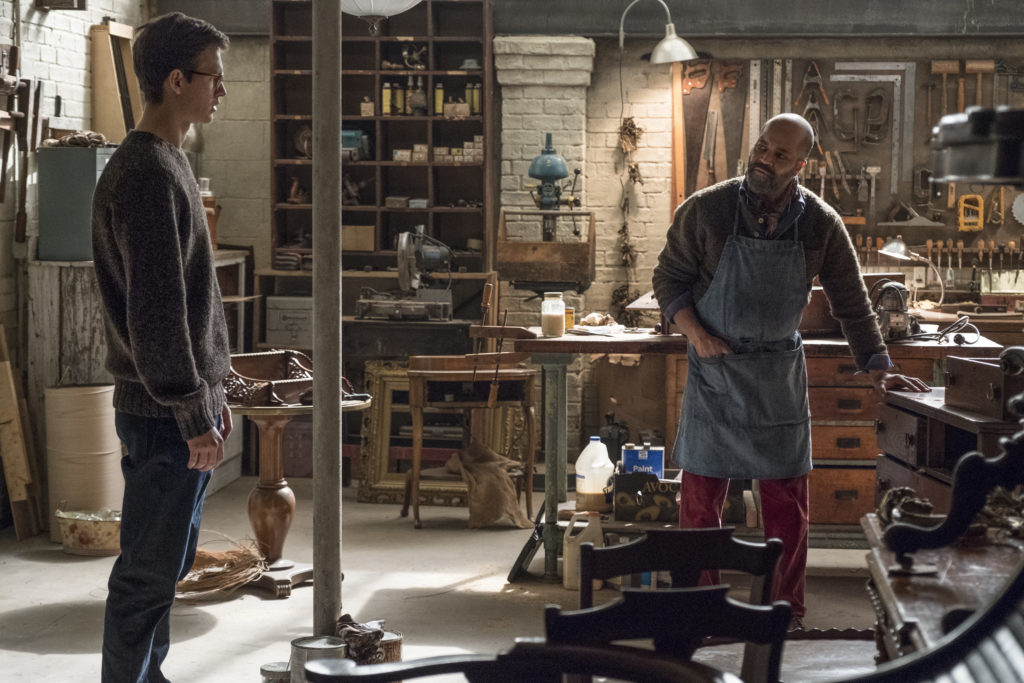
Jeffrey Wright as Hobie and Ansel Elgort
as Theo Decker in The Goldfinch. Photo by Macall
Polay, ©2018 Warner Bros. Entertainment Inc. and Amazon Content
Services LLC.
But not all requests to film at the Met get approved. “We had a
crime show that wanted to have a whodunit episode where a curator
was stabbed by another staff member—that’s not an appropriate thing
for us to participate in,” Weine said.
Despite the terrorist attack in The Goldfinch‘s
plot, Weine said the museum wasn’t concerned. “The filmmakers
were incredibly thoughtful. They were interested in the art,
interested in the museum, and wanted to work with us to do
something respectful,” he said. (Other films shot on location at
the Met have included The Mixed-Up Files of Mrs. Basil E.
Frankweiler, in which two runaway children begin secretly
living in the museum, and Ocean’s 8, in
which a team of thieves carrying out a major jewelry heist at the
Met Gala.)
In the end, the film shows how Theo develops a fascination with
art and antiques as a reaction to his traumatic experience. “[Theo]
becomes attached to antiques because he finds a kind of peace
in knowing that they have been around a lot longer than us and will
be around long after we’ve gone,” said Elgort in a statement. “An
object can endure, and I think that idea comforts him. And the
object he prizes the most—and the one that also haunts him the
most—is The Goldfinch.”
The post How the Filmmakers Behind ‘The Goldfinch’ Built
Near-Perfect Replicas of the Met and the Dutch Masterpiece at the
Story’s Heart appeared first on artnet News.
Read more https://news.artnet.com/art-world/goldfinch-movie-met-masterpiece-1649398
Further reading


Leave a comment