
How the National Archives’ Notorious Alteration of a Women’s March Photo Is Part of a Long American Tradition
It was the photograph that
outraged a thousand archivists.
On January 18, the National
Archives in Washington, DC, was forced to issue a public
apology
for altering a photo of the January
21, 2017 Women’s March to obscure slogans written on four of the
posters that referred either to President Trump or women’s
genitalia. The photo—which was removed that same day and then
restored, unretouched, on Wednesday—had been displayed in the
museum’s lobby to promote an exhibition commemorating the centenary
of the passage of the 19th Amendment, which granted women the right to
vote.
As historians ourselves, we know
that the historical campaign for women’s suffrage is an explicitly
visual history. It is, therefore, a special irony that an
exhibition commemorating the suffragist movement suppressed the
power of images from the Women’s
March.
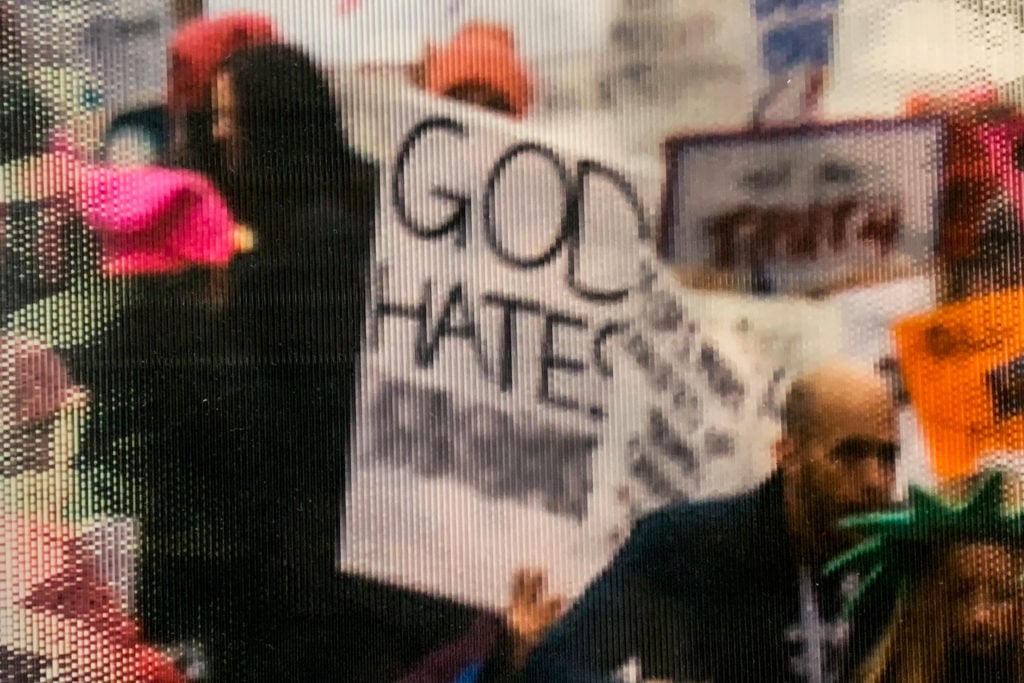
A close up on the altered sign in the
photograph from Women’s March in 2017 is seen on display at the
National Archives Research Center on Friday, January 17, 2020 in
Washington, D.C. The original sign read “God Hates Trump,” here
“Trump” has been edited out. (Photo by Salwan Georges/The
Washington Post via Getty Images)
David Ferriero, the top
archivist at the National Archives, said in a statement on Wednesday that the
decision to blur the signs was driven by a desire “to avoid
accusations of partisanship or complaints that we displayed
inappropriate language in a family-friendly Federal museum.” (Of
course, sexual vulgarity has been a common theme in efforts
to censor
art throughout history.) In this
case, the thinking seems to have been that it is fine to show women
protesting, but not what they are protesting about.
The blurring of the photograph
was swiftly and universally condemned by professional historians
and curators, including the Association of
American Archivists. The
American Historical Association said
the decision to alter the
photograph to “sanitize or whitewash history” amounted to
“distorting the historical record.” The National Coalition for
History sent a letter
complaining that “the possibility
that those charged with preserving and maintaining the historic
record of our nation can alter a representation of the past, such
as a photograph, diminishes trust in both the National Archives and
the federal government.”
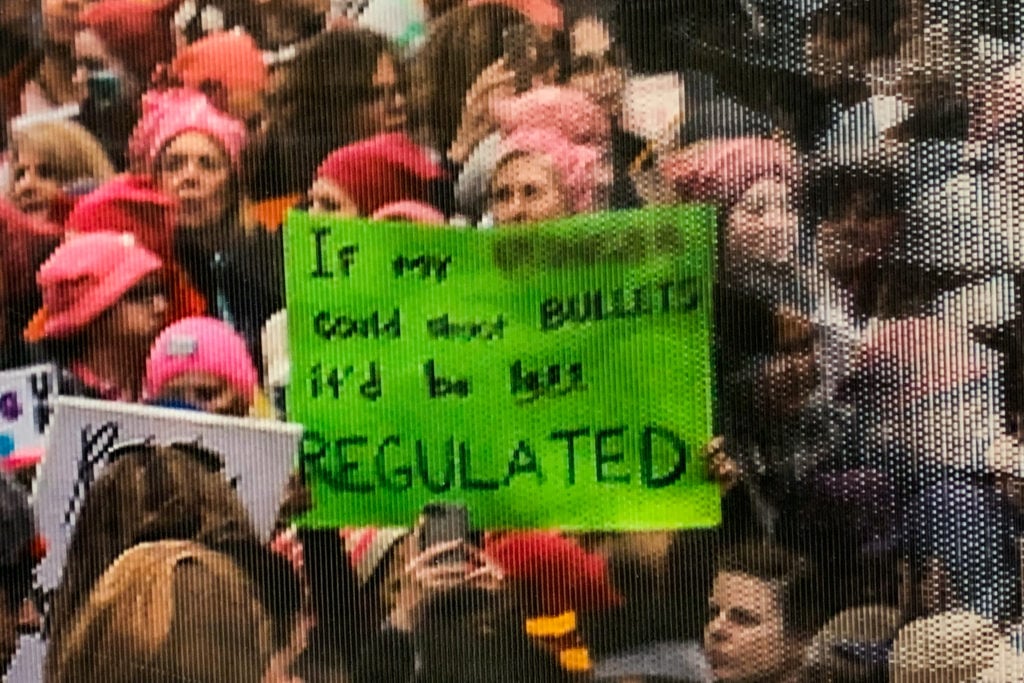
A close up on the altered sign in the
photograph from Women’s March in 2017. The original sign read “If
my pussy could shoot bullets it’d be regulated,” here “pussy” is
blurred out. (Photo by Salwan Georges/The Washington Post via Getty
Images)
But this event did not happen in
a vacuum. In fact, the astonishing decision to alter the photograph
is a result of the confluence of two powerful forces: one new and
one old.
On one hand, it transpires in
the era of “fake news,” where the flow of information and images on
the web is growing exponentially with few checks on veracity. New
“deepfake”
techniques make it
easier than ever for people to manipulate images and video to
alter—or, indeed, entirely invent—what is being
shown.
In this increasingly challenging
media environment, there is a president who aids and abets the
erosion of objective truth—and who is more than likely than any
leader before him to lash out at a publicly funded body like the
National Archives for commemorating an event, such as the Women’s
March, that protests his presidency. It is reasonable to assume
that the National Archives were not worried about the impact of the
Women’s March photo on their young visitors—they were worried about
its impact on the man in the White House.
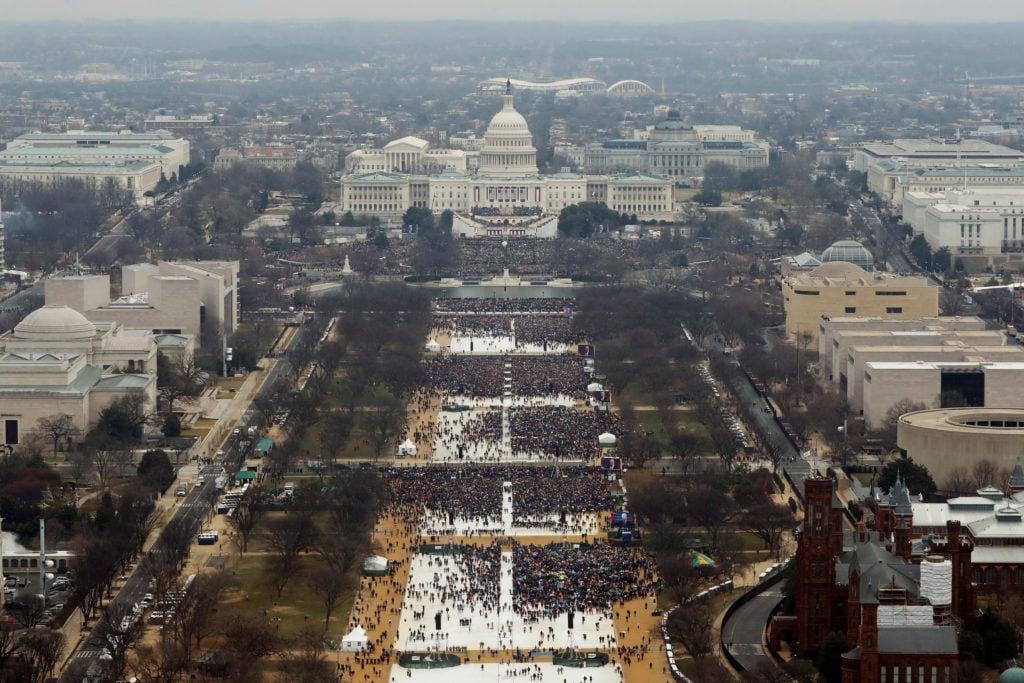
Trump’s inauguration (uncropped). (Photo
by Lucas Jackson – Pool/Getty Images)
After all, at Trump’s request, a
government photographer cropped
images of his inaugural
parade to make the crowds look bigger. And in May of last year, the
administration reportedly asked the Navy to hide a destroyer named
after one of his most vocal critics, Senator John McCain,
in order to avoid
its appearance in
photographs during Trump’s visit to a Japanese naval
base.
But the bungling of the photo is
also part of a long tradition of contestation and controversy
surrounding public history. There are few nations that celebrate
their failings in the public arena—but compared to countries like
Germany or Rwanda, the United States is among the most
avoidant.
Indeed, the US has long
struggled to determine the extent to which public institutions
should wade into controversies about how to interpret sensitive
issues in the nation’s history. In 1995, in the face of opposition
from veterans’ groups, the Smithsonian National Air and Space
Museum was forced to walk
back a plan to display
the Enola Gay bomber within an exhibit that discussed the
historical context and legacy of the atomic bomb and also
included graphic photos of atomic
bomb victims. Four years
earlier, Republican Senators had threatened to withhold funding
from the Smithsonian following an art exhibition that questioned
heroic images of the frontier. It also took until 2018, following
many years of resistance, for Monticello to open an exhibit
on the life of Sally Hemings,
who historians now accept was the enslaved mother of six of
Thomas Jefferson’s children.
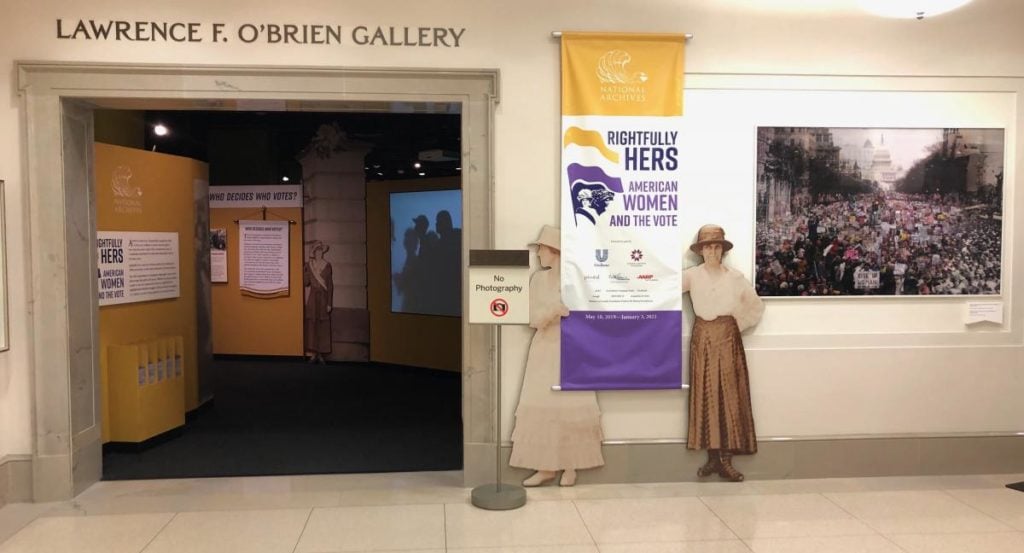
Installation of the lenticular
photograph in the lobby of the National Archives. Courtesy of
National Archives.
What distinguishes these past
controversies from the Archives affair is that they involved
hiding artifacts and information from public view or
offering a new interpretation. The episode surrounding the Women’s
March photo, on the other hand—one that is characteristic of the
Trump era—involved actually altering an artifact being shown to visitors. The
vigorous reaction from curators and historians shows that there is
a clear consensus that this crossed a line. (A spokeswoman for the
Archives clarified that the photograph was licensed for promotional
purposes and not a part of its collection, but still acknowledged
it should not have been altered.)
Images matter. They crystallize
ideas and spur powerful emotional responses, and have often been
used by protest movements to rally public attention to their cause.
The 2017 Women’s Marches across the country saw an
impressive variety
of innovative visual creations
encompassing image and text, including the oft-reproduced
pussyhats. Some of these objects have been
collected by museums, including London’s Victoria and Albert
Museum.
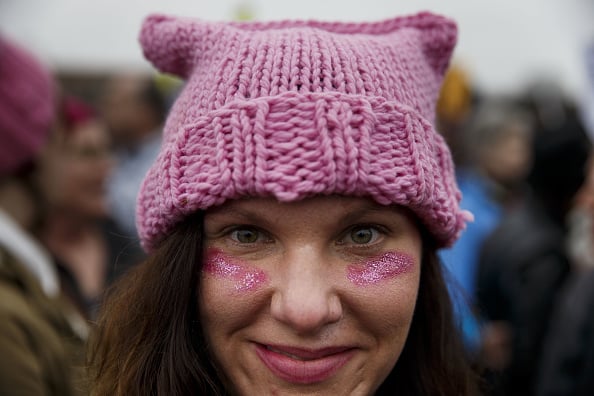
A demonstrator stands for a photograph
during the Women’s March on Washington in Washington, DC, on
January 21, 2017. Photo by Patrick T. Fallon/Bloomberg via Getty
Images.
By digitally blurring the
slogans on the posters, the National Archive curators were erasing
those voices from the public historical record.
It is worth noting that the
visual history of suffrage—from hand-designed
banners, posters, photographs, and postcards
to televised mass
demonstrations—was once
neglected, too. It was dismissed as too artistic for political
history and too political for the history of art. Today,
a new generation of
visual historians is
studying how social movements leverage the power of images to
promote their causes. But their job will be more difficult
considering the current forces that threaten to alter our own
histories to suit the winds of the present.
Artist Barbara Kruger has
said, “I work with pictures and words because they
have the ability to determine who we are and who we aren’t.” An
authentic image can reveal history in the making—but, as it turns
out, an altered one can, too. We just may not like what we
see.
Jennifer Tucker is an associate
professor of history and gender & sexuality studies at Wesleyan
University. Peter Rutland is
the Colin and Nancy Campbell Professor in Global Issues and
Democratic Thought at Wesleyan.
The post How the National Archives’ Notorious Alteration of
a Women’s March Photo Is Part of a Long American Tradition
appeared first on artnet News.
Read more https://news.artnet.com/opinion/national-archives-alteration-womens-march-photo-1761525
Further reading


Leave a comment