
‘How We Perceive the Past Has a Great Bearing on How We Live Now’: Art Historian James Meyer on Why the 1960s Won’t Fade Away
In the opening pages of the curator James Meyer’s new book,
The Art of Return: The
Sixties and Contemporary Culture, we find ourselves on
Martha’s Vineyard in August 1971. It is the Summer of Love, and “a
mania for nude swimming and sunbathing has overtaken the
beaches.”
Meyer and a friend, “determined to prove our independence,”
break free from their families and decide to hitchhike across the
island. They walk and walk until they’re finally picked up by a man
driving a VW bus. He has a beard, long hair, and he
shouts, “Come on in!”
Meyer is only nine years old.
So begins the art historian’s perceptive study of the “long”
1960s (which actually covers roughly 1955 through 1975), and why
that era continues to animate the imagination of artists, writers,
and historians—even if, like Meyer, they mostly missed the period
in question.
The book‘s impressive sweep, which looks at 20
international artists, is motivated by a range of probing
questions. What purpose do historical reenactments serve? How do
events from past eras shade our understanding of the present? What
are artists doing when they “remember” moments from before they
were even born?
Artnet News spoke with Meyer, a curator at the National Gallery
of Art in Washington, DC, about the book’s genesis, his turn
to Friedrich Nietzsche, and how today’s right-wing politics
grew from reactions against 1960s progressivism.
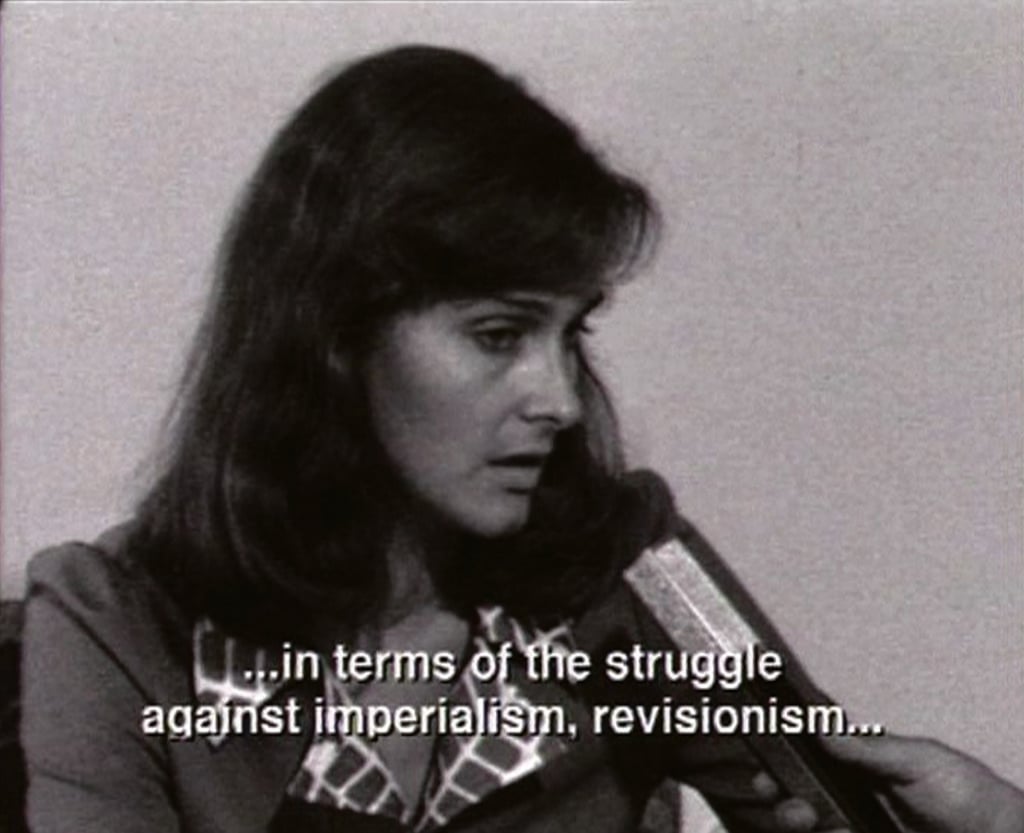
Anri Sala, still from Intervista
(Finding the Words) (1998). Courtesy of Idéale Audience
International, Paris; Galerie Chantal Crousel, Paris; Galerie
Esther Schipper, Berlin; Galerie Rüdiger Schöttle, Munich; and
Marian Goodman Gallery, New York/Paris.
What would you describe as the greatest challenge of the
book?
Figuring out the topic itself. What I am writing about? What is
the ‘‘’60s return?” How do you define it? How do you understand
that history is not static, that it impacts later periods or bleeds
into them?
My earlier work—my books on Minimalism and my exhibition on the history of the
Dwan Gallery in Los Angeles and New
York—reflected a structuralist understanding of history as a
set of discursive, economic, and institutional conditions specific
to their time. This book understands the “long” ‘60s—the period
stretching from the mid-‘50s to the mid-‘70s—as over and not over,
a past that is not “past.”
Nietzsche, in his essay “On the Use and Abuse of History for
Life,” proposes that history is a dynamic force. It can be a chain
that binds us to the past, and a model of emulation. How we
perceive the past has a great bearing on how we live now. As he
says, we need to strike a balance between remembering and
forgetting. It is vitally important to remember, yet not to the
degree that we get stuck in the past. I discuss Kerry James
Marshall’s paintings about Civil Rights-era memory, the Souvenirs,
along these lines.
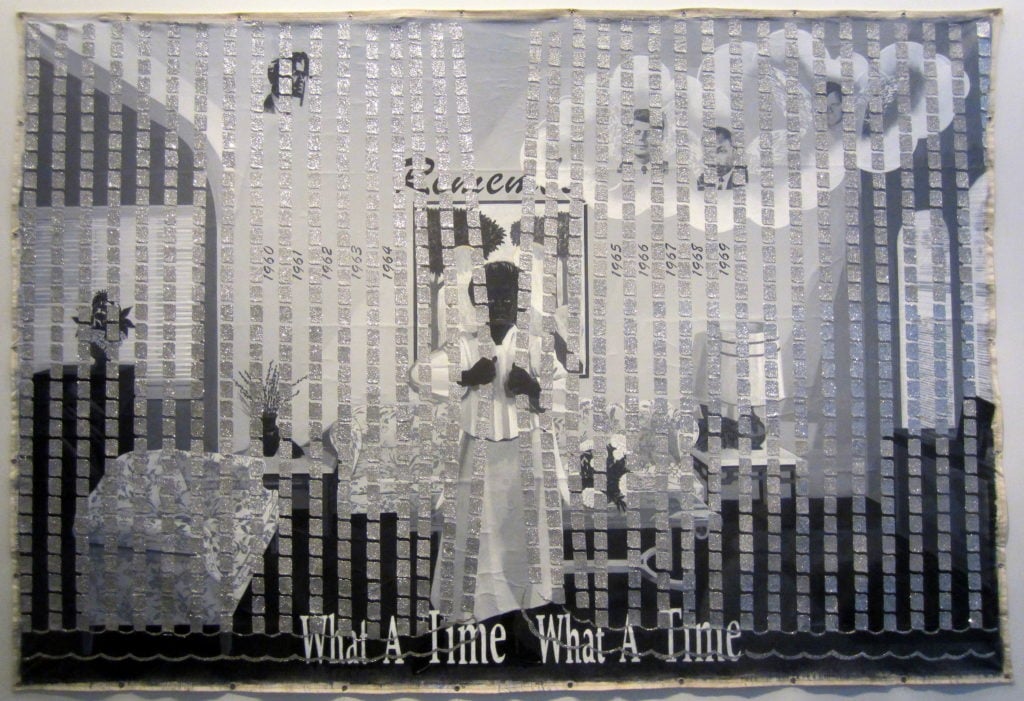
Kerry James Marshall, Memento V
(2003). Nelson-Atkins Museum, Kansas City, Missouri. © Kerry James
Marshall. Courtesy of the artist and Jack Shainman Gallery, New
York.
What about inserting yourself into the narrative? You
write about your childhood early in the book. Was that
difficult?
It was a challenge to write myself into the story. It was
counterintuitive to my training to inscribe my voice—my memory and
nostalgia for a period I experienced before I could understand what
was happening around me—into my work. It turned out to be at the
very core of what the book is about.
My generation—the children of the ‘60s and ‘70s—was deeply
impacted by what now appears to us as the last revolutionary period
on a global scale. Revolutionary eras produce a surfeit of memory.
They last longer because they’re more traumatic and more impactful
than more quiescent eras. They return. I was forced to consider how
my experience—the impressions of childhood we each have—had
inflected my research, and the work of so many others: why it is
that so many artists, writers, scholars, and filmmakers of my
generation, give or take 10 years, have felt compelled to revisit
that time? The more I looked into it the more I realized the
phenomenon is international and quite broad. My book discusses more
than 20 figures from the US, UK, Eastern and Western Europe, Asia,
Africa, and South America. I considered 90.
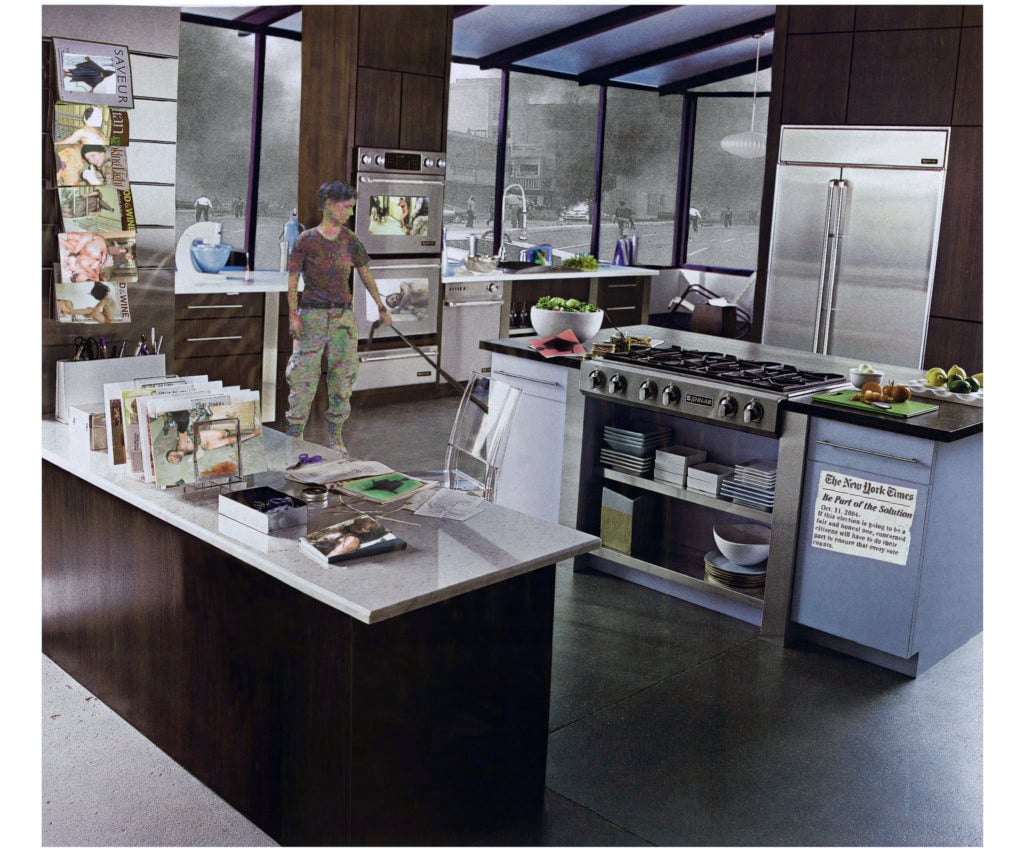
Martha Rosler, Election
(Lynndie), from the series “House Beautiful: Bringing the War
Home, New Series” (2004). Photomontage. © Martha Rosler. Courtesy
of the artist and Mitchell-Innes & Nash, New York.
In the book, you make a number of connections between
the George W. Bush years, with the Iraq War, and the turmoil of the
‘60s. What are the connections between the long ‘60s and the moment
we’re living in now?
The most obvious connection is between Watergate and the growing
scandal involving Russia and Ukraine. The adjective “Nixonian”
comes up a lot, and you see Watergate-era veterans—John Dean, Carl
Bernstein, Bob Woodward, and so on—on TV regularly. What we have
come to understand is this isn’t Watergate. Practices of return, as
I call them, force us to see the differences between then and now.
The misinformation campaign and hacking of the DNC server by
Russian state intelligence was a highly successful espionage action
by a foreign government, damaging to the Clinton campaign and US
democracy. The impact is ongoing. A failed burglary in DC seems
almost quaint in comparison.
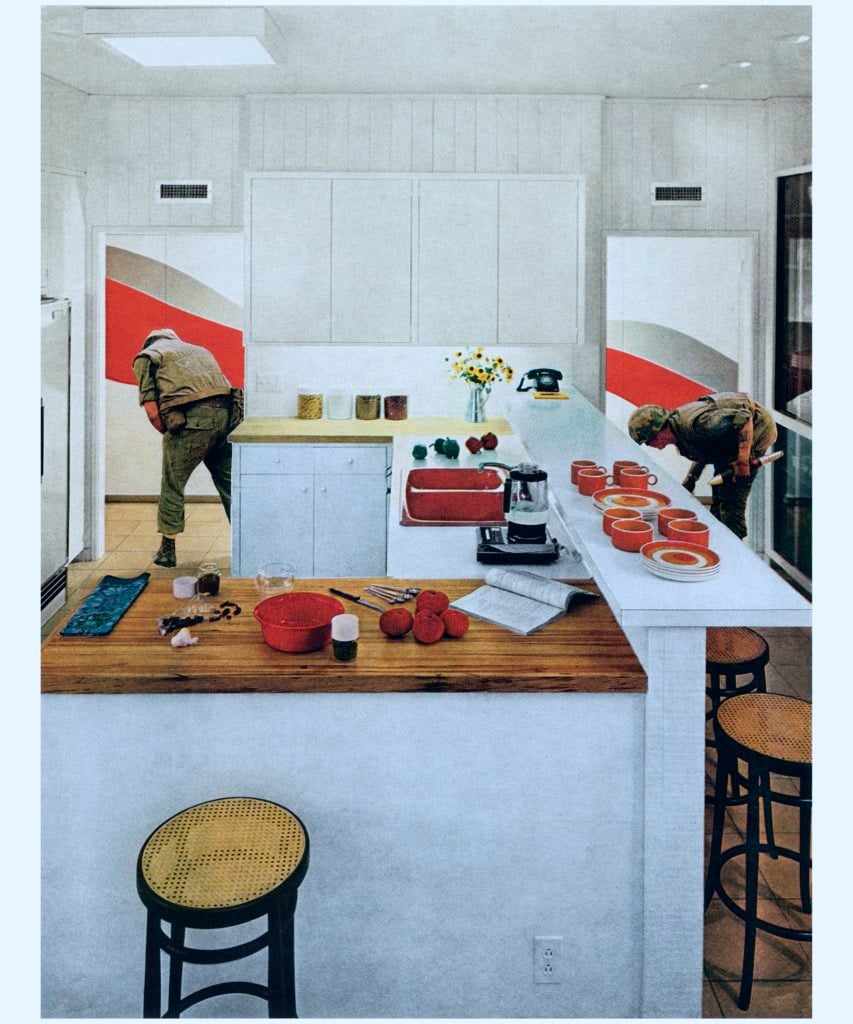
Martha Rosler, Tron (Amputee),
from the series “House Beautiful: Bringing the War Home” (ca.
1967–72). © Martha Rosler. Courtesy of the artist and
Mitchell-Innes & Nash, New York.
The book was written over the course of a number of
years. Were you ever concerned that its relevance might expire in
the gap between writing and the book’s ultimate
publication?
Just imagine, my first essay on the subject was published in
1998! I was indeed worried that the book would lose its
contemporaneity. What I discovered in the course of writing it is
the very point the book makes: there is the historical ‘60s, a
period that came to an end, and a “’60s” that returns, each time
differently, depending on what’s happening in the current moment.
It doesn’t go away.
During the Bush era, comparisons were made between the Vietnam
and Iraq Wars, and between the anti-war movement and the relative
lack of activism on campuses during the 2000s, connections I
explore in works by Martha Rosler, Nancy Davenport, and Matthew
Buckingham. Watergate is clearly germane right now. But it is
important to recognize that the fissures we are experiencing
between “red” and “blue” electorates came into play then, with the
emergence of the New Left, identity politics, and Johnson’s Great
Society programs, on the one hand, and the rise of Nixon’s “Silent
Majority” on the other.
One could say that the reactionary turns since the
‘60s—anti-busing during the ‘70s, the election of Reagan in 1980,
the rise of the Tea Party in 2010 and Trumpism in 2016—are
extensions of that division. Right-wing efforts to disenfranchise
voters of color, the Supreme Court’s 2013 gutting of the Voting
Rights Act of 1965, and the administration’s efforts to curtail the
Immigration Act of 1965 are other attempts to repeal the
progressive gains of the ‘60s.
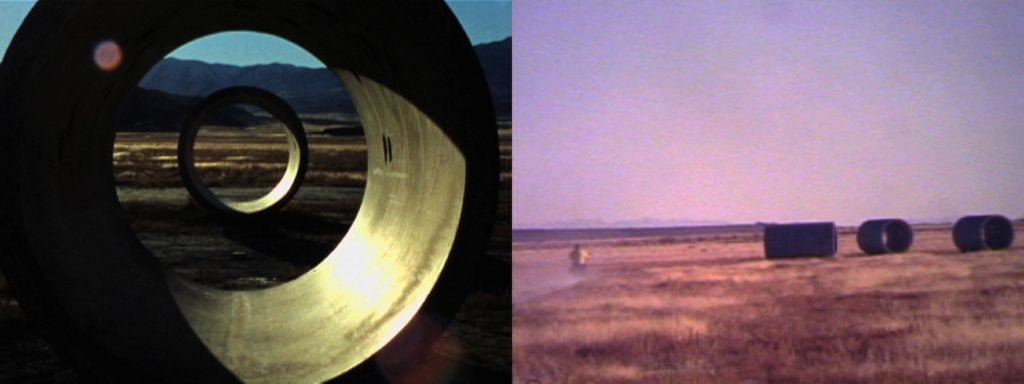
Amy Granat and Drew Heitzler,
T.S.O.Y.W. (2007). © Amy Granat and Drew Heitzler.
What about the other side of the battle? Are there
connections between the popular movements of the ‘60s and the
movements of today?
The Civil Rights, anti-war, feminist, and LGBTQ movements
emerged then; each had a powerful constituency that developed
around a particular issue. One can hope that climate politics and
the Black Lives Matter and gun-control movements will be so
impactful.
The post ‘How We Perceive the Past Has a Great Bearing on
How We Live Now’: Art Historian James Meyer on Why the 1960s Won’t
Fade Away appeared first on artnet News.
Read more https://news.artnet.com/art-world/james-meyer-art-of-return-interview-1742649
Further reading


Leave a comment