
‘I Am Mistaken as the Spokesperson of Native America’: Hock E Aye Vi Edgar Heap of Birds on What the World Doesn’t Get About Native Artists
Since 1981, Hock E Aye Vi Edgar
Heap of Birds has lived on tribal land in Oklahoma, far away from
the coastal headquarters of the art world. But that hasn’t stopped
the art world from trying to bring him in.
Across his four-decade career,
the artist, who belongs to the Cheyenne and Arapaho Nation tribes,
has been the subject of numerous solo shows, surveys, and public
installations, injecting an oft-ignored voice into the culture of
the art world. Still, Heap of Birds has stayed true to his
roots.
Following a mini-retrospective of sorts at MoMA PS1 last year, the
artist has just opened a new exhibition at Fort Gansevoort. Titled
“Standing Rock Awakens the World,” it
features the debut of a new eponymous installation of blood-red
monoprints, each emblazoned with a simple phrase that thrums like a
haunting incantation: “OIL / DANGER / MAN / CAMPS / MISSING /
MURDERED / WOMEN.”
The title references the
protests at the Standing Rock reservation,
where demonstrators in
early 2016 began speaking out against the Dakota Access Pipeline, a
shale-gas line that activists said would leak into and contaminate
water sources.
In the show, 24 original prints
are each matched by an accompanying “ghost print”—a faded facsimile
made with the residual ink of the first. Whereas the first phrases
resound like rallying cries, their partners echo like a faint
whimper.
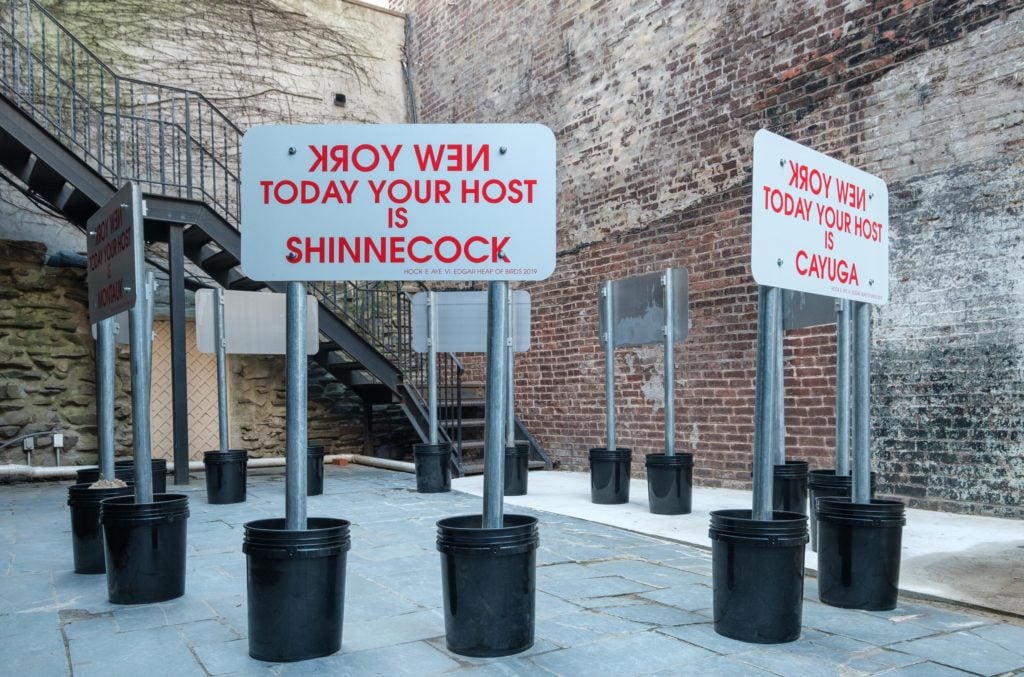
Also included in the show are
new versions of his “Native
Hosts” series of signs,
listing the names of tribes that once occupied New York. Heap of
Birds first introduced the series at New York’s City Hall Park in
1988, but the project was censored, and only six of the 12 tribes
that lived in the region were represented. The artist has reprised
the full work for his Fort Gansevoort show.
On the occasion of the
exhibition, Artnet News spoke with Heap of Birds about the
censorship episode and his battle with the New York mayor’s office,
why success should be shared with others, and why Native peoples
live “in the realm of ghost spirits.”
A view of “Standing Rock Awakens the
World,” Hock E Aye Vi Edgar Heap of Birds’s exhibition, at Fort
Gansevoort. Courtesy of the artist and Fort Gansevoort.
The Standing Rock and Dakota Access Pipeline protests brought
a number of issues facing Native peoples to the consciousness of
the wider public. What did that movement mean to you?
There’s one print in the new
installation that has a list of tribes: Arikara, Cheyenne, Arapaho,
Nakota. Those are the original signers of the Fort Laramie treaty
[which established territorial claims for Native peoples in 1851].
The activists who came to protest at Standing Rock cited that
treaty as their right to come to that land. The tribes had made
that agreement and they came to that property on the basis of the
treaty, even though America reneged on it.
Today, Native tribes are very
separated in a sense. They’re informed and enriched by their
separate doctrines and practices, and as a result, they’re not very
unified when it’s time to come together to battle something. What
meant the most to me at Standing Rock was the unification of
tribes. That’s so necessary.
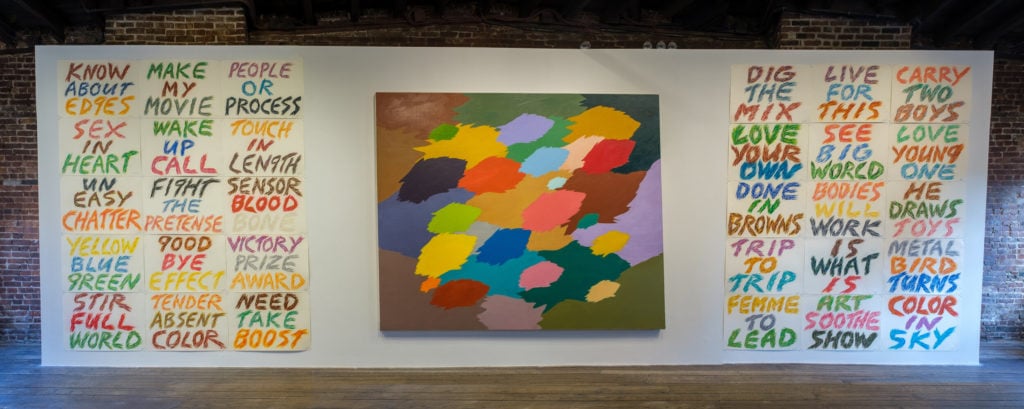
An installation view of the show.
Courtesy of the artist and Fort Gansevoort.
Why do you think Standing Rock resonated with non-tribal
people?
I think it was the environmental
component. It wasn’t strictly a Native issue; it was about water.
It was about the pollution of the water. And then, of course, the
pipe did leak, just like everyone thought it
would.
Can you tell me about the ghost prints? This is a technique
you’ve used before, such as in the Surviving Active
Shooter Custer installation at MoMA PS1 last
year.
It’s a conventional method that
printmakers use. When you’re making monoprints, there’s still a
residual amount of ink on the plate after the first pull, so you
can make a second, fainter print. I use it as a metaphor for the
marginalized life of Native people in this republic. We’re so
faint. We hardly exist in contemporary society and history is so
biased. Couple that with all the massacres where I’m from—there are
so many ghosts out there. That’s primarily where the Native people
reside, in the realm of ghost spirits. So I vow to always make a
ghost.
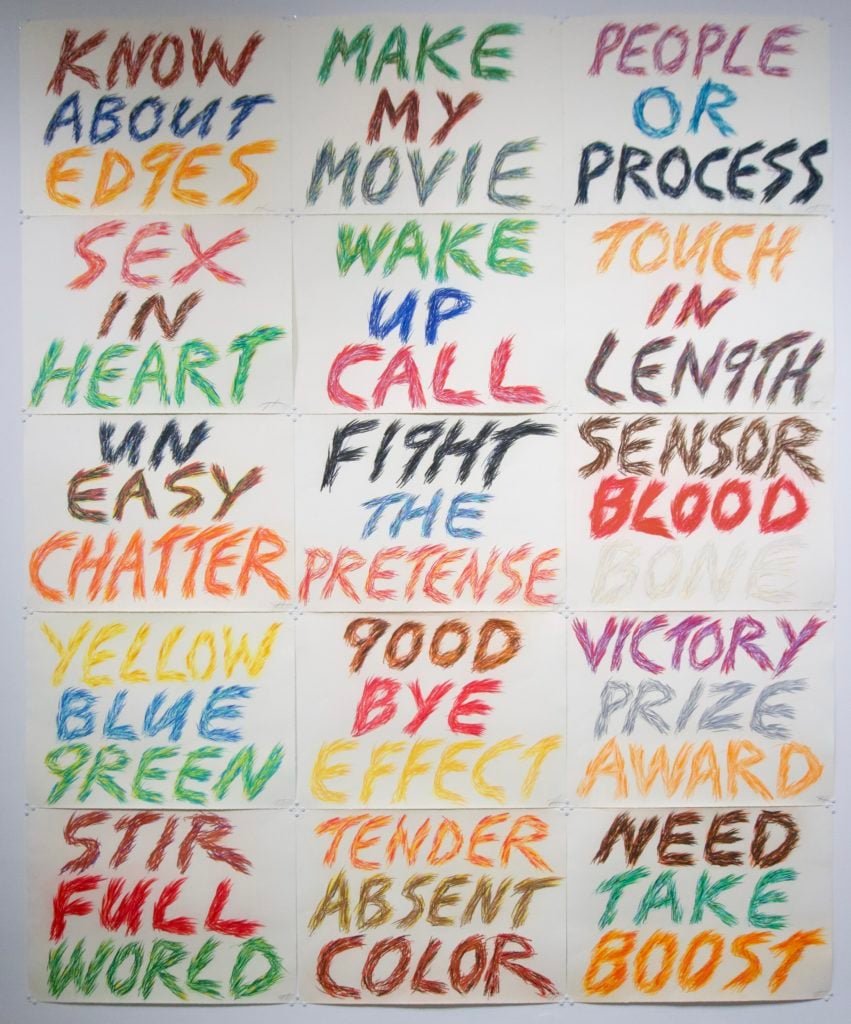
Hock E Aye Vi Edgar Heap of Birds,
Boost West (1990). Courtesy of the artist and Fort
Gansevoort.
The show features a new version of your “Native
Hosts” series of signs dedicated to the tribes that once
lived in New York. It’s the first time you’ve mounted them in the
city since you debuted the series at City Hall Park in
1988.
The original was actually
censored. Only half of the series was allowed to be installed.
Mayor Koch’s office said there could only be six signs, even though
there were 12 tribes. We were forced to settle for that. The Public
Art Fund didn’t do a very good job supporting
it.
Did the mayor’s office give you justification for limiting
the number?
I don’t know. It could have been
the amount of signage. Maybe it was too many tribal identities around the building.
They were scattered all over the park, so it would have been
somewhat innocuous, and there were other huge public sculptures
installed in the area and they were all allowed to stand. Not the
signs. It was too much to have a noticeable presence of Native
lives, I guess. The Public Art Fund also said that people were
graffitiing on the signs.
I’ve done these installations
all over the world. I feel very strongly that whenever you step out
the door with art, it’s a dialogue. You have to allow people to
respond to your work. If they graffiti it, well, that’s part of
their response. But the Public Art Fund said, “Well, if we let them
graffiti on your stuff, then we’ll have to let them do it to
everybody’s work. We have to clean it.” So I said, “Okay, clean
them.” And then when I went to get my final payment, they billed me
for the cleaning.
I was a young artist; I didn’t
know how to fight back. So I just took the smaller check, even
though it wasn’t a very big check to begin with. The whole affair
was handled badly.
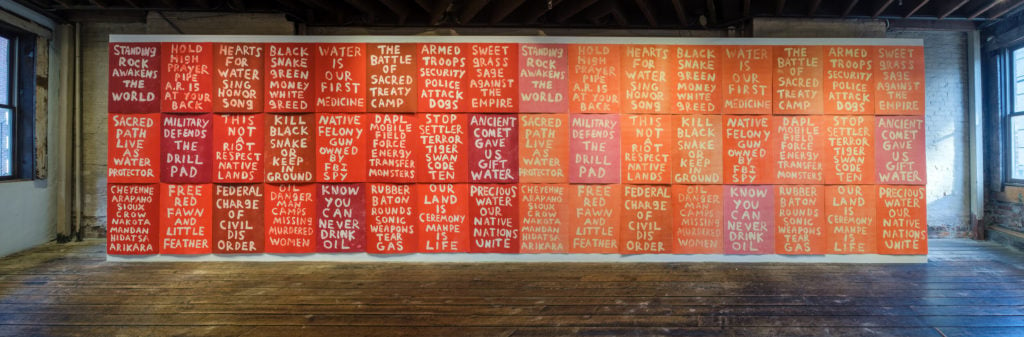
Hock E Aye Vi Edgar Heap of Birds,
Standing Rock Awakens the World (2019). Courtesy of the
artist and Fort Gansevoort.
The series features the names of tribes that aren’t your own.
Is there any tension for you in evoking those other tribes, even
though you’re doing it out of a sense of recognition? Have you ever
faced any pushback?
The project is about me being a
foreigner, really. I’m not from New York, I’m from Oklahoma. I feel
strongly that you have to honor your hosts. Everyone that comes
here needs to make that acknowledgment. I do, too. I’m a guest in
New York for the Native tribes. I do the same thing when I go to
Vancouver, when I go to Ohio, when I go to California. There’s no
Native America. It’s all individual tribal nations.
I feel like I am mistaken as the
spokesperson of Native America when I visit the art world. That’s
wrong, but I take that interest and I spin it back into the
community. I bring forward Native leaders that are local. I do my
work as well, but the first thing I do is to acknowledge the
original people of the place. In some rare cases, people from the
tribe say, ‘Well, we don’t want to have a sign. We want to make our
own sign, or we want to do this, or do that.” If they say that,
then I don’t make them. I’ll only do it with their
support.
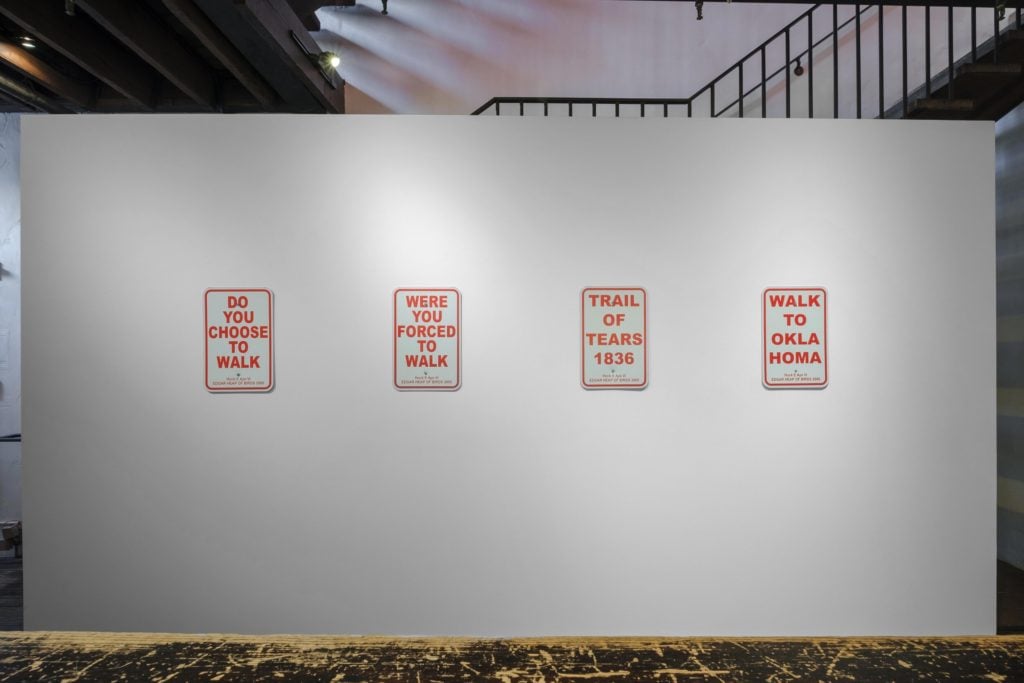
An installation view of the show.
Courtesy of the artist and Fort Gansevoort.
Is there a balance to be struck between being a voice for
marginalized communities, and being mislabeled or
tokenized?
You’ve got to share with the
local artists and community members. You can’t be a superstar.
That’s what the white man thinks artists are—solo geniuses. And
then they want to make me the solo Indian genius. If you’re weak
and don’t understand your own life, then there’s a temptation to
adopt that premise. That’s a big mistake. They tell you to do that,
but that’s wrong. What are you doing to share that with all the
young artists? What are you doing to help a community of people? If
you claim a tribe, you better know the damn tribe. Otherwise, don’t
tell me about it; I don’t want to hear about it. There are enough
imposters out there; we need people that are actually investing in
a place.
You may make art, but that’s not
your whole job. That’s just a tiny little part of your life. It’s
not something you believe in or worship. You don’t believe in
Chelsea, do you? If you worship Chelsea, you’re in trouble. If
Chelsea’s your God, well I’m sorry [laughs].
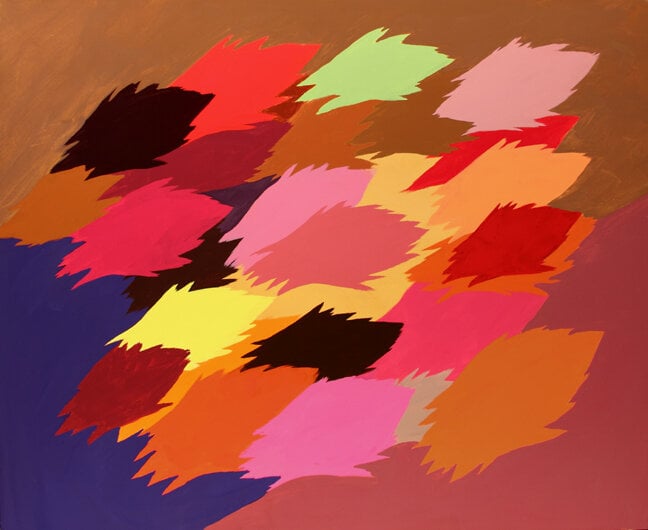
Hock E Aye Vi Edgar Heap of Birds,
Neuf for Autumn I (2014). Courtesy of the artist and Fort
Gansevoort.
You’ve made a point of living outside of the art world, both
geographically and ideologically. You’ve also enjoyed success, with
solo shows at MoMA PS1 and the Honolulu Museum of Art.
You’re now an insider in the art world. Does that change your
relationship to it?
I’ll back up a tiny bit. There’s
a big painting upstairs on the third floor of Fort Gansevoort, from
the Neuf
series. For me, that painting is
about sovereignty. That’s a sovereign painting. I was living in a
small canyon when I made the first painting in that series. I had
to deal with the cold and the heat, I had to cut firewood and walk
to the outhouse in the middle of the night. I was living with a
tribe, learning the ceremonies and becoming a contributor, a
mentor. All of that informed those paintings. I’ve since painted
them in South Africa and Hawaii and Japan and Mexico, but the
visual language—the shapes and the atmosphere—that came from here,
where I’m sitting right now in Oklahoma.
Success, to me, is spending time
with a place and a community of people, giving them credence. You
can’t just use them as subject matter. Someone asked me the other
day, in an art-world context: “Who are your peers?” I said grandma
[laughs]. My brother, he moved into a new apartment and
I’m about to go help him move his junk. Those are my peers. I’ve
been living in this place for over 30 years. People know me as the
guy that helps their son go through ceremonies. They also know me
as the art guy who’s written up in the paper or teaching at Yale
University. But I’m more useful to them as the man that takes care
of their sons.
“Hock E Aye Vi Edgar
Heap of Birds: Standing Rock Awakens the
World” is on view
through February 22, 2020, at Fort Gansevoort.
The post ‘I Am Mistaken as the Spokesperson of Native
America’: Hock E Aye Vi Edgar Heap of Birds on What the World
Doesn’t Get About Native Artists appeared first on artnet
News.
Read more https://news.artnet.com/art-world/hock-e-aye-ii-edgar-heap-of-birds-interview-1755741
Further reading


Leave a comment