
‘I Am Not Part of Some Propaganda Machine’: Artists and Curators Defend Their Participation in the Saudi-Backed Show Desert X
The opening of the Desert X exhibition in AlUla this week could
be a rare opportunity for Saudi artists to show their work to a
global audience of industry tastemakers. But the murder of
journalist Jamal Kashoggi at the direction of crown prince
Mohammad bin Salman in 2018 led several prominent board members to
withdraw from the government-backed event. Now, the participants
who remain are left wondering whether the world will be able to see
through the shadow of the crime to the art.
Saudi Arabia has long had an image problem. This formerly
closed-off country is still largely associated with the suppression
of women’s rights, the maltreatment of migrant workers, public
beheadings, and the confinement of social activists. But events
like the inaugural Desert X Alula, due to take place from
January 31 to March 7, are part of the country’s campaign to
modernize and change its public image.
Desert X AlUla takes place under the auspices of the Saudi Royal
Commission of AlUla, which is part of the crown prince’s economic,
cultural, and social reform plan known as Vision 2030, which aims
to open the country up to tourism.
Organized by Desert X artistic director Neville Wakefield and
Saudi curators Raneem Farsi and Aya Alireza, the show takes its
cues from the Land Art movement of the late 1960s and early ’70s,
and features large-scale works installed amid the gigantic rock
formations, tombs, and ancient city that defines AlUla.
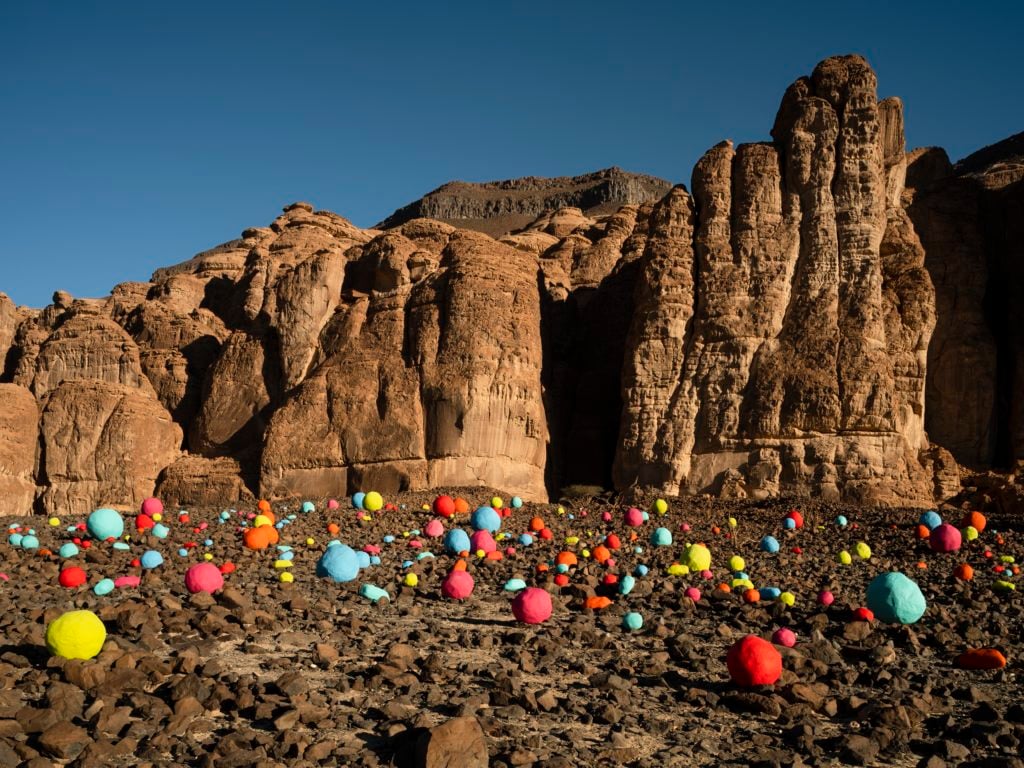
Mohammad Ahmed Ibrahim, Falling
Stones Garden (2020). Installation view at DesertX AlUla. Photo
by Lance Gerber, courtesy of the artist, Lawrie Shabibi, RCU,
Desert X.
Condemnations and Withdrawals
In October, Los Angeles Times art critic
Christopher Knight called Desert X AlUla
“morally corrupt” when it was announced almost exactly a year
after the murder of Khashoggi. Three of the show’s board members
resigned in protest: fashion designer Tristan Milanovich, curator
Yael Lipschutz, and artist Ed Ruscha, who, in an interview with the
Desert Sun compared the Saudi edition to “inviting Hitler
to a tea party.”
Since then no other board members have resigned.
“The Desert X board overwhelmingly supported the decision to
move forward with this exhibition,” Wakefield told Artnet News.
“The current board supports this program and believes that art has
the power to make change and foster dialogue and exchange.”
“I wish Ed [Ruscha] could have come to AlUla, attended the show,
gotten to know us and seen our work,” Muhannad Shono, one of the
participating artists, told Artnet News. “Many Saudi
artists are fed up with having to deal and respond to the bad
headlines. None of the western media outlets have asked me about my
work. All people want to do is talk about the controversy and not
the art.”
The perception, Shono continues, is that “what I am doing and
what other Saudi artists are doing is part of some propaganda
agenda. I am working on concepts and ideas that are in no way
scrutinized or censored. I am not part of some propaganda machine.
I am an individual artist that is excited to be part of all the
changes happening here. We want people to come and reach out to us
and see what the people are doing.”
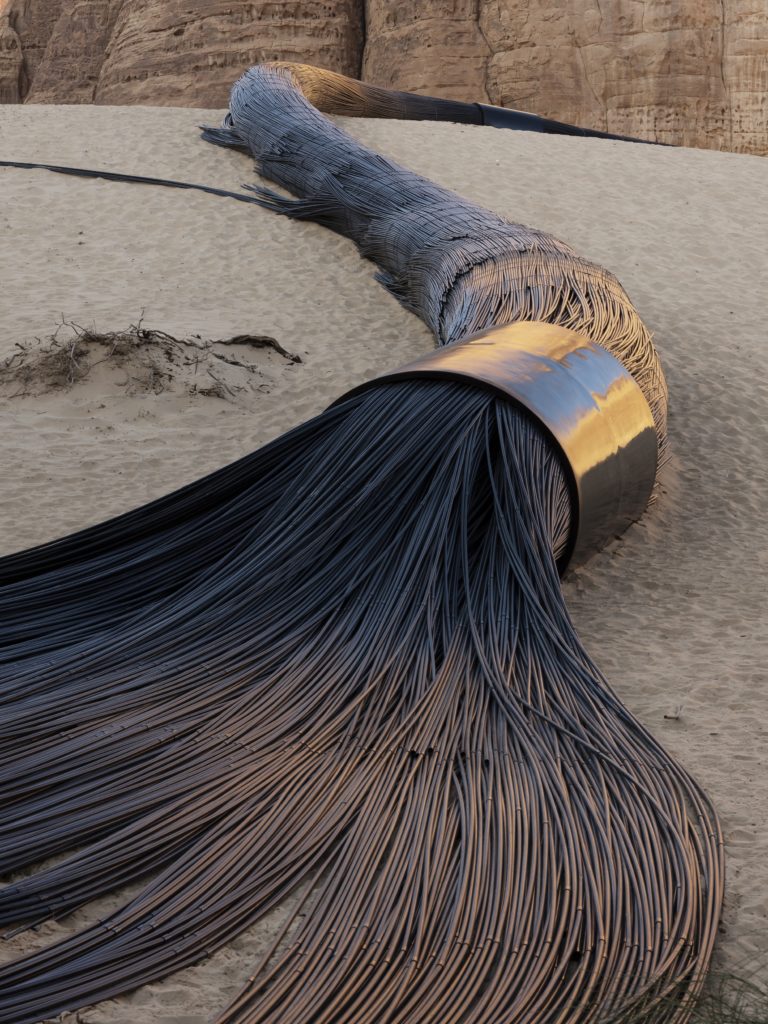
Muhannad Shono, The Lost Path
installation view at Desert X AlUla. Photo by Lance Gerber,
courtesy of the artist, RCU, and Desert X.
Shono will show a 984-foot-long sculpture made out of 65,000
pipes called The Lost Path (2020). “I want to inspire a
sense of adventure whereby the viewer discovers that finding their
own path and learning something about themselves in the process is
the ultimate treasure,” he explains. His use of pipes also serves
as a reflection on the oil they once stored, and how that oil,
according to Shono, “impacts change, policy, and decisions of
nations.” The material, he continues, “is like a stroke of ink that
allows me to make a sculptural sketch in the desert.”
Another hurdle has reportedly been the
timing.
“Desert x is a great initiative
because it brought regional and international artists together,”
says French-Tunisian street artist eL Seed. “However, it was very
challenging to install my work in just three weeks time. I
challenged myself and tried to match my ambitions with the beauty
of the place.”
Plans were revealed to the media on
October 7, 2019 in a press release. By that date organizers said
most artists had visited the site and were in the midst of
preparation of their works.
The hardship of mounting an outdoor
exhibition of large-scale works has nothing to do with the show’s
location, says Wakefield. “Regardless of where they take
place, by their very nature, site-specific shows come with
challenges and unknowns that artists chose to accept or not.
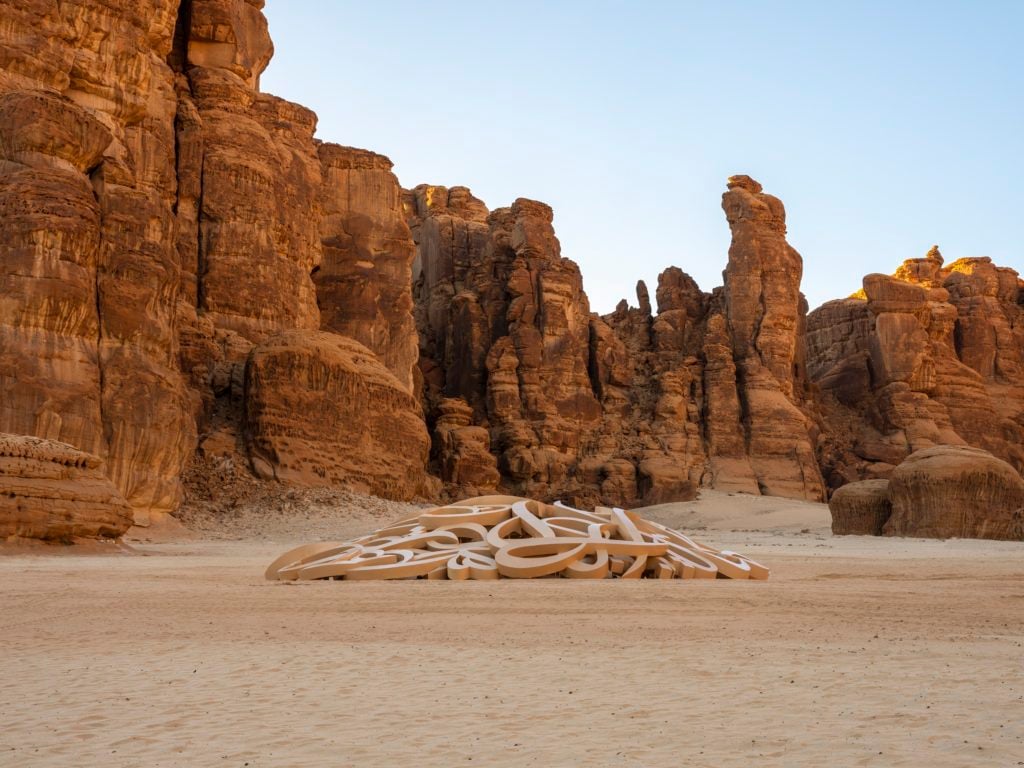
eL Seed, Mirage installation view
at Desert X AlUla. Photo by Lance Gerber, courtesy of the artist,
RCU and Desert X.
Part of the Problem or the Solution?
Some participants say that skipping the event would be a missed
opportunity to foster positive change in the region.
“The exhibition was always intended to be a cross-cultural
dialogue between artists from Saudi Arabia and its surrounding
region, artists from previous iterations of Desert X in California,
and from around the world,” Wakefield said. The artists who
previously participated in Desert X are Lita Albuquerque, Sherin
Guirguis, and Superflex.
“This has been confirmed by engagement with local communities,
which has included the participation of a group of women weavers in
Sherin Guirguis’s project, as well as workshops organized by
Sherin, Manal AlDowayan, and Zahra AlGhamdi that have brought local
women artists to site to preview the work and experience the
process of installation,” added Wakefield.
“The message from the local curators, artists, and long-term
collaborators was ubiquitous: change is necessary and coming,” said
Cristina Casals Soler of the Danish artist group Superflex, which
believes in visiting “unfounded territories, embracing different
cultures, exchanging different values and working in difficult
contexts,” Soler said. “The more difficult the context, the more
important it is to engage and to be present and empower those who
are determined to challenge the usual structures of power.”
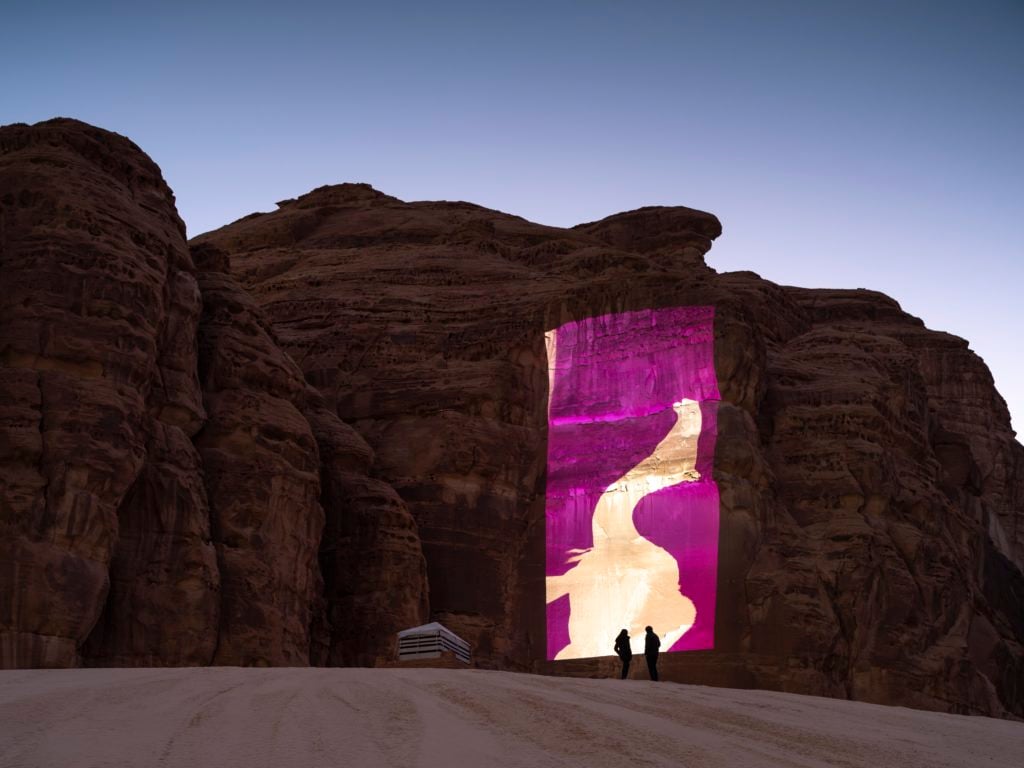
Wael Shawky, Dictums: Manqia II
installation view at Desert X AlUla. Photo by Lance Gerber,
courtesy of the artist, RCU, and Desert X.
In a country like Saudi Arabia, where 58.5 percent of the
population is under the age of 30, according to the Saudi General
Authority of Statistics, Desert X offers the opportunity to
influence and support the next generation in establishing its own
Saudi identity.
“This is the first opportunity of its kind in the kingdom,”
co-curator Raneem Farsi told Artnet News. “It wasn’t
part of our upbringing here to be exposed to all this art and
culture. Now, with the opening, it’s such a great opportunity. [The
exhibition] is so rich in its content. We want to elevate the art
appreciation.”
Los Angeles-based Egyptian-born artist Sherin Guirguis says she
“went back and forth” about whether to participate. “My work is
political and very much about freedom of speech and telling the
stories—the voices—of people who have been suppressed and
oppressed, whose work has disappeared,” said Guirguis. “I’m
interested in engaging with other artists and the people of AlUla,
of Saudi Arabia, and exploring what it means to make art under
these kinds of conditions.”
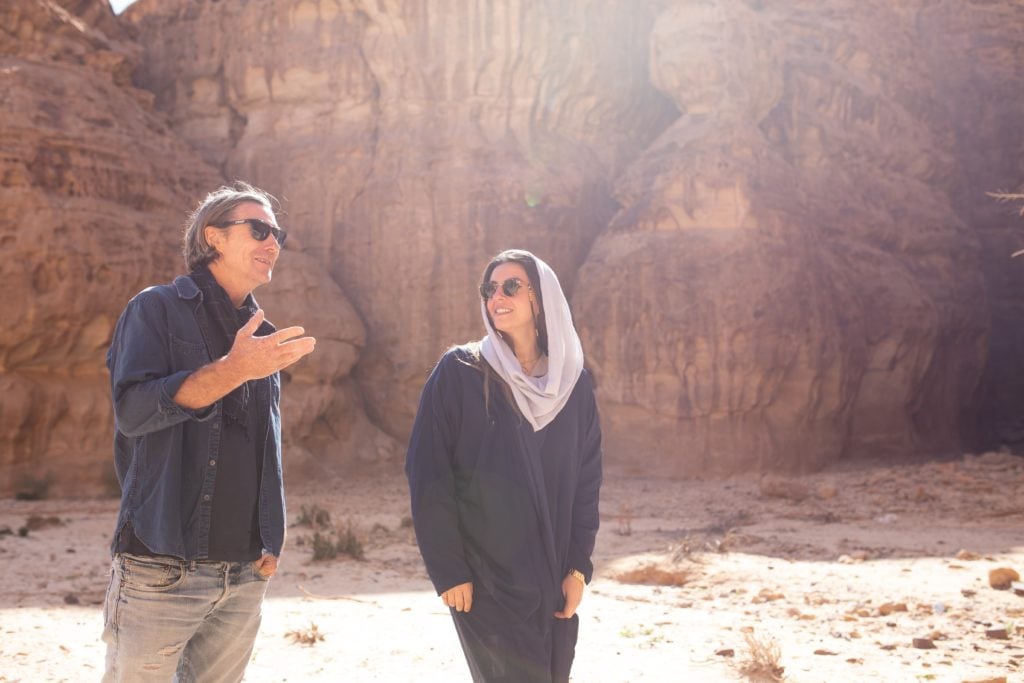
Neville Wakefield and Raneem Farsi,
co-curators of DesertX AlUla onsite. Photo: Noon Art © RCU.
Her installation, Kholkhal Aliaa, will look at the role
of cultural memory in shaping ideas of the present. It is wedged in
a rock crevice, and takes the form of a Bedouin anklet—a symbol of
female power and agency as well as a metaphor for travel, a
reference to the ancient days of AlUla and how the area served as a
place for trade.
The 2,000-year-old city of AlUla, situated nearby the desert
rock tombs made by the Nabateans, the pre-Islamic Arab people who
also built Petra in Jordan, has long been considered haunted,
occupied by Jinn or evil spirits. Today, the notion that
the Prophet Mohammad urged people not to enter is contested and
AlUla is open to all—Saudis and tourists alike.
Desert X, staged for the first time in this storied ancient
region, is also, in many ways, making its first appearance after
decades of silence on the world stage, and it’s debuting with a
clear message. “The reason everyone wants to do this, the artists
and myself, is to open up dialogue,” Wakefield said. “The common
voice among all the artists I’ve been working with has been, ‘If
you don’t give people the opportunity to change their hearts and
minds and become engaged with outside cultures, then you’re part of
the problem, not part of the solution.’”
The post ‘I Am Not Part of Some Propaganda Machine’: Artists
and Curators Defend Their Participation in the Saudi-Backed Show
Desert X appeared first on artnet News.
Read more https://news.artnet.com/art-world/desert-x-alula-preview-1763889
Further reading


Leave a comment