
‘I Don’t Think Art Should Learn Anything From Fashion’: Rising-Star Sies Marjan Designer Sander Lak on Why the Fashion World Envies Artists
Where is the line between art and fashion, and is it
shifting?
In a time when buzzy collaborations between artists
and designers have become de rigueur for major brands, when
fashion exhibitions are increasingly reliable museum blockbusters,
and when the distinctions between different creative fields are
being blurred—if not entirely erased—by a new generation of
talents, the question is more intriguing than ever.
To talk about this subject, you couldn’t ask for a
better interlocutor than Sander Lak, the visionary creative
director behind the white-hot fashion line Sies Marjan, whose
latest season is part of a fascinating and potentially
unprecedented collaboration with the architect Rem Koolhaas’s
current Guggenheim show, “Countryside, The Future.”
How does one collaborate with an exhibition? It’s
complicated.
First, a bit more about Lak. The Dutch designer was
born in Brunei and raised between Malaysia and Scotland. He spent
the early years of his career taking on increasingly prominent
roles at Phillip Lim, Balmain, and Dries Van Noten, before being
tapped in 2014 to start his own label, which he named Sies Marjan
after his father and mother’s first names.
Since then, his clothes, which are defined by
ravishing jewel-toned colors, cutting-edge materials, and
billowing, non-binary cuts, have been a critical and commercial
hit, winning him the 2018 CFDA award for best new designer and
raves in the fashion press.
As seems to be the trend these days, Lak has done a
few collaborations with artists like Tina Barney and Walter
Robinson, but his new project with Rem Koolhaas and the Guggenheim
is his most ambitious yet. For the first live recording of the Art
Angle, Artnet News editor-in-chief Andrew Goldstein sat down with
Lak at the Armory Show art fair for a wide-ranging conversation
about where art and fashion are today.
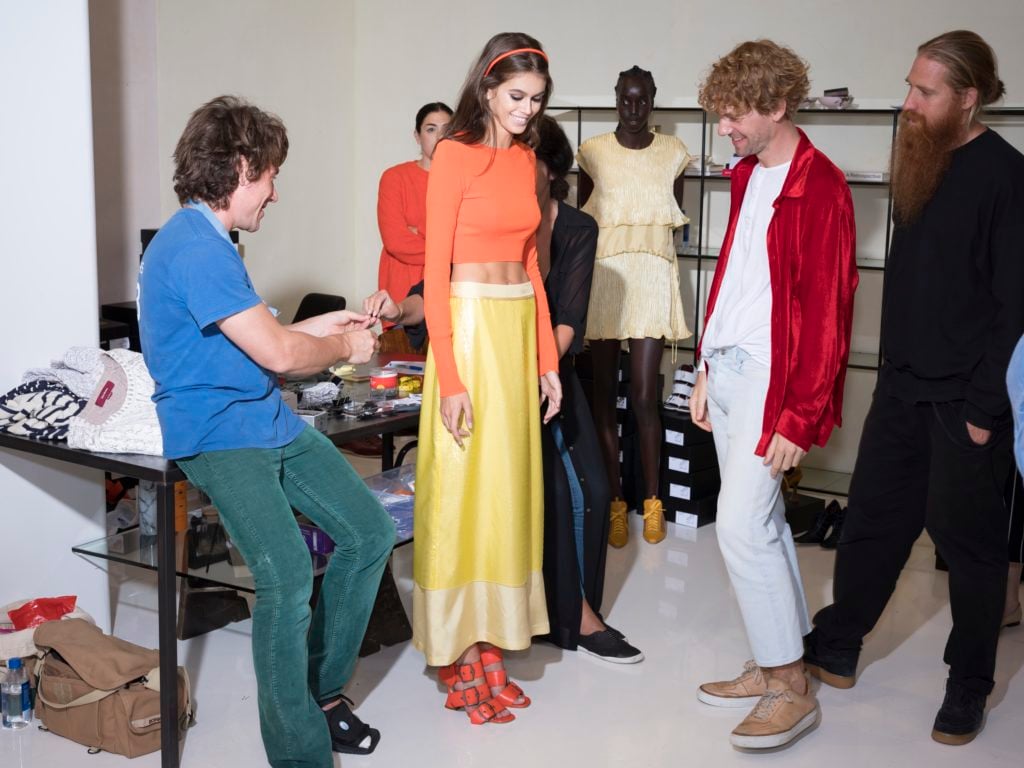
Sander Lak with models backstage at Sies
Marjan fashion show. Photo © Tina Barney.
You collect art, your mom is a painter, you have
collaborated with artists, and I believe you met your boyfriend at
the Met gala. So how does art fit into your life?
I always kind of considered fashion the industry that really
takes from everywhere else, because of the pace we have to create
things. Art, from a professional point of view, is something I
can tap into quite easily for my work. I’ve always wanted to be an
artist, but very quickly I realized that is not what I’m good
at.
I like seeing it, I like experiencing it, I like working with
it. But I’m actually not an artist. What I do is much more applied,
and I like the restrictions of the industry that I’m in.
You studied fashion at Central Saint Martins in London.
Did you ever try your hand at studio art?
When I was younger, before I discovered fashion, I was always
drawing or creating something. But I’m very critical and I’m very
Dutch in this way. I know exactly what is working and what isn’t
working, and I saw very quickly I’m not an artist.
So right now you’re expressing yourself through a new
fashion collaboration with Rem Koolhaas in the Guggenheim. How did
that project happen?
About a year and a half ago, we were put in touch through some
people and then Sies Marjan decided to sponsor the exhibition. I
knew then that I had access to Rem and his team and that I would be
able to do something with them.
Just to give you a little bit of context for how things usually
work in the fashion industry: you do about a gazillion collections
a year, and every week is finalizing something else, every month
another collection comes out, so you’re really working from
deadline to deadline. There’s really never that much time to think,
so this was interesting because I had literally six months just to
think about what I wanted to do with this, and then six months to
research and communicate with Rem and then translate what he was
doing into what I am doing.
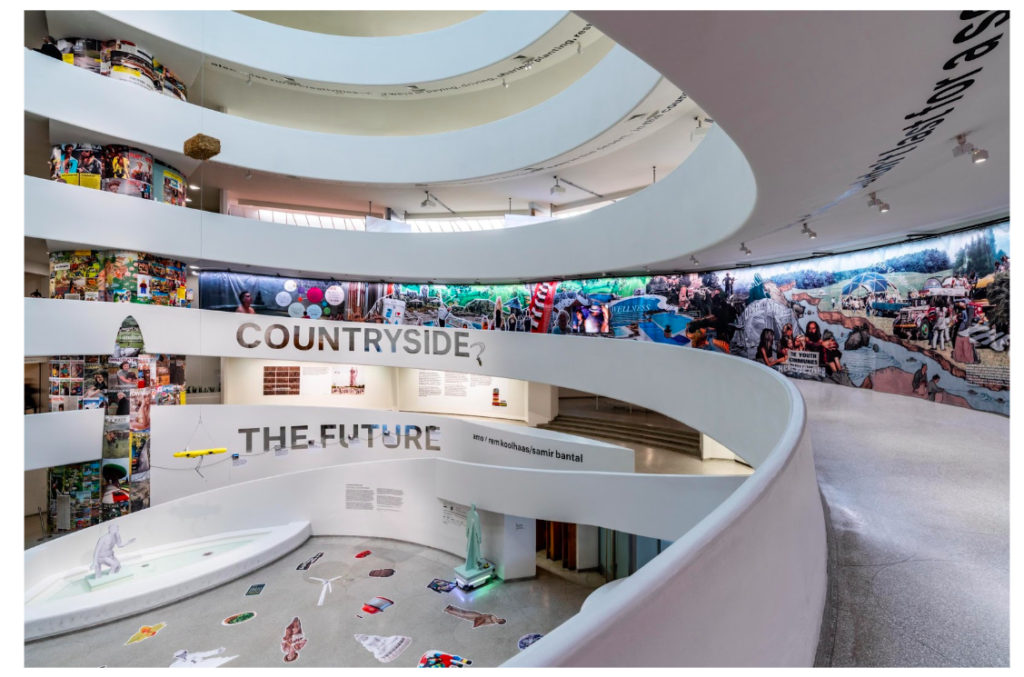
Installation view of “Countryside The
Future” at the Guggenheim. Courtesy of the Solomon R. Guggenheim
Museum.
This is a very high-concept exhibition. Rem Koolhaas
realized that the countryside is this entirely forgotten dimension
of contemporary life, where everybody is thinking about
cities—which occupy about two percent of the surface of the earth
and by 2025 will contain 70 percent of its
population. How do you take that big topic
into a fashion collection?
I admit that was really the challenge, and I have to say—and Rem
knows this because it’s the first thing I said to him—I would never
have picked this subject myself. It’s just not a fashion subject.
But that’s why it’s really interesting because it’s so wide and
very hard to speak about.
Initially my interest was that his agency OMA was conducting an
eight-year research project into the Guggenheim, and that gave a
new twist to how I was approaching the project. Thinking about how
I work, how I never have any time, I suddenly realized I needed to
use this time to do the same—to pretend I’m doing a research
project where the end result will be a fashion collection instead
of an exhibition.
And did you and Rem have a dialogue while you were
working?
Yes, absolutely. Sies Marjan is really known for our use of
color, and it was interesting because the first thing Rem wanted to
discuss was color. Of course, he thinks about color in the context
of space, whereas I talk about color that goes on your body, so I’m
talking about skin colors and body shapes. So there are these
differences, but also clear similarities between what we do.
When I went to visit his studio, like a piece of stone next to a
piece of metal that he was probably putting together to think about
what would look nice in a building. It’s exactly the same in my
studio, there’s a piece of fabric next to a zipper next to a
button. These are the ingredients I play with.
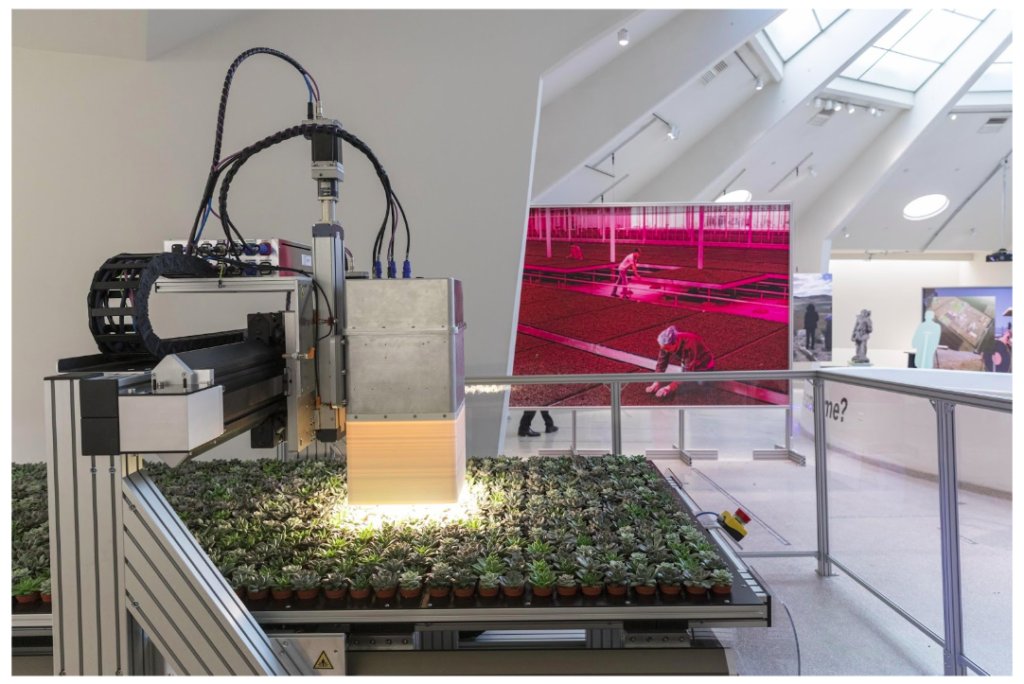
Installation view of “Countryside The
Future” at the Guggenheim. Courtesy of the Solomon R. Guggenheim
Museum.
What were some of these bigger issues you discussed
between architecture and fashion?
When he starts a project it can take 10 years, it can take 50
years. And he was talking about how he and his team have so much
time they start questioning things. And for me, it’s the other
way around, where I’m like, “oh my god, I have one week to do a
whole thing.” And I have no time to really reconsider things. I
just have to go, go, go.
So how did you approach this show? What were some of the
ideas and entry points you used to tackle this big
idea?
The first thing we always do with a collection is start with a
color card. So I started with a color card based on the
visuals from the research they did. From there, I began [thinking]
about what angle I was going to take. Should it be something purely
about sustainability? That was initially my first reaction, but it
became very clear that the exhibition isn’t directly about
sustainability, it’s about countrysides—a much wider subject.
I did want to make sure we were conscious of [sustainability]
because it’s a sensitive subject, and the fashion industry doesn’t
always get it right. So I wanted to make sure that there were
elements of that, but also to make something inspiring, about the
beauty of what people can make and how nature can be used to
create.
You’re working with Rem now, who has a bit of a
reputation as an environmentally conscious designer. But do you
have any more concrete plans in terms of
sustainability?
Well, to start, the best thing is to not do it at all. If I
really want to be sustainable, I should just quit, because that’s
the nature of producing anything. What I can do is make sure that
the footprint we have as a company, as a business, is as small as
possible. All of the usual suspects like recycling, not using
plastic, et cetera, we do all of those things. Outside of that,
this collection has really taught us a lot about the different
kinds of fabrics we can use, and that there are versions of fabric
that are partly recycled or even 100 percent recycled that work the
same way. But there is a certain limitation, in reality, as a
fashion brand.
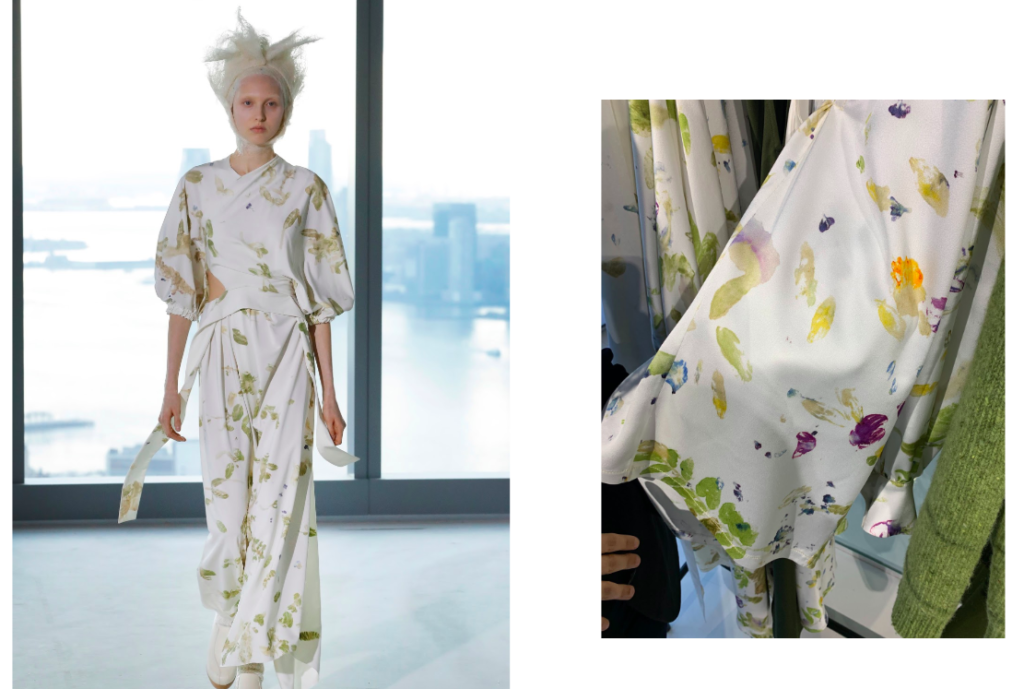
Looks from Sies Marjan’s Runway Fall
2020 line. Courtesy of Sies Marjan.
You take a high-tech approach. You have an ensemble that
you created with scientists and technicians at Cornell University.
Can you tell me about that process?
At Cornell they have a department that specializes in all things
related to natural dyeing and fibers. One of the techniques is
called contact drying, which is when fabrics are prepared to take
whatever you put on top of them, they absorb the color and the
fibers of the plants and flowers you put on top. That’s an
exhausting and time-consuming process, and of course the reality is
that it’s just not possible to commercialize it with the timeline
we have. So we made a digital version of it to give the feeling,
but also to communicate the message without it being pure
couture.
Some of these things are so advanced and require so much human
skill and labor, that it’s just not ready-to-wear anymore, it
becomes couture.
Another approach you took was to work with a very
interesting wool artist. What did that entail?
Yes, Claudy Jongstra is her name, and she’s an artist who
boils and washes these blankets made from wool. There’s no
practicality to them really, it’s purely a visual vehicle, but you
can make beautiful garments out of them.
Cindy has a lot of sheep and she literally just waits for the
hair to fall off naturally, and then she collects it until she has
enough to make something with. She donated the blanket to us and we
made a garment and some pillows. Again, the process, isn’t really
ready to be produced for fashion yet, but it is something that
demonstrates the beauty of some of these crafts.
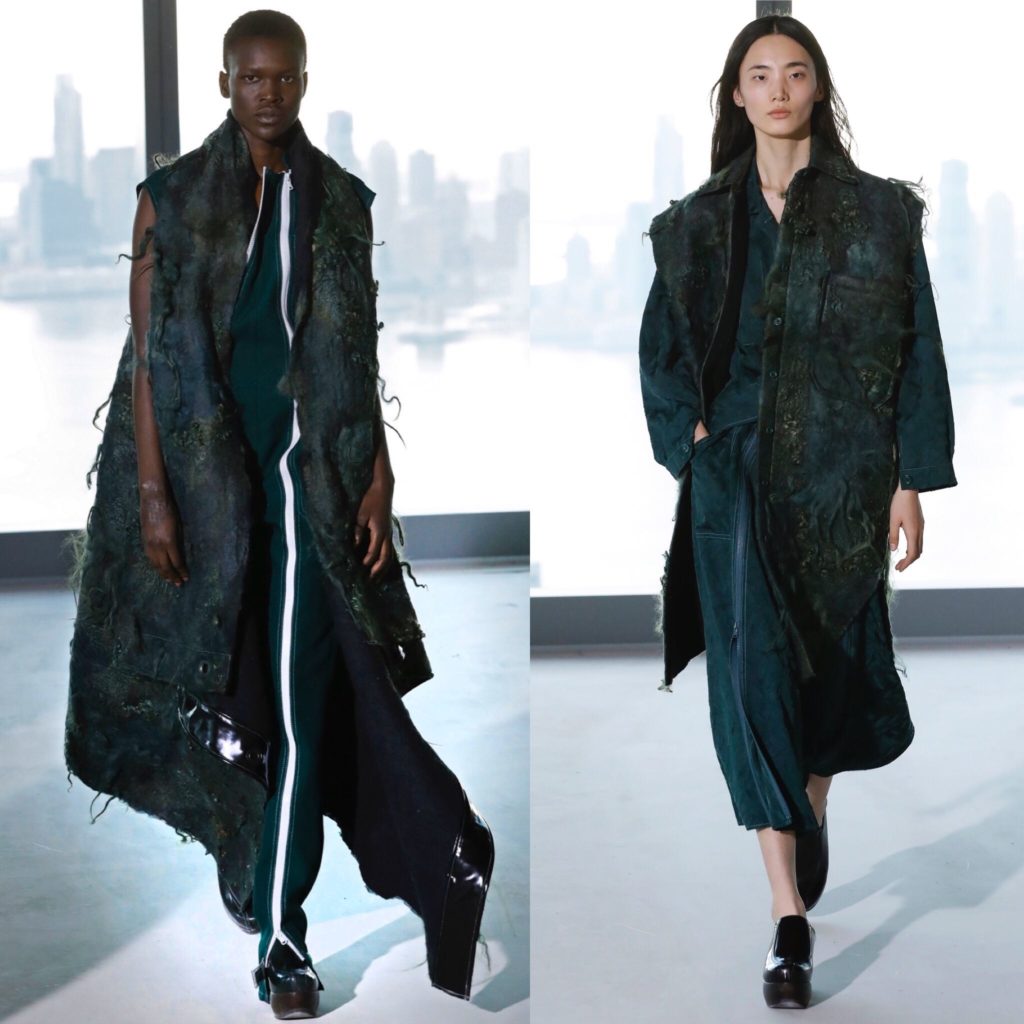
Looks from Sies Marjan Runway Fall 2020.
Courtesy of Sies Marjan.
And Diane Scherer, who specializes in manipulating plant
roots into intricate patters, can you describe that
collaboration?
She works with a university in Holland and she’s been trying to
figure out a process to grow fabrics. So basically what she does is
grow a sheet of grass, say, and then when the roots are strong
enough the top layer of the soil and the grass is chopped off and
the roots become a leftover film.
It’s not yet a fabric, it’s very fragile, just dried roots that
are really thin and delicate. She’s working to biologically
manipulate them so that you can eventually wash and dry clean them,
but it’s not there yet. Still, we wanted to play with it, so we
fused a layer over cashmere and it became a really incredible
look.
So an architect, a root artist, a wool artist—this is
clearly very hybridized terrain. Let’s pull things apart a little
bit. What is the difference between fashion and art? Is fashion
art?
I don’t think there’s a right or wrong answer, so I can only
share my personal opinion: I’ve always said no, fashion is not
art.
The limitations and frames you have to work within in fashion
are so limiting that it constricts the freedom I think you should
have when creating art. Just in the same way painting is not
necessarily art if it’s just made for a living room to hang above a
couch. If that’s the goal of making a painting, then for me, that
is not art either.
Is it design then?
Yes, it’s design. And I don’t believe that art is higher than
any other thing, it’s just apples and oranges. They’re all fruits,
you know?
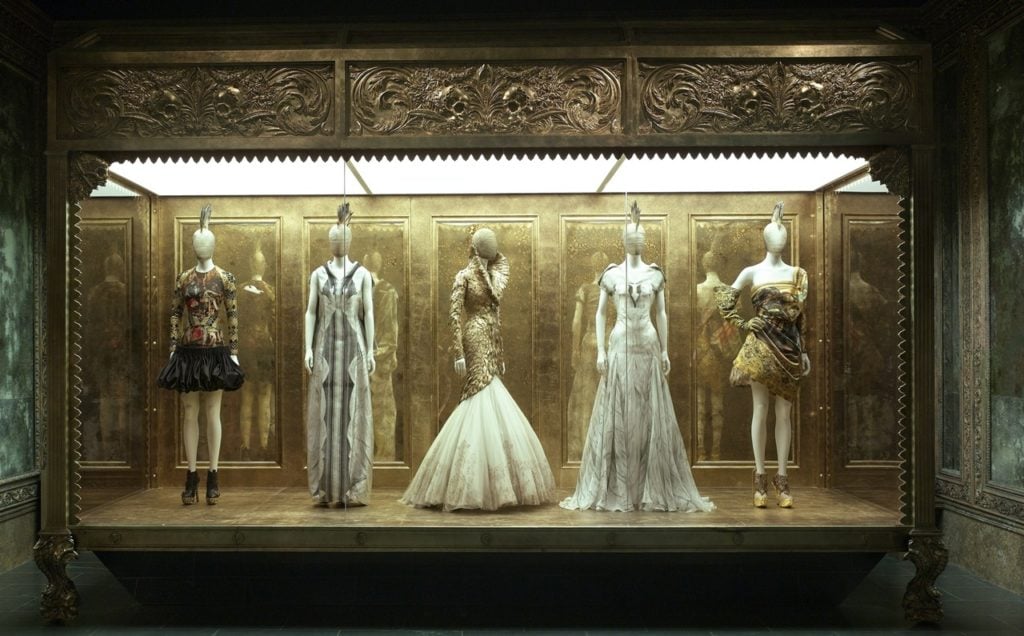
Exhibition view, “Alexander McQueen:
Savage Beauty,” at the Metropolitan Museum of Art, New York.
What about all of the shows like Armani and Alexander
McQueen that are in museum spaces?
I think just because you put something in a museum doesn’t make
it art. It becomes appreciated from an art angle, but the thing
itself, even if it is there, is still a garment, in my opinion.
McQueen is somebody who touched this sphere between art and fashion
absolutely, he’s probably one of the very few who I feel really
really had the brain of an artist and applied it to fashion.
But again, with my rules, which are not the right ones
necessarily, the clothes are made in the end to be worn, and to
make money off of. So it’s an applied form in that sense.
There is also an economic rationale behind all of these
fashion exhibitions, because not only do they get sponsorship, but
they also routinely draw blockbuster crowds.
Again, it’s an ecosystem. The prestige of being in a museum for
a fashion house is good. But at the end, you know, it’s a business
and so it’s a win-win in that sense.
The ancient term for art is techne, which
just means very high and refined skill. And just as you’re talking
about working with these artisans on making exquisite but
impractical pieces of clothing that you can’t actually wear, that
seems to shade into a definition of art as something impractical
and non-functional.
It’s playing with it for sure. You know, fashion plays and rubs
and makes love to everything because we have to use everything.
That’s what I love about fashion, it’s just shamelessly sleeping
around with every other art form because we have to produce so much
stuff.
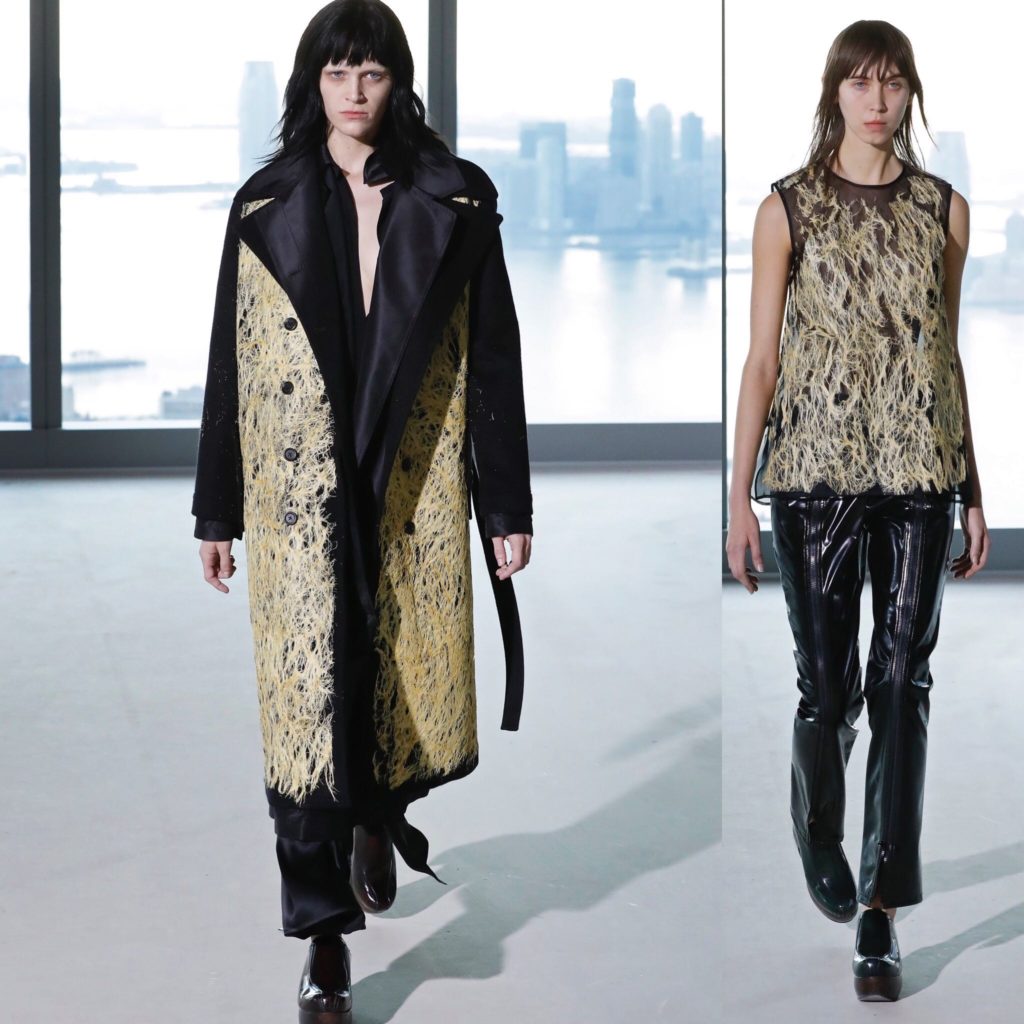
Looks from Sies Marjan Runway Fall 2020.
Courtesy of Sies Marjan.
Well you’re not the only designer sleeping around with
art right now. Designers like Virgil Abloh and Tom Ford are making
art and artists like Sterling Ruby are making fashion. Chanel just
hired the former CEO of the Serpentine Galleries to be its new
global head of art and culture. There seems to be a tremendous
amount of activity between these fields. Why do you think there is
such a proliferation of this activity right now?
Because we need each other. There is no art fair without fashion
week, and there’s no fashion week without an art fair. When you
look at who your customer is: where are they going? What kind of
gallery? What art do they buy? It’s all tapping into the same
thing. For galleries too, they look at what someone is wearing,
what is the brand, what are the shoes like, are they designer? It’s
all tapping into the same idea.
These are not the easiest times, so we all need to rely on each
other in a certain way. Sometimes it happens really beautifully and
sometimes it’s really nasty, but it is all connected, and there’s a
big economic component to this as well.
Do you think the fashion world sees the art world and
thinks, okay, this is a clientele that I want to approach by
nodding to the art aspects? Is it a form of marketing?
Absolutely. And in a way it makes sense, because if you think
about where people spend their money, whether you’re a gallerist or
a designer, it’s the same thing. It becomes very clear that someone
who spends $3 million on a painting, most likely that person
wouldn’t flinch at a $20,000 dress, you know?
What do you think fashion can learn from the art
market?
I feel like there’s an art fair every week. I’m sorry, I
probably should not say that here, but there’s a lot of urgency
happening in the art world. Again, when you’re looking at it from a
business point of view it’s different.
When I look at artists, there’s a lot of things fashion can
learn: the fact that artists keep to their own schedules and their
own artistic process, for example. When it comes to the business of
art and the business of fashion, I think they’re becoming quite
similar.
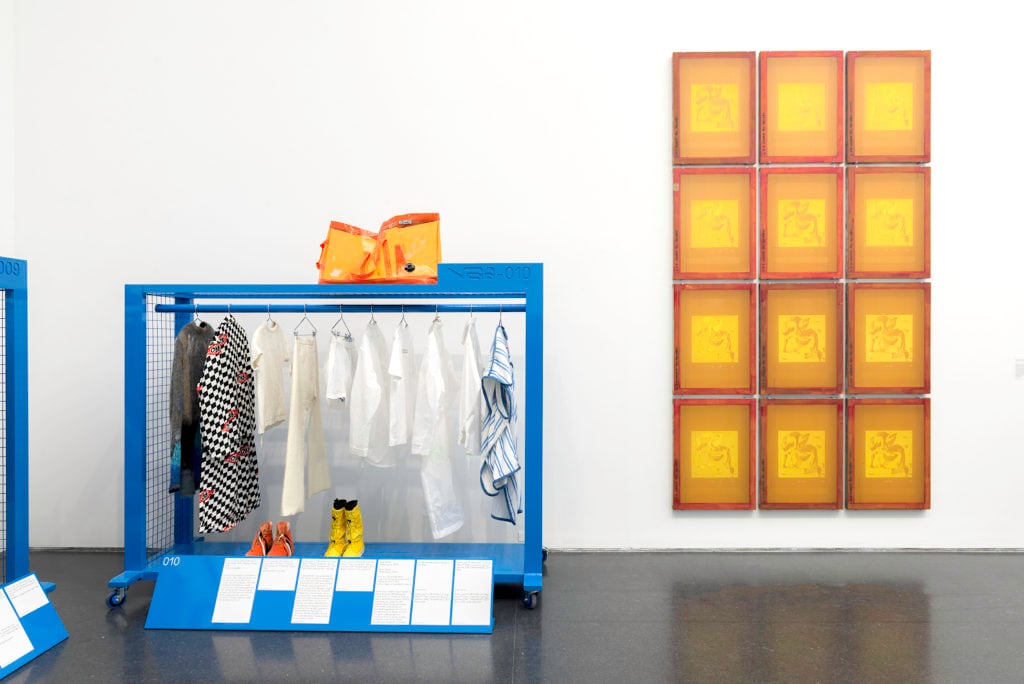
Installation view, Virgil Abloh:
“Figures of Speech”, MCA Chicago. Photo: Nathan Keay, © MCA
Chicago.
And what do you think art can learn from
fashion?
I don’t think art should learn anything from fashion. I think
art should be more itself, it should not look at fashion. Fashion
should look at art, fashion should look at everything and sleep
around with everything. Art should maybe close its eyes to
fashion a little bit more, and as I’m saying this, I may be
shooting myself in the foot because obviously I’m also tapping into
it.
You’ve brought this up a few times, that you feel the
cycle of the fashion world is oppressive in some ways. Now that
you’ve tested this year-long timeline working with the Guggenheim,
is there a way you can actually incorporate that more sustainably
into your practice?
Yes, I’m trying to. I said to my team how liberating and freeing
it was after finishing this collection.
I do think there are ways that I can make decisions earlier, or
really stick to an idea before instead of lingering around and
waiting until the last moment. I think honestly that’s the only way
forward because I was getting really tired. Sies Marjan is a part
of my career but I’ve been in the industry for a long time.
I’ve been in the rat race for a while, and before the
collaboration with Rem Koolhaas I was getting exhausted—not like I
need to sleep, but creatively exhausted. I was tired of always
having to one-up myself creatively, when I do something three
months later it has to be better than before and sell better than
before, it has to look better, get better reviews, and if you win
an award once you have to win it again the next year. So this
project really gave me a new energy in a way.
What do you make of these multi-hyphenate fashion
designers like Virgil Abloh who have been broadening their scope
from fashion into music, furniture design, and art
museums?
I think it’s incredible that he is able to do that. If you do
too many things I think at some point something’s gotta give. When
I put my energy into something I really put everything into that
one thing, so it would be hard for me to dabble a little bit here
and there.
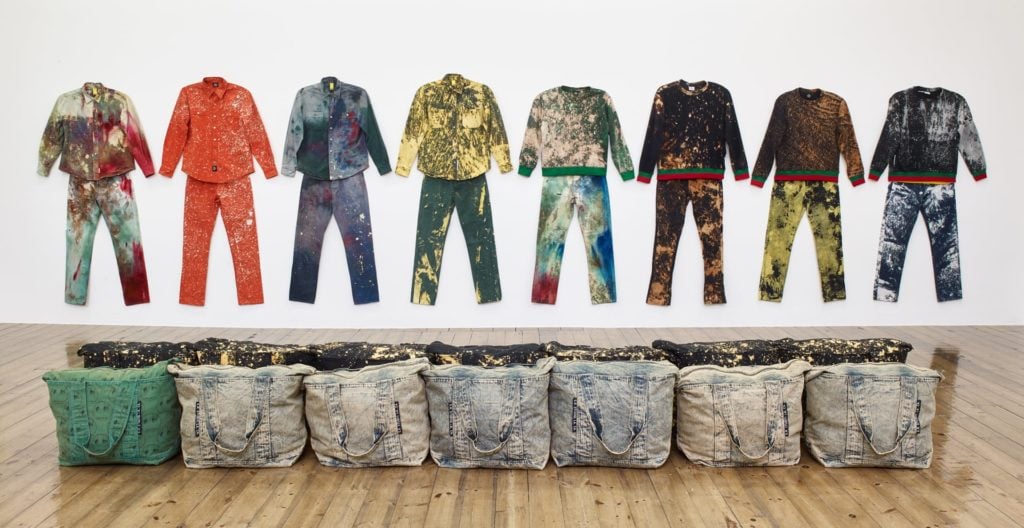
Installation view of Sterling Ruby’s
2016 Sprüth Magers show, “Work Wear: Garment and Textile Archive
2008–2016.” Photo courtesy of Sprüth Magers.
What do you think about the other side of the equation,
where Sterling Ruby is working with Raf Simons and now going out on
his own?
That’s great, I think that is a more unusual route and therefore
a really great thing to happen. I’m curious to see where that goes,
and what the business model is behind that. Everyone is very much
on their own right now, and if fashion is very much about the rules
and relationships you had, now it’s everyone for themselves. There
are a lot of people who are using that to their advantage, and I
applaud that.
At the same time people are playing by their own rules,
there are a lot of trends that are very visible. If you walk
through an art fair you’ll see variations on neo-Mannerism in
painting for example. What do you see in fashion that are the
interesting trends?
That’s sort of like asking an artist what the trends are in art.
I don’t really pay attention to that, I would like to think the
trends happen from the work that I do, and not that I am following
the trends.
I do watch trends in a broader sense from a business point of
view in terms of spending patterns and what people are listening
to, watching, reading, all of that stuff. Fashion is a cultural
sponge in that way. When it comes to the trends in fashion, I
really don’t know.

“The Ultimate Sneaker Collection”
auction at Sotheby’s in New York City. (Photo by Dia
Dipasupil/Getty Images)
One trend we’re noticing in the art world is the huge
interest in sneakers and athleisure. Last year, Sotheby’s had a
sale of sneakers that sold collectively for over $1 million, and it
seems as though the art world is identifying these sneaker
buyers as potential new art collectors. How do you see that from a
fashion perspective?
Well it’s going back to what you were saying about the art world
tapping into future customers in the fashion world. I think I can
speak to the trends that have happened in the past, and there has
been a resurgence in streetwear and everything related to what we
can call day wear. There’s been a normalization of fashion that has
happened over the last five or six years, and the holy grail are
the sneakers.
The idea of designer sneakers is relatively new; for a long time
sneakers were sneakers, and that was it. And then fashion saw an
opportunity, like they always do, and tapped into it. Hermes makes
a sneaker that costs $2,000. People thought it was a bubble, but I
don’t think that’s the case, I think that’s just the reality of
what’s happening now.
How do you think the fashion world will be affected by
the coronavirus pandemic?
Well, one of the direct results is in this room right now: my
head of fabrics came back from Italy and was quarantined for two
weeks. She’s out now, she’s alive and well, but that is definitely
one of the first things that happened for us. Like everyone in the
industry, we had people in Europe because of fashion week,
everything was happening there. There was a big fabric fair in
Italy and that’s when it started to get really bad there.
We had to take certain measures, and as a small company it has a
really big effect when you know, one person is not there. We work
with Italy a lot, we work a little bit with China and all around
the world. We were seeing buyers afraid to go to Paris, and again
this is happening for everyone, not just at Sies Marjan, it really
is, for lack of a better word, a shit show. Hopefully we will all
be able to recover from it, but we don’t know.
The post ‘I Don’t Think Art Should Learn Anything From
Fashion’: Rising-Star Sies Marjan Designer Sander Lak on Why the
Fashion World Envies Artists appeared first on artnet
News.
Read more https://news.artnet.com/art-world/sander-lak-interview-1807791
Further reading


Leave a comment