
‘I Felt This Is the Essence of Life’: Watch Wolfgang Laib Explain How He Makes His Meticulous Art Out of Pollen and Beeswax
For most of us, packing as many
activities, meetings, phone calls, and outings into a single day
directly correlates to personal success. Not so for German artist
Wolfgang Laib.
In fact, he’s spent not just
hours, but “days and days” in a dandelion meadow, collecting
pollen and soaking in the atmosphere. He knows it’s unconventional,
telling Art21 in an exclusive interview that his
art is “something totally different than what our society thinks of
what you should do or what you should achieve in an hour or a day
or a month.”
The lack of understanding doesn’t stop Laib though. If anything, it
propels him further into a more dedicated, almost monastic artistic
practice, rooted in study of the Taoist philosopher Lao Tzu, the artwork of
Constantin Brancusi, and past travels to India and around
Germany.
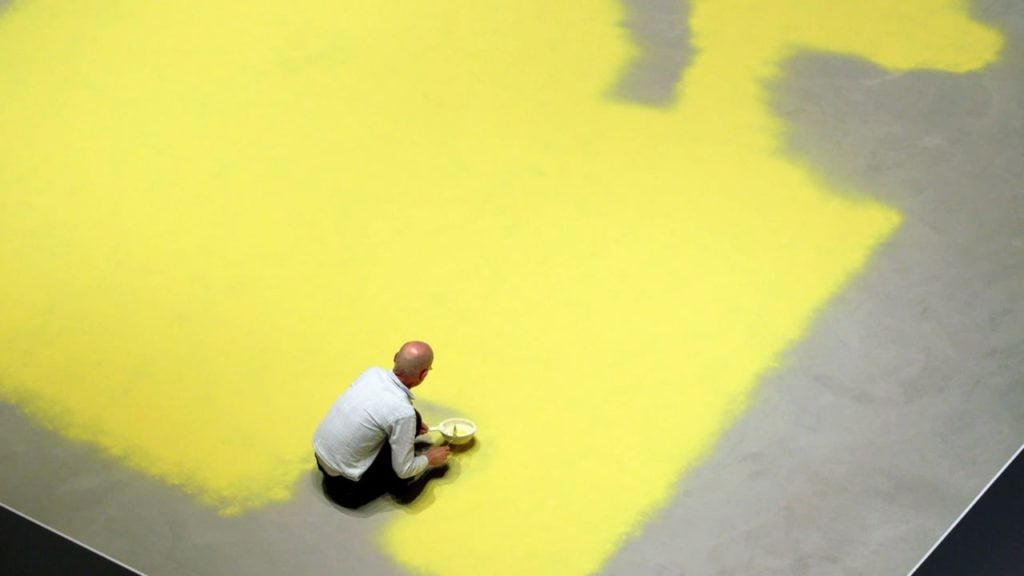
Production still from the “Legacy”
episode of “Art in the Twenty-First Century,” Season 7. © Art21,
Inc. 2014.
In the interview for the Art in the Twenty-First
Century series, we see Laib crouched over a blank floor at the
Museum of Modern Art, painstakingly constructing a perfectly even
square by sifting pollen onto the ground. “For me,” he
tells Art21, “the pollen is the beginning of the life
of plants… and not less.” Given his interest in philosophy and
nature, it makes sense that Laib is drawn to using organic
materials like pollen, which he harvests from dandelions and
hazelnuts, beeswax, milk, and wood.
“I had this drive to show this as soon as possible to as many
people as possible in the world,” he explains of his deep
connection with nature. “I felt this is the essence of life and
this is something which holds the world together.”
One of the works he describes is a stepped-pyramid made from
beeswax with the title Ziggurat, in reference to
the Mesopotamian structures. “It
was always very beautiful that you can do something today, in the
21st Century, which is not an imitation, but which has a connection
to art which is 4,000 years old,” he says.
Laib’s works have an aura of spirituality and an appreciation
for the harmonious relationship between the natural and built
worlds. Right now, a series of his pollen works are on view at
various historic locations around Italy, juxtaposed
next to Renaissance buildings and chapels, collapsing the physical
boundaries between past and present.
Watch the video, which originally appeared in
the Art in the Twenty-First
Century series, below. “Wolfgang Laib: Without Time, Without Place, Without
Body” is on view at the Magi Chapel, Palazzo Medici Riccardi;
Rucellai Chapel, Marino Marini Museum; and Pazzi Chapel, Monumental
Complex of Santa Croce; through January 26, 2020.
This is an installment of “Art on Video,” a collaboration
between artnet News and Art21 that brings you clips of newsmaking
artists. A new season of the nonprofit Art21’s
flagship Art in the Twenty-First
Century television series is available now on PBS. Catch
all episodes of New York Close
Up and Extended Play and
learn about the organization’s education programs
at Art21.org.
The post ‘I Felt This Is the Essence of Life’: Watch
Wolfgang Laib Explain How He Makes His Meticulous Art Out of Pollen
and Beeswax appeared first on artnet News.
Read more https://news.artnet.com/exhibitions/art21-wolfgang-laib-1731093
Further reading


Leave a comment