
‘I Just Try to Leave Myself Open’: Legendary Art Journalist Calvin Tomkins on How He Cracks the Secrets of the World’s Greatest Artists
Getting his start in the frenetic hotbed of artistic creativity
that was postwar New York, the art journalist Calvin Tomkins
couldn’t have found a more chockablock scene to explore for the
history-making profiles he wrote for the New Yorker.
At the same time, the artists he profiled—ranging from Marcel
Duchamp to the Jasper Johns/Robert Rauschenberg/Merce Cunningham
group to, later, Cindy Sherman, Chris Ofili, and other modern-day
art stars—could not have been luckier. In Tomkins, these artists
not only found a chronicler, but a true understander, someone whose
reporting could pick up the conceptual threads and tease out the
real-life backstory necessary to nestle their great art in an
all-important context. His profiles make artists human, allowing
other humans to understand their art.
But how does he do it? And why do these secretive artists let
him? Here, in the conclusion of a two-part interview,
Artnet News editor-in-chief Andrew Goldstein spoke to the veteran
94-year-old journalist and author about how he goes about plying
his mysterious and enlightening trade.
You can listen to a condensed version of this
interview here on Artnet News’s Art
Angle podcast.
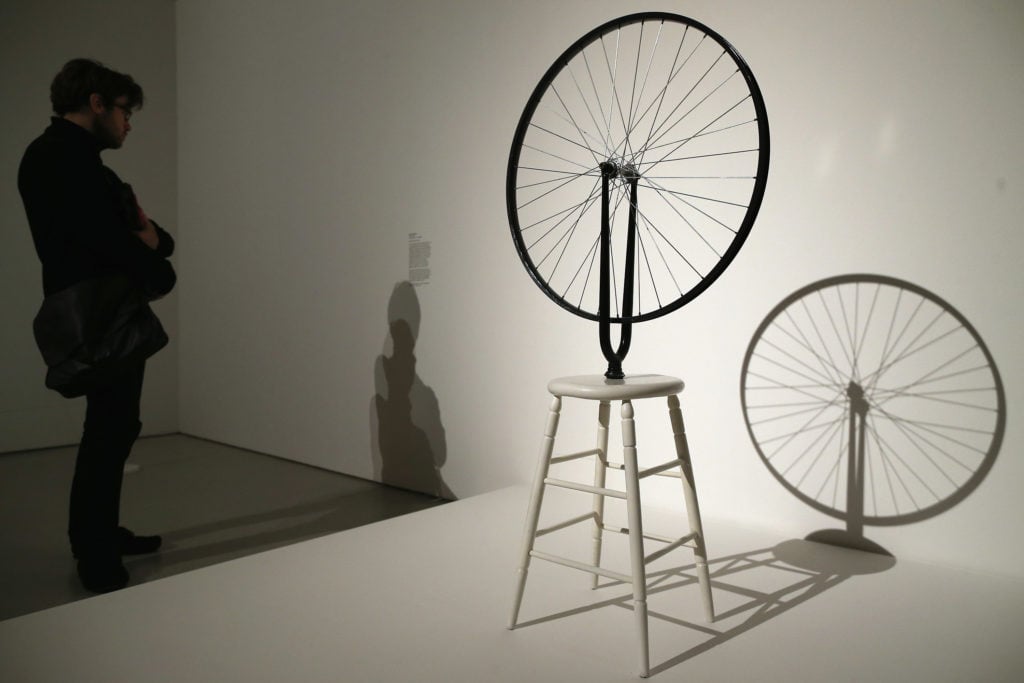
Marcel Duchamp’s Bicycle Wheel.
Photo by Dan Kitwood/Getty Images.
Let’s talk about your own art, which is the art of the
profile. How do you go about choosing who you want to profile? And
then, after you make that choice, what is your process from
there?
In my case, it was always a matter of one thing leading to
another—the [Jean] Tinguely profile led to [Robert] Rauschenberg,
which led to John Cage and Merce Cunningham, and back again to
Duchamp. I didn’t think about this beforehand, but it just so
happened that these first artists had many of the same approaches
and ideas about art. And I think a lot of this came from Duchamp,
although each one of them had reached his own way of working before
being really aware of Duchamp. Bob Rauschenberg and Jasper Johns
went down to the Philadelphia Museum in the ‘60s to see the
work—they had never seen it before.
Duchamp had sort of been forgotten, but they had somehow gotten
on the same wavelength—that art was maybe not what people had
thought it was, or that it could be different. It could involve
change; it could involve chance measures. And Duchamp had opened
this up, of course, with his “Readymades,” which are common
manufactured objects that are transformed into art by the artist
who chooses them and signs them. Although in Duchamp’s case, he
never thought of them as art objects. He said that he chose them
with absolutely no aesthetic, because they had no aesthetic
appeal.
Years later, he was having a public conversation with Alfred
Barr of the Museum of Modern Art, and Barr said, “We know that
you’ve always said that the ‘Readymades’ have no aesthetic appeal,
but why is it that some of them—quite a few of them—are now so
beautiful to look at?” And Duchamp said, “Well, nobody’s
perfect.”

The editor of the New Yorker, David Remnick,
has compared you to a “portraitist” in the way that you go about
your work—which is a very specific term to be using when talking
about an art journalist. As somebody who has studied more than a
few portraits over the years, what do you think are the necessary
ingredients for creating a true and lasting portrait of an
artist?
Rauschenberg always spoke of his work as a collaboration with
materials—he didn’t want control, he didn’t want to make one thing
subject to another, he didn’t even want to choose colors. By giving
up control in that sense, he and the other artists felt they were
working in a new field of human awareness, that what they were
doing was experimentation and you didn’t want to try to control
where it was going, because they wanted to go beyond art, or beyond
where art had been.
So, from Rauschenberg, I got this idea of art as a
collaboration, and I thought to myself, “Why can’t profiles be
thought of as a collaboration?” And this became one of the things
that I looked for—artists who I felt could be interested in this
idea of collaborating, of exploring territory that maybe that they
hadn’t explored themselves, and finding out new stuff. But aside
from that, I’ve never had any theories about how it could be done
in every profile. Almost every profile has been unlike the last and
a certain strain of personality can lead to a different tempo of
writing. I just try to leave myself open enough to pick up the
sometimes-unspoken currents.
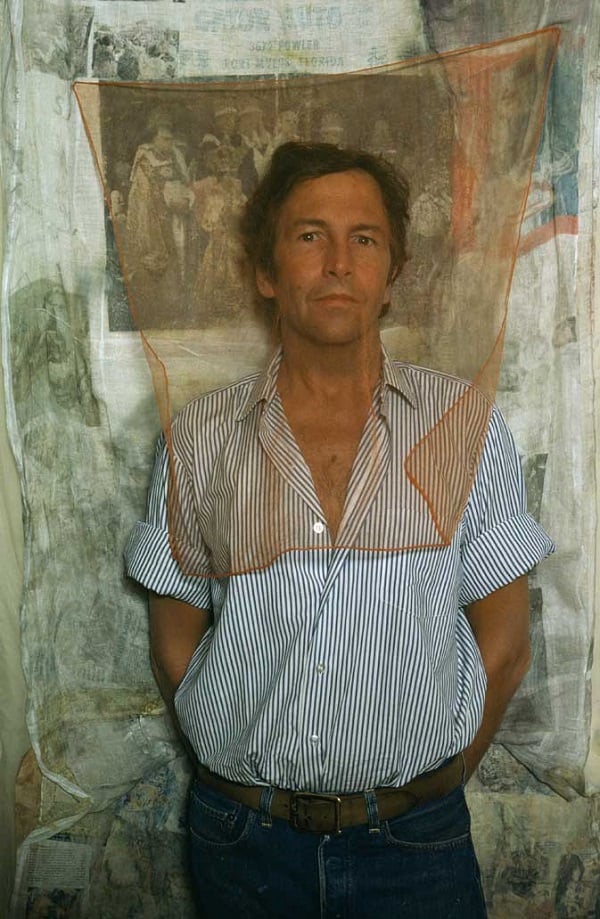
Robert Rauschenberg (1974). Image:
Photograph by Art Kane/arttattler.com
That’s a fairly profound theory of profile writing.
Because here you’re saying that Cage, Cunningham, and Rauschenberg
were welcoming chance into their creative process so that one plus
one could equal five, and then you’re the journalist coming into
their studio to draw what you can out of them and add the details
of everyday life that you’re able to imbue into their creative
process, generating a result that is incredibly additive to the art
itself. Is that something that you’ve found works?
Yes, I think it works. And I think it goes along with the kind
of learning curve that each and every profile is. It’s a learning
experience for me and maybe sometimes for the subject—we’re not
coming at it from fixed positions. We’re not talking a lot about
technique, or about how things are done. But there are exceptions.
With Jasper Johns, who I tried for 30 years to get to agree to a
profile, he kept saying, “I have nothing to say about my work.”
Finally Dodie [Kazanjian, Tomkins’s wife and a fellow journalist]
suggested, “Why don’t you just get together for lunch and try it,
just to see how it goes. If it’s uncomfortable for either one of
you, then just call it off.” And Jasper said, “Okay,” and we got
into a profile.
But it was that different kind of profile. With Jasper, he never
wants to talk about the meaning of his work, or what it signifies.
He doesn’t feel that he should have to discuss that, and sometimes
maybe he feels he doesn’t really know. But he was very good about
technique, with talking about the process of working with hot wax
for those encaustic paintings. I don’t think it was a philosophical
approach by either of us, but I felt that, in the end, he
collaborated.
My favorite story I’ve heard about Jasper Johns is that
a curator at the Whitney once called him up and said, “Hey, Jasper,
how’s everything?” And he said, “How could I possibly know that?”
And I think this kind of gnomic, reticent artist is somebody that
you’ve specialized in cracking. What kind of access do you need in
order to do your best work?
The ideal is what David Remnick calls somebody who will “fill
your bowl.” You just turn them on and they pour forth their lives
into your lap. There aren’t too many people like that. But I don’t
think there’s any particular method or course to a profile. I mean,
I get to know them a little bit beforehand, or try to, and it
depends on the subject how far or in what way we get into it. It
keeps being a different experience.
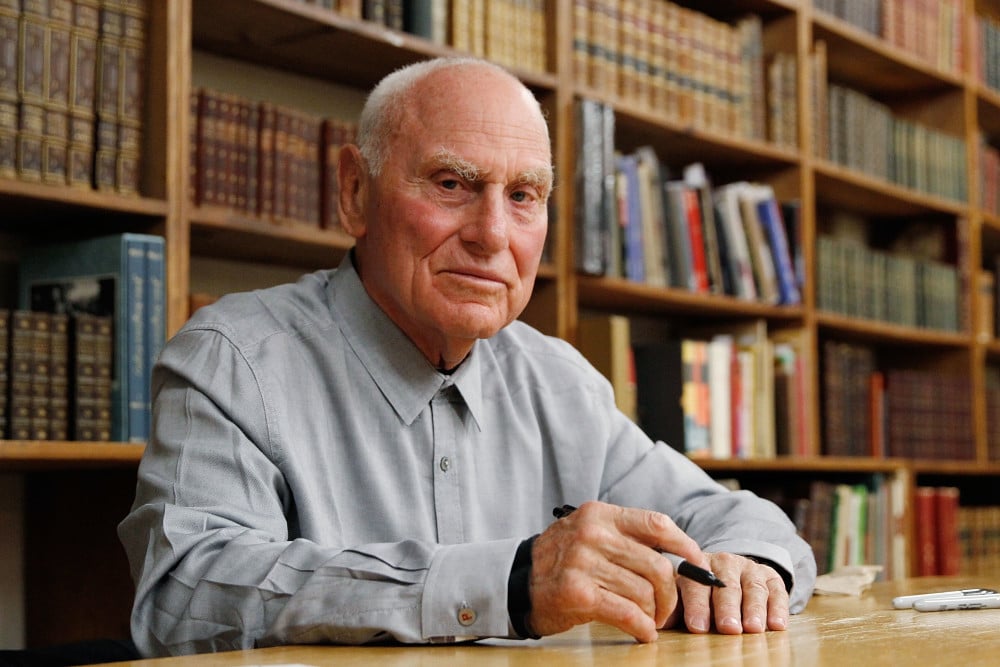
Richard Serra. Photo by Mireya
Acierto/Getty Images.
Have there been any artists who have surprised you,
either in how difficult they were to profile, or in how easy they
were? Who was the rudest?
I think a candidate for that would be Richard Serra. I wasn’t at
all sure he would agree to it, because a few years earlier I had
written about his Tilted Arc in New York [a massive public
art sculpture in Foley Federal Plaza, near City Hall that provoked
a firestorm of controversy]. A lot of people in the vicinity hated
it, and I wrote about it, saying something to the effect that
public art requires different approaches than art for museums or
private homes. And he was very offended by that and didn’t speak to
me for two years.
And then, eventually, that was no longer the case, and he was
doing such magnificent work that I thought I really couldn’t not
try. It became a slightly painful but very rewarding experience to
watch some of these huge walls of steel come together and be
installed. The amazing thing always was that, for all this huge
amount of weight, there was a lightness to them. There seemed to be
a movement up and out, and I didn’t know how that happened, but
that’s not the kind of thing he could talk about.
He did want to control the whole thing—and that persevered until
the very end. When the piece was going to press in the New
Yorker, he called us and the photo department saying that he
didn’t want them to use the photographs of his work that he had
agreed to use. He said, “I have just finished a new piece in New
Zealand and I’m going to photograph it and I’m going to send it to
you, and I want you to use those.” And so we got three photographs
of a long, low piece in the landscape, going over the hills, like a
wall but sort of undulating.
The next day, he called and he said, “You can use the one where
the sheep on the right. But you cannot, under any circumstances,
use the one where the sheep is on the left.” And besides wondering
why he didn’t tell us that the first time or why he sent those ones
in the first place, I know right away that the one that
the New Yorker would have chosen would have been the
one with the sheep on the left, which they had, and he was
absolutely furious. But they wouldn’t change it—by that time, they
had spent so much money pulling out one layout and putting in
another that they weren’t going to change it again. But, up until
the very end, he was trying to control.
I have to say, you got your revenge a little bit. In
your David Hammons
profile, a Richard Serra sculpture makes an appearance when
Hammons is relieving himself onto a work of art. I think the
photographer Dawoud Bey has even immortalized this performance in
some photographs. I’m surprised you didn’t print
those.
Um, the New Yorker is still a little resistant to
nitty-gritty.
You have profiled so many great artists over time, and I
know you said that you haven’t developed any overarching theories,
but is there anything that unifies them to give you some insight
into what makes a great artist tick?
Quite possibly there is, but I don’t know what it is. To me, art
is still a mystery. I’m a Duchampian in the sense that I believe
it’s impossible to define, and it’s always going to be changing. I
think some of the same elements that made a great paining in the
16th century would be in a work by Richard Serra, for instance. But
there are still so many differences. It’s interesting that the art
of painting took 300 years to bring to an absolute high point, and
then people stopped painting. But now it seems to be coming back,
and there are artists like John Currin and George Condo who have
rediscovered Renaissance painting techniques, underpainting,
veneers, and all sorts of things. So nothing really gets lost.
Everything just gets more complicated.
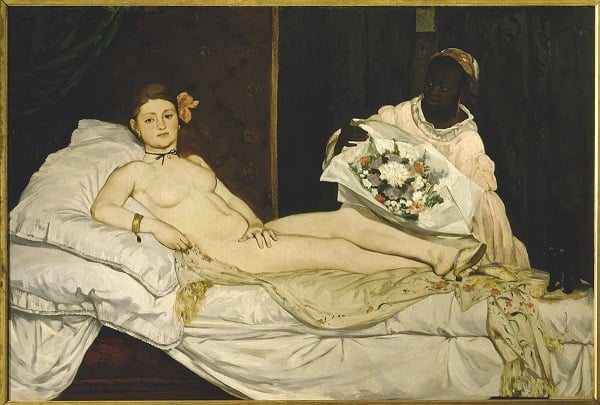
Édouard Manet, Olympia (1863).
Image: Courtesy of New Directions.
Painting is now incredibly important again in part
because there is a movement within the art world to start bringing
people who have not yet been represented into the mainstream
cannon. Often, this involves people who are not white and male, and
one way that this is playing out in the art market right is a great
wave of interest in portraiture of people who have not been
previously widely represented in art. This is honestly par for the
course across journalists who have been working over the past
couple of decades, but, out of any cohort, the majority of the
artists you’ve profiled have been white male painters. Out of the
82 articles featured in your Phaidon collection, 72 are male, and
about as many are white. Now that you’re in a position to look
around at what is happening today, and to look back into the past,
how do you understand this huge shift in the way that art is
peopled in the public consciousness?
I think it’s wonderful. I think one of the most exciting things
going on in the art world now is the number of terrific young
African American women artists who have emerged. It’s interesting
that so many of them do paint, and paint figuratively. Quite a few
of them seem to want to present themselves or their ancestors in
situations that have been used for centuries by white male artists,
the court portrait or the interior. They seem to want to see black
faces in those kinds of landscapes, and it’s fascinating. There was
that great show just a little while ago about the black model in
19th-century art, with a particular focus on the
model in Manet’s Olympia. If you really look at the
painting, the image of the black model is larger than the image of
the Olympia—it’s really dominant, but for a long time, all you saw
was the white nude. I think that we’re learning very quickly to see
difference, different ways to do it, different openings for
figurative art, but not so much abstraction, in this new wave.
It’s amazing to think that painting is really one of the
most ancient forms of technology—it’s basically wet dirt on a
rag—but this is really where the vanguard of art is today, in terms
of the politics of representation. What are some other ways that
art has evolved over the whole course of your 60 years at the
New Yorker that you find really compelling
today?
It certainly has opened up to all sorts of different
possibilities—that art can be video, film, performance. And Duchamp
is often is often blamed for ruining art, that he’s the one who
opened the door to all this terrible, mediocre, sort of lazy art
that we do see a lot of, along with the more important art. But it
also gives us artists like Maurizio Cattelan, who has put images
into the world that you are not going to forget. Who’s going to
forget the Pope in his full regalia just after being struck by a
meteor, or the kneeling figure who, when you walk around to the
front, you realize is Hitler? And the big question hits you: Would
God forgive Hitler? Conceptual art is many, many things, but one of
them is this ability to deal with very big ideas.
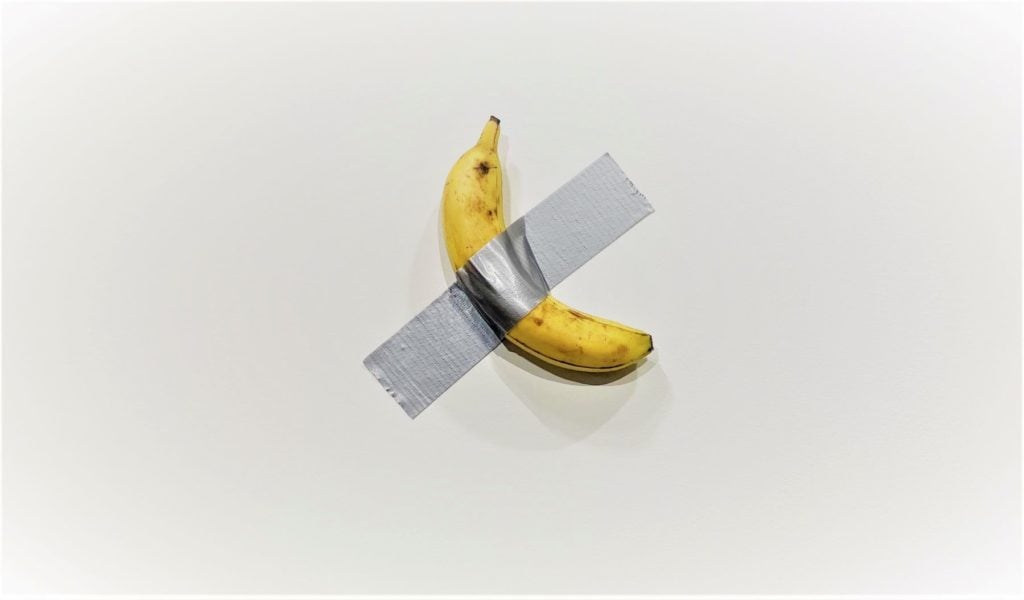
Maurizio Cattelan’s Comedian,
seen at Art Basel Miami Beach. Photo by Sarah Cascone.
I have to ask you, as a reigning Duchamp scholar, what
do you make of Maurizio Cattelan’s
banana that has created this enormous international furor in
the press? What does this mean about the world that we’re in? Is it
just a circus act and we’re monkeys dancing around this cultic
banana?
Well, of course, the joke is that anybody thought it was worth
paying $120,000 for. This is the joke. There are plenty of artists
who put little, miserable pieces of string or something on the
wall, and they’re quite serious. But this is an artist who’s
professionally not serious. He’s making fun of everybody—making fun
of the art, of the audience, of the buyer, of the gallery, which I
think is very therapeutic. It’s great fun, and it’s very
invigorating to have everything called into question.
The piece is called Comedian, which certainly
supports your interpretation.
And we must not forget that the piece before that was a solid gold toilet
that was installed at the Guggenheim Museum, fully functioning.
With all these slippery characters, do you believe
everything that an artist tells you in your reporting
process?
That would be disastrous. Very often, an artist is putting you
on. I can never make up my mind about Jeff Koons when he talks
about his work having this moral duty to relieve people from their
shame and guilt over sexuality. You think he’s kidding when he says
that, but he isn’t. He’s perfectly serious. The difference between
Jeff Koons and Marcel Duchamp is that Jeff Koons is always sincere,
and Marcel is never sincere.
Now, the original Lives of the Artists by
Vasari was published in 1550, and many of those artists remain
renowned today. In your book of 82 profiles, how many do you think
will last?
In every age, the consensus on the greatest artists always
narrows down to relatively few. I think in an art period, what you
have is a great many artists who are not great but who are very
good; and then artists who are not so good; and a great many more
who are not good at all. But the field is much wider [today], and
we don’t know what art is going to be like in the future. Duchamp
was very pessimistic—he said that art was becoming so
commercialized that husbands will pick up a little art on the way
home to give to their wives. I sometimes wonder about all these
shops on Madison Avenue and elsewhere that are going out of
business—maybe they can all become mini-museums for not perfectly
good art.
As somebody who has gotten Jasper Johns and David
Hammons, who are the remaining big-game-hunting artists that you
really want to nail down?
Well, I missed a couple. I didn’t get to Ellsworth Kelly, and
there were a lot of women I’m really sorry I didn’t get to, like
Eva Hesse, Lee Krasner, probably some of the people in the Ab Ex
period.
Who is next on the list?
Offhand, I can’t think of anybody, but it’s probably because
I’ve been sort of rushing it the last couple of years because I’m
94, and I don’t have more than 30 years left. I’m kind of tired at
the moment, but that will pass, and I’m sure there’ll be others. I
have others in mind—I was just talking to David Remnick about it
this morning, but I’m not allowed to divulge who. That’s the
omertà of the New Yorker.
The post ‘I Just Try to Leave Myself Open’: Legendary Art
Journalist Calvin Tomkins on How He Cracks the Secrets of the
World’s Greatest Artists appeared first on artnet
News.
Read more https://news.artnet.com/the-big-interview/calvin-tomkins-lives-artists-interview-part-2-1734096
Further reading


Leave a comment