
Introducing: The artnet Intelligence Report, Fall 2019 Edition
As you might glean from the smokestacks on the cover, this fall
2019 edition of the artnet Intelligence Report advances a thesis:
that over the past 30 years, the art world has evolved into an art
industry. Once the modestly sized province of connoisseurs,
passion-driven dealers, and hobbyist collectors, the art business
today exists as an interconnected global network dominated by
multibillion-dollar corporations and swashbuckling, profit-minded
investors who care about numbers as much, if not more, than they
care about the art itself.
From one point of view, this market is a strange, chimerical
amalgam of the luxury industry, the financial sector, and a
high-class casino; seen another way, it is a burgeoning engine of
creativity and innovation that could yield a new Renaissance in
art. As with art itself, the art market’s nature is in the eye of
the beholder.
In this issue, we speak to a trio of collectors who touch on how
the business side of things has changed over the past three
decades—for better and for worse. We also dive deep into reams of
data, which show that the market is now slowing, with key indices
coming down from their recent peaks. This report outlines those
areas of retrenchment in the marketplace and identifies where the
alarm bells are ringing. It also shows where opportunities are
developing, both through the data and via an in-depth survey of the
increasingly exciting market for African contemporary art. As the
current reshuffling continues, it is likely that the winners and
losers with be spread unevenly around the globe, in ways that
mirror broader macroeconomic trends.
Because this fall is artnet’s 30th anniversary, our report also
takes a look at how the company’s pioneering Price Database shaped
the art field and helped accelerate its headlong growth. We spoke
to Hans Neuendorf, the founder of artnet, about the obstacles he
and the company overcame as it became the first-ever art business
to go online—and about his ambivalence regarding the impact that
access to transparent pricing has had on the field he entered as an
idealistic art dealer in the 1960s.
Today, 30 years into the history of artnet, and now in the midst
of what looks like the beginnings of a market correction, it is
clear that we remain in the infancy of the art industry—with all
the positive and negative connotations that word, which conjures a
smoke-belching factory, conveys. Where will things go? See you in
30 years.
Click here to download the
full report.
— TABLE OF CONTENTS
—
– Marketplace
• Total auction sales around the globe
• Why the top of the market is shrinking
• Expert predictions for what’s ahead
– What I’m Buying & Why
Collectors dish on their latest obsessions and the works that
got away
– The Best-Seller Lists
The top 10 lots of 2019 to date in every major
category
– How the Art World Became (Sniff) the Art
Industry by Tim Schneider
As artnet celebrates its 30th anniversary, we use data to tell
the story of how the market has transformed—radically—over the past
three decades
– Why the Golden Age of Auction
Guarantees Is Probably Over by Eileen Kinsella
These lucrative hedges were once the financial instrument of
choice for speculators and market manipulators, but now they’ve
lost their luster
– Collecting Isn’t What It Used to Be: A
Roundtable by Cristina Ruiz
Dimitri Daskalopoulos, Paul Ettlinger, and Patrizia Sandretto
Re Rebaudengo discuss how the business of collecting has evolved
since 1989
– Why Is Everyone Talking About the
African Art Market? by Rebecca Anne Proctor
We break down the rising stars, most important players, and
everything else you need to know about the buzzing scenes spread
across six African cities
– How Hans Neuendorf Changed the Art
Business by Andrew Goldstein
artnet’s founder recalls how he developed the first online
auction database and reveals why he is torn about the sweeping
changes it wrought
– Dive Into Some Refreshing Market
Data by Julia Halperin
We pull together exclusive data about the market’s performance in
2019 to date, gathered from the artnet Price Database, and speak to
experts about what it all means
– Who Are Today’s Most Bankable
Artists?
See the 10 best-selling artists in each genre
— KEY FINDINGS —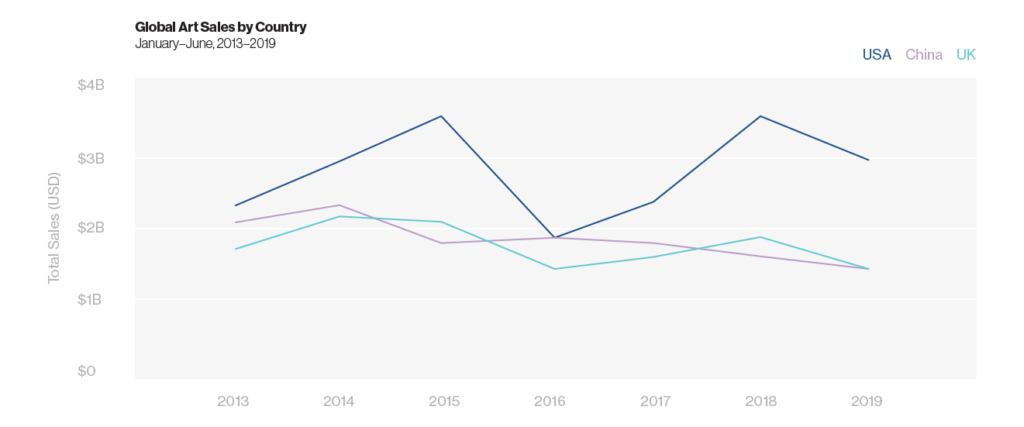
- A grand total of $9.1 billion was spent on fine art, decorative
art, and design at auction in the first half of 2019—down 13.5
percent from the equivalent period one year ago. - Weakness at the top of the market is driving this slump: Total
auction sales of works over $10 million dropped by 35 percent in
the first six months of this year compared to the first half of
2018. - Figuration has officially displaced
abstraction as the most desirable style of new art. Not one of the
top 10 works sold at auction by ultra-contemporary artists in the
first half of this year was abstract. - The Brooklyn-based artist KAWS
outsold Jean-Michel Basquiat, the far more established graffiti
artist-turned-market phenomenon. Work by KAWS generated $70.6
million at auction in the first six months of 2019, compared to
Basquiat’s $65.6 million. - The UK saw its auction sales plummet
24 percent in the first half of the year, while China only
experienced a 10.5 percent dip, suggesting that the prospect of
Brexit is having a more catastrophic effect on the market than the
US-China trade war. - The gap between Christie’s and
Sotheby’s has narrowed for the first time in several years, with
both auction houses posting just over $2 billion in sales in the
first half of 2019.
The post Introducing: The artnet Intelligence Report, Fall
2019 Edition appeared first on artnet News.
Read more https://news.artnet.com/market/introducing-artnet-intelligence-report-fall-2019-edition-1644430
Further reading


Leave a comment