
LACMA’s $750 Million Renovation Was Once Hailed as a Powerful Vision of What a 21st-Century Museum Could Be. Now, It’s a Lightning Rod
At first, it was met with
cautious optimism, called “architecturally ambitious” and
“powerfully strange.” But eight years later, the Los Angeles County
Museum of Art’s new building project designed by Swiss architect
Peter Zumthor has been criticized—sometimes by the very people who
praised it initially—as “uninformed” and a “scorched-earth
plan.”
How did this building, initially
embraced as promising, if not visionary, come to ignite a
scorched-earth debate in its final stages? The story of LACMA’s
campus reconstruction—and the current opposition to it—reflects
some of the thorniest questions at play in the operation of museums
today: what they are meant to be, who gets to decide, and who is
meant to pay for them.
Time for this debate is running
out, however. There is already a hole in the side of the Ahmanson
Building, one of four buildings slated for demolition this month.
While LACMA is currently closed to the public due to the
coronavirus outbreak, it is continuing to make progress on its new
building, as construction has been deemed “essential” by the city
of Los Angeles. According to a statement from the museum, the
process to remove asbestos from the campus is on track, and workers
are wearing protective gear, remaining six feet apart, and
frequently washing their hands at portable sinks.
In defending the decision to
forge ahead with construction while other nearby museums, including
the Academy Museum of Motion Pictures, have paused, Govan told the
Los Angeles Times that the $750 million campus revamp would be an
“engine of job creation and economic recovery.”
The Museum and the City
The Zumthor building, which
floats one story above the ground, was intended to be
groundbreaking. It originally resembled an imposing black amoeba,
designed to keep all galleries on a single level and thus avoid any
literal or symbolic hierarchy—the only stairs would be those up to
the entrance. But in recent years, it has morphed into a more
conservative-looking beige wave that crosses over Wilshire
Boulevard.
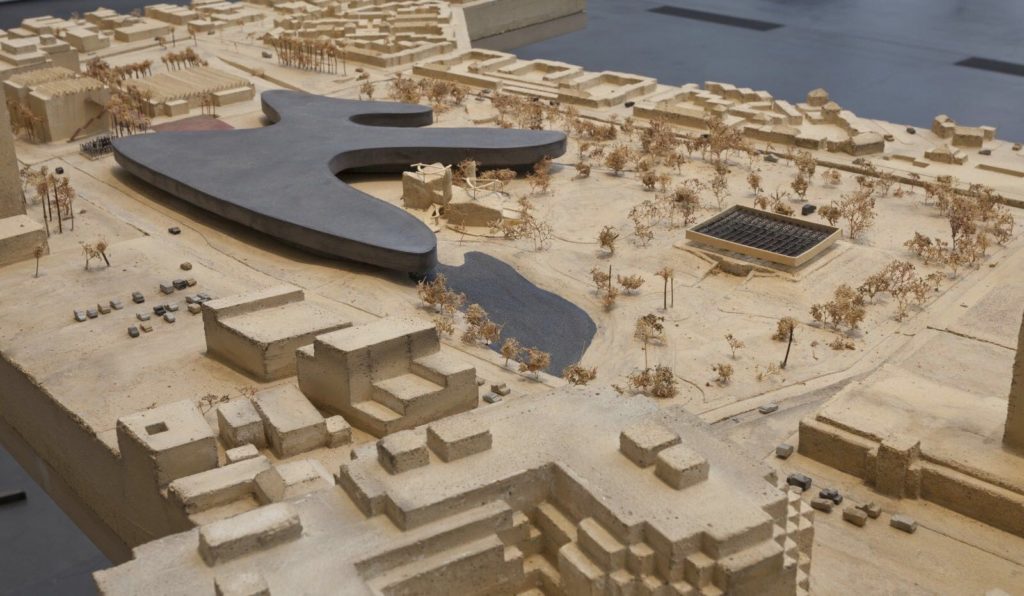
Images: Installation views, The Presence
of the Past: Peter Zumthor Reconsiders LACMA, June 9—September 15,
2013, Los Angeles County Museum of Art, Photo © 2013 Museum
Associates/LACMA.
As the architectural plans
shifted and the costs crept up, pushback began to build. And the
scrutiny has been as much on the museum’s plans as on whether Los
Angeles residents can and should trust elected officials to make
sound decisions about an institution their tax dollars help
fund.
Five years ago, when Michael
Govan first began asking local officials for funding and plan
approvals, few detractors showed up to city
meetings. But something
changed in April 2019, after LACMA released a revised Environmental
Impact Report that showed the Zumthor building had decreased from
170,000 square feet of gallery space to 109,000. Certain attractive
features, such as high-ceilinged “chapel galleries,” were also
cut.
Before a Board of Supervisors
meeting on April 9, where city officials would vote on whether to
release $117.5 million in taxpayer dollars to LACMA, 226 citizens
wrote to express concern. Only 48 wrote in support of the project.
“How can a county that closes health centers and other county
resources justify the new LACMA spending?” asked a local government
teacher.
Some of the same concerned
citizens showed up on April 9 to comment, only to be overshadowed
by celebrities Diane Keaton and Brad Pitt, there to praise
Zumthor’s design. The Board of Supervisors barely acknowledged
detractors before voting unanimously to
release the funds. The same thing happened months later, on
December 3, when the City Council deliberated over whether to grant
LACMA an air rights above Wilshire Boulevard. A group of citizens
voiced their alarm, and, as soon as they finished speaking,
Councilmember Herb Wesson congratulated LACMA for having the public
on its side.
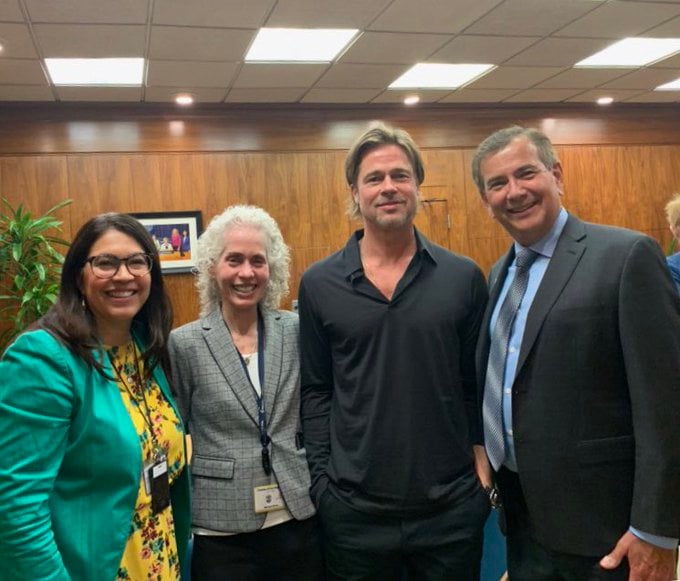
John Wicker, Deputy Chief Norma Edith
Garcia, and DPH Director Barbara Ferrer with #BradPitt at the Board
Meeting. Brad Pitt supporting an LA County Agenda item.
The attitude of city officials
toward public comment at these meetings has only heightened concern
that the opposition is not being taken seriously, especially given
current probes into corruption at city hall, including
investigations into bribes that have allegedly shaped official
votes. Both
supervisor Mark
Ridley-Thomas, who
represents the district home to part of LACMA (the museum spans two
districts), and council member Wesson, currently running to take over the seat that
Ridley-Thomas must vacate due to term limits, have come under
scrutiny for alleged financial improprieties.
Discontent Rising
The split pressure on LACMA and
the city rose to new heights at the beginning of this year with a
series of pointed developments. The nonprofit Save LACMA, founded
by a group of concerned preservationists, proposed a ballot measure
that would limit the amount of county funding the museum could
receive and also mandate that an elected official sit on the museum
board.
Later that month, another newly
formed group, the Citizens Brigade to Save LACMA (which is not
associated with Save LACMA), ran two full-page newspaper ads in
the L.A. Times
and the New York Times showing Zumthor’s design sinking into water.
The following month, the Ahmanson Foundation—which has given $130
million worth of European art to the museum over decades—announced
it would cease gifts to LACMA because it was unsure how much space
its gifts would be afforded in the new
building.
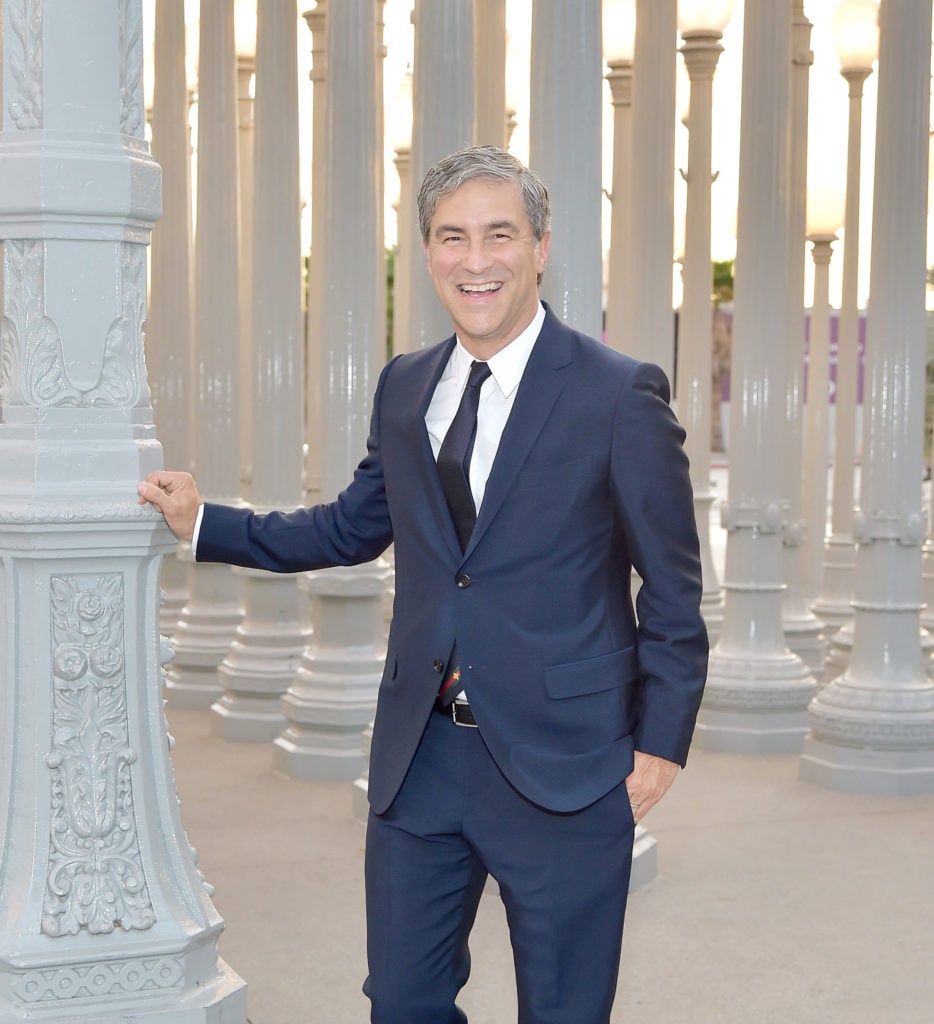
LACMA CEO and director Michael Govan.
Photo by Stefanie Keenan/Getty Images for LACMA.
These signs of discontent were
capped off by a report by
L.A. Times journalist Carolina
Miranda that the museum carried $443 million in total debt,
with $330 million owed to L.A. County. In response, the newspaper
published 24 letters by readers, many more frustrated with the
county for funding the project than with the building itself. “Have
Los Angeles City and Los Angeles County officials taken leave of
their senses…?” asked Joann Duray of Playa del
Rey.
Rob Hollman, the president of
Save LACMA, found such comments heartening. “It is very 11th hour,
unfortunately,” he told Artnet News. “But fortunately, the public
has been speaking out more and they’ve been echoing our
concerns.”
Public Money
LACMA is among the only major
art museums in the country that heavily relies on county funding.
The county annually appropriates around $25 million for the museum,
which represents between 19 percent to 23 percent of its annual
budget. Govan believes the oversight and accountability that
accompanies this funding “serves the museum well.” “The working
relationship with the county on this project has been very, very
close from day one,” he told Artnet News.
He meets with county
representatives monthly, and the museum must propose comprehensive
repayment plans for the debt it takes on. And, he said, city
officials “are always welcome to attend” board meetings: “This idea
that somehow LACMA is operating on its own is extremely
untrue.”
Govan noted that county
officials are legally required to respond to every public comment,
and that LACMA administrators have met with concerned neighbors,
community groups, and individuals about the project. “I can also
say that we asked for meetings with a lot of community groups and
were rebuffed,” said Govan. According to a statement by LACMA, the
Ahmanson Foundation was one group that declined meetings (the
foundation did not return requests for comment for this
story).
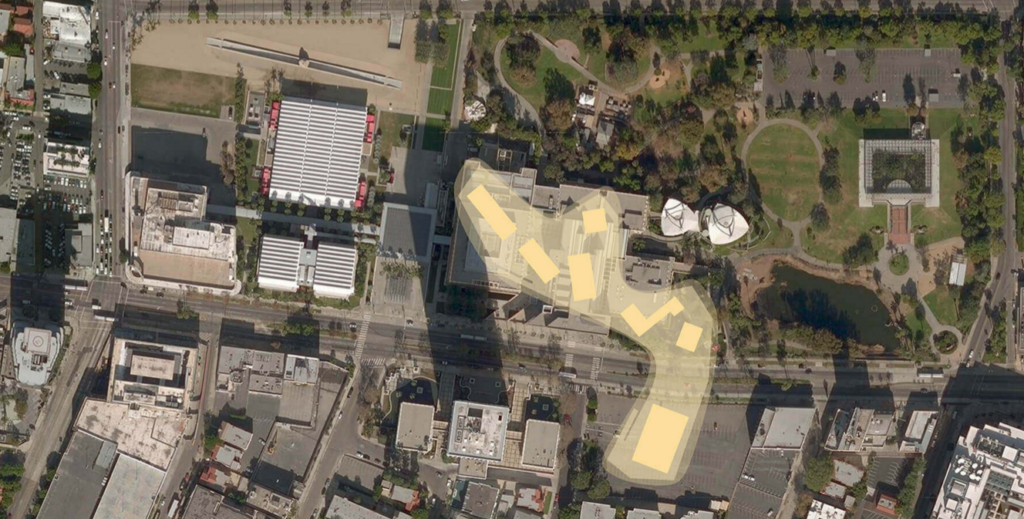
Building footprint spanning Wilshire
Blvd. Atelier Peter Zumthor & Partner / Courtesy Building
LACMA.
But Govan has been in touch with
Save LACMA’s Hollman, and also met multiple times with architecture
critic Joseph Giovannini, who has written critically of the design
and cost of the new building since 2014 and now belongs to the
Citizen’s Brigade to Save LACMA. “I don’t know how much more you
can do, because, of course, you have hundreds and thousands of
people on the other side who are working on this and need to get
things going,” Govan said.
In his view, the detractors are
averse to change and reluctant to reimagine what a 21st-century
museum could be. But his
critics view their efforts another way: as the last chance to keep
an irresponsible,
out-of-touch vision from taking over and diluting the museum’s
mission for years to come.
History Lesson
The saga surrounding LACMA’s
rebuild dates back to May 2001, when the late Andrea Rich was
LACMA’s director. The museum’s board announced a competition for
architects to devise a renovation to the campus for $200 million or
less. The two 1965 buildings by revered L.A. architect William
Pereira, finished the year the museum opened on Wilshire, required
repairs to ensure climate control and fix leaky roofs. The
buildings’ upper galleries were also dark and claustrophobic. The
1986 addition by Hardy
Holzman Pfeiffer posed similar problems.
To address them,
finalist Jean Nouvel proposed a
renovation of the existing buildings, while Dutch architect Rem
Koolhaas proposed replacing everything but the elegant Japanese
Pavilion with a fluid combination of plazas and galleries. LACMA’s
board chose Koolhaas. But by 2002, the projected cost had ballooned
from $187 million to $400 million and the museum failed to raise
the necessary funds.
In 2003, the renovation plan
took another turn when billionaire board member Eli Broad promised
$50 million toward a smaller new building for contemporary art,
designed by Italian architect Renzo Piano, and Lynda and Stewart
Resnick donated $45 million for a second Piano-designed building.
But these donations did not pay for the projects in their entirety,
and the museum took on $331 million in county bond debt
to pay for the projects.
The second building was still under
construction in 2009, when newly appointed Govan announced he had
been working with Zumthor on a plan to replace the 1965 and 1986
buildings.
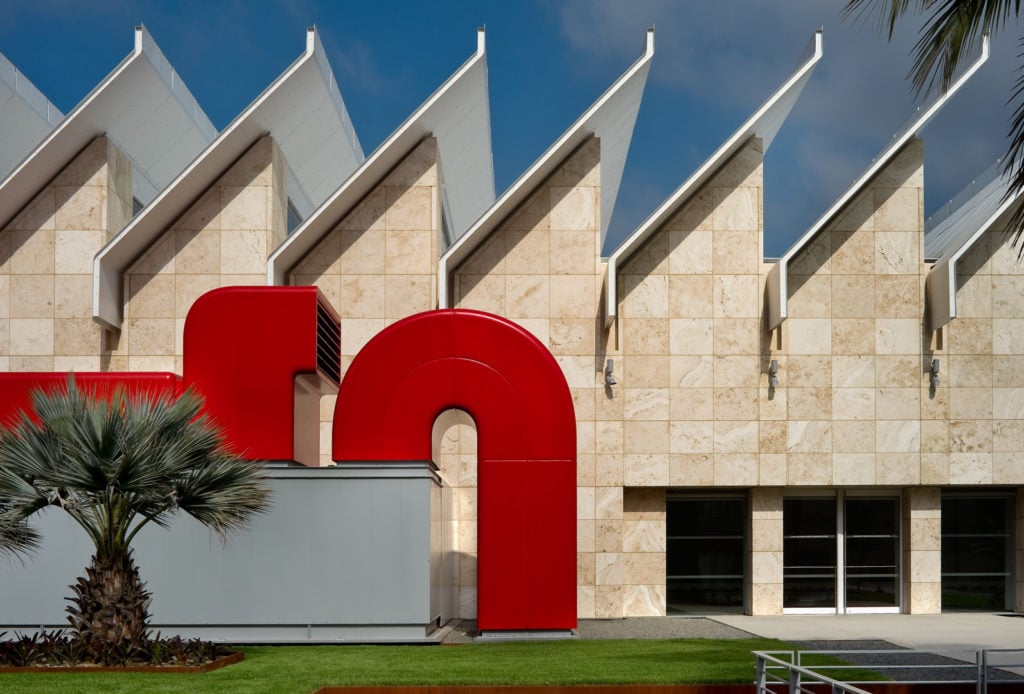
The Lynda and Stewart Resnick Pavilion
at the Los Angeles County Museum of Art. Photography by James Joel.
Image courtesy of Flickr.
Before the museum’s board
approved Zumthor’s design for the rest of the campus in 2013, LACMA
enlisted engineering firm Aecom to estimate the cost of
refurbishing the existing buildings. They put the number at $317
million. The county hired another firm to conduct an independent
analysis, putting the refurbishment at $246 million.
By the end of 2019, LACMA’s own
estimated cost for the Zumthor project reached $750 million (Govan
is confident the project will otherwise remain on budget). At that
time, the museum had just $217 million of the $640 million promised
funds in hand, including the $125 million from the
county.
Despite Govan’s insistence that
refurbishing the existing buildings would ultimately be just as
expensive as constructing new ones, critics have suggested
otherwise. They have also wondered if a renovation might have taken
less time, thus bringing the art back to public view more
swiftly. The
Ahmanson Foundation, which recently issued a letter
reiterating its decision to cease donations, said they
decided not to purchase a painting
for the museum last year “because we could not resolve the issue of
when or if the painting would ever be displayed.” In response,
LACMA asserted, “It is too
early to give precise locations for any of the permanent collection
in the new building.” (Govan has resisted donors’ attempts to
dictate collection installations before, which notably led
to Eli Broad rescinding a
promised gift in 2008.)
According to Govan, most
masterpieces have never had precise, permanent positions at LACMA
anyway. “So
there’s also a false notion that
fixity has been the rule,” he noted, adding, “We really are
permanent collection-focused. I believe the future of museums rests
in this better utilization of collections.”
What Should a Museum Be?
The new building, all on a
single level, allows for changing and non-hierarchical
installations, said Govan, who considers flexibility a timely
strength. “I’ve never seen a more exciting time in art history,” he
said. “It’s thrilling to hear what curators are thinking, and how
museums are almost waking up from a slumber, from a legacy of a
hundred years of categorizing the world once and leaving it that
way.” He described current disagreements over the building as
simply part of this shift in thinking. “There are different points
of view being put out there by different people. And I, of course,
think it’s beautiful.”
Critic Joseph Giovannini, a
co-founder of the Citizens Brigade, also finds different points of
view compelling, so much so that he and his colleagues have
initiated an idea competition, asking architects to suggest new,
more attuned plans for LACMA. He agrees with Govan that a
non-hierarchical, experiential, and responsive building would be
wonderful, but believes Zumthor’s current plans fall
short.
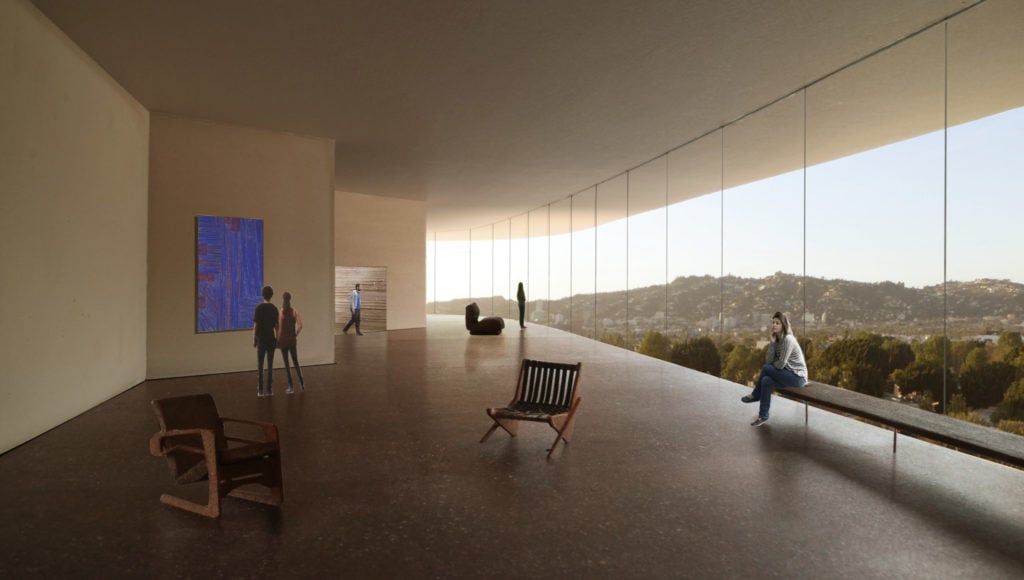
Peter Zumthor’s new LACMA design.
Courtesy of Atelier Peter Zumthor.
“Zumthor wants a museum to open
cords for someone who is going in, so that your senses are alert.
It’s experiential, it’s immersive. And I totally believe in that,”
Giovannini said. But he also believes that a poor use of space has
resulted in a design that will ultimately do the art in LACMA’s
collection a disservice, and so is seeking alternatives even as
LACMA’s campus comes down.
Save LACMA’s founders have more
pragmatic concerns, however. The day Los Angeles enforced a “stay
at home” order in response to the COVID-19 outbreak, the nonprofit
tweeted, “LACMA Board of Trustees now is the time to announce that
you’re rescinding your request of over $450 million in county funds
… so that the funds can be redirected to help with our
extraordinary humanitarian crisis. Please, be the hero for us
all.”
The post LACMA’s $750 Million Renovation Was Once Hailed as
a Powerful Vision of What a 21st-Century Museum Could Be. Now, It’s
a Lightning Rod appeared first on artnet News.
Read more https://news.artnet.com/market/lacma-expansion-analysis-1822221
Further reading


Leave a comment