
Mark Bradford’s Brooding New Show Looks at the Most Urgent Environmental and Political Catastrophes of Our Time
Mark Bradford’s first London
show with Hauser & Wirth offers a stark, post-apocalyptic vision of
the future.
The exhibition, titled
“Cerberus,” is named after the mythical three-headed dog that
guards the gates of Hades. In the show, monumental works depict an
abstract landscape on which legends and actual historical events,
such as the 1965 Watts
Rebellion in Los Angeles, play out. In total, the works address the
widespread dangers of polarized thinking and our neglect of the
environmental future.
Bradford’s messy works juggle
interconnected issues of class, gender, race, and sexuality, and
offer a glimpse into a future in which the eviscerated human race
becomes a tangle of peachy intestines.
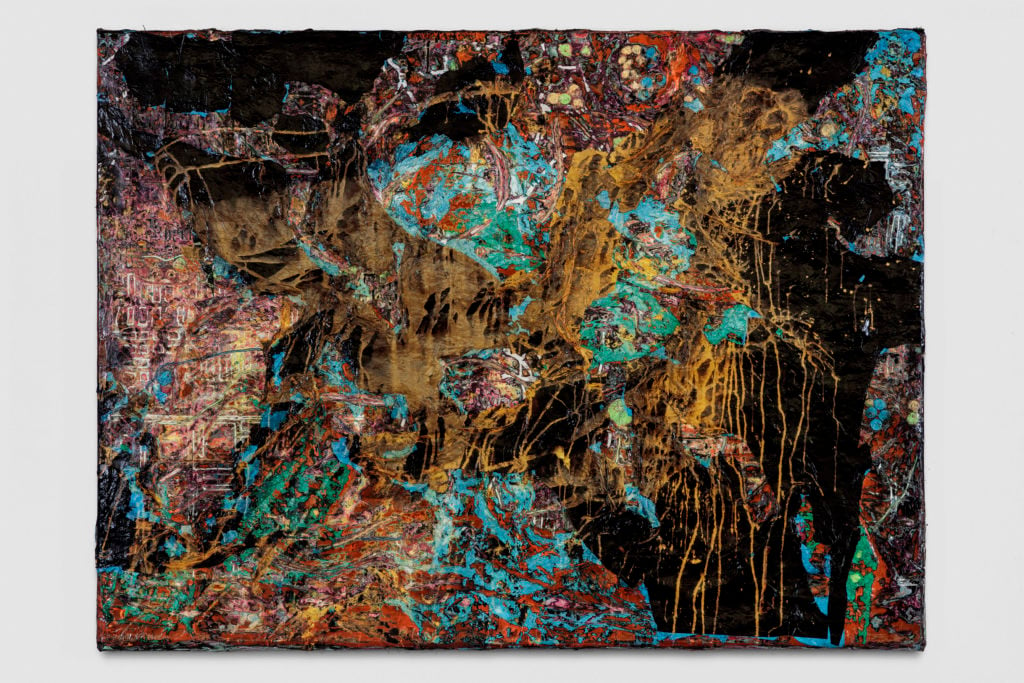
Mark Bradford, The path to the river
belongs to animals (2019). © Mark Bradford. Courtesy the artist
and Hauser & Wirth. Photo by Joshua White.
“For me, the environmental crisis is something that obviously we
know has been long-brewing, so at this point it is just looking at
it in a holistic way, and saying ‘this is part of our
conversation,’ and kind of allowing that to bleed into the work and
see what I’m going to do with it, how I feel about it,” Bradford
tells artnet News about his latest works.
The environmental
paintings—which do not actually involve any paint, but are created
through his signature process of layering sodden swathes of
pigmented paper—emerged when Bradford was midway through making
work for the show.
The exhibition’s enormous
titular painting hits on themes that are common in Bradford’s work.
Its base layer is a map commissioned by the California
governor following the Watts Rebellion in an effort to understand
the unrest. Bradford says the map tried to “flatten all that pain
into data,” by demarcating so-called “hot spots” of violence,
looting, and death. Earlier versions of his works were peppered
with these colored spots.
But after a while, Bradford
became detached from the trope of the hot spots, and began to pull
them off the canvas, realizing that this gave the works an almost
botanical look. His urban grid then gave way to an urban jungle,
where the forest reclaimed the city. Bradford says the imagery
reminded him of the way that, over the course of centuries, trees
have crept into the Cambodian temple of Angkor Wat.
The summer of 1965 is also
evoked in a video installation, Dancing in the Street (2019), named after a 1964 Motown
hit recorded by Martha and the
Vandellas. To make the
work, Bradford drove around the industrial neighborhood of his Los
Angeles studio and projected a video recording of the group
performing the song onto the urban landscape.
At the press preview for
exhibition, he explained that a myth was built around the song
after its release, when some people considered it a call to
action. “My mom swears that
it was,” Bradford said. “Others say it was just a fun Motown
song.”
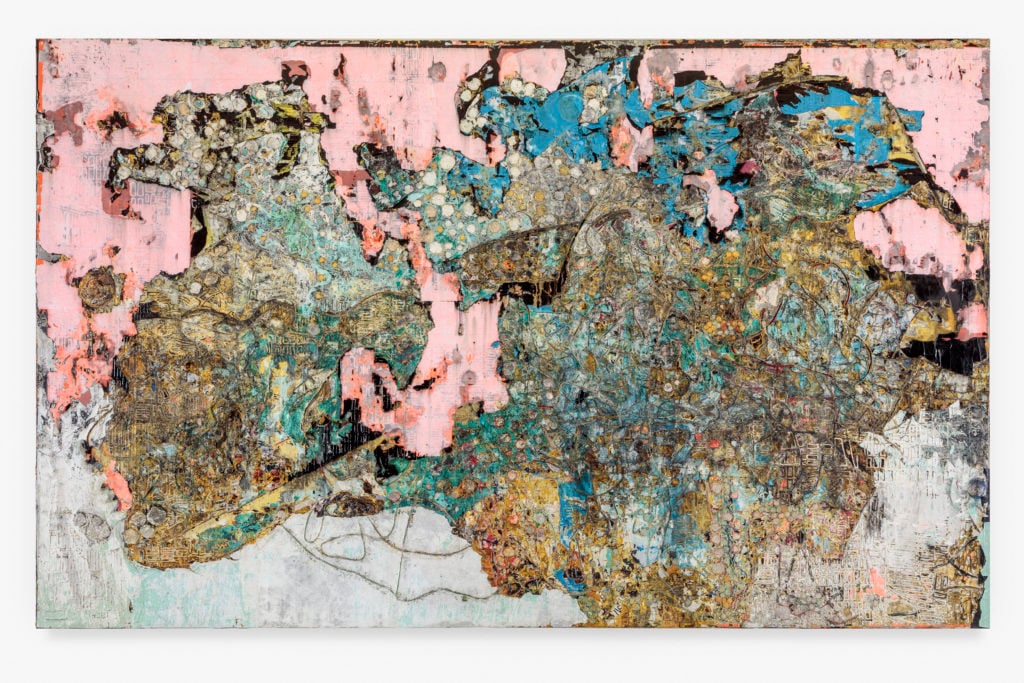
Mark Bradford, Gatekeeper (2019).
© Mark Bradford, courtesy of the artist and Hauser & Wirth. Photo
by Joshua White.
“For me, I’m in a space where I
can kind of grapple with these large political ideas, and I knew
that it wasn’t going to be possible for me to deal with [them]
through figuration,” Bradford says. Myths offer a way of prying
open polarized conversations.
“It is a way of unearthing these
things and really having those uncomfortable conversations to
really get to a certain kind of social, fundamental truth about
certain things.”
Although the works are dark and
brooding, Bradford argues that they are not meant to be despairing,
and that a note of hope runs throughout.
“There always has to be hope,”
he says. “There always has to be faith. The Civil Rights movement
could not have moved forward from slavery to 2019 without hope… So
no matter whether the work is bright or dark or turbulent, there is
always, fundamentally, a hope, and a faith.”
The post Mark Bradford’s Brooding New Show Looks at the Most
Urgent Environmental and Political Catastrophes of Our Time
appeared first on artnet News.
Read more https://news.artnet.com/exhibitions/mark-bradford-cerberus-hauser-wirth-1667266
Further reading


Leave a comment