
Michelangelo, Warhol, and Other Famous Artists Wrote Intimate Letters to Friends and Family. Here Are Some of the Most Revealing Passages
Spare a thought for the art historians of the future: They’ll be
stuck combing through messenger threads and decoding emojis for
insight into their objects of study, instead of reading
letters. If you need to be reminded of what a loss that
is, take a peek at
Artists’ Letters: Leonardo da Vinci to
David Hockney, a new book
brings together 100 pieces of correspondence from some of the most
famous artists of the last 600 years.
The assembled missives are entertaining in their glimpses of the
everyday thoughts of artists, and sometimes downright moving. The
letters range from the poignantly prosaic (“I beg you, kind Sir, to have my payment order
prepared promptly, so that I will now finally receive my
well-earned 1244 guilders,” a destitute Rembrandt begs a patron) to
the overpoweringly intimate (“Let your dear hands rest on my face,
so that my flesh can be happy that my heart feels once again
suffused with your divine love,” writes Rodin to Camille Claudel,
around 1886).
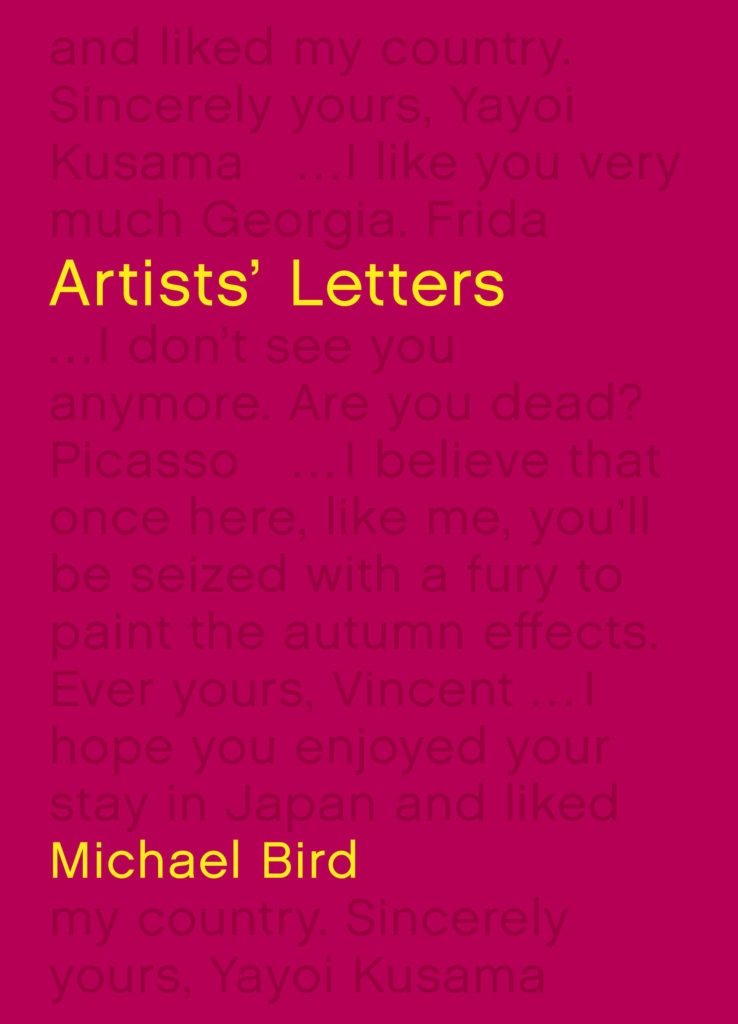
“Artists’ Letters: Leonardo da Vinci to
David Hockney,” 2019. Courtesy of White Lion Publishing.
The book, set to come out October
1 from White Lion Publishing, was edited by Michael Bird. The
British writer and lecturer has been behind a number of art
historical texts targeted at a popular readership, most notably
“100 Ideas that
Changed Art,” from
2012.
Bird combed through thousands of
documents in the process of putting together his newest project, a
curated compilation of letters that charts the evolution of the art
world from the 1500s to today. It includes names such as Francisco
Goya, Pablo Picasso, Joseph Cornel, Frida Kahlo, and Yayoi
Kusama.
Sorted into sections like “Artist
to Artist,” “Love,” and “Professional Matters,” the letters range
in tone from biting to banal, sublime to silly—much like the work
of the artists that inspired them. In some cases, the texts
humanize the figure who is writing; others add to the artistic
legend.
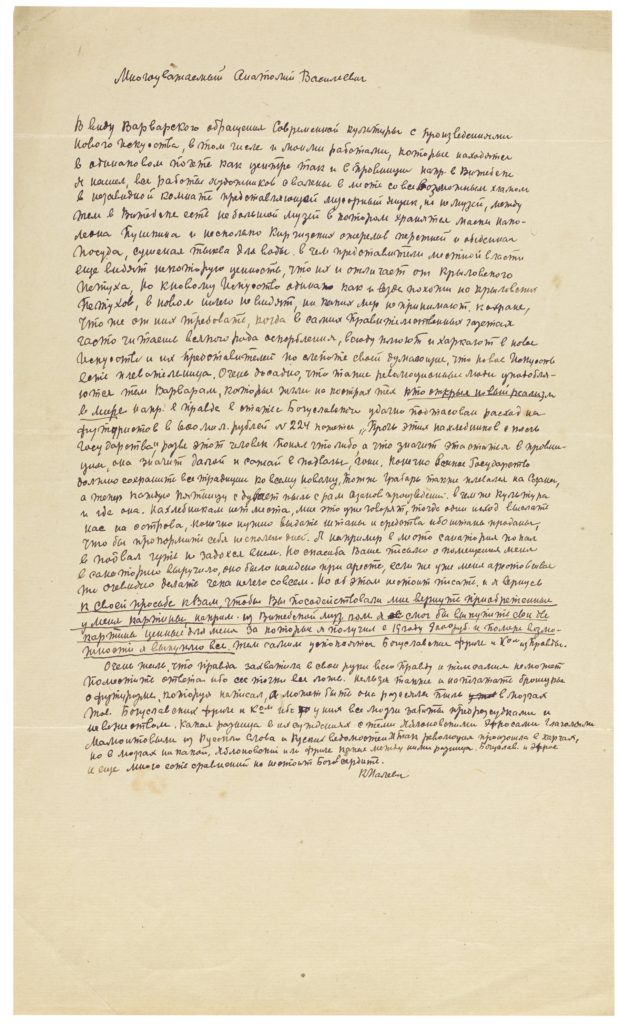
A letter from Kazimir Malevich to
Anatoly Lunacharsky, November 1921.
There’s a strange pleasure, too,
in seeing the actual handwriting of the famous artists as well as
doodles and notes in the marginalia. Van Gogh’s handwriting is
surprising graceful and measured; Marcel Duchamp is virtually
unreadable.
A 1945 birthday invite from George
Grosz illustrates in cartoon fashion how much Hennessy he plans to
drink on his special day. (He may have started early, given the
nonsensical text: “You are cordially invited to attend the
birthday Party of ME Thursday 26 afternoon / we will have lots of
drinks, this time ME too.”)
A particularly memorable
1973 note from Judy Chicago to Lucy Lippard (more on that below)
has stickers of butterflies and cats, a drawing of a rainbow, and a
note that reads, “This is definitely not a ‘cool’
letter…”
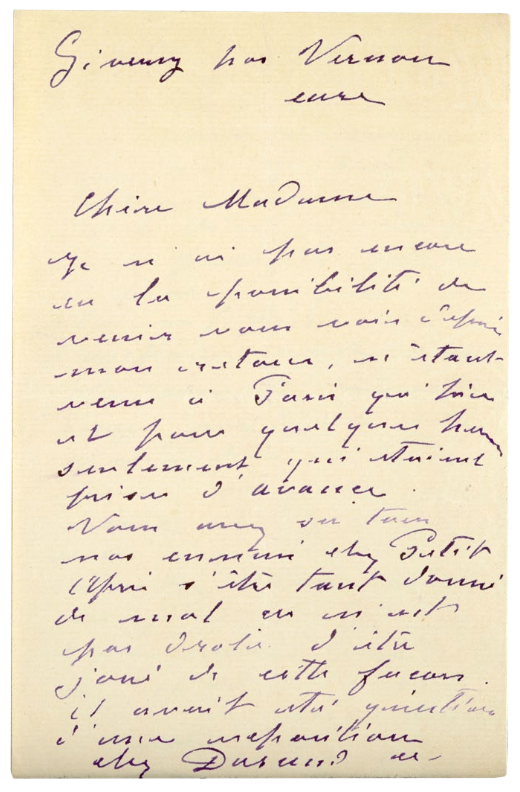
A May 1888 letter from Claude Monet to
Berthe Morisot. Courtesy of White Lion Publishing. excerpts from
them below:
Below, here are some excerpts of some of our favorite finds
in Artists’ Letters:
Michelangelo, in a tightly written 1550 dispatch to his nephew,
offers some blunt, mercenary advice about marriage:
About your taking a wife—which is necessary—I’ve nothing to say to
you, except that you should not be particular as to the dowry,
because possessions are of less value than people. All you need
have an eye to is birth, good health and, above all, a nice
disposition. As regards beauty, not being, after all, the most
handsome youth in Florence yourself, you need not bother overmuch,
provided she is neither deformed nor ill-favoured. I think that’s
all on this point. William Blake, in 1804, is glimpsed
extravagantly trying to win the good graces of a client after a
blown deadline delivering some illustrations he had been
commissioned to produce for a biography of William Cowper:
Engraving is Eternal work; the two plates are almost finish’d. You
will receive proofs of them for Lady Hesketh, whose copy of
Cowper’s letters ought to be printed in letters of Gold &
ornamented with Jewels of Heaven, Havilah, Eden & all the countries
where Jewels abound. I curse & bless Engraving alternately, because
it takes so much time & is so untractable, tho’ capable of such
beauty & perfection. A pre-fame Andy
Warhol offered a flash of vulnerability in this incredibly
abbreviated, self-effacing auto-biography he sent
to Harper’s editor Russell Lynes, in 1949:
biographical informationmy life couldn’t fill a penny post cardi was born in pittsburgh in 1928 (like everybody else—in a
steel mill)i graduated from Carnegie tech now i’m in NY city moving from
one roach infested apartment to another.
Robert Smithson waxes political to Enno Develing in a letter
about the importance of his earthwork in Broken
Circle/Spiral Hill, in the Netherlands, in 1971:
As Jennifer Licht says, ‘art is less and less about objects you
can place in a museum’. Yet, the ruling classes are still intent on
turning their Picassos into capital. Museums of Modern Art are more
and more like banks for the super-rich. […] Art should be an
ongoing development that reaches all classes.
And, in the thick of the feminist
art movement, Judy Chicago explains the connections between her
artistic and creative evolution to Lucy Lippard (who seems to have gotten a
lot of great letters), in the summer of 1973:
You know, a lot of people have
hassled me in the last several years about whether
my ‘political activity’
was interfering with my art, and it always made me feel vaguely
guilty […] I suddenly
realized that the guilt was similar to the guilt I used to feel
when people implied that I was somehow stepping out of ‘female role’ …
there is really an ‘artist role’ and I am
determined to break out
of it […] That role demands that the artist, like the woman, be
victim … dependent upon
the approval of the Establishment […] Anyway, you know … in this
time of great change […] artmaking and art become essential. If the
relationship of the artist to her community
changes, then people can
‘be involved’ in art in a way they are not now, and the artist can
cease to be victim, the
barriers between art forms will break down, the barriers between
art ‘roles’ will end.
Further reading


Leave a comment