
MoMA’s Nimble New Incarnation Is Well Suited to a World in Constant Flux. If Only It Didn’t Choose Tourists Over Its Artists
Back in 2017, in the wake of the reverberant protests around
Donald Trump’s first, nasty attempt at a “Muslim ban,” MoMA
did something
extraordinary. As a curatorial gesture of solidarity, it
inserted works by artists from Muslim-majority countries or with
Muslim backgrounds into the heart of its Modern galleries, where it
keeps the crown jewels. Thus, a large canvas by Iranian painter
Charles Hossein Zenderoudi suddenly joined Matisse’s The
Dance; a small black-and-white work by Sudanese modernist
Ibrahim El-Salahi appeared in the Picasso galleries.
Judged as a curatorial act of protest, MoMA’s gesture felt
exciting and—grading on a curve for a mega-institution with a
byzantine bureaucracy—bold. Sure, as an act of meaning-making, it
probably didn’t do full justice to the independent creative worlds
of the artists summoned for its purpose, inserting them into
someone else’s history and removing them from their own chronology
and context. In a way, the very need for the gesture highlighted an
absence that had otherwise been there, in the heart of the story of
art being told: Modern art, as told by the Museum of Modern Art,
was the story of émigrés, exiles, and outcasts—but mainly ones from
Europe.
But it was an emergency gesture, responding to a sense of crisis
and the need to do something that felt substantial.
I bring this up because here we are, two years later and on the
far side of the museum’s forceful $450 million building expansion
and a far-reaching curatorial attempt to rethink the logic of the
permanent collection galleries, to open them up to tell a more
inclusive and global story—and the results feel strikingly similar.
For all the evident long hours and agonizing hard work building up
a new system, the new story of art that MoMA is telling still feels
curiously the same—reactive and provisional.
Tearing It Down to Build It Up Again
If you’ve read anything about the
reinstallation of MoMA’s collection, you will know the basics:
film, photography, design, and architecture holdings have been
integrated into the heart of the story, so that building maquettes,
Modernist floor plans, stills from classic films, troves of
vernacular photos, and looping film clips alternate with the
conventional displays of painting and sculpture. An attempt has
been made to add more women artists, minorities, and non-Western
voices throughout, as well as to break down, to a certain extent,
the membrane between “insider” and “outsider” art.
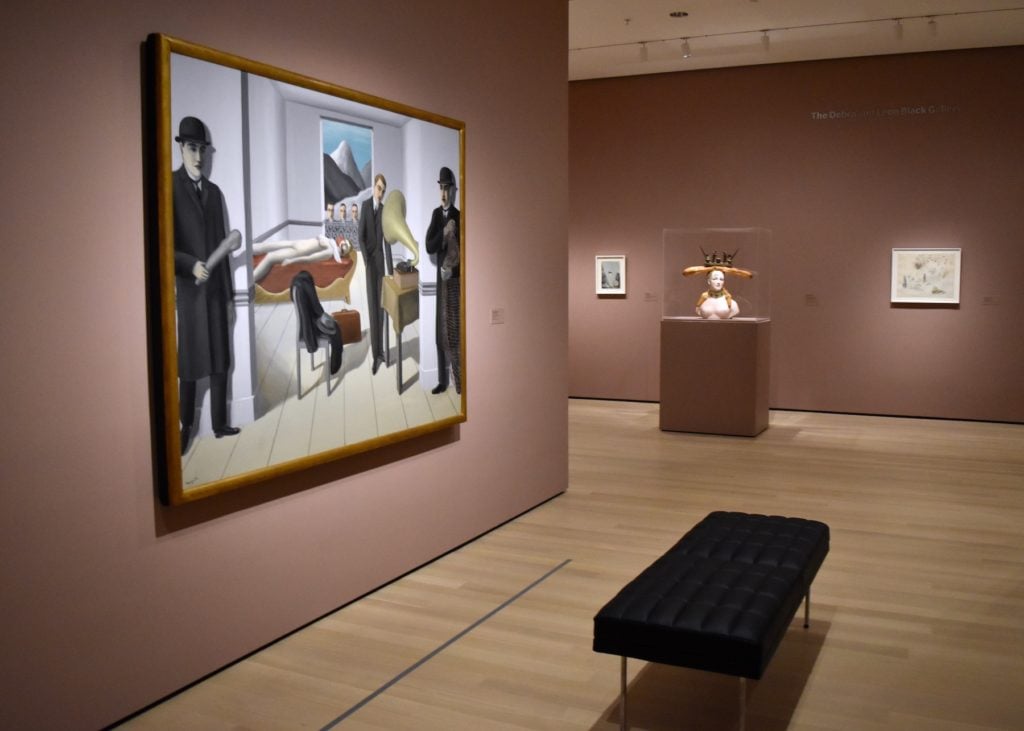
The “Surrealist Object” gallery at MoMA.
Image: Ben Davis.
It’s all broadly chronological, still, with art from the 1880s
to to 1940s up on the fifth floor, the 1940s to the 1970s on the
fourth, and the post-1970s contemporary down on the second. But it
no longer marches to the rhythm of the art historical movements
familiar from old college art surveys.
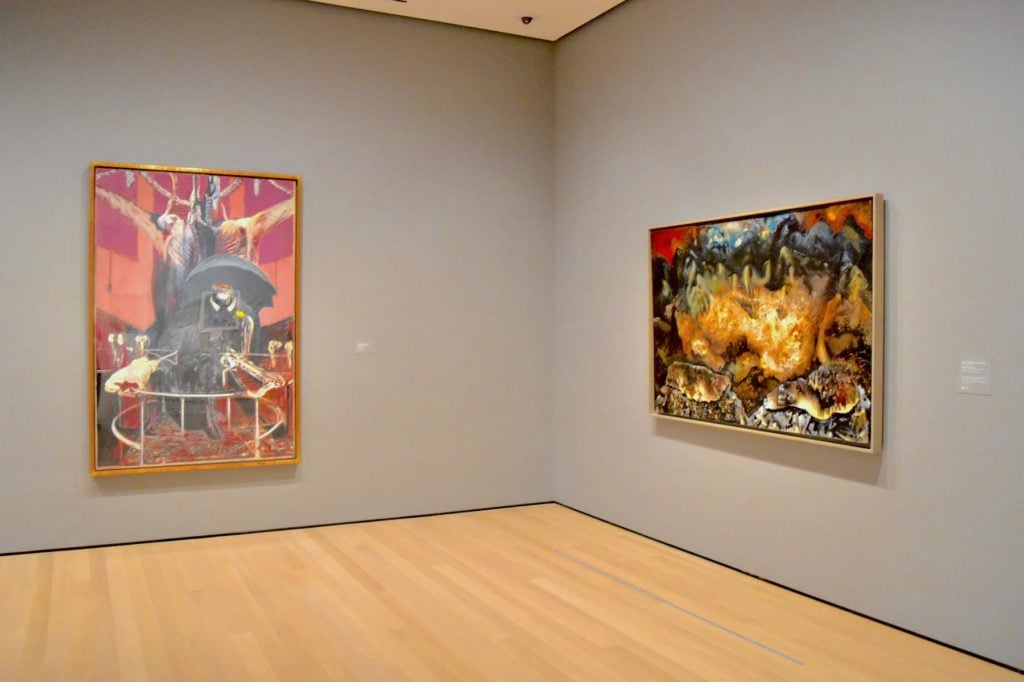
Francis Bacon’s Painting
(1946) and David Alfaro Siquieros’s Collective
Suicide (1936) in the “Responding to War” gallery. Image: Ben
Davis.
Instead there are more thematic rooms. Sometimes the themes are
pegs to hang a familiar MoMA-approved cluster of artists on, e.g.
“Readymade in Paris and New York,” “Surrealist Objects,” “Planes of
Color.” Sometimes these are more allusive and deliberately mushy,
allowing for conjugations of works you might not think about
together: e.g. “Responding to War,” “Stamp, Scavenge, Crush,”
“Inner and Outer Space.” As art history, it feels lumpy: different
thoughts and strategies are happening from gallery to gallery.
Are there highlights of this new installation? Are you kidding
me? The highlights are too numerous to list!
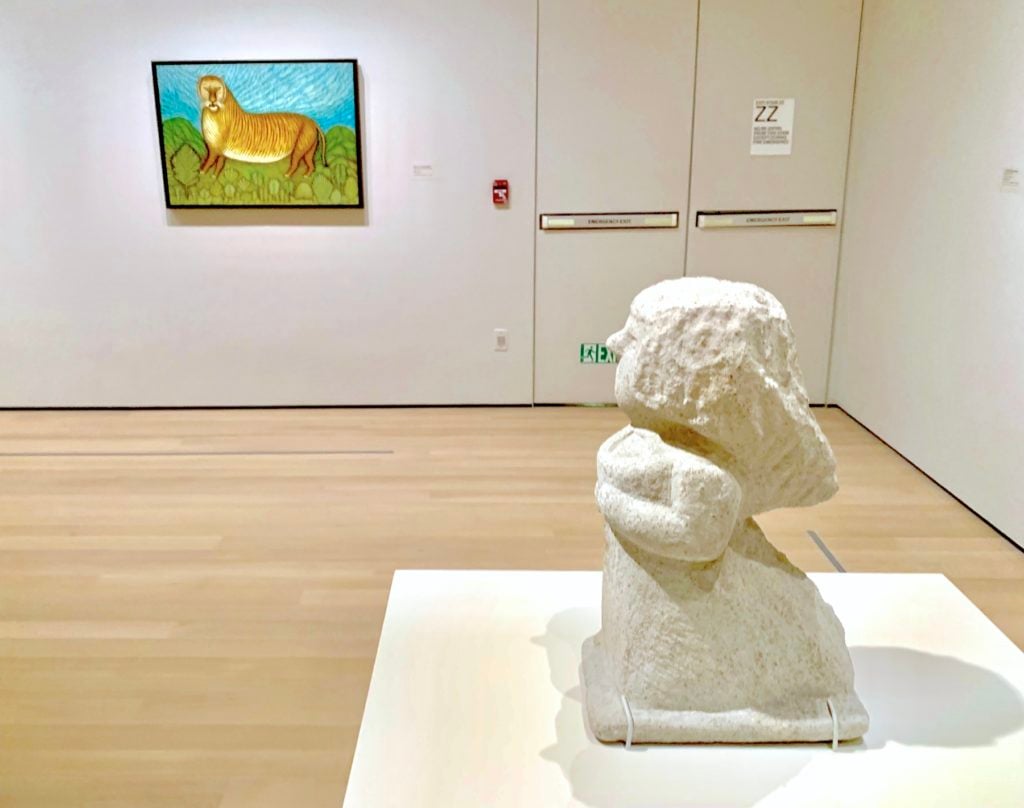
Morris Hirshfield’s Tiger
(1940) and William Edmondson’s Nurse Supervisor (ca.
1940). Image: Ben Davis
In the Modern quarters, I think of the sense of unsettled
innovation conveyed by the “Early Photography and Film” gallery,
which puts the whole era’s fine-art experiments with fragmentation
into multimedia context; the entirety of the jewel-box “Surrealist
Objects” room; the institution’s new faith in the oddly incredible
paintings of Morris Hirshfield (“Among twentieth century American
paintings I do not know… a more unforgettable animal picture than
Hirshfield’s Tiger,” MoMA’s founding director and czar of
Modernism, Alfred Barr, once raved of the self-taught artist’s
work).
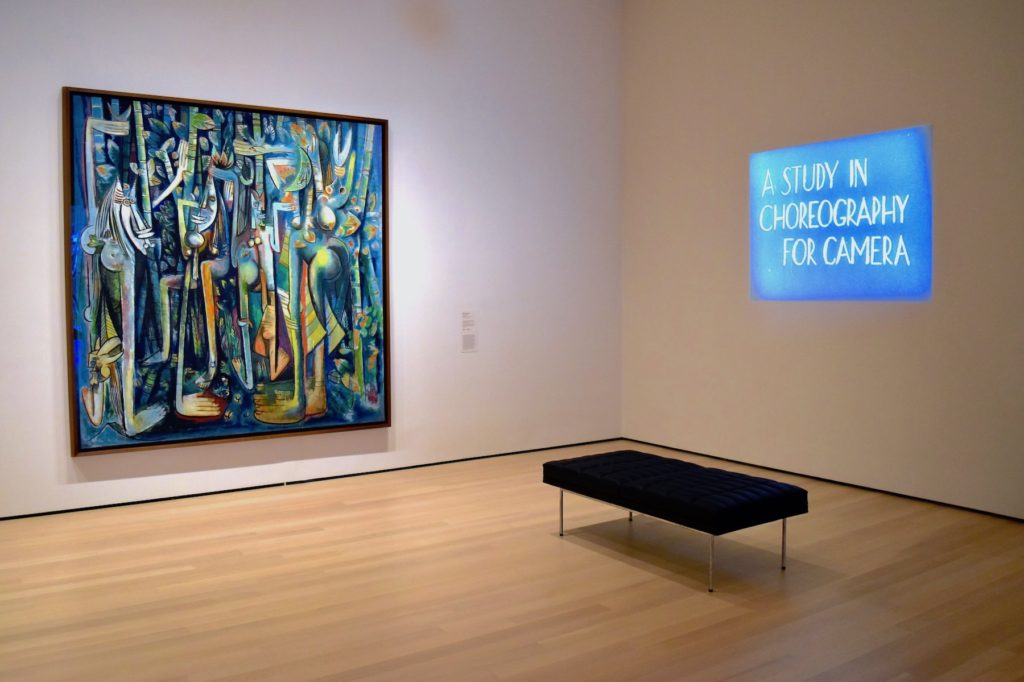
Wilfredo Lam’s The Jungle
(1943) and Maya Deren’s A Study in Choreography for
Camera (1945). Image: Ben Davis.
In Postwar, I think of Wilfredo Lam’s the Jungle
(1943) and Maya Daren experimental dance film hung in
conversation (1945); Marisol’s small and unforgettable sculpture of
a disembodied face being force-fed a bottle of Coca-Cola placed
before a poker-faced Jasper Johns flag; the eloquent grit of
Japanese photographer Daido Muriyama’s photos; a case of Ibrahim
El-Salahi’s intricately drawn notebooks from his time in
prison.
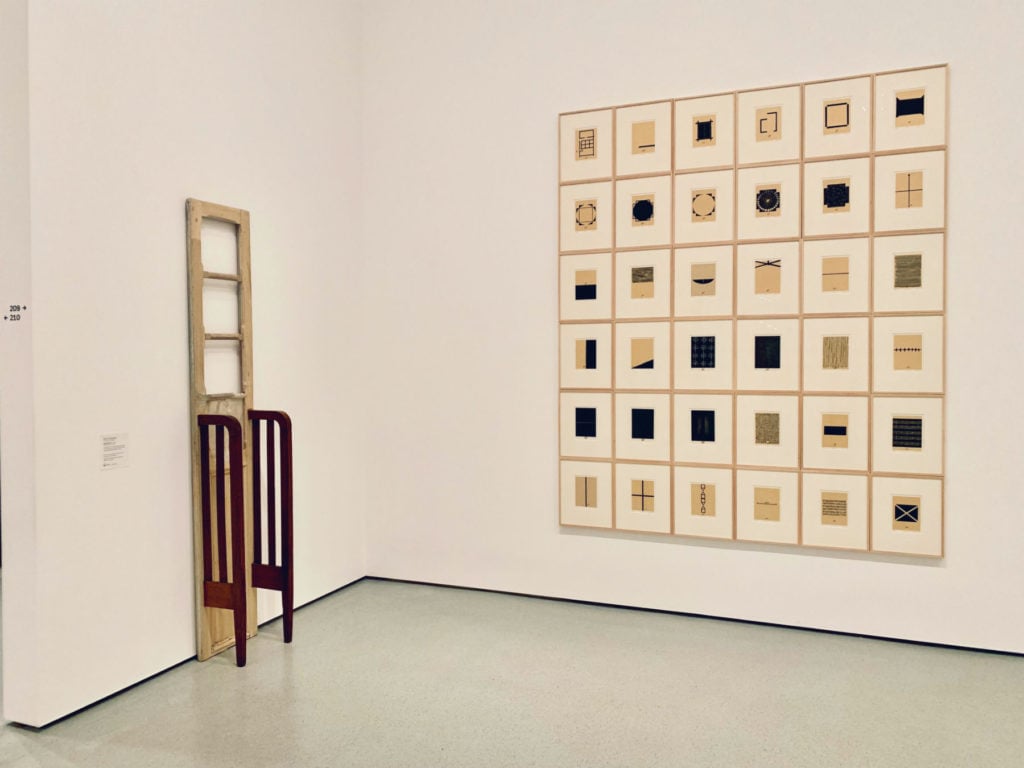
Doris Salcedo’s Widowed House
IV (1994) and Zarina’s Home is a Foreign Place
(1999). Image: Ben Davis.
In Contemporary, there’s Zarina’s beautifully cryptic and
personal portfolio “Home Is a Foreign Place,” a kind of visual
poem; the great post-Pictures
artist Gretchen Bender’s cataclysmic multichannel video
installation Dumping Core; the heady but righteously
visceral dance film from Wu Tsang, We hold where
stand.
But then, of course, any show with these resources and this much
curatorial talent behind it will have individual highlights. It’s a
highlights show.
So let’s talk about what’s weird about the thing as a whole.
A New Art History?
The idea of needing to rethink the story of modern art has been
very much in focus in recent years. In 2016, the Haus der Kunst’s
huge and ambitious “Postwar” show, for
instance, set out to do exactly that, seeing how the 1940s to the
’60s moment looked artistically, if you opened the aperture of art
history to let in the light of multiple modernities.
“To soldier forth with this endeavor, the weight of ‘canonical’
art history must first be shrugged off, let fall, gracefully, by
the wayside,” the late curator Okwui
Enwezor wrote in that show’s massive catalogue tome. “That does
not necessarily mean casting it aside in toto, nor abandoning some
of its many important insights. But it is part of this exhibition’s
mission to acknowledge and identify the persistent blind spots of
that history, and the Eurocentric limits that it places on artistic
activists outside Europe and North America.”
I think that’s a pretty good program. But this is very much
not how material manifests in this MoMA reinstall.
The sharp features of the MoMA-approved history may have
expanded to offer a more detailed topography—but, really, it is
still the same general landscape. The river of history still runs
from Paris through New York to the ocean of “the global,” only now
with a few extra tributaries.
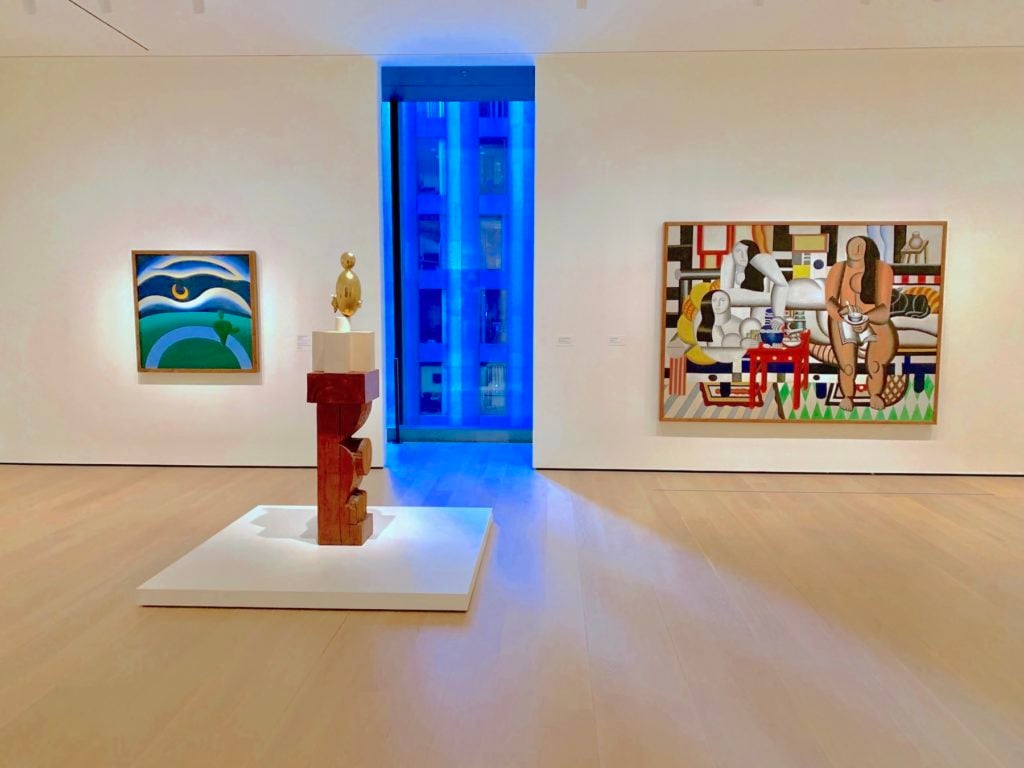
Tarsila do Amaral’s The
Moon (1926), Constantin Brancusi’s Blonde
Negress (1933), and Fernand Léger’s Three Women
(1921-22).
Indeed, not one but two galleries are devoted to Paris as a
meeting place for the global avant-garde, “Paris in the 20s” on the
fifth floor and “In and Out of Paris” on the fourth. This proves to
be one way to retell the same old story while still diversifying
the palette. The former gallery, for instance, gives us not just
Brancusi and Léger but also a canvas by Tarsila do Amaral, the
towering, troubling Brazilian artist (recently given a solo show at
MoMA).
Paris is part of her story, but Brazil is where its impact is.
Particularly given the stakes of the “Anthropfagia” (or
“Cannibalist”) movement she helped initiate, which was all about
advocating for a unique Brazilian aesthetic that blended cultural
influences, you really want to see her surveyed in a Brazilian art
context as well.
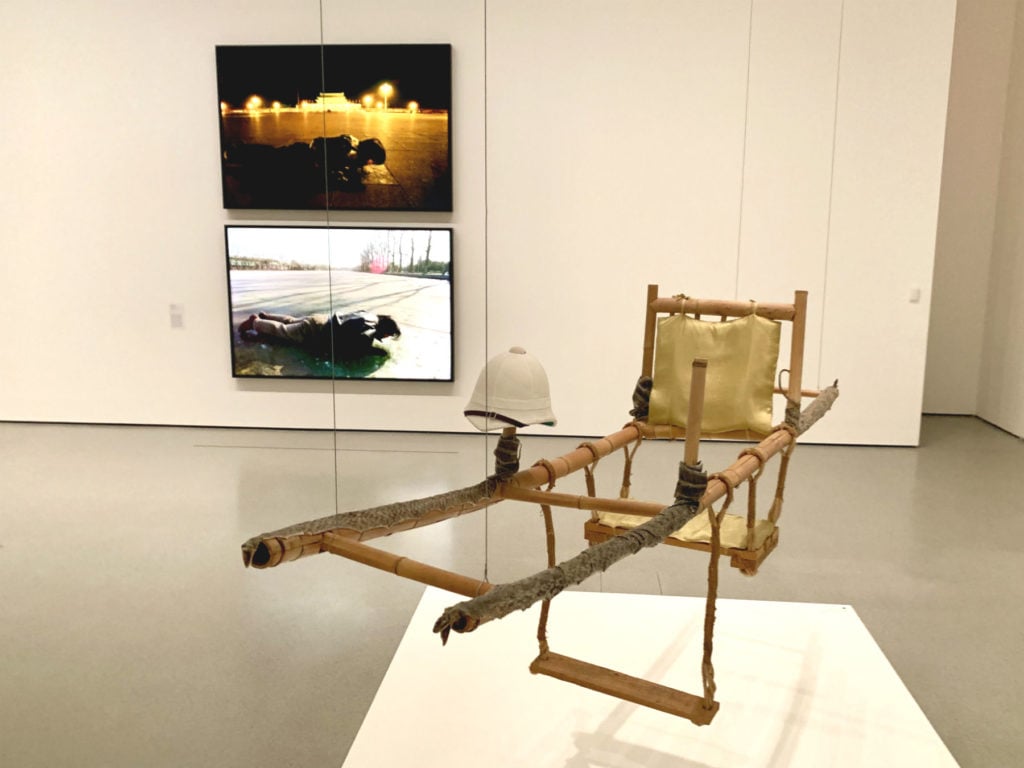
Song Dong’s Breathing
(1996) and Huang Yong Ping’s Palanquin (1997). Image:
Ben Davis.
Meanwhile, the entirety of this new, rethought permanent
collection features just one geography-specific gallery dedicated
to a non-Western art scene, down in the contemporary section. It is
titled “Before and After Tienanmen” and dedicated to Chinese art
around 1989—which makes good sense, since the rise of China is in
many ways the major human event of the last decades. Yet
given how seismic the artistic energy coming out of China has been
in recent years, this is still very, very abbreviated showcase,
with just five artists.
What is the governing logic here? You have to think of this
installation, above all, as a compromise formation reflecting an
institution wrenched between two poles.
On the one hand, MoMA’s bread and butter is mass tourism.
“Critical works that people travel long distances to see, like
Matisse’s Dance, Van Gogh’s Starry
Night, the Demoiselles d’Avignon,
Monet’s Water Lilies—we’re not going to change
those,” the museum’s director, Glenn Lowry, told my colleague Andrew
Goldstein.
On the other hand, particularly since Trump’s election, a
decidedly mainstream form of cultural consumption for an educated,
liberal audience now involves a hyperawareness of and symbolic
atonement for the sins of history. The New York Times
is the paper of record for these kinds of gestures, not just with
the refreshing historical reexamination of US racism with its “1619
Project,” which had fans literally lining up in
Times Square to get special copies, but in its project of writing new
obits for women whose
accomplishments it had historically overlooked.
MoMA’s own reinstalled contemporary galleries, which center
feminist critique, black artists, Latin American political work,
and queer subjectivity, provides the lens through which its own
past history has to be viewed. You can’t just pretend that there
was no dark side to European and American history.
Pinioned by these two impulses, some kind of compromise must be
reached.
Mostly Monochronology
And so, new voices have been inserted, which is an exciting
thing. Yet very often the new voices are quite
obviously marked out so that they appear as icons of
“inclusion,” very much on the “Muslim ban” protest model. The
least generous way you could say this is that they feel, sometimes,
like tokens. Because the underlying narrative remains intact, it is
pretty clear whose story is primary, and who is a supporting
character.
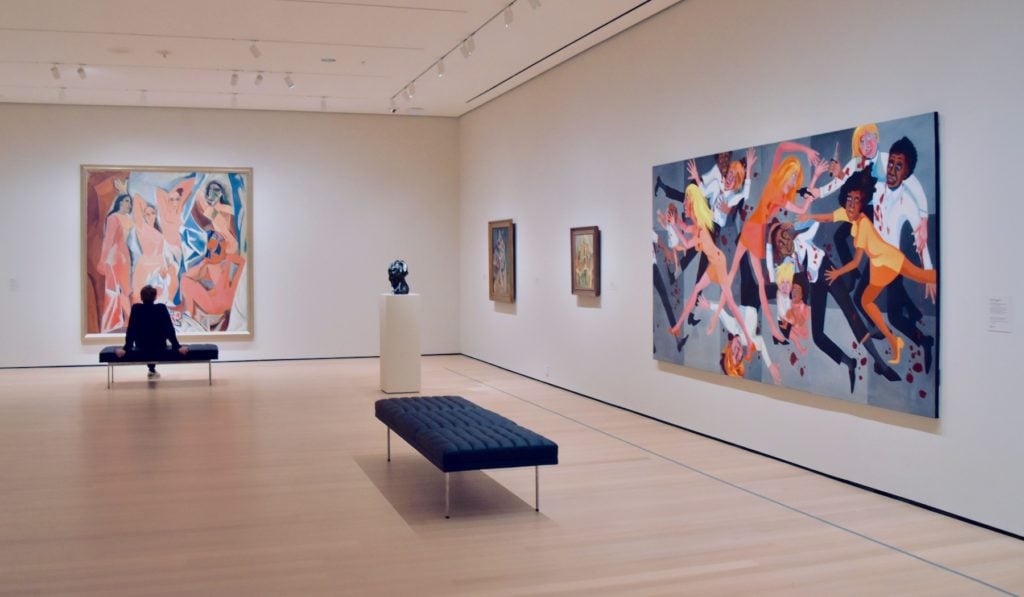
Pablo Picasso’s Les Demoiselles
d’Avignon on the left, and Faith Ringgold’s American
People Series #20. Image: Ben Davis.
The most-talked-about example, because it really is so striking,
is Faith Ringgold’s vivid painting of a race riot hung to rhyme
with Picasso’s ur-modern Les Demoiselles d’Avignon,
in a room full of classic-period Picassos. Nearby, a room dedicated
to MoMA’s magical, must-see Matisses—The Red
Studio, The Dance, et al.—gets the accent of a
small red-and-blue abstraction by Alma Thomas. Down in the postwar
galleries, the glories of the New York School remain inviolable,
but now Mark Rothko is paired with an abstract work by Indian
modernist Vasudeo S. Gaitonde.
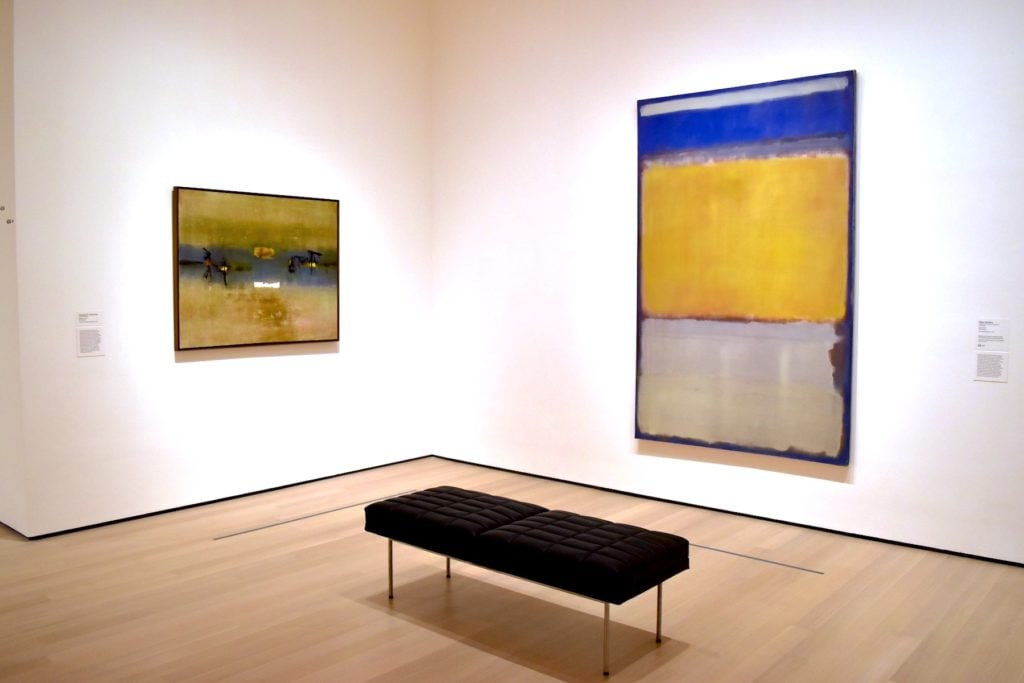
Vasudeo S. Gaitonde’s Painting,
4 (1962) and Mark Rothko’s No. 10 (1950). Image:
Ben Davis.
Introducing the volume Modern Art in Africa,
Asia, and Latin America, art historian Eileen
O’Brien writes of the need to reject an approach to global
modernism whereby “artworks are presented thematically, as if they
had no histories or precursors.” This pretty much exactly describes
what you get when, say, you pay homage to Korea’s recently hotly discussed
Dansaekhwa (“Monochrome”) movement of abstract painting via exactly
one 1974 dotted burlap canvas by Ha Chong-Hyun, placed in a gallery
dedicated to responses to violence and oppression (“War Within, War
Without”).
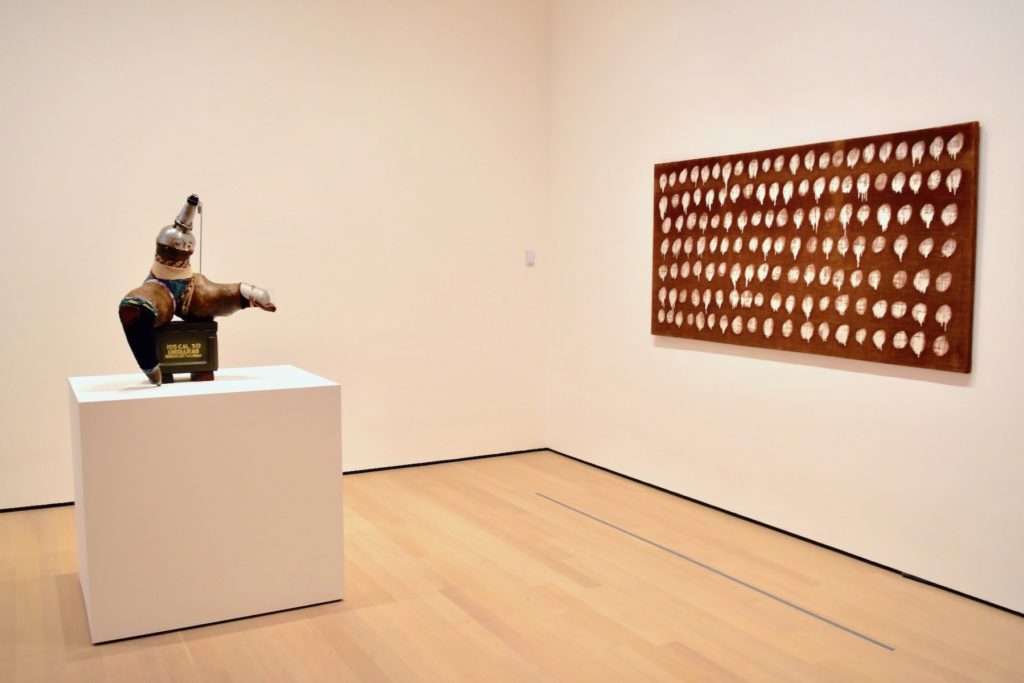
John Outterbridge’s Broken
Dance, Ethnic Heritage Series (ca. 1978-82) and Ha
Chong-Hyun’s Conjunction 74-26 (1974). Image: Ben
Davis.
Enwezor mentions a “heterotemporal” and “heterochronological”
approach—which really just means: give the “new” art histories the
dignity of their own spaces and contexts. Do an actual gallery of
Gutai (rather than a single drawing by
Atsuko Tanaka mixed in with a bunch of other stuff), or the
Bombay Progressives
(rather than just that lonely Gaitonde), or Dansaekhwa. MoMA’s
thematic approach starts to feel like an expedient way not
to concede this space.
“On the Modern”
This suspicion is thrown into relief over on the third floor,
where you can actually see what another approach could look like in
the galleries turned over to “Sur moderno: Journeys of Abstraction—The
Patricia Phelps de Cisneros Gift.”
The temporary installation of mainly abstract Latin American
geometric painting reverses the energy field. It presents MoMA
canon staples like Piet Mondrian and Aleksandr Rodchenko as
guest stars to illustrate influence and affinity. The main story is
the tremendous flowering of different experiments with abstraction
in Venezuela, Brazil, Uruguay, and Argentina in the postwar
period.
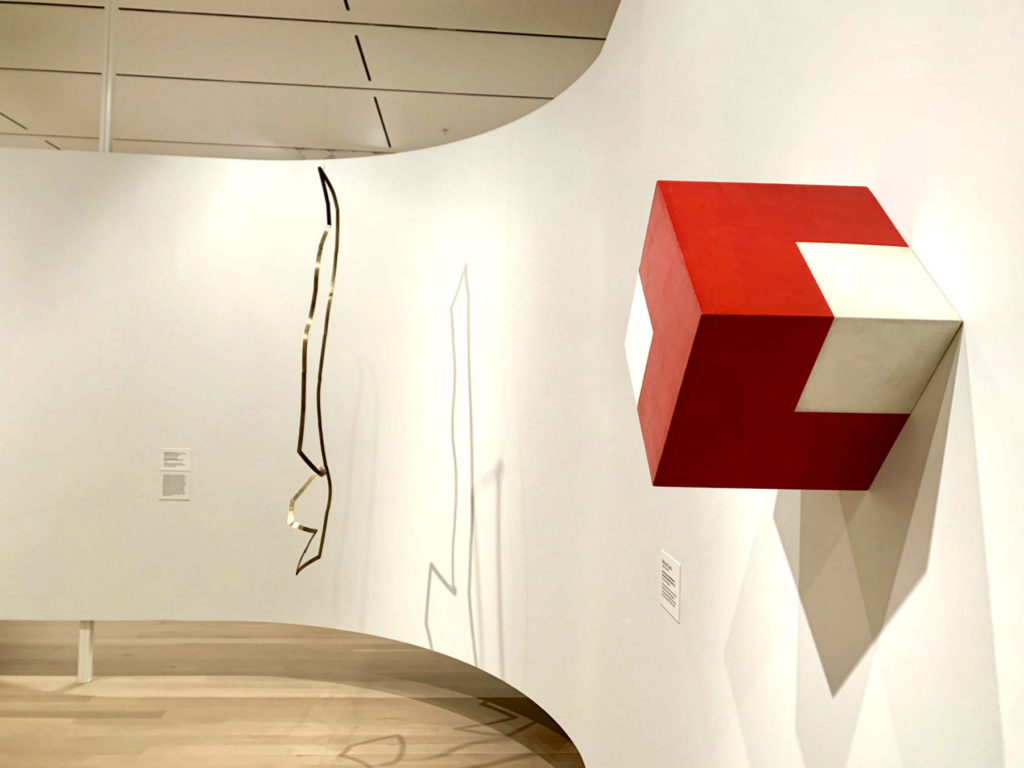
Willys de Castro’s Objeto ativo
(cubo vermelho/branco) (1962) and Gyula
Kosice’s Escultura móvil (1948). Image: Ben
Davis.
This is very clearly one story of Latin
American art, not the story of Latin American
art, conveying a very specific taste. The way that Brazilian
Neo-Concretism eventual boiled over into the gnarlier interactive
psychedelia of Hélio Oiticica and
Lygia Clark is merely
alluded to in the inclusion of Ivan Cardoso’s 1979
film H.O. and some photos of Oiticica’s
experiments with wearable art in action; the affiliations of the
more zealous Latin American abstractionists to Communism are
mentioned, but dutifully. On the whole, it’s a pretty preppy,
formal installation.
Nevertheless, “Sur moderno” tells a relatively focused story
from outside the usual axis of MoMA’s Modernist geography, without
lapsing into thematic indistinction or pseudomorphism. By its
example, it illustrates the degree to which the underlying logic of
the main reinstall, even with all its many sincerely
interesting new presences, recalls Visconti’s famous quip
representing the plaint of a fading aristocracy: “everything must
change so that everything can stay the same.”

Antonio Bandeira’s 2a Bienal
Museu de Arte Moderna São Paolo, Poster for 2nd Bienal, Museu de
Arte Moderna, Sao Paulo, Brazil (1954) and Lina Bo
Bardi’s Poltrona bowl (1951). Image: Ben Davis.
At the same time, “Sur moderno” also cuts against the fantasy of
institutional omnipotence, i.e. smart aleck complaints like mine
that imply that at any moment the all-powerful MoMA can just tell
whatever story it wants. The point this show clearly projects is
precisely that MoMA could not have told this new
story without the largesse of Patricia Phelps de Cisneros, a woman
with the resources of “one of the largest privately held media fortunes in the
world“—just as, over in contemporary galleries, the handful of
works from the Congo all hail from a single generous gift
from Jean Pigozzi. The canon is not just a mental structure to
be wished away. It is a calcification of tremendous amounts of
historical wealth.
A Permanent Crisis in the Canon
“We know that there are dozens of issues that were left on the
table when we made hard decisions about what to show in the
museum,” Lowry cheerfully concedes. You could go on listing things
this installation does not do justice to, or how even without
trying to account for a global story, MoMA’s US story is quite New
York-centric. (Recently resonant movements like LA’s Light & Space,
Chicago Imagism, AfriCOBRA, and the Washington Color School all go
wanting, and even Andrew
Wyeth’s Christina’s
World (1943), most certainly a painting “people travel
long distances to see,” does not make this christening.)
With its expansion, MoMA’s has never been physically bigger.
Because of contemporary intensified awareness of exclusion and the
expansion of the cultural conversation, though, it has also never
looked smaller, more particular, less universal.
Thus, the most radical gesture of the new MoMA permanent
collection display is that it is not permanent. The decision to
turn over the galleries every few months to rethink juxtapositions
and react to new conversations is a strategy, both sly and
expedient, to forestall any conversations about lacks or
absences.
It’s nevertheless possible to argue—since, as Lowry notes, the
crowd favorites will remain—that, in a way, the traditional Modern
stars are rendered more monumental by this dynamic scheme, standing
as the traumatic material that everything else constantly reorders
itself around to justify. It is also possible to be really
conspiratorial and say, “Oh great, just when finally when the canon
starts to get seriously opened up—whoops, no more canon!”
This really is too cynical. With finite space and a
near-infinite task, there is probably no other way to do it. In
essence, it is as if the quicksilver, incessant stream of
commentary on the internet has poured against the collection,
annealed with it, and rendered it into a new and more pliable form.
The sense of crisis-response in MoMA’s “Muslim ban” intervention
has, in effect, been rendered institutionally permanent. In an age
of continual contemporary upheaval, what it takes to stay feeling
relevant and meaningful is continuous upheaval in art history.
But how this is done matters to me a lot! In a gesture of
pseudo-populism, MoMA has banished the traditional terms like
“Pop,” “Abstract Expressionism,” and “Dada.” I am sure they have
the data to back up the fact that these seem off-puttingly jargony
to new audiences, with the more abstracted thematic categorizations
better suiting some measure of visitor engagement.
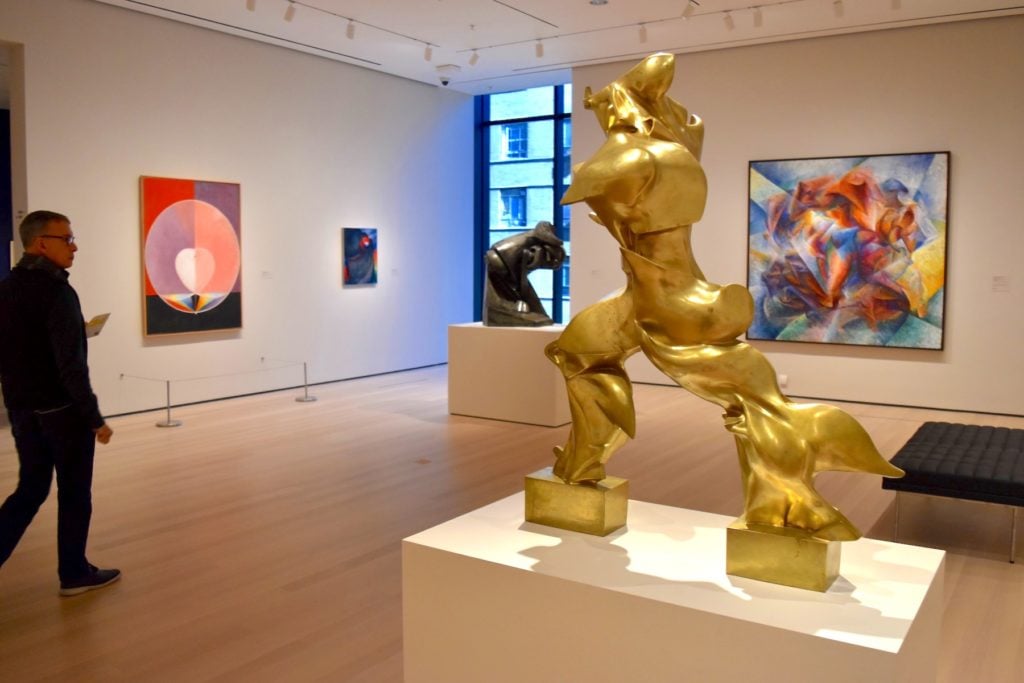
The “Circa 1913” gallery with Umberto
Boccioni, Unique Forms of Continuity in Space (1913).
Image: Ben Davis.
My own lesson from the revisionist art historical blockbusters
of recent note points the other way. Hilma af Klint at the Guggenheim, or
“We Wanted a Revolution” at the Brooklyn Museum,
or “Radical Women” at the Hammer all have
their echoes in this reinvigorated display. But what each of these
shows proved to me was that
audiences will absorb a heck of a lot of complexity and context
indeed—as long as there’s a human story that feels resonant and
relevant. Presented as trophies in incidental rhymes with other
things—as, for instance, when the now-sanctified Hilma af Klint is
brought in to be paired with the problematically fascist-curious
Futurists in the MoMA’s new “Around 1913” galleries—I just feel
that they lose that hard-earned human depth.
You shouldn’t take the triumphs of this new display for granted.
I’ve spend more than 10 hours in it, and that is not enough to
fully see or explore all the great things there. It’s the product
of a lot of work, and navigates problems that can’t necessarily
just be undone with good curating.
But if a time of uncertainty and acceleration isn’t to deplete
these objects, then the loosening up of history is a mistake, I
think; history and context is more important than ever as a
counterweight. That just may mean fully giving up the residual
fantasy of telling a universal history, so that the different,
specific stories actually get the space to get their whole due for
the time they have.
The post MoMA’s Nimble New Incarnation Is Well Suited to a World in
Constant Flux. If Only It Didn’t Choose Tourists Over Its
Artists appeared first on artnet News.
Read more https://news.artnet.com/opinion/moma-reinstall-1681075
Further reading


Leave a comment