
Mother Knows Best: 6 Famous Artists Whose Dynamic Mothers Became Their Creative Muses
Is there a more complex, loving,
and sometimes fraught relationship than that between mother and
child? Psychology tomes have been written trying to untangle the
nuances and consequences of that very quandary. Perhaps it’s
inevitable, then, that over the course of history, mothers of
artists would sometimes become their muses. Who could make a more
perfect model or a more deserving source of inspiration?
Patient, encouraging, and
especially affordable, mothers often make the ideal subject.
Albrecht Dürer, for example, certainly thought so, and was one of
the earliest artists to capture the likeness of his mother, when,
in 1514, he rendered her at 63 years old, aging but resolute. And
he was certainly not the last to do so.
Below, discover the tales of
artists whose mothers have been immortalized in artworks across the
centuries.
Dante Gabriel
Rosetti
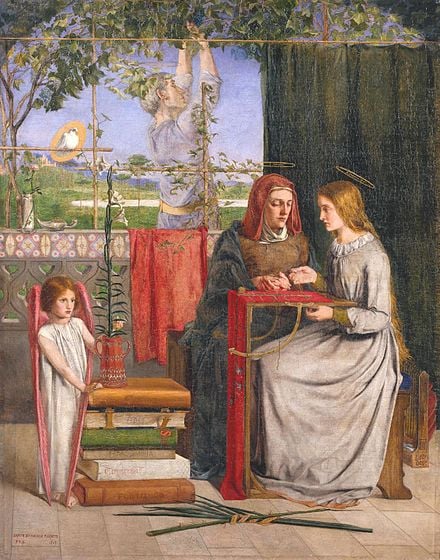
Dante Gabriel Rossetti, The Girlhood
of Mary Virgin (1849). Courtesy of Wikimedia Commons.
The Daughter of
Intellectuals: Perhaps more than most artists, Dante
Gabriel Rossetti owes his artistic success to his
mother, Frances Mary Lavinia Polidori (later Rossetti), who
not only steadfastly supported him but reared him in a heady,
intellectual sphere. The daughter of an Anglican high-born
governess and an Italian exile to England, Frances married the poet
Gabriel Rossetti (who was, coincidentally, also an Italian exile),
with whom she had four children—two sons and two daughters. The
eldest of her sons, Dante, would go on to become a leader of the
Pre-Raphaelite Brotherhood in England.
An Unconventional
Educator: An
exceptional and avant-garde educator, Frances educated her four
children at home, cultivating a vast sweep of interests from
medieval history to Italian painting. A devout Anglican, she imbued
her lessons with a deep sense of religious interest and moral
upstanding, ensuring her children would remain close to her all her
life. Sometimes this religiosity had its consequences—Dante first
refused to marry and then later all but hid his wife and frequent
model, Elizabeth Siddal, from his family for shame of her low-born
position.
A Picture of
Virtue: Dante would paint his mother repeatedly. One
of the more poignant images of her can be found
in The
Girlhood of Mary
Virgin (1849). The image
shows his mother as Saint Anne educating the Virgin Mary, who is
modeled after his sister, Christina.
Not Her First
Rodeo: Rossetti wasn’t the only artist interested in
his mother’s likeness. She was also photographed by Lewis Caroll in
a work that is on permanent display at the National Gallery in
London.
LaToya Ruby
Frazier
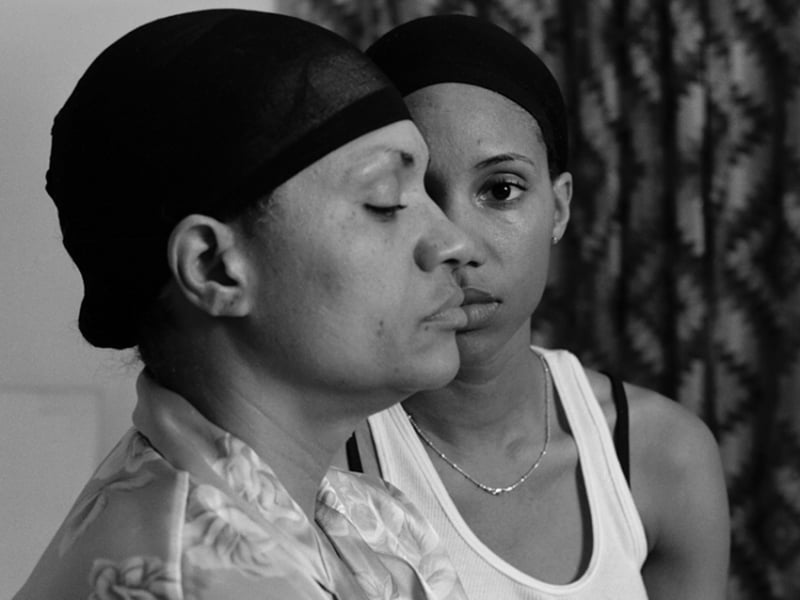
LaToya Ruby Frazier, Momme
(2008). Courtesy the artist and Michael Rein, Paris/Brussels. ©
LaToya Ruby Frazier. Collection of ICA Boston.
A Family Portrait: Photographer LaToya Ruby Frazier’s 2014 book,
The Notion of Family, is filled with stark and
moving images of her home city of Braddock, Pennsylvania, and has
been hailed as one of the best photography books of the 21st
century. At the heart of the project are Frazier’s haunting images
of her mother and “Grandma Ruby,” lifelong residents of this
forgotten American industrial city, who come to embody the personal
toll of poverty and societal disenfranchisement.
Constant Collaborator: Among the most stirring portraits in the
collection are ones made in collaboration with Frazier’s mom. In
these works, Frazier herself at times appears partially obscured by
her mother’s figure, like a small child hiding behind her parent’s
legs. In another sense, these same images are a window from the
past into the future, showing the effects of a lifetime of struggle
on the body—but also, in a sense, a kind of hereditary of
strength.
Caregiving: To date,
Frazier’s mother suffers from lupus and the photographer continues
to live close by to provide care for her
mother.
James McNeill
Whistler

James McNeill Whistler, Arrangement
in Grey and Black No.1 (1871). Courtesy of Wikimedia
Commons.
American Idol:
She’s been called the Victorian Mona Lisa. Anna
McNeill Whistler was forever enshrined in the pantheon of
artist-mother muses when her son depicted her in profile for as
Arrangement in Grey and Black No. 1., an image that has
come to signify puritanical American motherhood.
A Lifesaver:
Though the work became a symbol of motherhood, it was actually
intended as a study in color and composition. As the story goes,
McNeill-Whistler offered to pose for her son when his model failed
to show up. “To me, it is interesting as a picture of my mother.
But what can or ought the public to care about the identity of the
portrait?” the artist later wrote. (Apparently, a whole
lot.)
Andy Warhol
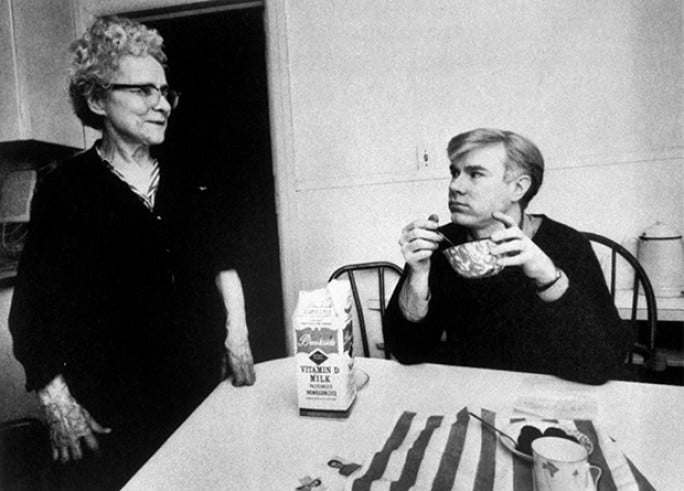
Andy Warhol, eating cereal, with his
mother, Julia Warhola. Courtesy of Ken Heyman/Woodfin Camp/Woodfin
Camp/Time Life Pictures/Getty Images.
Lunchtime
Inspirations: Julia Warhola emigrated from
modern-day Slovakia to the Pittsburgh area with her husband in
1921. She gave birth to three sons, the youngest of which, Andrej,
would become the father of Pop Art. It’s rumored that her
frequently served lunches of Campbell’s soup were Andy’s first
sources of inspiration.
A Mother’s
Touch: Julia Warhola had artistic aspirations herself, but
it was her son’s passion that she fostered from childhood. She
would sometimes contribute her idiosyncratic penmanship to his
works. Occasionally, her own pieces were given their own platform,
as with her publication Holy Cats—a book filled with her
whimsically drawn depictions of beatific cats—which she signed, not
with her own name, but as “Andy Warhol’s Mother.”
Roommates:
Warhol adored his mother and she lived with him for many years, up
until 1971, a year before her death. In 1966, he made a 66-minute
movie called Mrs. Warhol starring his mother as an
oft-married aging movie star. Two years after her death in 1974, he
painted a portrait of her as well, which he marked with
finger-painted squiggles, reminiscent of his childhood art
projects. It was the last
painting he created in the “old” Factory.
A Bitter End:
In the last years of he life, Julia was placed in a nursing home
(which Warhol paid for), but though he called her every day, the
idea of her death terrified Warhol, who refused to visit her,
despite her repeated entreaties. When she died, he paid for her
funeral, though he didn’t attend. Later, he grappled with this
decision in his diary, wondering if he had made a grave
mistake.
Closet Catholic: Though Warhol was a bon
vivant, he followed his mother’s wish that he attend mass every
Sunday.
Vincent Van
Gogh

Vincent Van Gogh, Memories of the
Garden at Etten (1888). Courtesy of Wikimedia Commons.
Collection of the Hermitage State Museum.
At-Home
Education: Born in the Hague, Anna Carbentus Van Gogh
would not marry until the unheard-of age of 32, when she wed the
older brother of her art collector brother-in-law, the husband to
her younger sister. She was an amateur artist herself and raised
her six children in a creatively encouraging home.
A Photo-Likeness: In 1888, Van Gogh
painted Portrait of the Artist’s Mother, but unlike
most of his portraits it was not made from life. Instead, he worked
from a photograph and imbued the image with his vivid sense of
color. In the portrait, Anna appears her age, and while not
idealized, she looks alert, kindly, and—in sharp distinction from
her son—mentally quite stable. Though his mother wrote to him often
(quite understandably, she worried over him), this portrait came
three years after he last saw her in 1885.
Nature’s Lesson Book: Anna had a green thumb
and made sure that all her children helped her in tending to the
family garden. Her love of nature was instilled in Vincent at a
young age, too. In 1888, he would paint Memories of a Garden
in Etten, which shows his mother and two of his sisters
in that idyllic place.
Marilyn
Minter
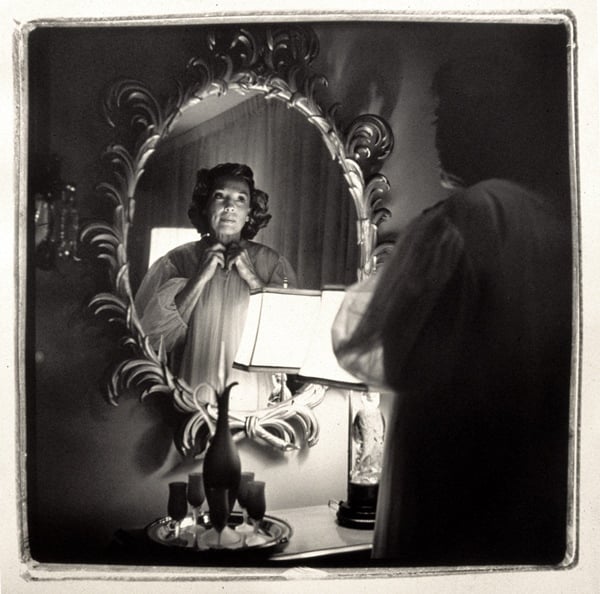
Marilyn Minter, Coral Ridge Towers
(Mom in Negligee) (1969). Photo: Courtesy of Salon
94.
Art Student: While still
an undergraduate student, Marilyn Minter spent a weekend in Florida
documenting the daily rituals and comings and goings of her
eccentric though glamorous mother. The resulting 12 dynamic
photographs have come to be known as the “Coral Ridge Towers”
series.
Ready for Her Close-Up: A hazy, Sunset Boulevard-esque
allure characterizes these images. Minter’s mother, then-60 years old and struggling with
addiction, rarely left the house. She’s captured with noir-like
beauty and grit—smoking cigarettes and trying on wigs while wearing
a glossy slip in a dramatically lit boudoir.
High Praise: Though most of her classmates were
turned off by these unconventional images of her mother, they were
a hit with Minter’s visiting professor at the time—who happened to be none other than
Diane Arbus.
The post Mother Knows Best: 6 Famous Artists Whose Dynamic
Mothers Became Their Creative Muses appeared first on artnet
News.
Read more https://news.artnet.com/art-world/artists-whose-mothers-became-their-muses-1830039
Further reading


Leave a comment