
Museum Workers Across the Country Are Unionizing. Here’s What’s Driving a Movement That’s Been Years in the Making
“Let us in! Let us in!” chanted
a small crowd of visitor services associates dressed in black. They
stood at the locked gate of the Marciano Art Foundation (MAF) on
Friday, November 8, at 11 a.m., the time the museum normally would
have opened to the public. Three days earlier, the austere
contemporary art foundation had closed abruptly—less
than a week after the visitor services associates announced their
plan to unionize.
The foundation, a private
nonprofit opened in early 2017 by
the two art-collecting brothers behind the denim brand Guess,
initially released a statement saying they were
“supportive of all
recommendations to improve the workplace.” But several days later, the administration
sent out an email with a very different message: they
would be “laying off all visitor
service associates” and closing the current exhibition nearly one
month early due to “low attendance.”
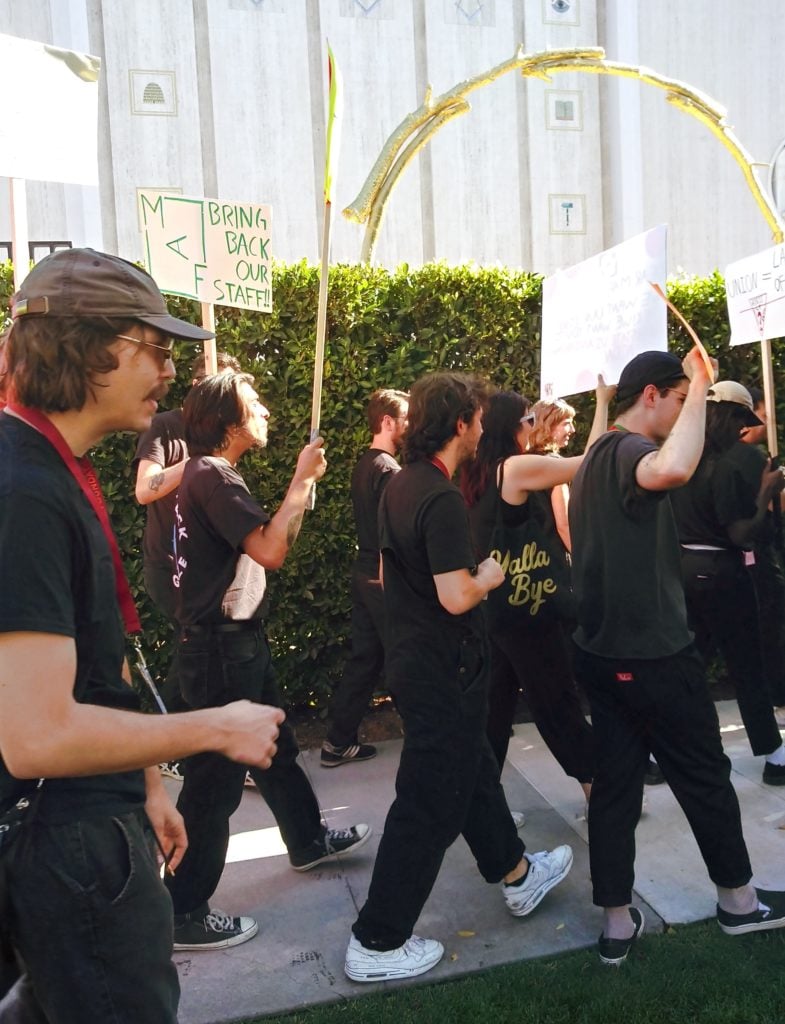
Workers march outside of the Marciano
Foundation in Los Angeles. Photo: Catherine Wagley.
After filing a complaint with
the National Labor Relations board, the just-formed union returned
to their former workplace with colorful signs. “We want to work!”
they chanted forcefully at the locked gate. (Their action wasn’t
without its humor—“We want to see the Alex Israel,” called someone
in the crowd, referring to the clichéd installation of palm trees
and parking meters on the museum’s mezzanine. “Ewww,” someone else
responded.)
A Growing Wave
The employees knew, as they
moved to unionize, that they were part of a bigger, industry-wide
conversation.
The New Museum, the Solomon
R. Guggenheim Museum, the Museum of Tolerance in Los Angeles, and
the Frye Art Museum in Seattle have all formed unions this
year.
And the tide doesn’t seem to be
slowing: On November 22, a group of workers from Los Angeles’s
Museum of Contemporary Art across multiple departments—exhibitions,
education, communications, and audio-visual—followed suit.
(Notably, Maurice Marciano, one of the brothers behind the MAF, is
a board member emeritus at MOCA, and director Klaus Biesenbach’s
full title is technically “the Maurice Marciano
director.”)
The forces driving this
push—ranging from a mandate to diversify staff to the rising cost
of living in urban centers—are not necessarily specific to the art
world. Similar efforts have rippled through higher education, as
adjunct professors organize, and across the publishing
industry.
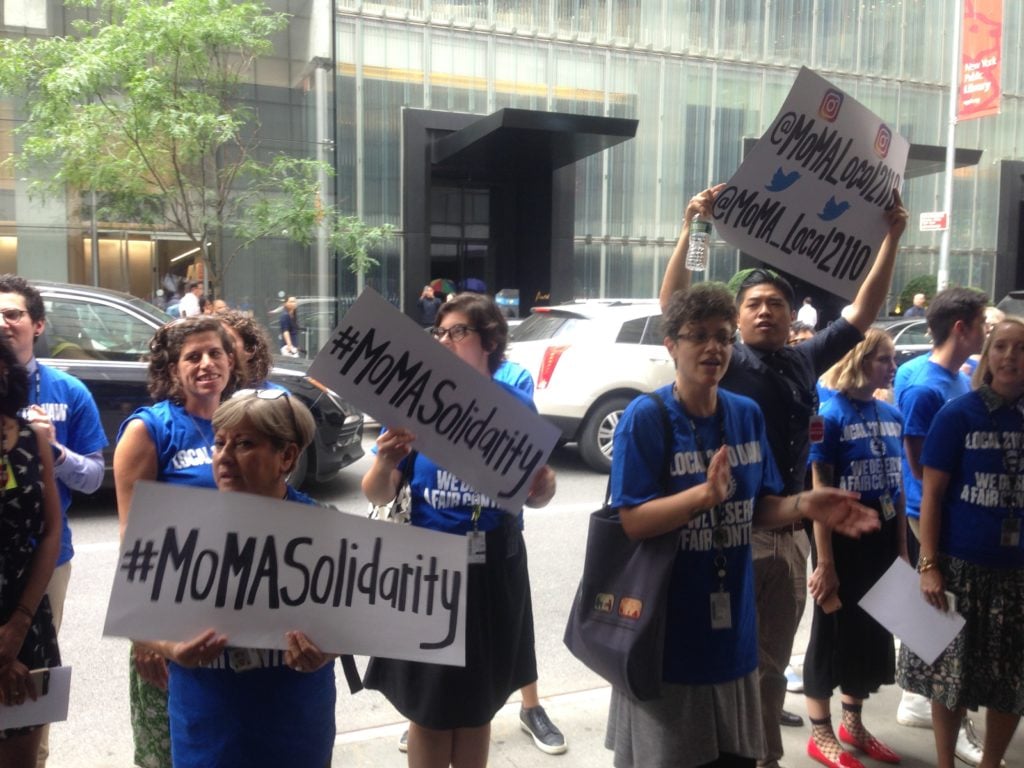
MoMA union worker protest at the Museum
of Modern Art. Photo by Sarah Cascone.
But art is a field in which some
of the world’s wealthiest people regularly interact with artists
and workers hovering near the poverty line. Because of this wealth
gap, and because art institutions regularly celebrate critiques of
capitalism and power abuses in art while failing to engage with the
concerns of their own low-paid employees, unionization feels like a
critical culture shift.
What makes this shift a
“movement not a trend”—according to the meme multiple art museum
unions posted in the past week, rejecting the use of the word
“trend” by press outlets and museum administrators—is the fact that
workers from across different institutions, many of whom had not
spoken to one another in the past, are exchanging strategic advice
and sharing information about pay and benefits. In the process,
they are attempting to thwart the art world’s own exclusivity in a
way that could have lasting and widespread
impact.
Information Sharing
Visitor services associates at
MAF make $14.25 an hour, minimum wage in Los Angeles, but their job
involves overseeing the galleries while acting as gallery educators
and security. (The trend for this dual role began at the Broad, a
non-profit museum founded by billionaire collector Eli Broad, which
hired personable, art-aware quick-learners to protect the art while
also engaging the public when it opened in 2015.)
When MAF’s visitor services
associates decided to unionize, they reached out to the New Museum
union, which announced its formation in
January. “The New Museum was sort of our direct Dharma
transmitter as it were,” said Eli Petzold, an organizing member of
the MAF union.
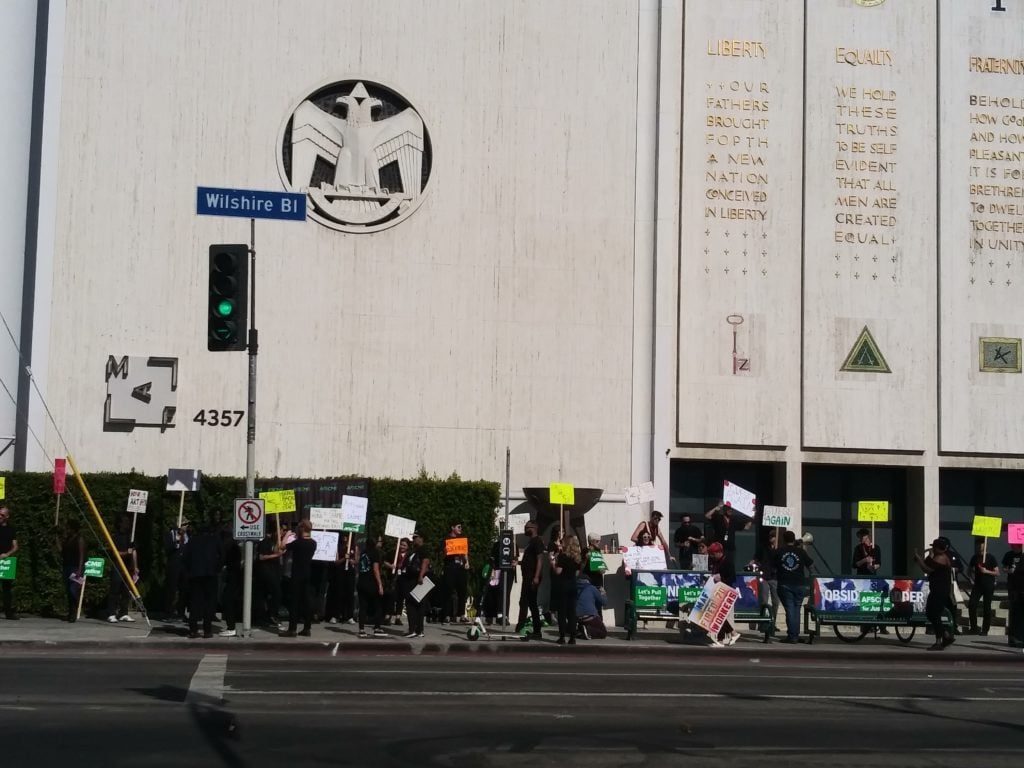
Protests outside of the Marciano
Foundation in Los Angeles. Photo: Catherine Wagley.
This kind of information sharing
has been critical to the formation of museum unions. Dana Kopel,
one of the New Museum union organizers who stayed in touch with the
MAF staff, said that she and her colleagues decided to unionize
themselves after reaching out to a steward at the Museum of Modern
Art’s union, who put them in touch with United Auto Workers’ Local
2110. The union’s president, Maida Rosenstein, brought members of
MoMA’s union with her to meet New Museum staff. When the New Museum
began contract negotiations, the MoMA union brought over snacks and
Advil. “It was very sweet,” Kopel said.
Abigail Entsminger, an artist
and art handler involved in the Guggenheim’s effort to
unionize, said that the Guggenheim’s move was partly spurred by
the large number of freelance art handlers working there, many
of whom encountered similar
labor conditions across the New York art world. “I think we’re all
a little bit frustrated with the state of having to advocate so
strenuously for ourselves in this industry,” she said.
As the Guggenheim began the
process, reps from the
International Union of Operating Engineers Local 30 would
occasionally bring to meetings workers from PS1 or the Whitney, who
would share their experiences. But the negotiations themselves
often felt particular to the Guggenheim’s culture and management.
“It’s hard in the moment,
when you’re trying to actually do all of those nitty-gritty, very
specified things, to think about it as a larger conversation,”
Entsminger said.
Too Special for Unions?
This issue—whether art museums
are too particular, too unique to integrate unions the way other
workplaces do—is at the heart of the debate between union
supporters and opponents.
After Guggenheim workers voted
to unionize over the summer, Richard Armstrong, the Guggenheim’s
director, emailed prepared remarks to staff, reiterating the
museum’s specialized identity. “I do not want to work with a third party who
has very limited experience in the museum field, and whose
membership is largely in the heating and air-conditioning and
construction industries,” Armstrong wrote. A spokesperson for the Guggenheim, which is now
in contract negotiations with the union, declined to comment on
whether the institution’s perspective had changed.
But Armstrong’s opinion is
hardly isolated. In the wake of MOCA’s announcement, a
representative for the museum said in a statement:
“While we respect the right
of employees to decide whether or not they wish to be represented
by a union, we do not believe that this union is in the best
interest of our employees or the museum.” Back when the New Museum announced its
intention to unionize in January, the museum adopted a similar
position, arguing that a union would threaten “what is special about our
culture.”
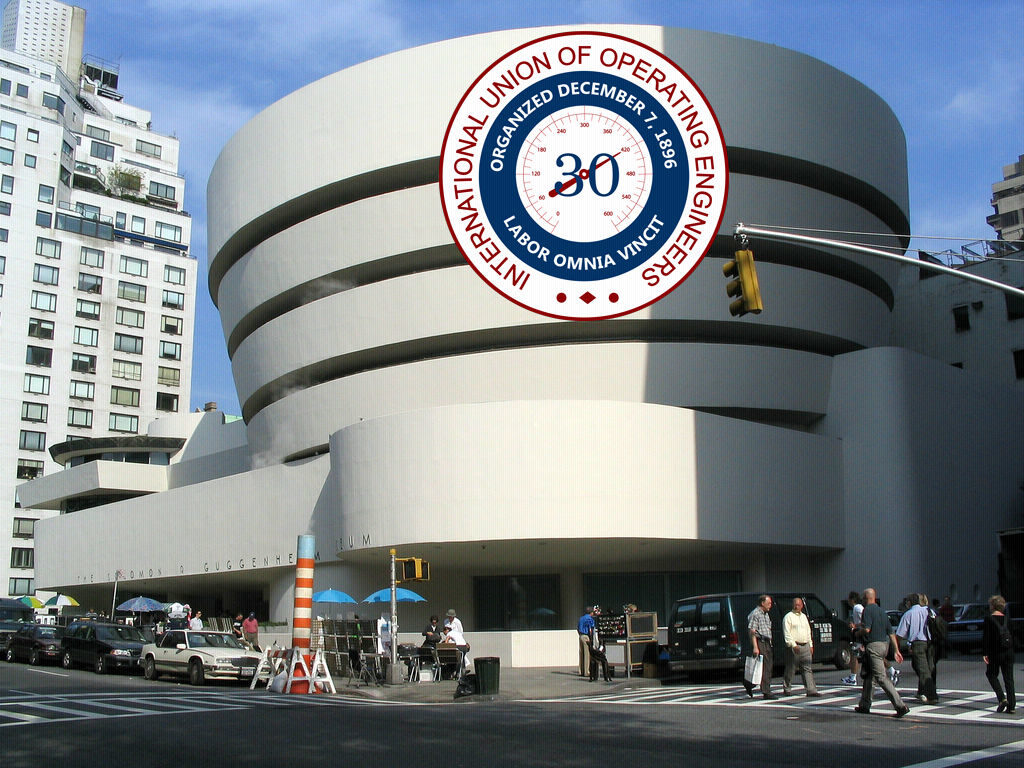
The Guggenheim Museum with the logo for
the IUOE Local 30.
Joseph Rosa, CEO and director of
the Frye, acknowledged that “the movement is not just related to the
organizations themselves but is tied to the bigger picture of the
cities and systems that we are all working within.” But he added:
“There is an important distinction to be made between a
nonprofit museum, like the Frye, and for-profit
businesses—they are not financially comparable.”
Maida Rosenstein, president of
UAW Local 2110 (which represents MoMA and New Museum workers),
thinks the assertion that art museums are too specialized for
something as populist as unions is “just absurd.” “If you want to,
as a worker, have any voice in your terms and conditions, then
unionizing is the only way to do that,” she said.
Rosenstein, who became a union
organizer after helping to unionize her own office at Columbia
University in the 1980s, has worked with many white-collar
professionals over the years. She does not consider the current
growth in art museum unions an isolated trend. “The context is
these urban centers, where workers working for employers that were
not traditionally unionized are trying to unionize because wages
are really low,” she explained, “and people are coming out of
school with loads of debt and they’re working [and] living in
cities where the rent is incredibly high.”
The History
Even widespread acknowledgement
that the art world is not unique represents a cultural shift for an
industry that has long banked on its exceptionalism. When MoMA,
which now has five unions, established its first in 1970 as an
outgrowth of the Art Workers’ movement in New York, their language
and goals resembled what is being said now. Workers cited concerns over low pay, but also
over corrupt museum management. “The museum has for too long been a
private toy when it should be a public institution!” cried one
protester at MoMA’s 1971 strike, according to
New York Times
reporter Grace
Glueck.
Glueck implied, in her coverage
of the strike, that other museum workers nationwide were taking
note. MoMA’s new contract, Glueck wrote, “should give pause to die
hard trustee boards,” since “[e]xpressions of interest have poured
in.” Instead, the movement seemed to start and stop with MoMA.
Today, only around 12 percent of museum workers across the US are
in a union, according to research by Bloomberg
Law.
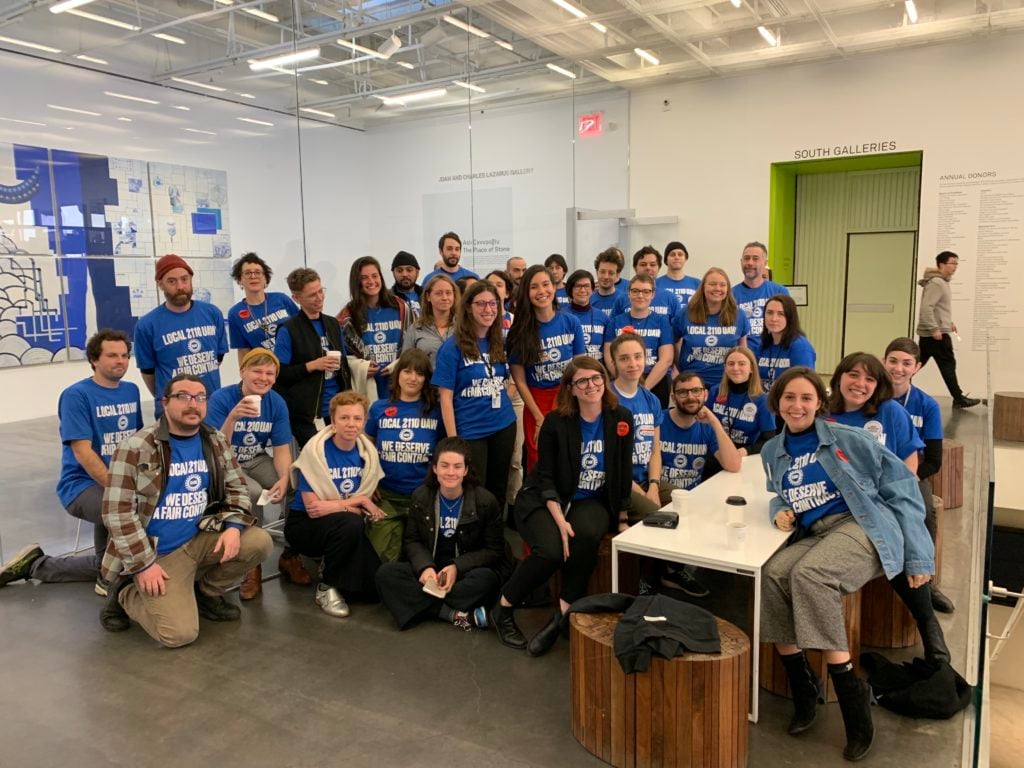
The collective bargaining unit at the
New Museum. Photo by Sarah Cascone.
Now, a few new collectives are
endeavoring to ensure the conversation about art and labor
continues. The Art and Labor podcast, produced by O.K. Fox and
Lucia Love, looks back at past labor movements, such as the Art
Workers’ Coalition and the Black Emergency Cultural Coalition, and
draws parallels to current movements in the art world.
Meanwhile, the collective Art &
Museum Transparency—the group behind a viral art salary
spreadsheet launched in May—recently debuted a new sheet
dedicated to art unions, including, among other resources, contact
information for organizers and a list of existing unions.
“We hope that seeing them
all listed there helps normalize the idea,” said representatives
for A&M. The group also
continues to promote individual unionization efforts online and is
working to develop a
watchdog system to keep track of and alert others to institutional
hostility, sexual harassment, or other labor issues.
What’s Driving the Change
While art institutions continue to resist change, their current
growing pains stem in part from their own attempts to diversify.
“Museums have been pressured to be more inclusive and to hire
people who are not coming from wealthy backgrounds,” said P., a
member of A&M Transparency who maintains anonymity. “But once
you start including people who are different, they’re going to
expect different things from the institution. I think that’s where
you see a lot of this tension and hesitation coming from, because
these institutions ultimately don’t want to change at all. They
just want to have the appearance of change.”
The push for diversity was
invoked explicitly in a release from the unionizing MOCA workers.
“We recognize that management has identified a need to shift
workplace culture in order to make equity, diversity, and
accessibility a greater priority,” the group said. “So far,
however, this has been a top-down structure that has involved
spending undisclosed amounts of money on external consultants who
speak on behalf of the entire staff.”
The New Museum union fought hard
for diversity protections during its contentious contract
negotiations. “We’re very aware of the fact that our union is
dominantly white and predominantly middle and upper class and that
the people who fall outside of that are often in the most
precarious and most poorly paid position,” Dana Kopel
said.
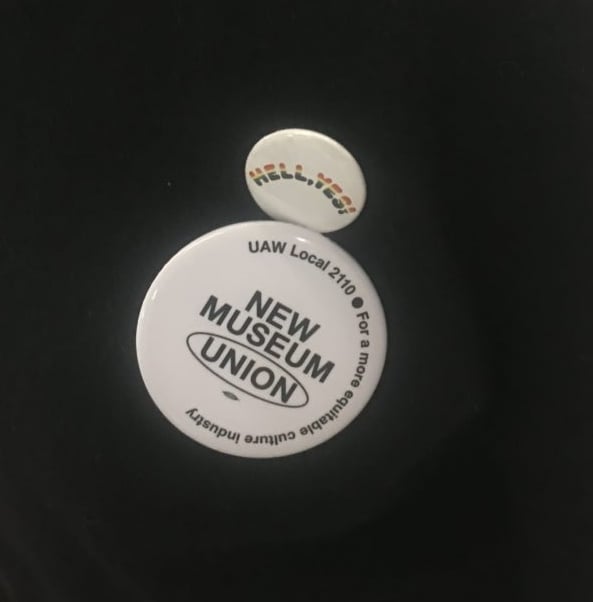
Union swag. Photo: Rachel Corbett.
The museum, whose founding
director Marcia Tucker prioritized minority voices, resisted any
protections for diversity that went beyond New York State law,
according to Kopel. But the final contract, reached on October 1,
did include non-state-mandated non-discrimination protections
(including for HIV status, union status and activities, and
citizenship). It also specified that, “on request of either party,”
the museum and the union could meet to discuss diversity in hiring,
recruitment, and promotion. “I think this is a huge cultural change
that’s going to be gradual,” Kopel added.
At least in public, some museums
are beginning to acknowledge that the expectations of their
employees are changing. A spokesperson from the New Museum
said: “Across many sectors,
our country has experienced a generational shift in values and a
corresponding evolution in expectations for workplace culture” and
that “the museum listened closely and worked very hard to
quickly reach a positive resolution.”
Nevertheless, the divides will
take considerable time and effort to bridge. And for its part, the
MAF union is still attempting to hold their bosses accountable. On
a recent Saturday, they gathered outside LAXART, a small non-profit
in Hollywood where Olivia Marciano, the MAF’s artistic director and
the daughter of Maurice Marciano, sits on the
board.
A child when her father and
uncle thwarted mid-1990s unionization efforts at Guess by laying
off organizers and moving production to Mexico and South America,
she has spoken liberally about wanting art to be accessible in Los
Angeles. In 2017, she told Modern Luxury Magazine, “Once you start
making an impact in a good way, there’s
no way to go back.”
The MAF demonstrators asked
LAXART’s director Hamza Walker, who came out to meet the group in
the modest courtyard, that Oliva be removed as a board member if
she remained silent on MAF’s labor issues. Walker listened attentively, but later told the
Los Angeles Times he does not necessarily see Olivia’s position
on the board as a conflict.
Union organizer Petzold sees the
situation differently. “I
think a lot of it is about higher principles,” he said. “It’s
acknowledging this is a whole community and there should be
accountability in that community.”
The post Museum Workers Across the Country Are Unionizing.
Here’s What’s Driving a Movement That’s Been Years in the
Making appeared first on artnet News.
Read more https://news.artnet.com/market/union-museum-analysis-1714716
Further reading


Leave a comment