
One of the UK’s Leading Sculpture Parks Is Shutting Down Amid Financial Woes It Attributes to Brexit and Overspending
One of the UK’s leading
sculpture parks has abruptly closed. The non-profit Cass Sculpture,
which was founded more than three decades ago, seemed like a model
of financial sustainability. But an overly ambitious selling show
of contemporary Chinese sculpture coupled with a downturn in the
art market partly blamed on Brexit has contributed to it closing
permanently at the end of October.
The sculpture park founded by
Wilfred and Jeannette Cass has shown hundreds of large-scale works,
many of which they commissioned. Works by leading British and
international sculptors are displayed in an idyllic rural setting
in West Sussex in the South of England.
A spokesman for the Cass
Sculpture Foundation confirms that its trustees have decided to
“wind down the charity over the next six to nine months.” He added:
“Wilfred and Jeanette Cass are now aged 94 and 92, respectively.
Furthermore, the lease of their grounds is due to expire in
2020.”
“It is very sad,” says Mark
Cass, a trustee of his parent’s sculpture foundation, who is the
founder and chief executive of the art supplier Cass Art. He says
that works on loan will be returned, and others have found new
homes. But its internationally important archive, which includes
maquettes of works commissioned by the Casses from artists
including Anthony Caro, Eva Rothschild, and Marc Quinn, has been
saved. It is heading to the nearby Pallant House Gallery in
Chichester. The art museum did not immediately respond to a request
for comment about the acquisition.
The Cass sculpture park was
financially sustainable, Mark Cass stresses, until the ill-fated
Chinese art show in 2016. He says that his main focus is on running
Cass Art rather than taking over the reigns of the sculpture park.
The sale of the archive has meant the foundation has cleared its
debts, he says.
Mark Cass says his parents’
innovative business model paved the way for the likes of Hauser and
Wirth, referring to the gallery’s rural space rural in Somerset, in
the West of England.
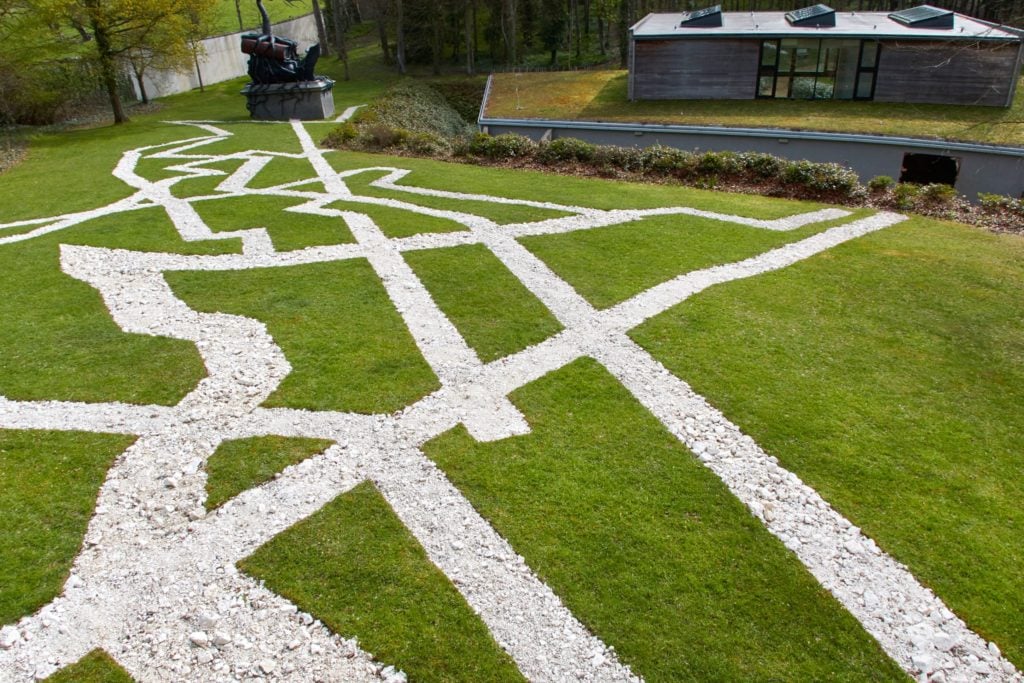
Xu Zhen (Produced by MadeIn Company)
Movement Field (2016) at Cass Sculpture, courtesy of the artist and
Cass Sculpture Foundation.
The story of Cass Sculpture is a
cautionary tale for founders of other private museums. Wilfred and
Jeannette Cass were in their 70s when they decided to help both
established and emerging sculptors realize ambitious works by
commissioning and displaying them on the grounds of their home. All
went well as 16 works were commissioned for the group show “A
Beautiful Disorder,” which was curated by Ella Liao, Wenny Teo, and
Claire Shea, the former curatorial director of Cass
Sculpture.
A critical success, it included
video works by the artists Cao Fei and Cao Dan about their father,
the socialist realist sculptor Cao Chong. But the high cost of
fabricating big works in China and shipping them to Sussex left the
foundation with a financial hangover. The exhibition went way over
budget, and totaled nearly £1 million ($1.3 million). Meanwhile,
sales of sculpture fell a third, from more than £800,000 in 2016
down to £270,000 in 2017, the foundation’s annual report shows. The
trustees blamed “a downturn in the sculpture sale market due in
part to Brexit.” Cost cutting, staff redundancies, and a
three-figure loan from the Casses has kept the park going since
then.
Cass Sculpture was partly based
on the Yorkshire Sculpture Park in the North of England, Storm King
in upstate New York, and the Louisiana Museum of Modern Art near
Copenhagen, but with one big difference: Cass Sculpture was always
a selling space. A percentage of the sales of the works went to the
artist and the rest supported new works, as well as the operating
costs of the sculpture park, and its educational programming. It
was also kept constantly refreshed by the arrival of new works as
pieces were sold.
The foundation’s website list
520 works of art by 290 artists. Currently on display are works by
Olaf Breuning, Bernar Venet, the Chapman brothers, and Laura Ford,
among others. The Casses were among the first to commission the
designer Thomas Heatherwick, who made a pavilion in 1992. Wilfred
Cass was also instrumental in the launch of London’s Fourth Plinth
in the late 1990s.
While the Casses were latecomers
to sculpture, the Cass family history is steeped in art. Wilfred
Cass, who escaped from Nazi Germany as a child, is the grandson of
the Berlin-based art dealer Paul Cassirer. He was instrumental in
establishing the reputations of artists, including Vincent van Gogh
and Paul Cézanne in Germany.
Today, Mark Cass is
philosophical about the end of his parent’s dream. “My
great-grandfather only sold Van Goghs for a decade,” he says. “The
sculpture park was my parents’ passion for 25 years.”
The post One of the UK’s Leading Sculpture Parks Is Shutting
Down Amid Financial Woes It Attributes to Brexit and
Overspending appeared first on artnet News.
Read more https://news.artnet.com/art-world/cass-sculpture-close-brexit-1697106
Further reading


Leave a comment