
Our Exhibition on Nazi Design in the Netherlands Has Been Controversial. Here’s Why We Did It—and Why It’s More Urgent Now Than Ever
Critics have said the show does not offer
proper historical context at a time when far-right ideologies are
on the rise across Europe, and that the museum and its director
haven’t responsibly handled the sensitive subject
mater.
On September 7, we opened the
exhibition “Design of the
Third Reich” at Design Museum
Den Bosch, in the south of the Netherlands. We fully recognized
that the design culture of National Socialism was a delicate theme
for an exhibition and that this was likely to be reflected in the
response. All the same, the reaction when it came was perhaps a
little stronger and more intense even than we had
anticipated.
The Dutch press published good
preliminary reviews, and we also caught the eye of the
international papers. The media in Germany responded cautiously and
with a touch of confusion. A few weeks in and all the online
tickets for the exhibition have been sold. The negative voices have
been small in number, but they have been fierce and
tenacious.
Preparations for the exhibition
began in earnest about two years ago, when we signed a cooperation
agreement with guest curator Almar Seinen, and later, Tomas van den
Heuvel, after first notifying and discussing the plan with our
supervisory board and the Alderman for Culture for our local
municipality, ’s-Hertogenbosch. We announced the exhibition via a
chance interview with the Dutch progressive newspaper
De
Volkskrant. That same
evening, the eight o’clock news on Dutch television included a
report on our plan. The run-up to the exhibition gave us a
foretaste of what was to come: Numerous conversations, from all
manner of parties with an interest in the subject, accompanied by
more or less continuous press attention, whether or not informed
from our side.
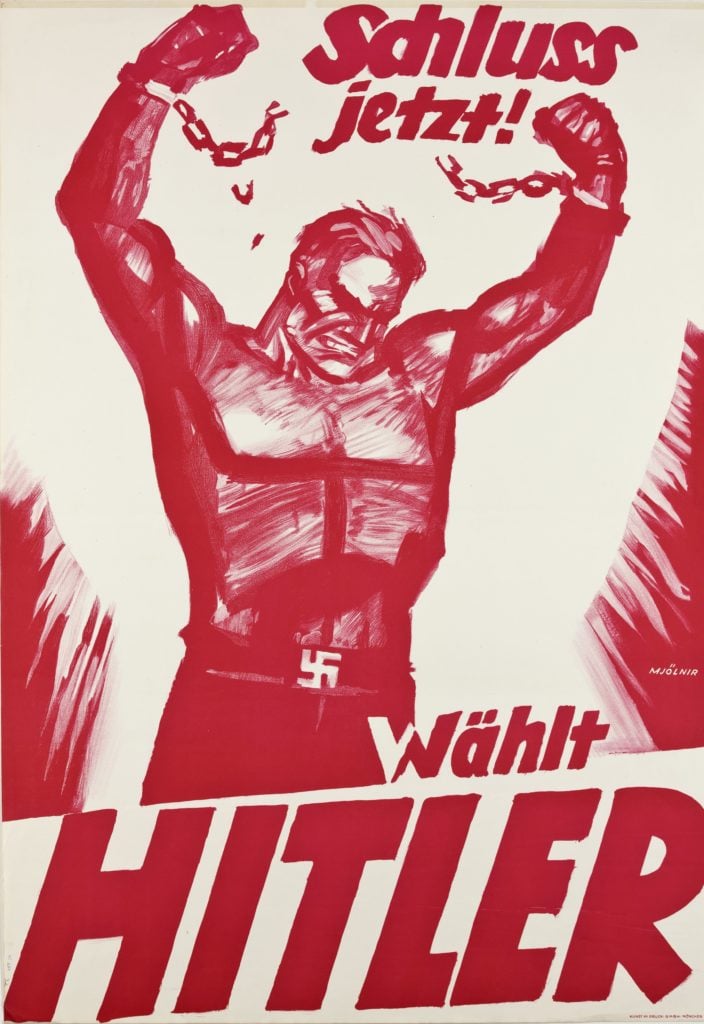
Election poster NSDAP, 1932. (Münchner
Stadtmuseum, Sammlung Reklamekunst)
Why Stage a Show About Nazis?
There was a recurring question
raised by many journalists: Why stage an exhibition about the Third
Reich? A lot of people in the museum sector also felt
ambushed by the theme. They were all aware of it, but virtually no
one had allowed themselves to consider that such an important
period in the 20th century deserved a place in a cultural
museum.
In the academic world, in which I worked for many years as a
professor of design history, the art and design of totalitarian
regimes is an established field of research, making it hard to
understand why an exhibition on the subject would be questioned. It
was this view, in the first instance, that led us to propose
“Design of the Third Reich” as an important and even necessary
theme. Necessary because the museum is still primarily a public
space in which history can be displayed and understood in all its
facets. And because the systematic absence of one of the most
important periods of the 20th century makes it impossible to
achieve a balanced analysis of our own time.
The cultural expressions of
National Socialism become highly controversial, however, as soon as
they are shifted to the public sphere of the museum. That is less
the case in museums of history, of course, where the art and
propaganda of the Third Reich have been explored on previous
occasions. The compelling exhibition “Kunst und Macht im Europa der Diktatoren 1930
bis 1945,” held at the
Deutsches Historisches Museum in Berlin in 1996, is a fine example.
This exhibition at a major history museum displayed Nazi art among
that of other totalitarian regimes, and comparative and educational
elements were called on at the time to justify such an
exhibition.
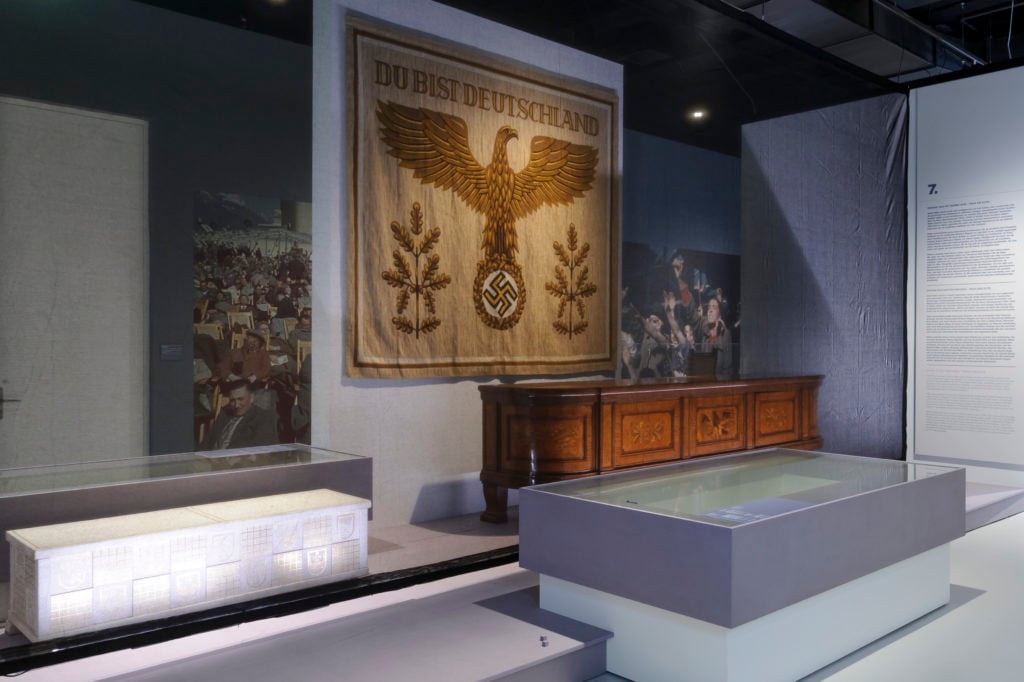
Installation view, “Design of the Third Reich.”
Addressing Controversy
The first controversy concerning
our exhibition “Design of the
Third Reich” arose following
the announcement that we intended to focus solely on the culture of
Nazi Germany and that we would do so at a museum with a cultural
function. The public consistently expects the collections and
exhibitions of art museums to maintain an ethically positive
approach. The constantly repeated idea that art represents the good
and the beautiful has been bolstered more recently by the notion
that art has a civilizing effect and brings people together. This
was very much in evidence, incidentally, at the ICOM General Conference
held just a couple of weeks ago in Kyoto, which sought to formulate
a new definition of museum
inclusivity.
It goes without saying that the
stance we have adopted in our exhibition is a critical one. Our
position is that design made an essential contribution to the rise
of National Socialism in Germany. This required us to present a
precise account of the racist character of National
Socialism.
The exhibition thus begins with
an explanation of the link between the racially pure Nazi ideal and
the “design” of the “new man” and his environment. It was clear to
us from the start that this had to be a proper design exhibition in
which we set out to show and to explain design in all its forms,
right through to the shaping of the landscape. We wished to
highlight the Nazis’ immense interest in the aesthetics of the
presentation of their party, state, and ideology, with Adolf Hitler
as the key instigator.
At the same time, the National
Socialists viewed architecture and the decorative arts as important
expressions of a new cultural high point in German history.
Alongside forms of design like this, which were intended to seduce
the public, there were, of course, the openly evil forms associated
with the SS and anti-Semitism. The story told by the exhibition
culminates in the visual communication of total war and the designs
for the gas chambers at Auschwitz.
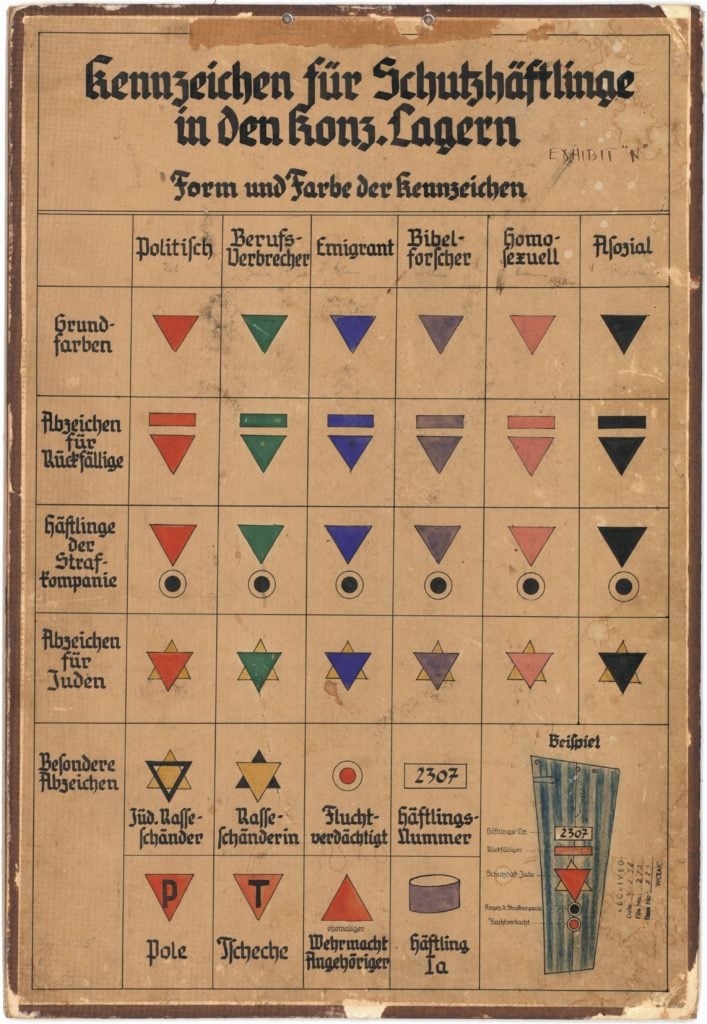
Symbol chart for prisoners in protective
custody, 1937. (ITS Archive, Arolsen Archives)
Providing Context
To avoid the pitfall of
glamorizing Third Reich design, we opted to give the exhibition a
documentary-like character. This does not mean that we are
presenting a historical exhibition with just a few aesthetic
objects, but that we use design to tell the key elements of the
story. The documentary approach ultimately enabled us to show and
to explain Nazi aesthetics, without allowing them to influence the
design of the exhibition itself.
Studio Pronk from Rotterdam
developed a sober scenography with clear, non-dramatic lighting
(insofar as the loaned items allowed this) and in which swastika
flags, for instance, are laid flat. We were determined not to
facilitate the seductive intentions of some of the exhibits. To
properly explain the malevolent character of Nazism and the way
design was frequently deployed to reinforce that ideology, we
present an introductory film in the first exhibition space.
Visitors are then provided with an incisive audio tour (free of
charge), which further explains the exhibition. It is striking to
see how intensely people respond to the film and what grateful use
they make of the audio tour.
While criticism was expected,
some of it has emanated from unexpected quarters. The response when
we first announced the exhibition was that the choice of subject
alone meant that we would, by definition, be insufficiently able to
reject National Socialist culture. According to these critics, any
attention that an art museum pays to Nazi culture inevitably makes
that culture more acceptable—a normalization which can never be
reversed.
These reactions came at first
from a small anti-fascist movement, followed by young communists
and socialist artists, mostly in advance of or without having seen
the exhibition. Oddly enough, similar criticism was then published
in the populist press, including Bild in Germany and De Telegraaf in the Netherlands.
We have argued from the outset
that we consider National Socialist cultural attitudes to be evil,
but an essential part of the 20th century. Failure to show and to
analyze them amounts to nothing less than a desire to forget
history: an omission that risks making fascism actually seem
mysterious and attractive.
We were fully aware that a focus
on Nazi culture would generate confusion, due in particular to the
prevailing expectations toward the contemporary art museum. For
that reason, we hope that a design museum like ours will be able to
create expectations comparable to those held towards museums of
history and technology.
To us, Design Museum Den Bosch
represents a new generation of design museums, which no longer
simply collect good design as an example to future designers, but
which also want to consider design critically in its historical and
contemporary context.
Timo de Rijk is director of the Design Museum Den Bosch in the
Netherlands. The exhibition “Design of the Third Reich” is on
view at the Design Museum Den Bosch in the Netherlands through
January 19, 2020.
The post Our Exhibition on Nazi Design in the Netherlands
Has Been Controversial. Here’s Why We Did It—and Why It’s More
Urgent Now Than Ever appeared first on artnet News.
Read more https://news.artnet.com/opinion/timo-de-rijk-nazi-design-1652641
Further reading


Leave a comment