
Paris Was Emerging as Europe’s Next Big Art-Market Hub. Post-Lockdown, Can It Maintain the Momentum?
In the months preceding the worldwide shutdown—what we have now
come to think of as the Before Times—Paris was in the midst
of an art-market renaissance. In
2019, galleries including David Zwirner
and White Cube opened outposts in the city and France’s auction
market grew a remarkable 49 percent, in large part because
collectors were consigning more works to Paris-based houses amid
Brexit jitters. The city’s central location had become one of its
biggest assets in its fight for primacy in the European
market.
But amid a two-month lockdown, and with the prospect of
limitations on large gatherings and travel extending far into the
future, a central location is no longer the asset it used to be.
And the current situation has left many wondering whether the
crisis could derail Paris’s long-gestating evolution into an
art-market hub.
As the city’s galleries and small museums prepare to reopen next
week, dealers are determined to keep Paris from losing its
edge—even if they have to maintain a five-foot bubble of personal
space while they do it. The
art dealer Almine Rech tells Artnet News that she will open her
Paris space on an appointment-only basis beginning May 11, limiting
attendance to 10 people at a time. (She also notes that most
clients already asked for appointments, even before the
social-distancing era.) Meanwhile, Paris Gallery Weekend announced
plans to hold its 2020 edition from July 2 through 5, with 50
participating galleries and a focus on guided tours (masks
required).
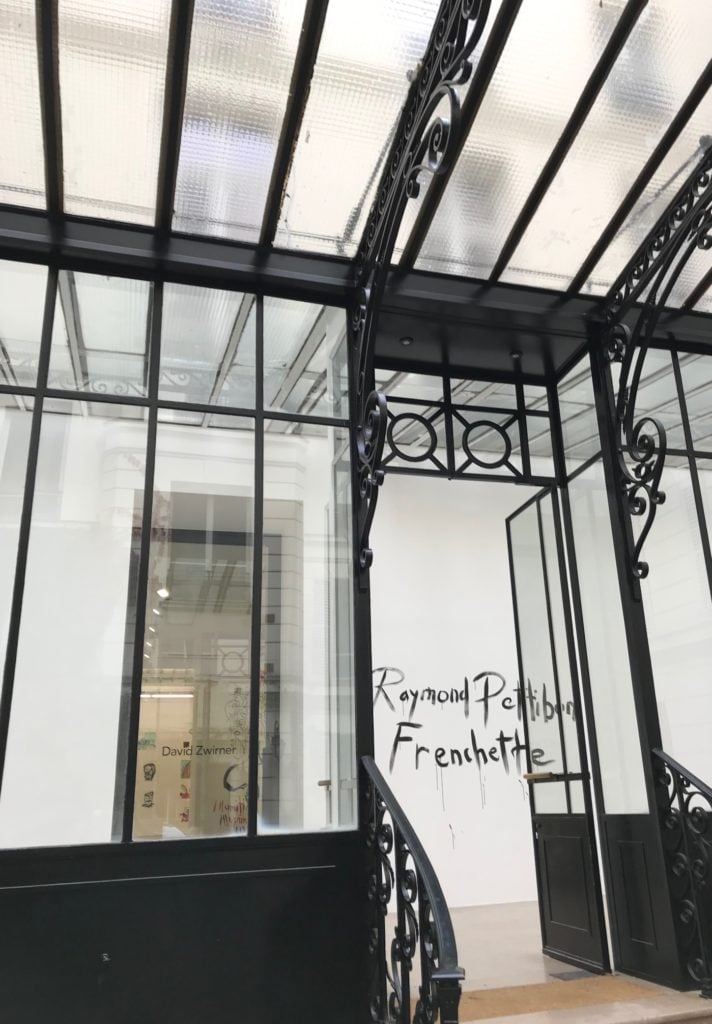
The outside of David Zwirner Paris.
Photo: Nate Freeman.
“Paris is a cluster of art
enthusiasts, and people are ready to come back,” says dealer
Thaddaeus Ropac, who plans to reopen his gallery in the Marais on
May 12. It is notable, he said, that Paris, rather than Austria,
where he also has a space, is leading the way with reopening given
Austria’s lower infection rate. But it also has the potential to
help the city’s scene bounce back quicker.
A Business Squeeze
The stakes are high, and not every art business will survive.
A shocking report released
last month by the Comité Professionnel des Galeries d’Art warned
that up to a third of French galleries might be forced to close
because of the crisis. French galleries, the report noted, also
expect to lose more than $200 million in revenue by June. Plus,
because 85 percent of the member art galleries are
small businesses whose turnover directly depends on collector
behavior, they will be hit hard if the economic crisis hits their
clients’ bank accounts for an extended period.
The head of the committee,
dealer Marion
Papillon, tells Artnet
News that previous crises in the ‘90s and 2008 have shown that it
can take a long time for the art market to recover. While Papillon
says that as of yet none of her members have been forced to close,
their future is far from assured. “Forty-six percent of galleries
closed between 1992 and 1995,” she says.
Larger galleries are also not
immune to the squeeze. Since closing his five spaces, Thaddaeus
Ropac says he has had to cut hours and pay for some of his team,
although with galleries reopening, he is actively starting to
restore their jobs.
With eight exhibitions in
storage, the closures have also effectively altered the next two
years of the gallery’s exhibition program—and the artists who rely
on it for income. While the gallery has been making sales from
its online viewing room and virtual art fairs, Ropac says that
“after two months of this virtual space, we are longing to go back
to the real thing.”
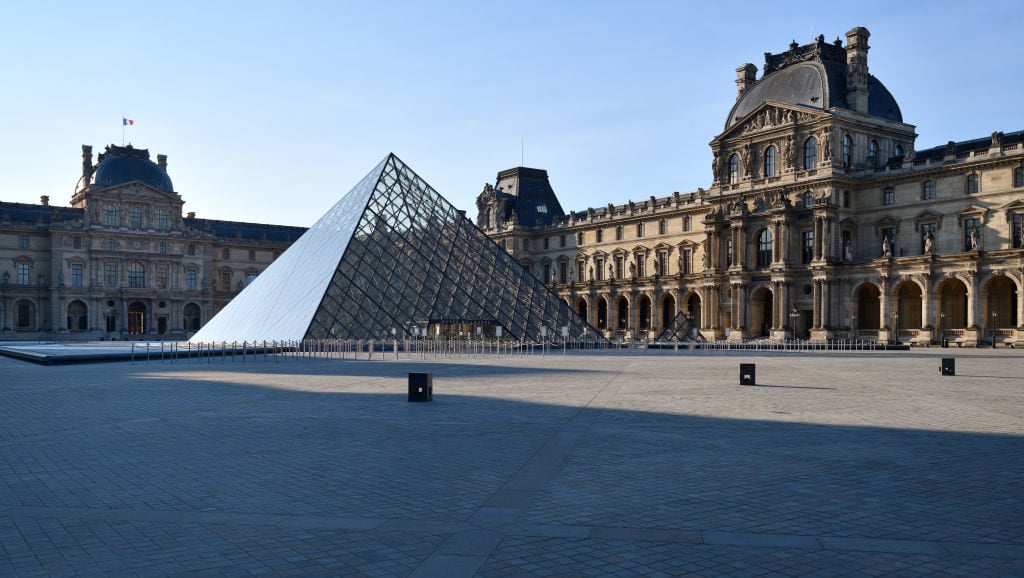
An unusually empty square in front of
the Louvre museum during Paris’s lockdown. Photo by Frédéric
Soltan/Corbis via Getty Images.
The French government has offered some supplemental aid, setting
up a €22 million relief fund for culture at the beginning of the
crisis, with €2 million set aside specifically for the arts. But
many have warned that this will not be enough to ensure galleries’
survival. After a consultation with cultural representatives,
president Macron announced on Wednesday, May 6, that additional
relief would be made available for the country’s arts and culture
sectors as part of a special €7 billion fund for small businesses
and independent workers.
Communal Efforts
Despite the challenges, however, some galleries have found that
clients are reaching into their pockets to support their
work. Nathalie Obadia, who
plans to reopen both her Paris galleries on May 11, says there was
an “almost immediate” halt in sales after the gallery shuttered in
mid-March. But for the past week, exchanges with both French and
foreign collectors have reignited. “The presence of the gallery through social
networks has made it possible to maintain links, but it is time
that collectors can come to the gallery to see works, especially
since this cannot be done at fairs,” she says.
Dealer Kamel Mennour will reopen
his three Paris spaces from May 12, and is forging ahead with plans
to open a fourth in October. Staff will likely work in shifts to
limit the number of people in each gallery at once. Although he has
successfully transferred gallery operations online, Mennour said
closing the galleries was “brutal.”
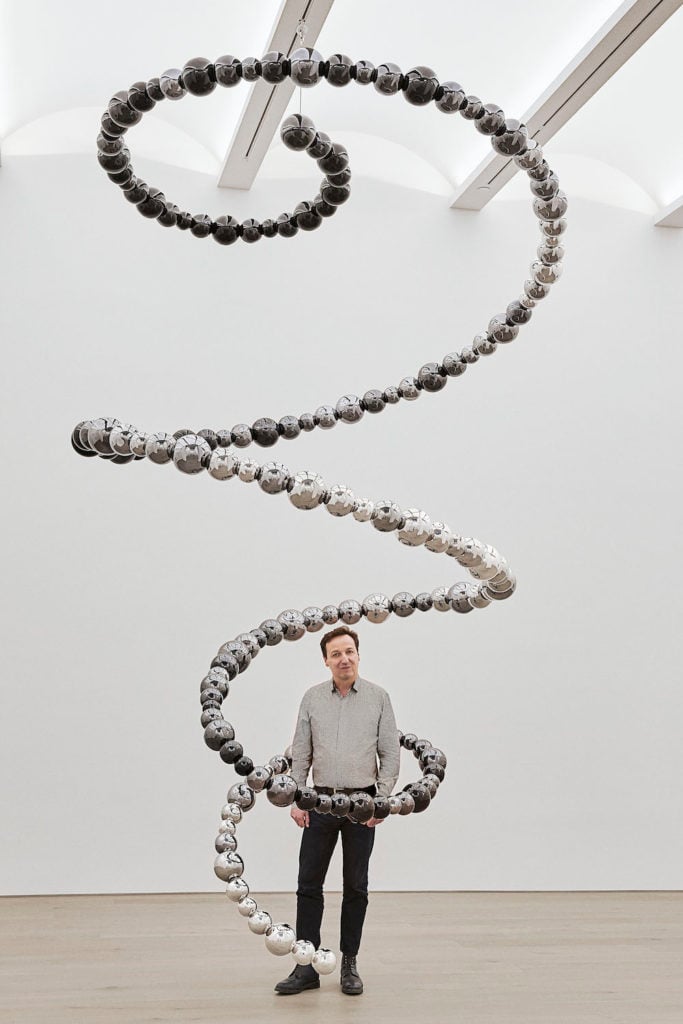
Emmanuel Perrotin. Photograph by
Guillaume Ziccarelli, Courtesy Perrotin.
Meanwhile, Galerie Templon will
reopen both its spaces in Paris on May 11, allowing 20 people in
the gallery at once. Its first opening post-lockdown is for a show
of work by Japanese artist Chiharu Shiota on May 30. In lieu of the
usual party and opening dinner, the gallery will offer extended
opening hours to avoid a crush of visitors.
“The economic consequences are
yet to be fully evaluated,” Daniel Templon tells Artnet News.
“Clearly with the closing of the gallery to the public and the
cancellation of fairs, our sales dropped in April, but we remain
optimistic.” The dealer adds that despite opening the gallery’s
Billie Zangewa exhibition on the day the lockdown was announced, it
has already sold out. Meanwhile, half its Norbert Bisky exhibition
sold before the show’s opening at prices ranging from €50,000 to
€60,000 and several works from the upcoming Shiota exhibition have
also found buyers for €30,000 to €40,000 each.
In an effort to support the
city’s dynamic gallery ecosystem, some larger outfits are also
opening up their spaces to smaller
counterparts. Perrotin, for
example, will be hosting a “solidarity exhibition”
in its Saint Claude gallery from
May 23 through August 24, inviting 26 local dealers to show their
artists’ work in four two-week-long group shows. Ropac has promised
to open up his Pantin space to smaller dealers as
well.
Despite these concerns, dealers are confident that Paris will
retain the market momentum it had gained prior to the
crisis. “We’re going to have
to reinvent things a little bit, but Paris today is a very strong,
dynamic city, thanks to its museums, to the private foundations
that are opening, to high quality fairs, and its very important and
dynamic network of homegrown and international galleries,”
Papillon, the head of the Comité Professionnel des Galeries d’Art,
says. “I hope we will
succeed in maintaining this dynamism. Reopening was a fundamental
first step, but we will have to mobilize our buyers.”
The post Paris Was Emerging as Europe’s Next Big Art-Market
Hub. Post-Lockdown, Can It Maintain the Momentum? appeared
first on artnet News.
Read more https://news.artnet.com/market/paris-galleries-reopen-1854126
Further reading


Leave a comment