
‘People Have Given Me My Own Space’: Sculptor Eva LeWitt on Growing Up With a Famous Artist Father and Finding Her Own Voice

The walls of Eva LeWitt’s studio
are lined with sheets of graph paper. Most have seemingly random
numbers and letters printed across them, like a secret code. In
fact, they’re instructions—a way of plotting out patterns that will
eventually manifest themselves in one of the artist’s
post-minimalist sculptures, which she creates from commonplace
materials like latex, vinyl, and acetate.
If the words “artist” and
“instructions” bring anyone in particular to mind, it’s almost
certainly Sol LeWitt, the pioneering late minimalist and conceptual
artist who also happens to be Eva LeWitt’s father. But a penchant
for preparing art projects with strict internal logic is one of the
only similarities between the practice of the older artist and his
daughter, who has carved out an impressive career of her own in a
relatively short time.
Where Sol LeWitt’s work is all
about divorcing the image from the hand of the artist, Eva’s is
about using her own touch to transform mass-produced materials into
delightful tableaux—turning commercial plastic, for example, into a
theatrical curtain that looks straight out of a
storybook.
“I wanted to get away from the
meaning of the manufactured, to transform it into something that
you wouldn’t have those associations with,” LeWitt says. She’s
sitting at a long table in her railroad-style studio on the Lower
East Side. The space, located on the ground floor of a building her
family has owned for decades, used to house an accordion store
called The Main Squeeze. Her father’s longtime studio on Hester
Street is just around the corner.
Fish tank-colored plexiglass and
sheets of colored mesh—the kind that you might find on a screen
door or a pull down window shadow—are splayed out before her,
clamped together with drying glue. This is one of the dozen or so
hanging scenes that will make up Untitled (Mesh
A–J), her new
site-specific installation that opens next month at the
Aldrich Contemporary Art
Museum in Ridgefield,
Connecticut. The installation, a series of hanging swaths of
layered mesh, will line the walls of the museum’s nave-like Leir
Gallery, a space with 16-foot-high ceilings.
The Aldrich exhibition marks
both LeWitt’s second museum outing and solo exhibition to date—an
impressive resume for an artist, especially one who just turned 34
this week. Indeed, LeWitt looks young—even younger than she
is—though she is an old soul. She complains about the lineup on the
local classical music station and says things like, “I never
learned computers. One day I’ll have to find a youngster that can
do it for me.” Perhaps in part because she grew up in the art
world, LeWitt has the air of a veteran who has been around the
block.
This attitude translates to her
art as well. Her approach is not particularly trendy: work that
incorporates the human figure or homespun materials like ceramic
and textile is far more in vogue than minimalism-inspired
sculpture. But LeWitt’s art aims to make minimalism feel vibrant
and urgent.
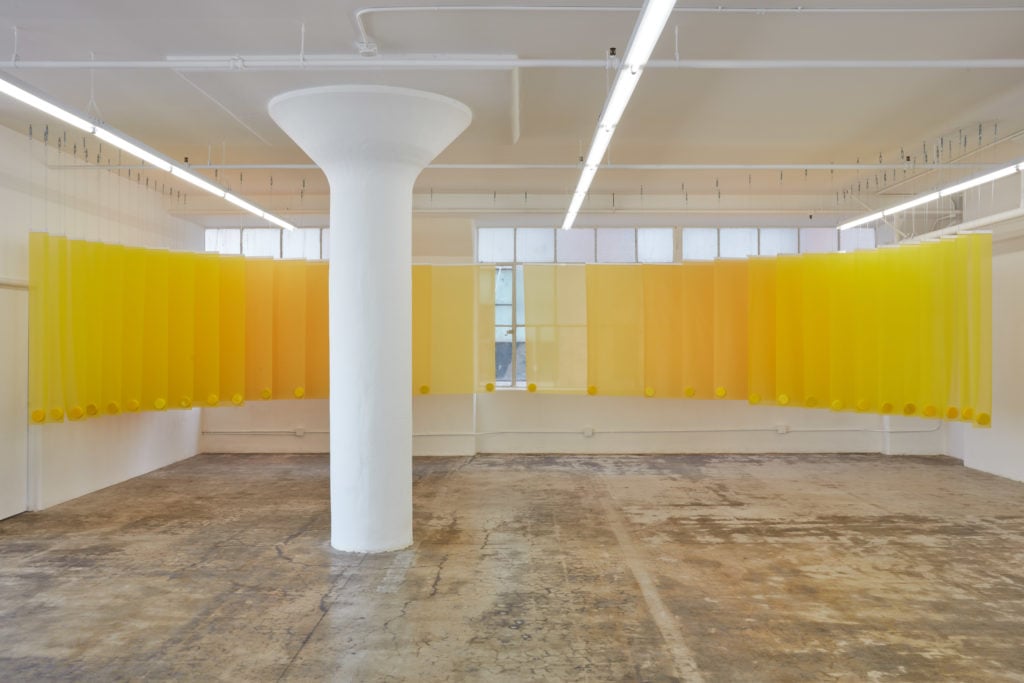
Eva LeWitt, Untitled (Los
Angeles), detail (2018). Courtesy of JOAN, Los Angeles. Photo:
Paul Salveson.
A Childhood Surrounded by Art
LeWitt was born in Spoleto,
Italy, in 1985 (her father moved to the small European town in the
early ’80s to get away from New York) and spent much of her early
life between there, Chester, Connecticut, and downtown Manhattan.
She knew from a young age that she wanted to be an artist and would
often hang around her father’s studio.
“I think he was a really great
teacher in his own way,” she says. “He would give me all his old
scrap paper and old paints to work with. I would just use what was
around.”
It wasn’t until she got to
college at Bard and started working with artist Judy Pfaff, she
explains, that she realized she could use any material she wanted
to say what she wanted to say. She began identifying exclusively as
a sculptor, even though her work can take a number of
forms.
After graduation, LeWitt worked
as an assistant to artist Tom Sachs for four years. Then she went
to work for Tara Donavan, whom she assisted for eight more, doing
“a little bit of everything” and traveling around the world to
mount exhibitions. Donavan was particularly instructive as a
mentor.
“She’s a small woman, but she
has never been intimidated by space,” LeWitt says. “She has so much
confidence in her forms and her materials, their ability to hold a
room on their own. I learned from her how to look at space like
that—without fear, just excitement.”
During her time as an assistant,
LeWitt was constantly making art, albeit on a small scale. She
participated in group shows here and there and focused much of her
energy on churning out what she calls “drawings”—three-dimensional
sketches with sculptural elements.
In 2017, after coming across an
installation by LeWitt at a group show in London, Esperanza Rosales
of the Olso, Norway-based gallery VI, VII, reached out and asked to see more of her
work. LeWitt sent along a few drawings and the gallerist was
impressed. She surprised LeWitt when she proposed
mounting a solo
presentation of her work at the high-profile Frieze New York fair
that spring.
It was a considerable leap of
faith for the dealer. “She hadn’t even seen the work in person,”
LeWitt recalls. “She didn’t really know what I was
doing.”
The artist showed up with a
handful of large new sculptures including a hanging, curtain-like
installation of latex and clay. None looked anything like the
sketches she had previously shared.
Fortunately, the booth was a
smashing success. It led to a prominent group show at Joan gallery
in LA, an invitation to create a site-specific installation at the
Jewish Museum in New York, and, eventually, the upcoming Aldrich
show.
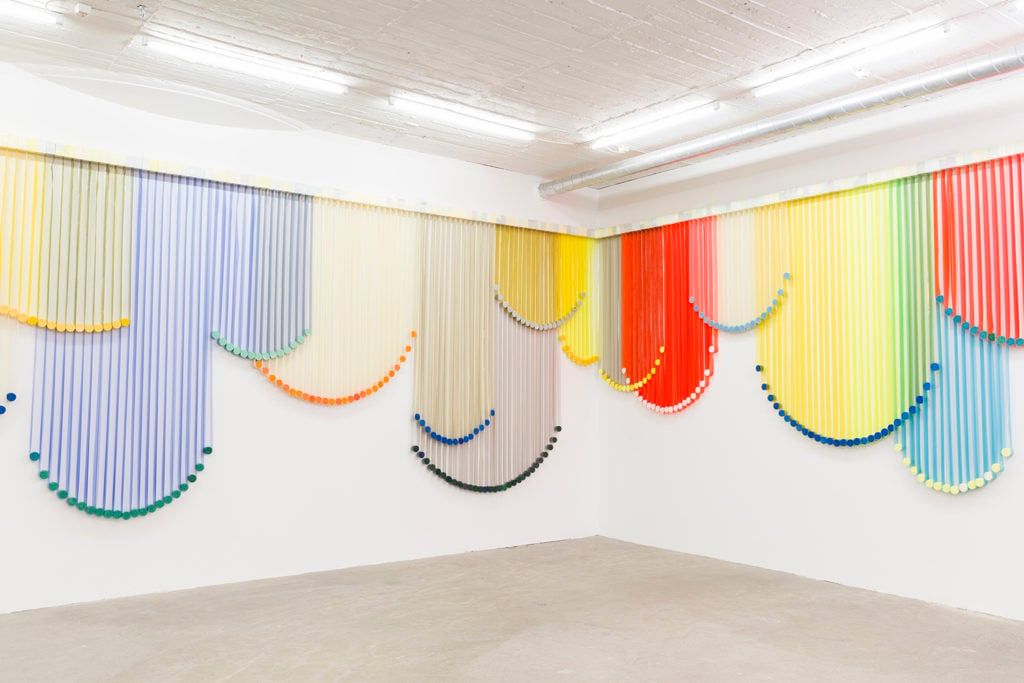
Eva LeWitt at VI, VII, installation
view. Photo: Christian Tunge. Courtesy of VI, VII, Oslo.
A New Approach to an Old Form
Unlike her father, who
outsourced the execution of his work to others, LeWitt defines her
art in part by the fact that everything she makes can be
manipulated by hand, without the need for a fabricator or even an
assistant. Though minimal in appearance, LeWitt’s works are not
capital-M minimalism; they eschew the kind of large-scale, polished
sculpture of older male artists like Donald Judd or Carl Andre in
favor of a subtler, more welcoming spatial intervention—like DIY,
home-improvement-store minimalism.
It was this dialogue between her
work and those macho minimalists that caught the eye of Amy
Smith-Stewart, who organized the Aldrich show after spotting the
work at Frieze New York in 2017. “Eva finds softness in the spaces
she inhabits,” Smith-Stewart says. “She rounds the
curves.”
The curator says the work
reminds her of artists like Eva Hesse, whose sculpture evokes the
body and “shares a kinship with minimalism, but there’s definitely
a transformative quality happening within the more commercial or
industrial materials she’s choosing, and a sensuality that comes
out of that.”
Unlike many artists responding
to this particular thread of art history, however, LeWitt saw it
all developing in real-time. “This is a young artist who actually was around
all these major artists who were testing the boundaries of what a
sculpture or a drawing could be,” Smith-Stewart says. “It had to
have had an incredible impact on her own
thinking.”
“It was around,” LeWitt says,
laughing. “A lot of it was really beautiful to a small child,
especially my dad’s work—when I was young it was really colorful.
Those were the walls I grew up with, and it was a comfortable,
happy place.”
Yet LeWitt contends that she’s
never felt burdened by the shadow of her father’s
legacy.
“People have really given me my
own space to say what I want to say, without comparing our careers
or our work,” she says. “Maybe it’s a generational thing. People
aren’t so reverential of these male, behemoth artists anymore.
There’s a much more nuanced understanding to the history of what
everyone was doing at that time.”
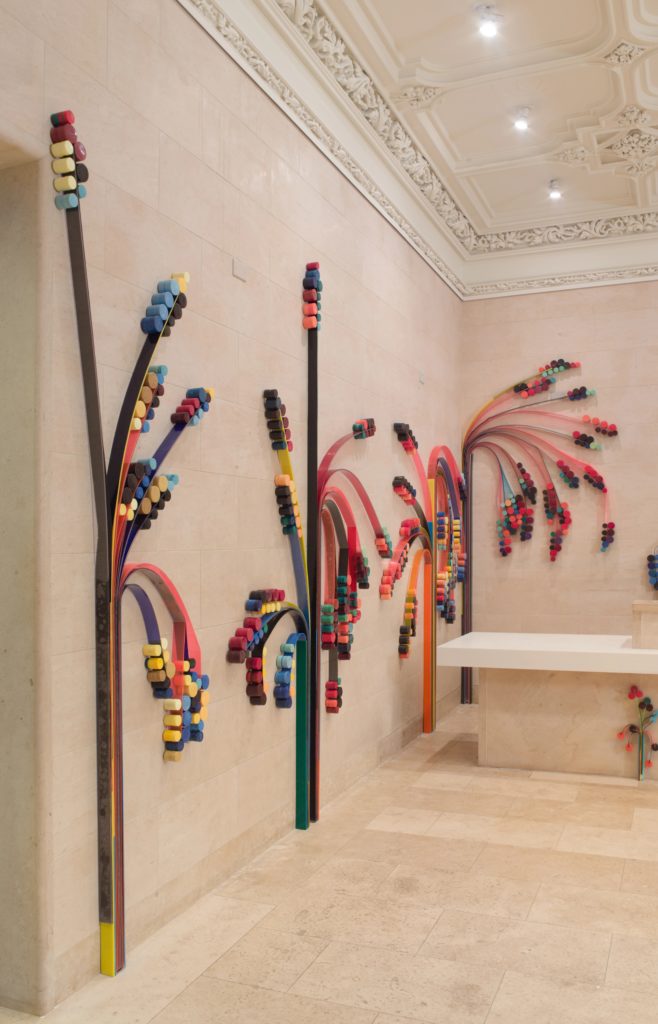
Eva LeWitt, Untitled (Flora),
detail, 2019. © Eva LeWitt. Courtesy of the Jewish Museum, NY.
Photo: Jason Mandella.
“Eva LeWitt: Untitled (Mesh
A–J)” will be on view at the Aldrich Contemporary Art Museum from
October 6, 2019, to April 5, 2020.
The post ‘People Have Given Me My Own Space’: Sculptor Eva LeWitt
on Growing Up With a Famous Artist Father and Finding Her Own
Voice appeared first on artnet News.
Read more https://news.artnet.com/art-world/eva-lewitt-1643554
Further reading


Leave a comment