
Provocateur Orlan Reflects on How She Went From Being Reviled for Her Body Art to Claiming Her Place in the Art World
For her first New York solo show since 1995, French multimedia
artist ORLAN is reminding viewers of
what she’s best known for: The unusual plastic surgeries that
transformed her face by adding unnatural growths at her temples.
The nine procedures, carried out between 1990 and 1993,
collectively make up the piece “The Reincarnation of Saint ORLAN.”
Three giant photographs on view at Ceysson & Bénétière document the surgeries
and their aftermath.
In one, ORLAN sits on the operating table, surgical directions
scrawled across her face, smiling and reading aloud—thanks
to anesthetics that ensured a complete lack of pain, she
remained awake for each of her procedures.
The other images were shotpost-operation, her beautiful face
swollen and discolored, red bruises blooming around her eyes. Taken
at the window in ORLAN’s apartment in Lower Manhattan, the photos
show the Twin Towers and the Woolworth building just behind
her.
“I’m getting emotional when I look at it, because New York
doesn’t have the same face,” ORLAN told artnet News, speaking at
the gallery the day before the 18th anniversary of the 9/11 attacks
that destroyed the World Trade Center. “I love New York,” she
added.
Though ORLAN’s facial modifications are often referred to as
horns, the artist simply refers to them as “my bumps.” They were
created using the same kind of implants used to enhance one’s
cheekbones, just placed above the eyebrows.
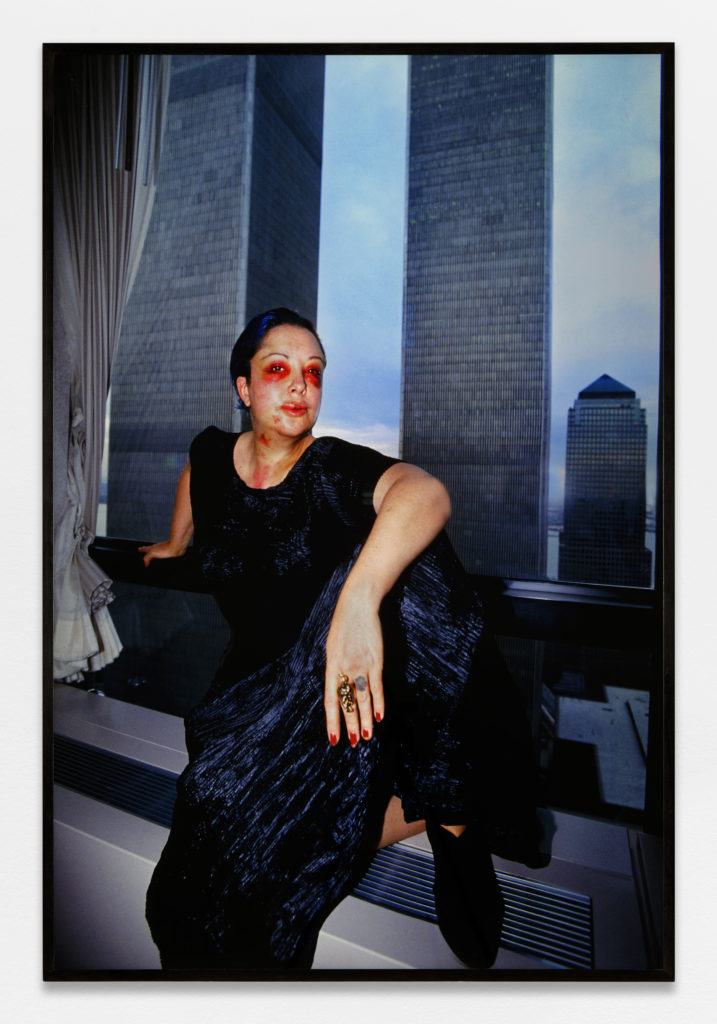
ORLAN, Refiguration d ORLAN
défiguration de New York (1993). Photo ©A. Mole, courtesy of
Ceysson & Bénétière.
The implants were inserted during a live performance broadcast
to museum audiences—a challenge before the advent of webcams,
requiring the use of a satellite link. (ORLAN’s other pioneering
uses of technology have included photocopier collages, on view in
the show, as well as early digital photography and photo
manipulation in Photoshop. More recently, she has made a video
game, an AI robot made in her likeness, and an augmented reality
app.)
The artist’s decision to alter her face so dramatically was not
particularly well received. “Some people wouldn’t talk to me
anymore,” ORLAN recalled. But she had already renamed herself as a
teenager—born Mireille Suzanne Francette Porte, ORLAN chose to
style her new name in all caps, “because I do not want to return to
the ranks, I do not want to be put back into the line.” Now, she
wanted a new face to go along with it.
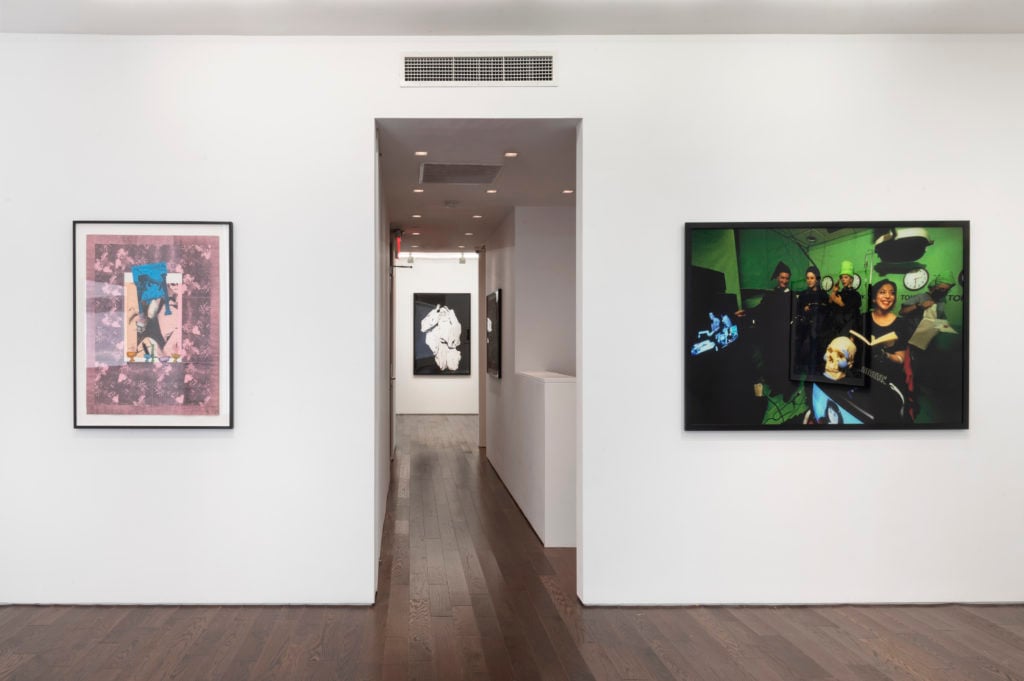
“ORLAN: SAINT ORLAN” at Ceysson &
Bénétière. Photo courtesy of Ceysson & Bénétière.
“The face that you have is something you don’t chose,” ORLAN
explained. “I wanted to attack Mother Nature.” Unlike the
traditional motivations for plastic surgery, these operations
weren’t an effort to make her look younger or more beautiful. Tired
of the ways that societal beauty standards constrain women, ORLAN
specifically set out to make herself less beautiful.
“All my work is against the stereotype,” she insisted.
The other half of the exhibition features 23 photographs of
ORLAN’s 1979 performance Etude documentair: le Drapé-le
Baroque. Over the course of three hours, men carried ORLAN in
a procession at Venice’s Palazzo Grassi. Laid out in a box, clad in
the billowing drapery of a Baroque saint, she moved in slow motion,
shedding her garments to reveal a single breast, before crawling
out of the building and disappearing to a waiting boat on the
canal.

ORLAN, Vierge blanche sortant du
noir (1978). Photo ©A. Mole, courtesy of Ceysson &
Bénétière.
The piece, which visually recalls the almost sexual elation of
Bernini’s Ecstasy of Saint Teresa, invites the
viewer to think about women as complex beings, not judged by a
strict Virgin/whore dichotomy. “These two stereotypes are difficult
to escape when you are a woman,” ORLAN explained. “It’s about
the importance of the and, and not or.”
ORLAN began making art “when I was a baby,” attending art school
but dropping out because it “was too conventional from me.” She
counts 1964, the date of her first documented
work, ORLAN Gives Birth to Her Beloved Self—a
photo in which the naked artist appears to have just delivered an
androgynous mannequin—as her own date of birth (actually she was
born in 1947).

ORLAN, Chevalet drappé dentelle et
faux marbre (1978). Photo ©A. Mole, courtesy of Ceysson &
Bénétière.
From the beginning, her body was ORLAN’s medium, whether that
involved contorting it into unattractive poses for her
“Body-Sculptures,” or dragging herself across the floor in famous
public spaces to count how many body lengths they measured in the
“MesuRAGES.”
“Working with my body was a political gesture,” said ORLAN. “It
was an act for the woman I was/I am/I will be, and all women, to
claim their freedom, which was denied to them.”
The current political climate, with the conservative threat to
abortion rights in the US, has been difficult for her to witness.
“In France, it is very difficult to be feminist without being
dismissed. In 1960, it was really terrible for women. There was no
contraception,” ORLAN recalled. “I really feel that my life has
been useless because I have always worked for the place of women in
art and society.”
“ORLAN: SAINT ORLAN” is on view at Ceysson &
Bénétière, 956 Madison Ave 2nd Floor, New York, September
12–November 2, 2019.
The post Provocateur Orlan Reflects on How She Went From
Being Reviled for Her Body Art to Claiming Her Place in the Art
World appeared first on artnet News.
Read more https://news.artnet.com/exhibitions/orlan-interview-1650289
Further reading


Leave a comment