
Rumors Swirl That Greece’s Demand for the Parthenon Marbles Could Gain Traction in the Brexit Trade Battle
As the European Union and Britain prepare for the next round of
intense negotiations, it appears that the restitution of cultural
objects will be one of many contentious issues. After a draft EU
mandate leaked to the media this week, reporters and sources close
to the matter were quick to speculate that the Parthenon Marbles in
the British Museum may become a bargaining tool in Brexit trade
talks between Europe and the UK.
A clause was added to a draft of the EU’s negotiating mandate
saying the British government should “address issues relating
to the return or restitution of unlawfully removed cultural objects
to their countries of origin.” Many looked to one of the most
disputed cultural objects within the UK’s museums, the Parthenon
sculptures, which reside in the British Museum in London. They were
shipped from Greece to London in the early 19th-century by British
aristocrat Lord Elgin.
According to Bloomberg,
some officials involved say the clause is seen as a direct
reference to the marbles that Greece has been campaigning to have
returned since 1832. “It is a measure of how Brexit has changed the
game that the Greeks feel able to use the trade talks to pursue the
Elgin Marbles,” says one EU ambassador involved in the draft of the
document, according to The
Times. Others disagree, adamant that the clause is
more about combating the illicit trade of antiquities in Europe and
Britain. One Greek official told Bloomberg that the
clause does not relate to the marbles at all, stressing that its
longstanding claim is a bilateral issue between Greece and the
UK.
The various EU governments are expected to finalize and sign the
mandate next week ahead of negotiations with the UK, which are due
to begin next month. The mandate defines the parameters of the EU’s
position going into the talks. The clause about cultural
objects was proposed by Greece, Italy, Spain, and Cyprus. Other
issues range from migration to fishing rights, farming, and
the financial sector.
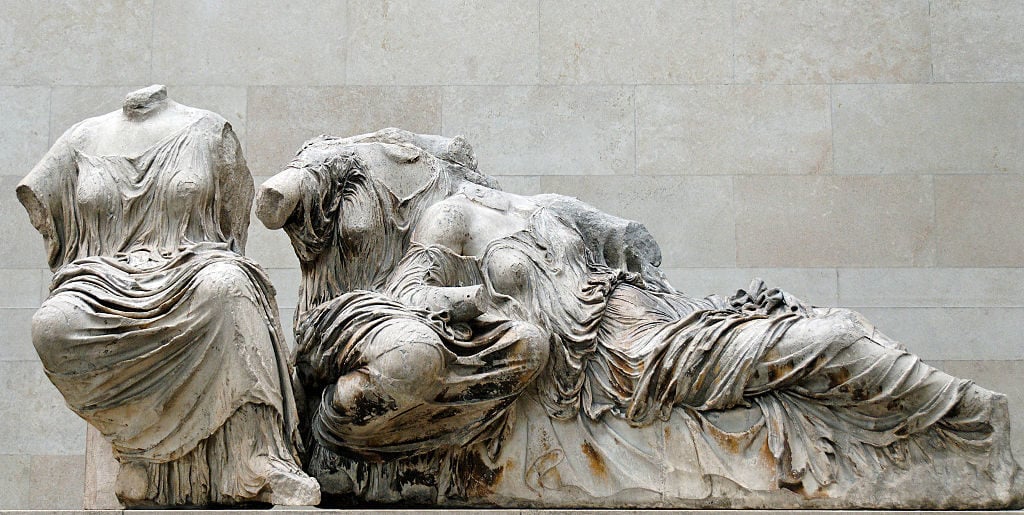
Part of the Elgin Marbles, were
originally part of the Parthenon in Athens. Photo: by VCG
Wilson/Corbis via Getty Images.
The ancient statues were taken from the Parthenon in the early
19th century by Lord Elgin, who later sold them to the British
government. Greece has long requested that they should be returned
permanently to Athens. Neither the British Museum nor the UK
government has flinched at growing pressure for their repatriation,
which has come from very high positions in the Greek government,
including its Prime Minister.
The US academic Patricia Vigderman, who is the author of
of The Real Life of the Parthenon, tells Artnet
News that that the marbles have figured into politically-motivated
crisis points before. The question of their return came up
during World War II as a way to potentially help Greece resist
German occupation; again the point was raised in the 1950s
during Greek-Cypriot revolts and terrorism; in the 1970s,
their repatriation was also floated as part of a possible way to
end Greece’s military dictatorship.
“None of those went anywhere, however, and it’s unlikely that
this will either,” she says. “In the ancient world returning
captured booty was a way of marking a ruler’s power and
magnanimity.” She thinks that a compromise today is as remote as
ever. Sounding a sceptical note, she says: “Such large-mindedness
is decidedly not the hallmark of our time, and throwing the marbles
into the cauldron will not flavor the stone soup of Brexit.”
In response to this most recent outcry over the sculptures, a
spokesperson for the British Museum restated its position. Speaking
to the Guardian, they
said: “The Parthenon sculptures were legally acquired and help
us to tell the story of human history presented at the museum. They
are accessible to the 6 million global visitors the museum receives
each year.” The British Museum also pointed to the Greek
government’s statement that they would not enter into Brexit
talks.
Last year, British Museum director Hartwig Fischer said the marbles would
never be returned because, according to him, “when you move
cultural heritage into a museum, you move it out of context. Yet
that displacement is also a creative act.” He said the sculptures
are as at home in Britain as they are in an archeological museum in
Athens. In 2009, the Greek government unveiled the new Acropolis
Museum designed by the French architect Bernard Tschumi. It was
partly funded by the European Union.
The post Rumors Swirl That Greece’s Demand for the Parthenon
Marbles Could Gain Traction in the Brexit Trade Battle appeared
first on artnet News.
Read more https://news.artnet.com/art-world/elgin-marbles-clause-brexit-negotiations-1780794
Further reading


Leave a comment