
Saudi Arabia Has Joined a Lawsuit Against Disgraced Dealer Inigo Philbrick, Claiming He Sold Them a Kusama Installation He Didn’t Own
The Saudi Arabian government is joining the international legal
fight against disgraced art dealer Inigo Philbrick.
An entity known as MVCA in Riyadh, Saudi Arabia, which is
connected to the collection of the Royal Commission for Al-Ula and
Crown Prince Mohammed bin Salman, according to Bloomberg, has
retained an attorney to represent its interests as a defendant in
an existing Miami lawsuit against Philbrick.
MVCA bought a major Yayoi Kusama installation, All The
Eternal Love I Have for Pumpkins (2016), in April of 2019 and
loaned it to the Institute of Contemporary Art, Miami
later that year, according to an October report
in Bloomberg, which cited sources
familiar with the purchase.
The problem? The original owners of the Kusama didn’t know that
their partner and co-owner, Philbrick, had sold the work to MVCA
from under them.
The Kusama installation is now one of nine works named in a
bombshell lawsuit filed against Philbrick last fall by the
Berlin-based finance company Fine Art Partners, run by principals
David Tümpel and Loretta Würtenburger, seeking the return of the
works, worth an estimated $14 million.
Attorneys for MVCA, the Royal Commission, and Fine Art Partners
did not respond to requests for comment.
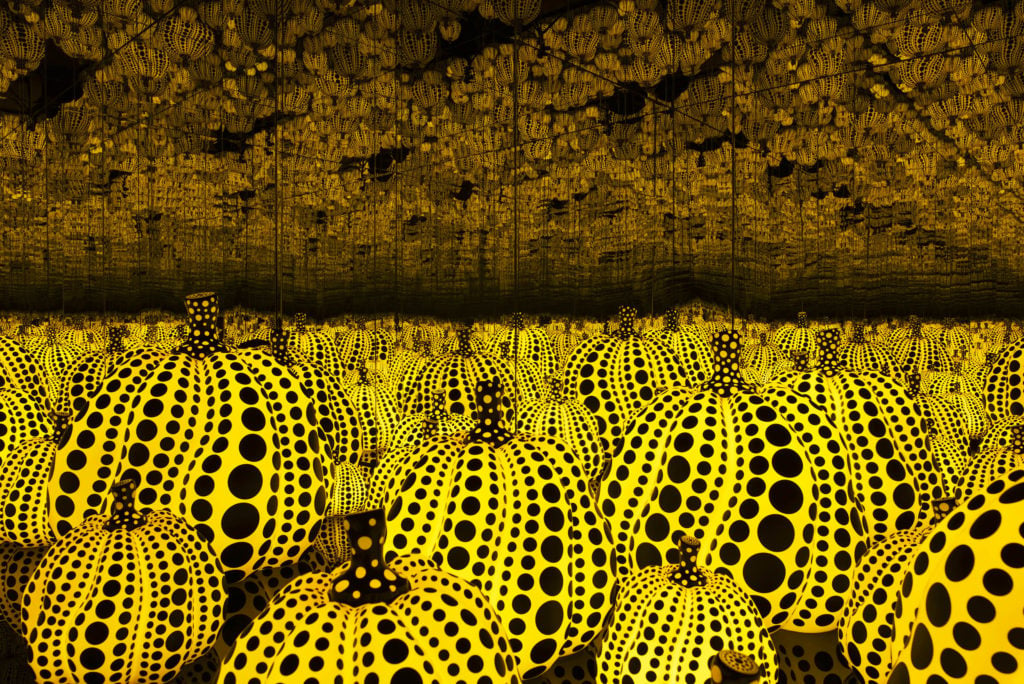
Yayoi Kusama, All the Eternal Love I
Have for the Pumpkins, detail (2016). Courtesy Ota Fine Arts,
Tokyo/Singapore and Victoria Miro, London. © Yayoi Kusama.
For years, Philbrick and Fine Art Partners had an art-flipping
arrangement where they would buy key works by blue chip
artists—including Wade Guyton, Donald Judd, Rudolf Stingel, and
Christopher Wool—hold them for several years, and then resell them
and split the profits according to prearranged percentages.
According to their complaint, Philbrick bought the Kusama on the
group’s behalf in September 2017 for $3.3 million with the
understanding that he would resell it for a profit—a target price
of $5 million is named on the agreement, with both sides splitting
the profit. It is not clear if the Royal Commission ultimately paid
that $5 million target price.
The contract was written in accordance with German laws, so it
remains to be seen how that will play out in a US court.
Even as Tümpel became increasingly frustrated over the course of
2019 over delayed or unremitted funds, Fine Art Partners seemingly
had no idea that Philbrick had already sold Kusama’s Pumpkin
installation out from under them. Roughly five months after the
purported sale to Saudi Arabia, in a September 2019 email
responding to concerns, Philbrick told Tümpel the Miami exhibition
could help attract a buyer:
“We are preparing the press launch for the Pumpkin Room, which
will go into soft view for trustees and other potential funders on
the 23rd, in advance of a public launch on October 1st. The
presentation is being coordinated with an international PR
campaign, which should bring us into contact with a number of
potential buyers… To my knowledge this is the first time a mirror
room has been presented in a public context that is not either
primary market or already in a museum collection.”
But soon thereafter, the owners learned that Philbrick had
already sold the Kusama, and filed their lawsuit against him.
In late January, as the Kusama show was nearing its end, a
Miami-Dade judge issued an injunction stipulating that the artwork
must remain in Miami as the case ran its course, according to a
report in ARTnews at
the time.
After the show’s run, the installation was to be broken down and
disassembled. Fine Art Partners had said in a prior filing that it
feared MVCA might remove the work from Florida soon after the show
ended. Kusama’s infinity room installations are known to be
extraordinarily complicated when it comes to installing and
deinstalling.
The current whereabouts of the Pumpkin installation are unknown.
An art storage company spokesperson in Miami who did not want to be
identified, confirmed to Artnet News that the empty crates used to
initially ship the work to Florida remain at the warehouse where
Philbrick stored them through the run of the Miami show.
Late last month, Artnet News learned that the US Department of
Justice is also investigating the dealer, according to four
sources who did business with Philbrick or are involved in legal
proceedings against him.
At least two companies that provided art support services for
Philbrick over the past several years confirmed that they received
grand jury subpoenas, indicating a criminal investigation, from the
Department of Justice in recent months, asking the companies to
supply all records related to business transactions with
Philbrick.
Since last fall, Philbrick, who has since vanished, has been
targeted by former clients who claim he sold the
same works to multiple people and defaulted on loans he
secured using art he didn’t own as collateral. Now, disgruntled
former business associates are trying to
seize his personal assets,
which filings suggest could amount to as much as $70 million, as
well as $150 million from his business.
The filing that MVCA attached to the Fine Art Partners lawsuit
does not mention the specific Kusama artwork nor the nature of its
involvement beyond that it is a defendant. But there is little
doubt the two entities are battling over ownership rights to the
highly-prized, seven-figure Kusama pumpkins.
The post Saudi Arabia Has Joined a Lawsuit Against Disgraced
Dealer Inigo Philbrick, Claiming He Sold Them a Kusama Installation
He Didn’t Own appeared first on artnet News.
Read more https://news.artnet.com/art-world/saudi-arabia-joining-lawsuit-against-inigo-philbrick-1867710
Further reading


Leave a comment