
Sex Workers of the World, Unite: A Pop-Up Museum in New York Is Dedicated to Practitioners of the Oldest Profession
New York’s latest pop up museum isn’t about ice cream, pizza, or
rosé. It’s called Sex Workers’ Pop-Up,
and it’s promoting the global campaign to support sex workers’
rights, featuring more than 50 works by 22 artists—17 of whom have
backgrounds in sex work.
“Sex work is really misunderstood, misrepresented, and
stigmatized, so it was important in this show to have people hear
from sex workers directly about their experiences and their
demands,” co-curator Daveen Trentman, cofounder of
the Soze Agency, told Artnet News. “The message
that we want to send with this exhibition is that sex work
shouldn’t be criminalized.”
The exhibition has been organized by the Open Society Foundation, a philanthropic
grant-making organization, with the assistance of Soze, a creative
agency that specializes in creating social impact campaigns—like
the New York Civil Liberties Union’s Museum of Broken Windows in 2018.
But while that exhibition featured such well-known artists as
Dread Scott and Hank Willis Thomas, the museum of sex workers
relies almost exclusively on less familiar names. Yes, there’s
Venice Biennale veteran Candice Breitz, whose video series
featuring accounts from sex workers has been shown widely in
Europe, and activist artist Molly Crabapple. (The
latter, who has illustrated sex workers’ magazine
$pread, is presenting drawings made of rallies held
by DeCrim NY, an advocacy group working to
legalize the sex trade in New York.)
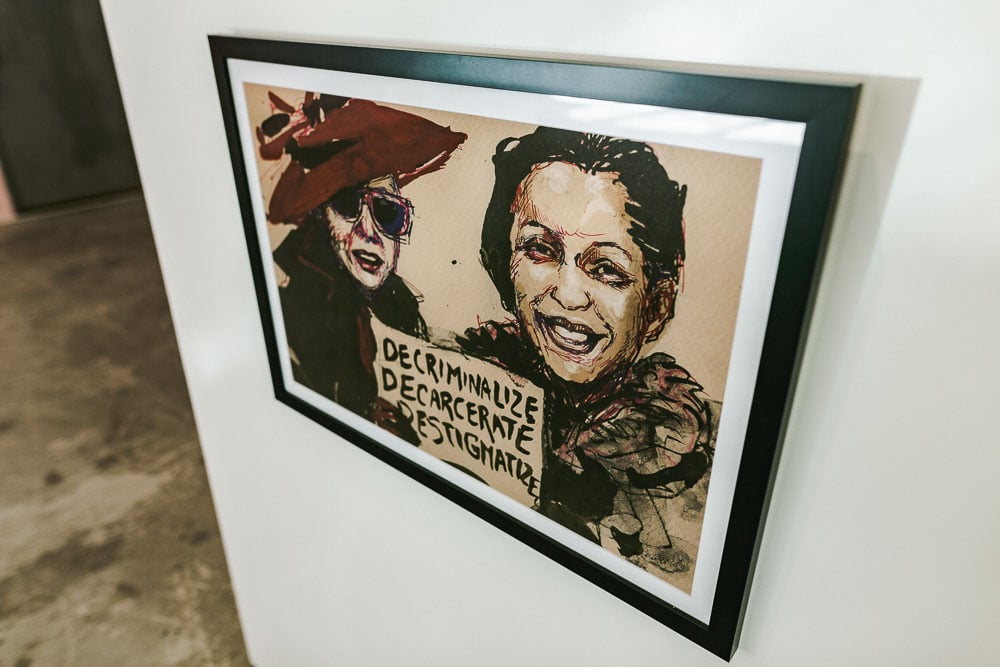
Work by Molly Crabapple at Sex Worker
Pop-Up. Photo courtesy of Sex Worker Pop-Up.
But you’ll also find single panel cartoons by Jacq the
Stripper—including I Just Want the Same Rights as the Girl
Who’s Famous Because of Her Brilliant Momager and Sister Who Made
Cute Lil Sex Tape, comparing an Instagram post of the artist
hugging her bare breasts that was censored by the platform with a
one featuring Maurizio Cattelan’s recent topless
sculpture of Kendall Jenner, which received a like from
Instagram’s official account.
“At the core of this exhibition is authentic storytelling,” said
Trentman, who teamed with Alexis Heller, curator of the
Leslie-Lohman Museum of Art’s recent exhibition “ON OUR BACKS: The Revolutionary
Art of Queer Sex Work” to find the right mix of artists for the
show. “When we’re talking about policy it’s one thing to debate it,
but it’s another to see the human side of it.”
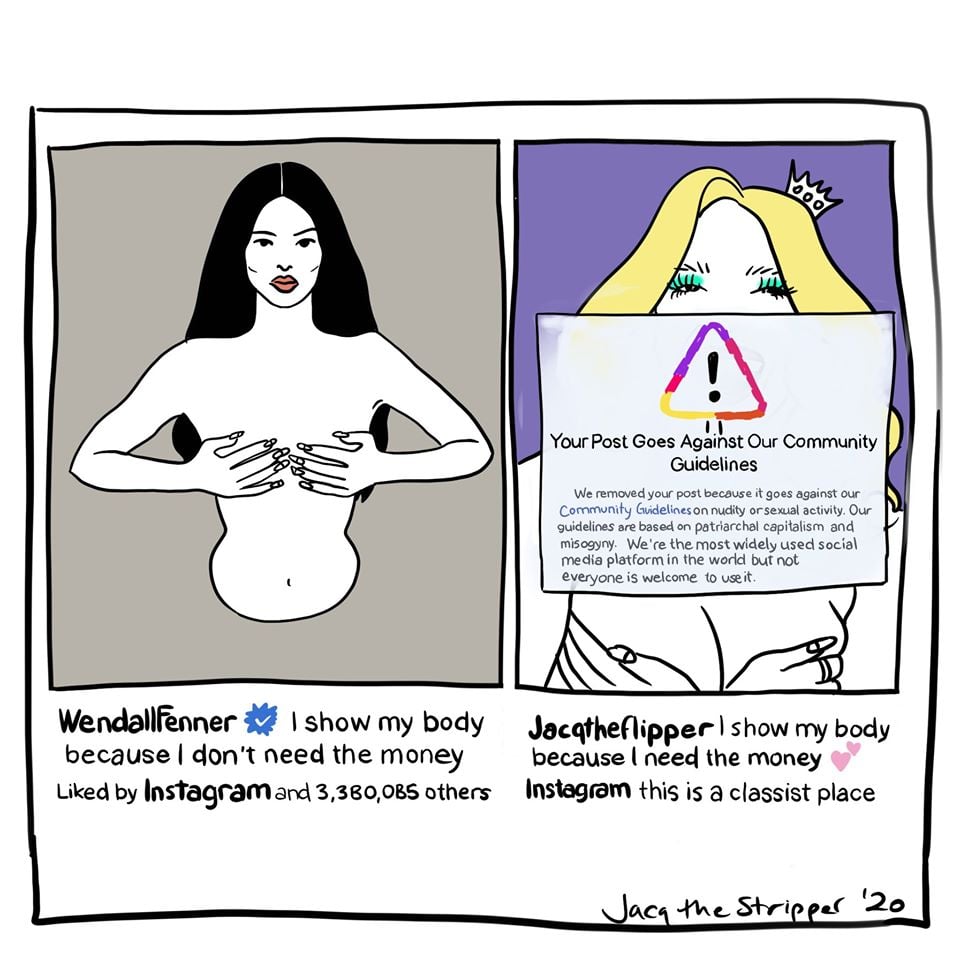
Jacq the Stripper, I Just Want the
Same Rights as the Girl Who’s Famous Because of Her Brilliant
Momager and Sister Who Made Cute Lil Sex Tape (2020). Courtesy
of the artist.
To illustrate the ways in which black cis women and black trans
women alike have historically been over-criminalized and
over-policed for sex work, the curators commissioned
photographer Kisha Bari to shoot
portraits of women in the sex trade. “When you look at these
portraits, there is such a range of emotion that was captured,”
said Trentman. “They really speak to the resilience that these
women have.”
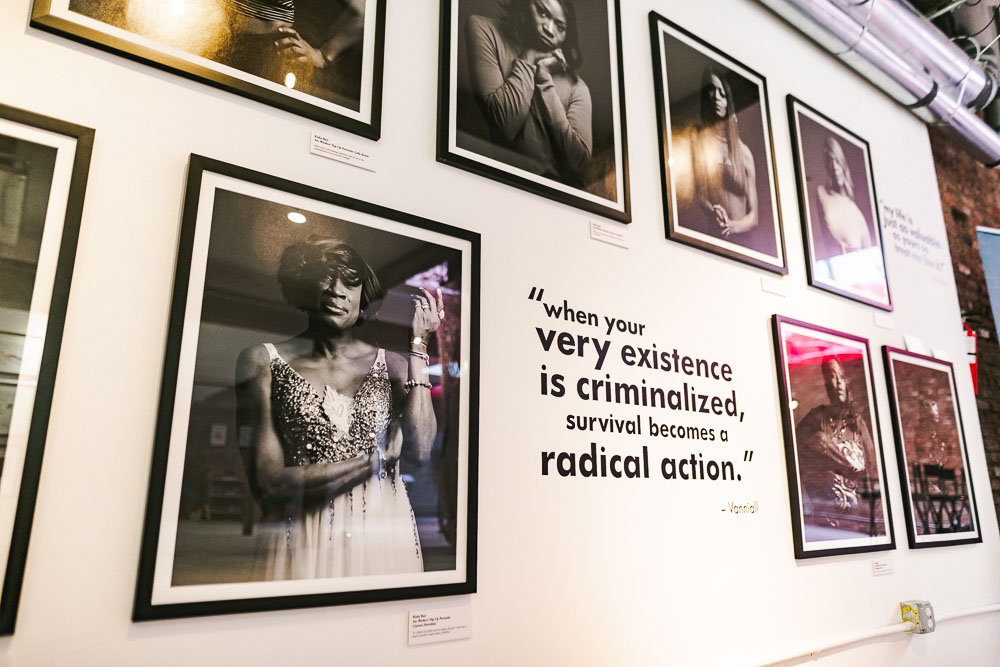
Installation view of Kisha Bari’s
portraits of black and brown sex workers at Sex Worker Pop-Up.
Photo by Jonna Algarin Mojica courtesy of Sex Worker Pop-Up.
Another highlight is the work of Brazilian photographer Gabriela
Leite, who runs the fashion line DASPU, which means “of the
whores.” The brand employs sex workers as models on the catwalk,
turning runway shows into political activism. The curators printed
the black-and-white images of these events on tapestries, hanging
them an inch off the wall so that they flutter a little as visitors
walk by.
“We wanted to capture the spirit of these fashion shows,” said
Trentman. “They are very lively, and they’re about empowerment,
self confidence, resilience, and joy.”
A more personal work is Midori’s InVocation, a
20-foot-tall interactive textile sculpture that appeared in the
Leslie-Lohman show. Visitors are invited to step inside the hemp
rope curtain, which is interwoven with garments once used by queer
sex workers. They’ve ritualistically retired these once-precious
belongings, imbuing the piece with a sense of collective
memory.
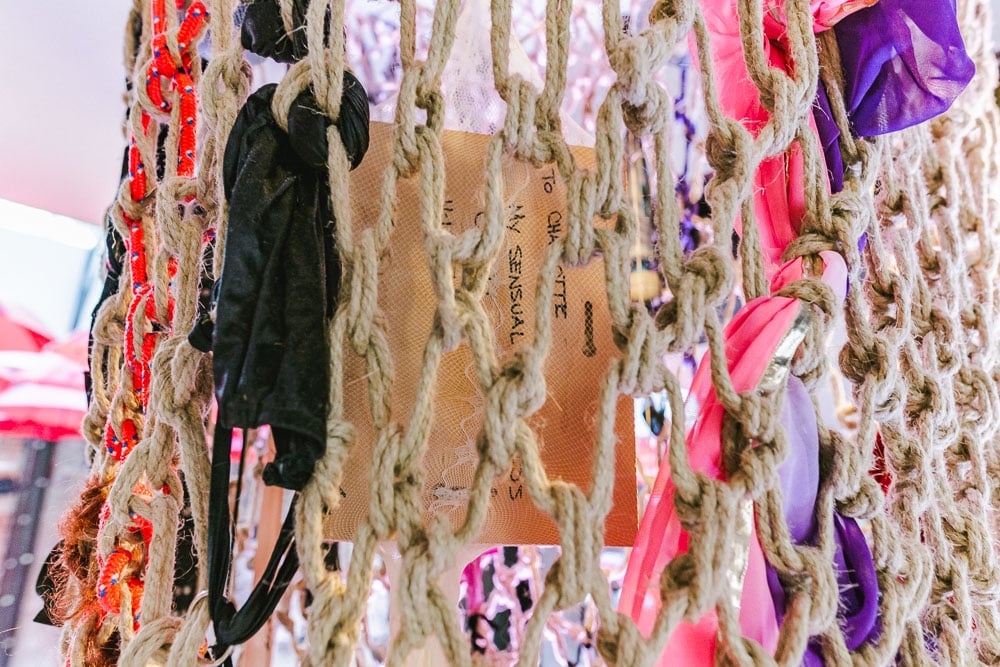
Midori, InVocation,
installation view. Photo by Jonna Algarin Mojica courtesy of Sex
Worker Pop-Up.
The work on view is thought-provoking, offering an illuminating
portrait of a marginalized segment of society forced to operate in
the shadows. But Trentman and Heller are savvy curators, offering
at least one Instagram-ready moment in the form of an installation
of a grid of red umbrellas by Sun Kim.
The umbrellas hang upside-down from the gallery’s skylight,
suffusing the space with warm light and offering a striking photo
op. But they also have a long history as a symbol of the sex
workers’ rights movement. During the Venice Biennale in 2001, the
Slovenian artist Tadej Pogačar staged a Prostitute’s Pavilion under
a tent, with sex workers marching through the streets of Venice
carrying red umbrellas and congregating in the Giardini for the
World Congress of Sex Workers.
“The red symbolizes beauty and the umbrella symbolizes
strength and protection,” said Trentman.
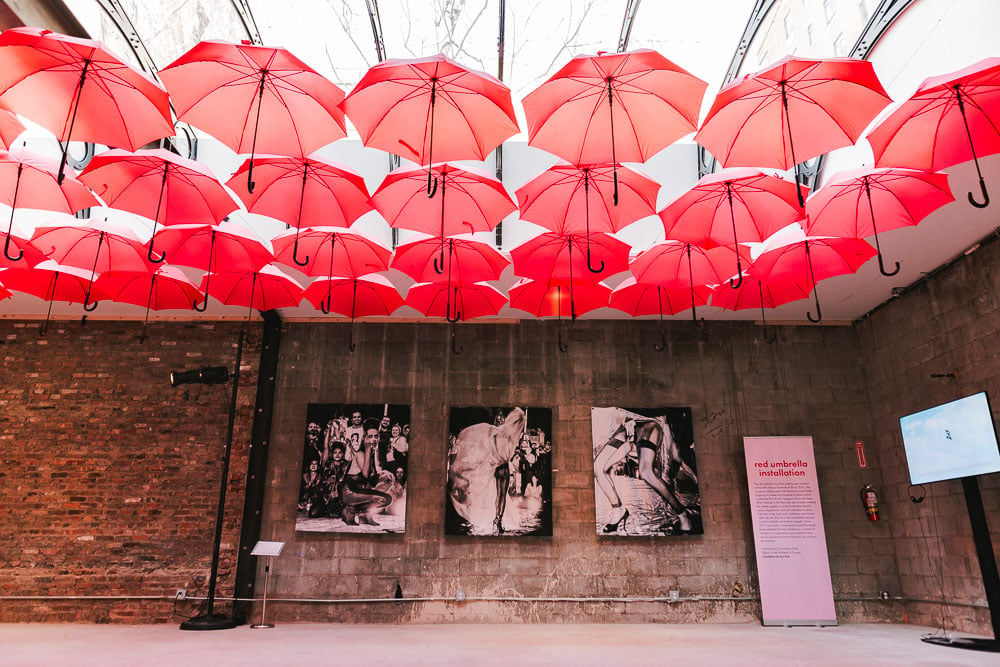
Sun Kim’s red umbrella installation at
Sex Worker Pop-Up. Photo by Jonna Algarin Mojica courtesy of Sex
Worker Pop-Up.
The week-long exhibition was planned to coincide with the
UN Commission on the Status of Women,
which was suspended following the opening meeting due to the
coronavirus outbreak. But the organizers still believe that their
message will be heard—the Museum of Broken Windows, for instance,
saw 10,000 visitors during its week-long run.
“Sex workers are asking for their work to be recognized as work,
and to have the same rights that are afforded to other
workers,” Sebastian Köhn, director of Open Society’s sexual
reproductive health and rights project, told Artnet News. “There’s
a demand to be free from exploitation and oppression.”
See more images from the show below.
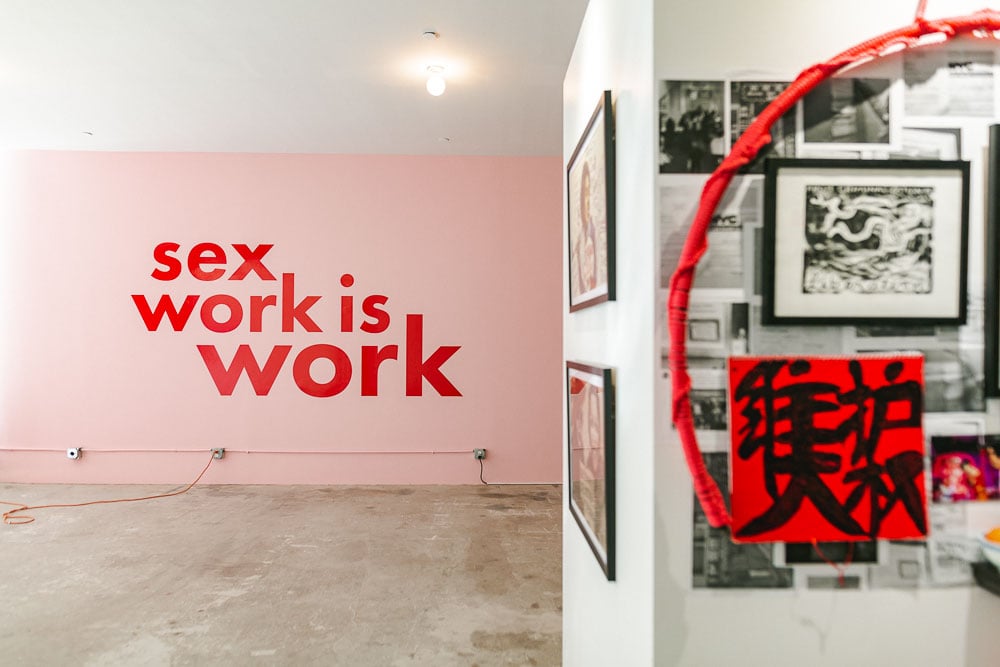
Sex Worker Pop-Up, installation view.
Photo by Jonna Algarin Mojica courtesy of Sex Worker Pop-Up.
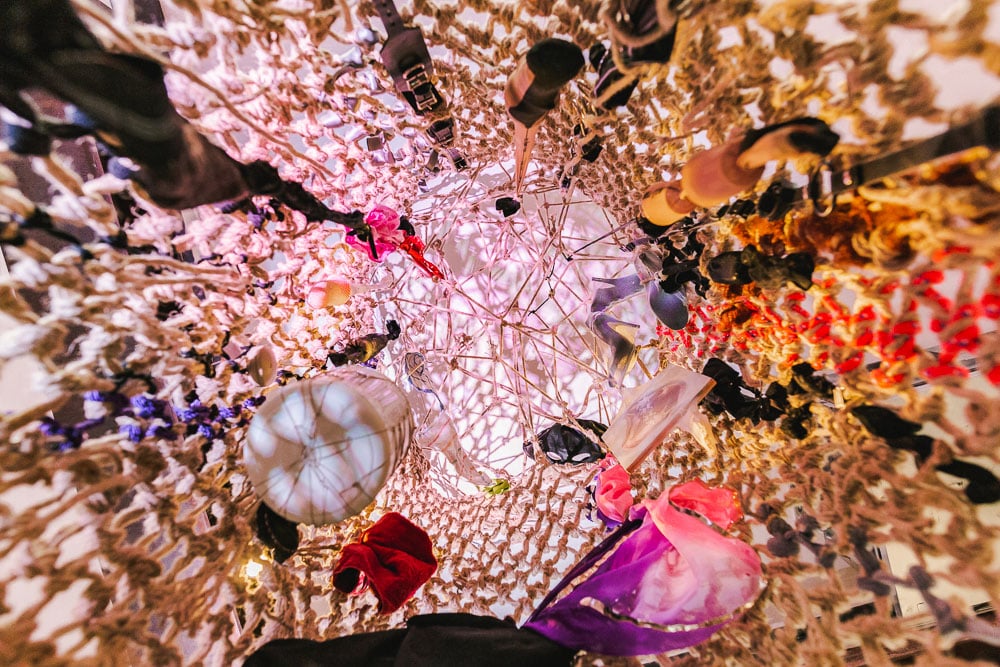
Midori, InVocation,
installation view. Photo by Jonna Algarin Mojica courtesy of Sex
Worker Pop-Up.
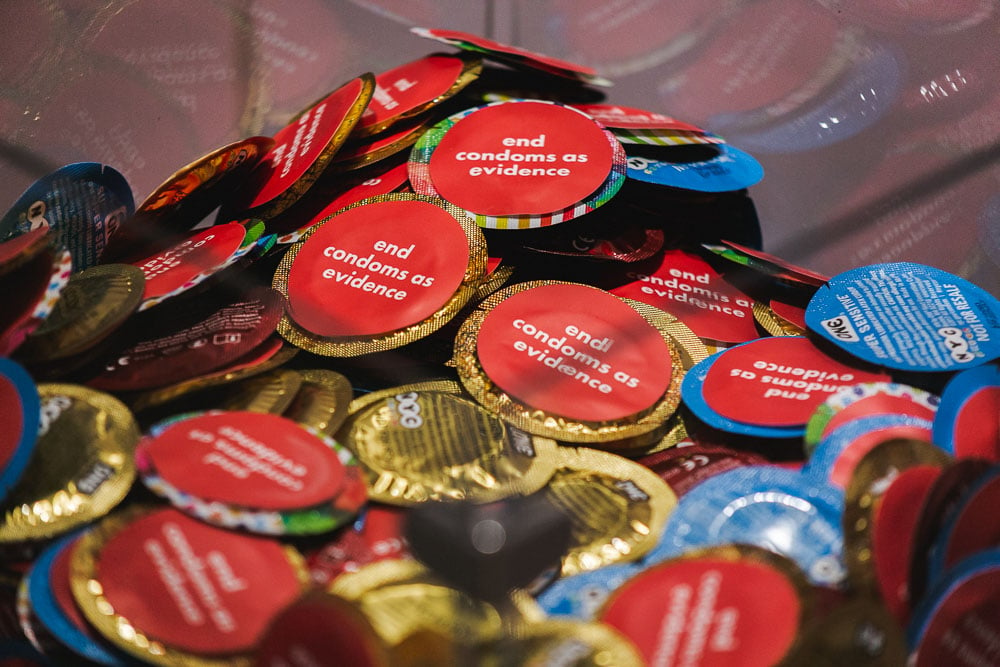
Empower Condom Police, Empower.
Photo by Jonna Algarin Mojica courtesy of Sex Worker Pop-Up.
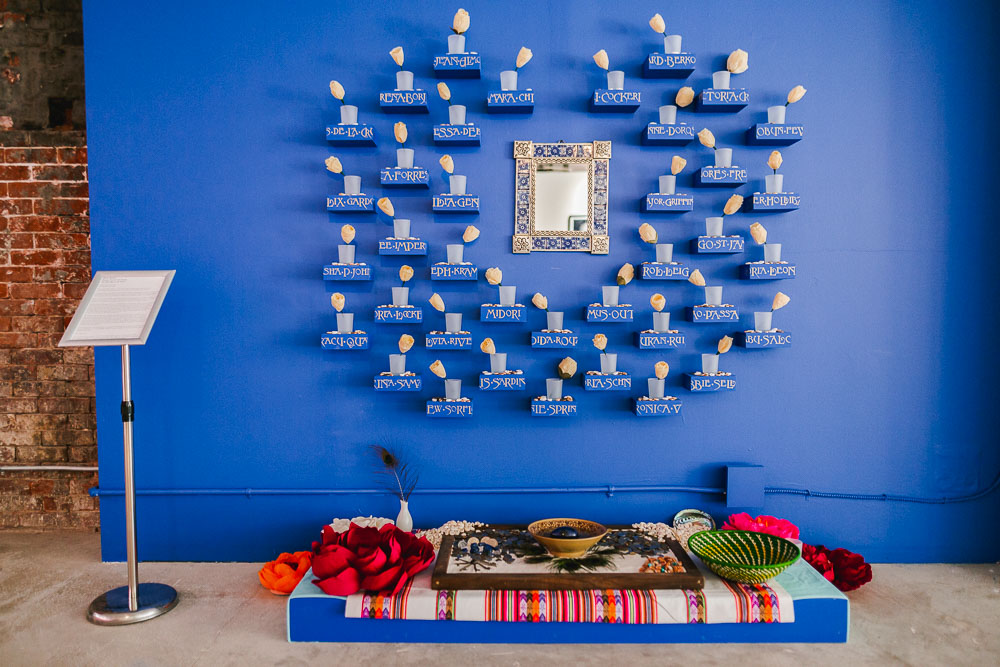
Pluma Sumaq, Nuestra Suerte en la
Arena Our Blessings in Sand), installation view at Sex Worker
Pop-Up. Photo by Jonna Algarin Mojica courtesy of Sex Worker
Pop-Up.
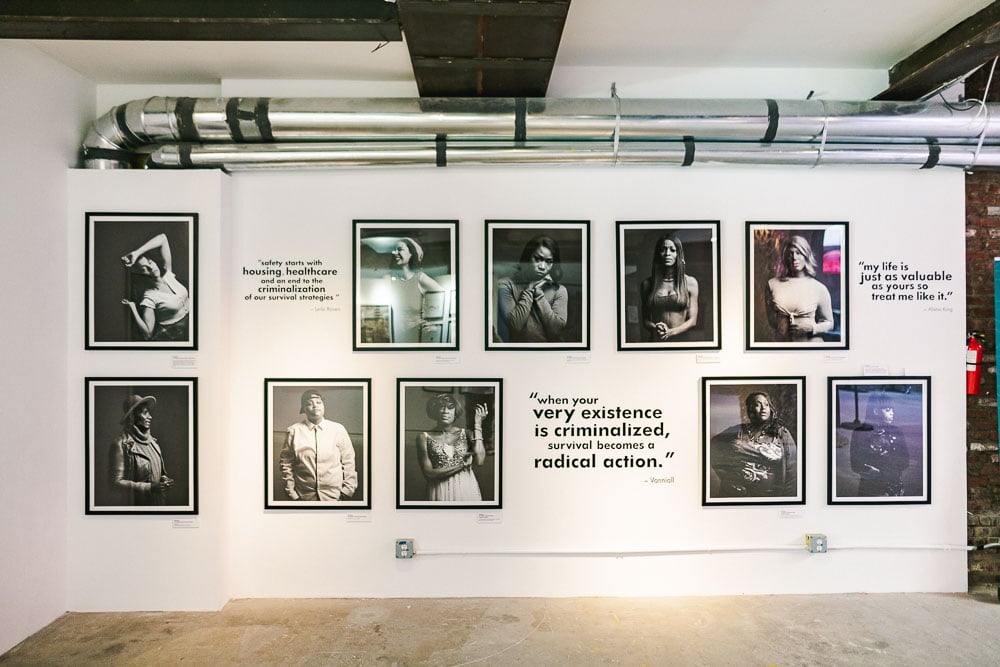
Installation view of Kisha Bari’s
portraits of black and brown sex workers at Sex Worker Pop-Up.
Photo by Jonna Algarin Mojica courtesy of Sex Worker Pop-Up.
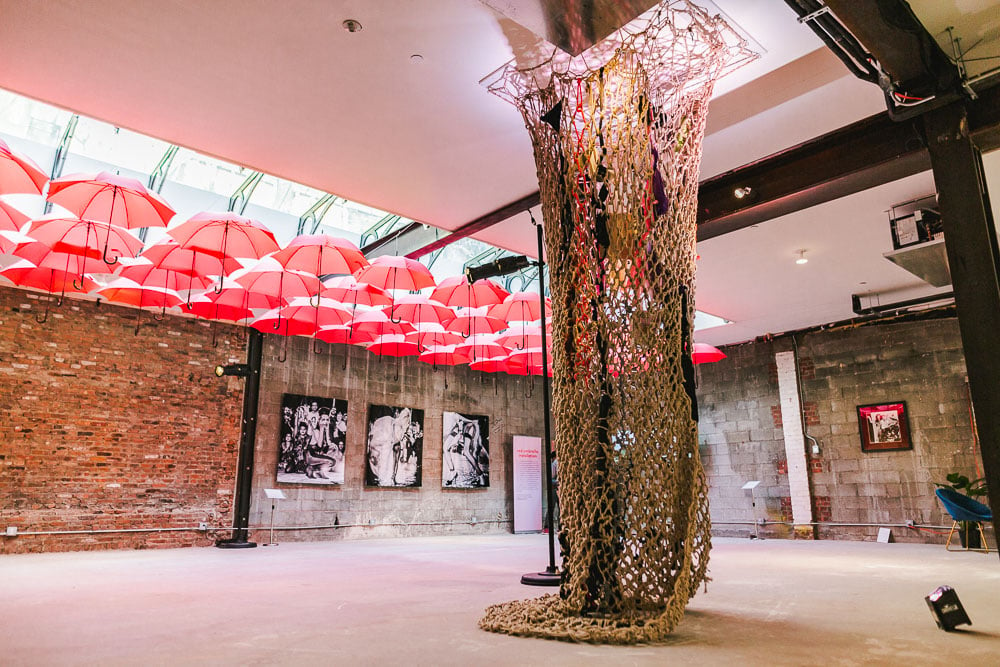
Installation view of Sex Worker Pop-Up.
Photo by Jonna Algarin Mojica courtesy of Sex Worker Pop-Up.
Sex Workers’ Pop-Up is on view at 9 West 8th Street, New
York, March 10–16, 2020. Hours are
10 a.m.–8 p.m. daily; admission is free.
The post Sex Workers of the World, Unite: A Pop-Up Museum in
New York Is Dedicated to Practitioners of the Oldest Profession
appeared first on artnet News.
Read more https://news.artnet.com/exhibitions/museum-sex-workers-1798545
Further reading


Leave a comment