
‘She Wears Her Wisdom Lightly’: How American Curator Zoé Whitley Became One of the UK’s Most Influential Arts Leaders
Zoé Whitley’s beaming face was
exactly the warmth I needed on a freezing winter’s day in
February, when the curator took me to see a Cameron Rowland
exhibition at London’s Institute of Contemporary
Arts.
After we wound our way through
the show—a conceptually dense presentation linking the history of
the transatlantic slave trade to present-day systems of
incarceration—we made a
pitstop at the ICA café, where Whitley ordered a tea and, as she
navigated our tray to a table, explained that she used to work in
the service industry as a waitress.
“I don’t come from money,”
Whitley, who was named the head of the nonprofit Chisenhale
Gallery in London in January, told me at one point. “Gender and race
and their attendant power—or lack thereof—are never going to be
purely academic to me. It’s always part of the way that I am
received or perceived.”
Waiting tables, she added, was “deeply unsatisfying” labor: no matter how hard
you work, you often end up getting shortchanged.
“It’s another cultural vestige
linked to indentured servitude, and to the history of not paying
black people equally for their work.”
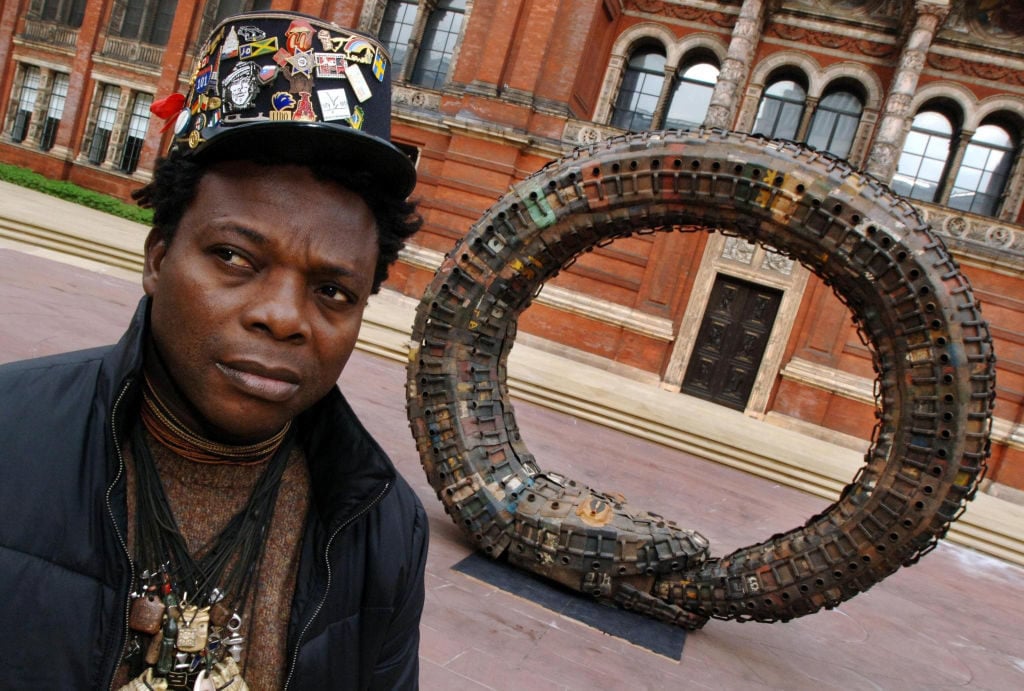
Romuald Hazoume with his work in
“Uncomfortable Truths,” a show Whitley organized at London’s
V&A Museum. Photo by Fiona Hanson – PA Images/PA Images via
Getty Images.
Addressing Matters Directly
Whitley doesn’t shy away from these kinds of discussions. In one
room of the Rowland exhibition, a branding iron was positioned
in a chilling face-off with a contemporary ankle monitor. It
reminded me of “Uncomfortable
Truths,” a show she curated in 2007 at the Victoria & Albert Museum to mark the
bicentenary of the abolition of the British slave trade, and to
examine its traces in contemporary art and design. The
curator does not want to let history to become “too cosy.”
“She understands exactly what is
going down but wears her wisdom lightly,” said artist Lubaina
Himid, who first met Whitley when she showed her work in that
exhibition, a decade before she would go on to win the Turner
Prize. Himid, who later became Whitley’s doctoral supervisor, said
that each conversation between the two “stretched us both in
different ways.”
Since then, in the span of just
a few short years, the 40-year-old curator has played an important
role in facilitating conversations about diversity in the art world
as museums across the UK are reconsidering the
canon.
In a rare opportunity for a
mid-career curator, she organized the Cathy Wilkes exhibition at
the British Pavilion at last year’s Venice
Biennale. Before that,
she was best known as one half of the curatorial duo behind the
groundbreaking exhibition “Soul of a Nation: Art in
the Age of Black Power,” a survey of mid-century works by African
American artists illustrating their vital contributions to American
art history. The
extraordinary outing showcased 20 years of black art during the
Civil Rights era, and included works by Frank Bowling, Betye Saar,
and Barkley Hendricks. Three years after its debut at Tate Modern, it
is still touring, and Whitley has just been recognized for her work
on the show with an award from the Association of Art Museum
Curators.
“Zoé has a very rich
understanding of many of the key artists from the past 50 years
whose work is only recently being collected by major art museums or
receiving more widespread critical acknowledgement,” said Ralph
Rugoff, the director of the Hayward Gallery, where Whitley was
previously—and briefly—a curator. “She has a very keen grasp
of the contemporary scene and a sharp eye for recognizing young
artists who are doing truly innovative work.”
Whitley’s first—and, as it turns
out, last—show at the Hayward, titled “Reverb,” which looks at
sound artists including Christine Sun Kim, Kahlil Joseph, and Oliver
Beer, will be her “introduction and swansong rolled into one,”
Whitley said. (Slated to open in June, it has been postponed until
at least the fall.)
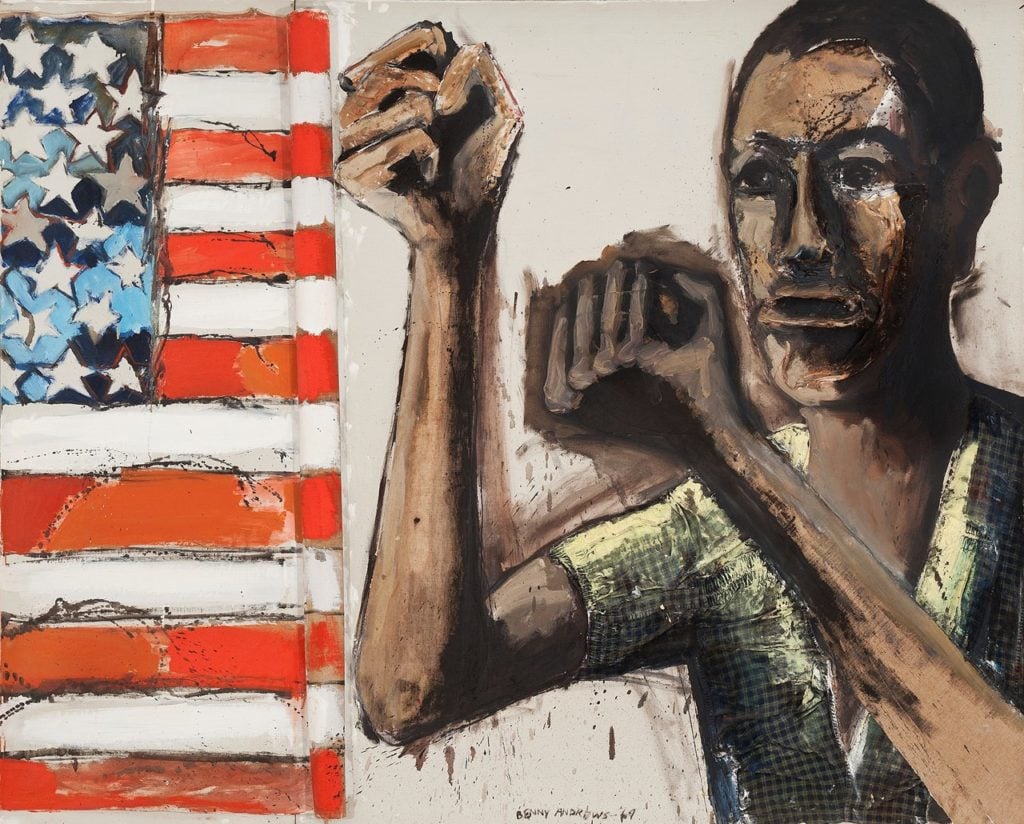
Benny Andrews’s Did the Bear Sit
Under a Tree (1969) at “Soul of a Nation: Art in the Age of
Black Power” at Tate Modern. © Estate of Benny Andrews/DACS,
London/VAGA, NY.
From LA to London
Whitley was born in Washington,
DC, and raised by a father with a keen interest in film and a
mother who studied art
history with the late David Driskell
at the University of Maryland. Her family moved to Los Angeles when she was a teenager.
In the summer of 1999, while she was an art history undergraduate
at Swarthmore College, she got a summer internship
in LACMA’s costume and textiles department under the
supervision of Sharon Takeda, who still runs the department
today.
“She was an LA kid and came in
bright-eyed and bushy-tailed, and was obviously extremely bright
and energetic,” Takeda recalled, noting that she still has the
feathered and beaded bookmark (an ode to Tom Ford’s iconic
jeans for Gucci) that Whitley made for her as a thank-you that
summer. By the end of the internship, Takeda and her
colleague, Kaye Spilker, suggested that Whitley consider curating as a
career.
“There’s something special about
being seen, even at a young age,” Whitley told me. On their
advice, she applied for the Royal College of Art’s design
history program and later graduated with a master’s thesis looking at representations of
blackness in Vogue magazine. Soon after,
she took a job as an assistant
curator at the V&A, and has now lived in South London for 20
years. “London
continues to appeal to me for the way that it is able to welcome
and absorb so many different cultures,” Whitley said.
But it was still a few years
after she took the V&A job that Whitley made the pivot to
working with contemporary artists. She vividly recalls attending
the opening of a David Adjaye and Faisal Abdu’Allah exhibition at
the Chisenhale in 2003. “Before that, I didn’t really have the
sense that it was possible to know artists and to actually talk
with them,” Whitley said.
![Ima-Abasi Okon, <i>Infinite Slippage: nonRepugnant Insolvencies T!-a!-r!-r!-y!-i!-n!-g! as Hand Claps of M’s Hard’Loved’Flesh [I’M irreducibly-undone because] —Quantum Leanage-Complex-Dub</i>(2019). Installation view, Chisenhale Gallery, 2019. Commissioned and produced by Chisenhale Gallery, London. Courtesy of the artist. Photo: Andy Keate.](https://news.artnet.com/app/news-upload/2020/04/23_Ima-Abasi-Okon-at-Chisenhale-Gallery-1024x683.jpg)
Ima-Abasi Okon, Infinite
Slippage: nonRepugnant Insolvencies T!-a!-r!-r!-y!-i!-n!-g! as Hand
Claps of M’s Hard’Loved’Flesh [I’M irreducibly-undone because]
—Quantum Leanage-Complex-Dub (2019). Installation view,
Chisenhale Gallery, 2019. Photo: Andy Keate.
The Benefits of a “Forced Reset”
As head of the Chisenhale, an institution known for
its ambitious projects, Whitley plans to commission works from a wide
range of artists.
“Productively, we’ve moved
beyond a kind of YBA model,” Whitley said. “An artist doesn’t have
to be young to be making excellent work, and to be at that
pivotal point in their career when a Chisenhale commission might be
exactly the thing to help ignite wider public interest.”
Whitley started in the role at the beginning of April, as the
coronavirus crisis put unprecedented pressure on museums and
galleries.
“I think the art world gets
caricatured as being hyper-competitive, with everybody wanting to
be first, or for something to be exclusive or
original. But one thing
I’ve seen is a huge amount of generosity, because everybody is
facing the same thing,” she said, noting that she has witnessed productive,
healthy dialogue between directors of smaller
institutions.
And despite what appears to be a
grim outlook for small institutions amid the crisis, Whitley has
reasons for optimism.
“This forced reset is giving
everyone time to think,” she said. “We can’t do what we’ve been
doing. So people are asking: what might the alternatives look
like?”
The post ‘She Wears Her Wisdom Lightly’: How American
Curator Zoé Whitley Became One of the UK’s Most Influential Arts
Leaders appeared first on artnet News.
Read more https://news.artnet.com/art-world/zoe-whitley-curator-profile-1846689
Further reading


Leave a comment