
Some People Cried, Others Prayed: Looking Back on the Explosion of Enthusiasm That Accompanied the Obama Portraits
It’s rare for a painting to be
the subject of international headlines. But this was the case for
the pair of portraits that Kehinde Wiley and Amy Sherald made of
President Barack Obama and First Lady Michelle Obama, which made
waves around the world.
When the
portraits were unveiled at the
Smithsonian’s National Portrait Gallery (NPG) in February
2018, they were a bona
fide cultural phenomenon. The museum’s attendance tripled; its web
traffic went through the roof. Lines the length of football fields
formed en route to the colorful canvases, snaking through hallways
and stairwells out into the museum’s courtyard.
But it wasn’t just the amount of
attention surrounding these paintings; it was the tenor of it.
Stories of visitors praying or breaking down in tears before the
portraits circulated on social media. An image of a two-year-old
girl, Parker Curry, went viral after a stranger snapped her looking
up in awe at Michelle’s image. (The girl’s mother had to hire a
publicist to field all the ensuing interview
requests.)
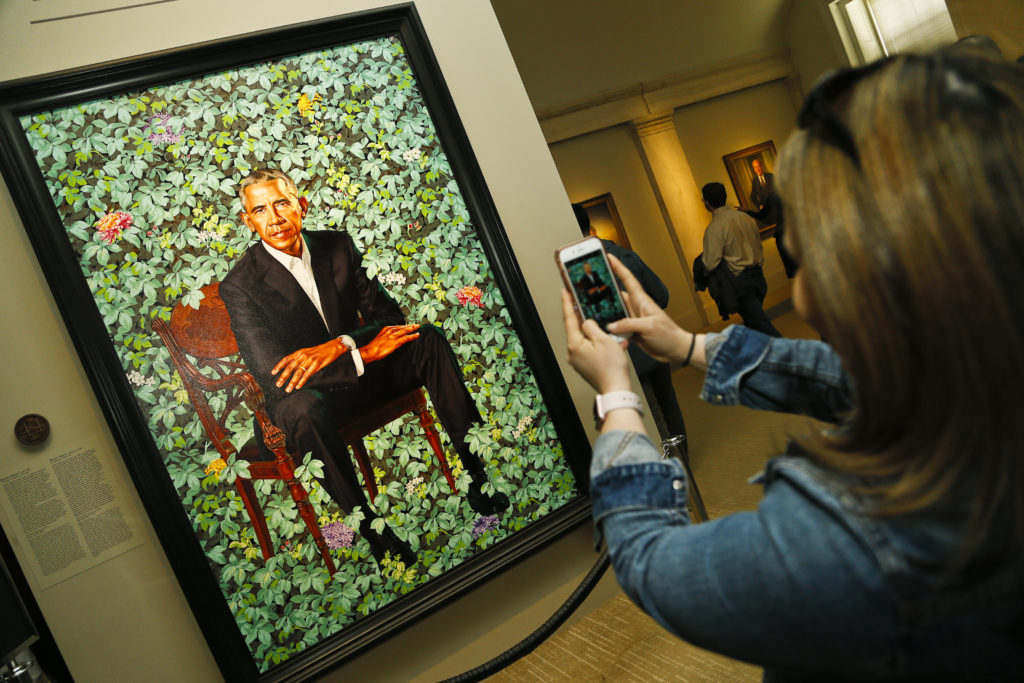
Photo: Paul Morigi. Courtesy of
Princeton University Press.
The portraits transcended art
and politics, inspiring the kind of spiritual experience typically
associated with religious icons. In fact, that’s not far off, says
Kim Sajet, the NPG’s director.
“It’s a form of what I call
secular pilgrimage,” she tells Artnet. “Much like people go to
Graceland or John Lennon’s grave—the response has that quality to
it.”
Now, two years after the frenzy,
the museum is taking stock of the artworks’ impact with a new book
published by Princeton University Press.
The Obama
Portraits, out this
week, retraces the portraits’ journeys, from behind-the-scenes
looks at Wiley and Sherald in their studios, to the much-publicized
unveiling, and finally to the burst of popular attention and
interest that followed.
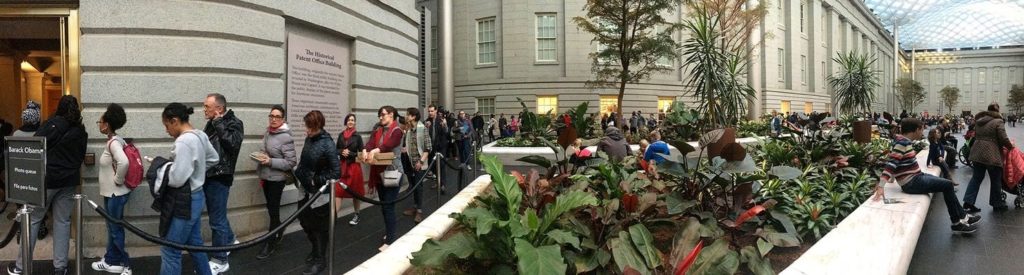
Photo © 2018, The Washington
Post. Reprinted with permission.
“I think it would be true to say
that we were all caught off guard,” says Sajet of the response to
the paintings. “We knew they were going to be popular but we had no
idea that they were going to be this popular. It was extraordinary.
We joke about it now, but it was 24/7 here at the time. We had
staff coming in on weekends and in their spare time just to be here
to talk to crowds who were lining up. Brochures that we had printed
for six months lasted six weeks.”
The director recalls a meeting
with the museum’s design team prior to the portraits going on view.
They wanted to put up stanchions in front of the canvases to keep
viewing experiences orderly.
“I said, ‘Guys, I think you’re
being a little overzealous. Do we really have to do
that?’”
Ultimately, Sajet sided with the
design team, and she was glad she did. Not only did the stanchions
lend a sense of organization to the chaos that ensued, they changed
the way people interacted with the paintings, giving onlookers the
space to share a rare, intimate moment with the
works.
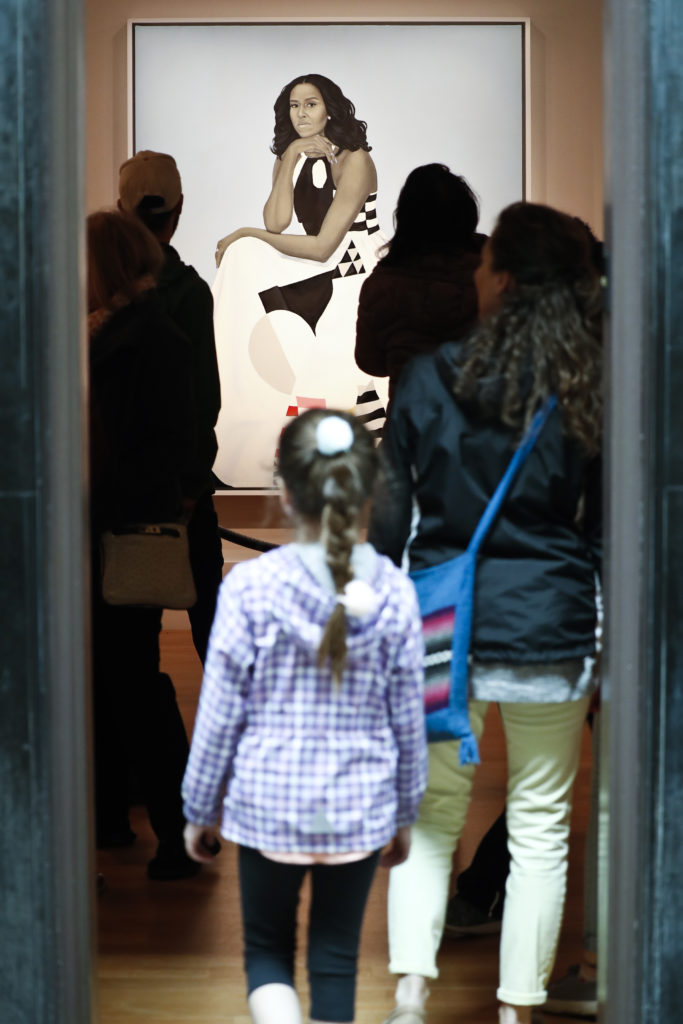
Photo: Paul Morigi. Courtesy of
Princeton University Press.
Waiting in a long line is never
a good time, but an overwhelming sense of fellowship flourished
among those waiting to commune with Barack and Michelle.
“I would go up to these people
who had been lining up for hours and would say, ‘Wait a minute,
don’t you live around the corner? The paintings aren’t going
anywhere, you can come back in a couple of months when it won’t be
so crazy,’” Sajet recalls. “And they would say, ‘No, that’s the
point. We want to be here with everyone else. We love the
environment!’”
The experience wasn’t limited to
these two portraits, either. The rush of visitors also developed
new relationships with the rest of the
NPG. Sajet explains
that the museum’s “In Memoriam” wall of portraits depicting
recently deceased figures grew in popularity too, occasioning the
kind of lengthy lines and creative, emotional responses that the
Obama portraits inspired. Visitors left purple flowers in front of
Prince’s painting, for instance, or wept before Aretha Franklin’s
likeness.
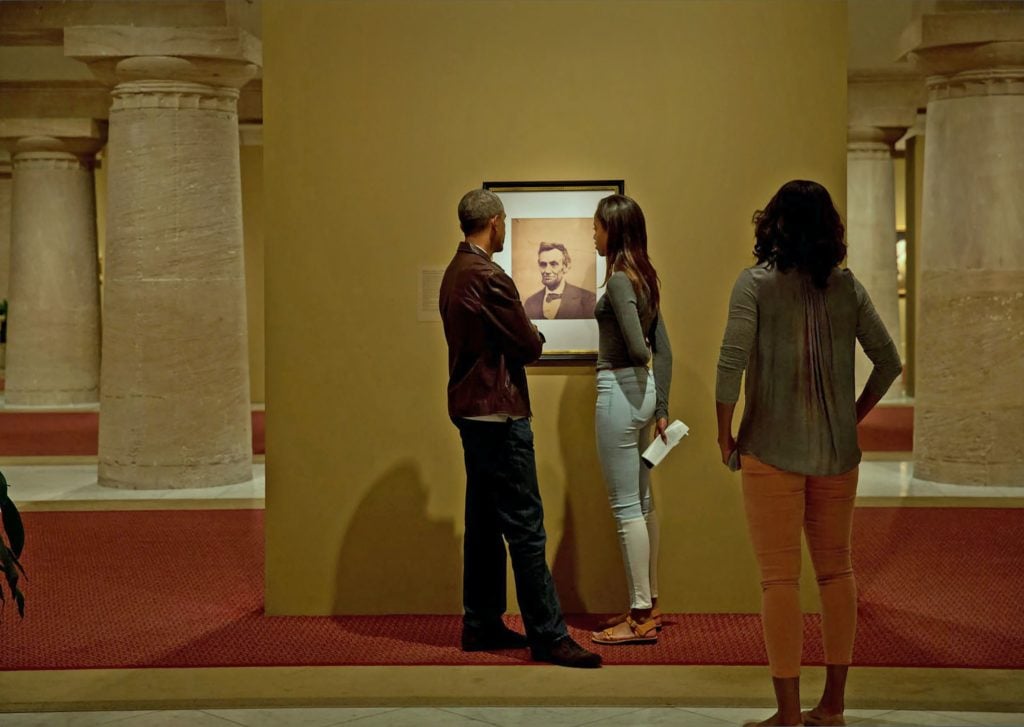
President Barack Obama, First Lady
Michelle Obama, and their daughter Malia look at Alexander
Gardner’s 1865 photograph of Abraham Lincoln during a visit to the
National Portrait Gallery in 2014. Courtesy of White House
Photo/Alamy.
Now, with its eyes wide open to
these new and inspired forms of visitor engagement, the museum is
tweaking its broader approach.
“It’s made me think a lot more
about creating spaces that are special, where you can sit on a
bench and have a moment with another person or by yourself,” says
Sajet. “It’s a little old fashioned, but I think people are looking
for that now.”
The Obama
Portraits is out now
from Princeton University Press. The portraits of President Barack Obama and First Lady Michelle
Obama will go on
their first national tour
starting next year.
The post Some People Cried, Others Prayed: Looking Back on
the Explosion of Enthusiasm That Accompanied the Obama
Portraits appeared first on artnet News.
Further reading


Leave a comment