
Street Art Is a Global Commercial Juggernaut With a Diverse Audience. Why Don’t Museums Know What to Do With It?
Street art is far and away the world’s most globally accessible
genre of contemporary art. It’s shared obsessively on social media,
courted by fashion and lifestyle brands, and now, a darling of the
commercial art market as well. If there was any perception that
work by street art’s stars was too lightweight to be taken
seriously, the $14.7 million paid for
a painting by KAWS earlier this year at least made those doubters
sit up and pay attention.
For museums looking for prestige and new audiences, this
combination of market power, press interest, and popular cachet
seems like it should make street art a natural fit. And yet almost
a decade has passed since Banksy’s surprise retrospective at the
Bristol Museum drew more than 300,000 visitors over the course of
its 12-week run, making it the most popular show outside of London
that year. Today, the British Museum is still the only
high-profile UK museum that has added his work to its permanent
collection: Banksy’s fake banknote, Di-Faced Tenner,
featuring Princess Diana, which was donated by the artist’s
representative, Pest Control, earlier this year.
In the US, eight years have passed since LA MOCA broke attendance
records for its “Art in the Streets” show featuring a host of
street art stars. Certainly, artists from Shepard Fairey to Swoon
to KAWS have gotten museum attention. Most recently, the Brooklyn
Museum announced that it would do a retrospective of the
prolific French street artist JR. And yet, it definitely does
not seem as if museums’ flirtation with the genre is about to
become a firm embrace. So what are the issues faced by the
field, and what’s stopping a full-scale love affair between the
museum and the street?
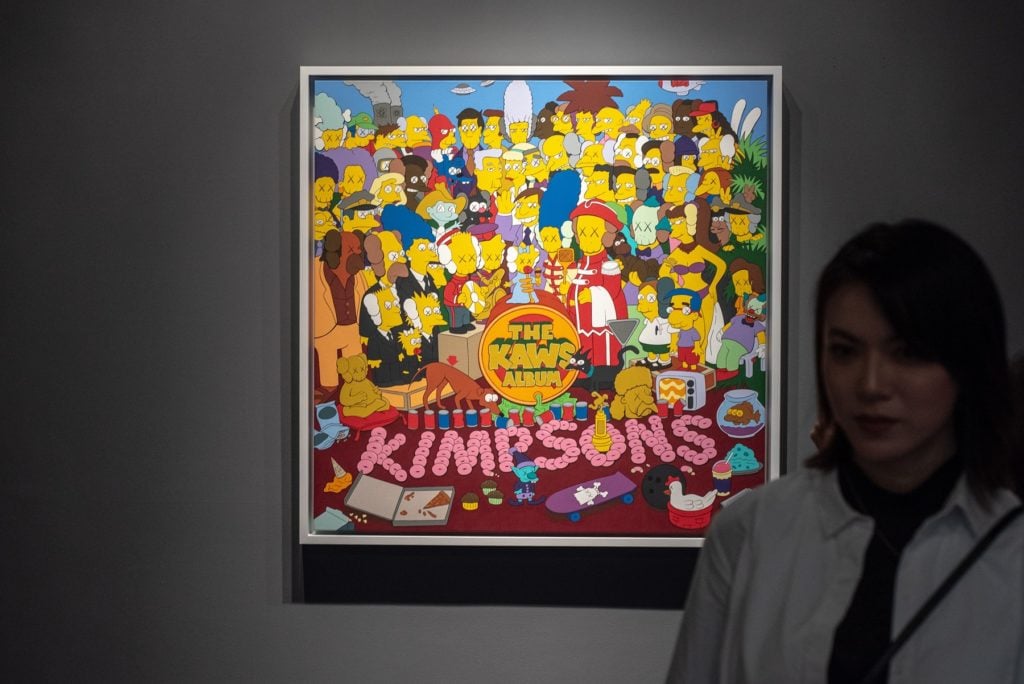
A woman poses for a photograph in front
of US artist KAWS, Untitled (Kimpsons #3) during Sotheby’s
Hong Kong’s media tour on March 29, 2019. Photo courtesy Philip
Fong AFP/Getty Images.
What Is Street Art?
One problem for art institutions
is simply one of definition. The terms are blurry, but whereas
“graffiti art” classically referred to spray painted tags or murals
featuring a given artist’s name, “street art” suggested a more
image-based genre that expanded to stencils, stickers,
wheat-pastes, trompe l’oeil murals, and various other forms of
visual trickery in the urban environment, sometimes interacting
directly with its
surroundings, such as existing
signage or the
convenient
positioning of a tree.
This makes “street art” somewhat
more visually appealing than classic tags. However, the name itself
suggests that the work’s value remains rooted in public space (i.e.
the street), putting it at odds with the two contexts taken most
seriously by the art world: the market and the museum. Some argue
that divorcing street work from its original context in order to
sell or archive it removes some of its anarchic magic, even as some
of its artists have expanded their practices radically beyond
alleyways and overpasses—albeit in ways that still don’t
necessarily fit into the traditional museum framework.
KAWS got his start as a street
artist, but his output isn’t limited to the street. Are the
limited-edition toys and KAWS-branded clothes “street art” in the
same way as his “subvertized” bus shelters and phone booths
are?

A wall of spray paint cans constructed
for the exhibition “City as Canvas: GraffitiArt from the Martin
Wong Collection” is seen with Reflections on Times Square
#2 (2013) by Chris “DAZE” Ellis at the Museum of the City of
New York February 3, 2014 in New York. Photo courtesy Stan Honda
AFP/Getty Images.
From Vandalism to Branding
Tina Ziegler, a curator who is
the director of street art fair Moniker, says that the movement is having
an “identity crisis.” For Ziegler, “urban contemporary” has become
a better handle because it can include art made in the studio, such
as installations, prints, and paintings on canvas. The defining
characteristic shared with street art proper, Ziegler says, is its
accessibility, and the motivation to take artwork outside of the
stuffy walls of an art gallery and into the public domain. That
said, Ziegler admits that “street art” still communicates quickly
to a mass public what her fair is about.
Others, such as Liam West,
the director of art
consultancy West Contemporary and the
street art gallery and branding agency Beautiful Crime,
might eschew the euphemistic
qualifier “urban,” and argue that street art now falls within the
genre of contemporary art, with names like Banksy and KAWS now
fixtures of contemporary sales at the major auction
houses.
“Banksy has done wonders for the
credibility of the genre—he really brought street art into the
mainstream,” West says. “My mum knows who Banksy is, but she has
never heard of Andy Warhol.”
This very popularity, however,
may point to a different reason you don’t see more street artists’s
work in museums: Street artists are focused on a different set of
opportunities to begin with. West’s job is to help street artists navigate
between the street and the market, but in a very different way than
traditional gallerists, who help find collectors, and place works
with prestigious institutions.
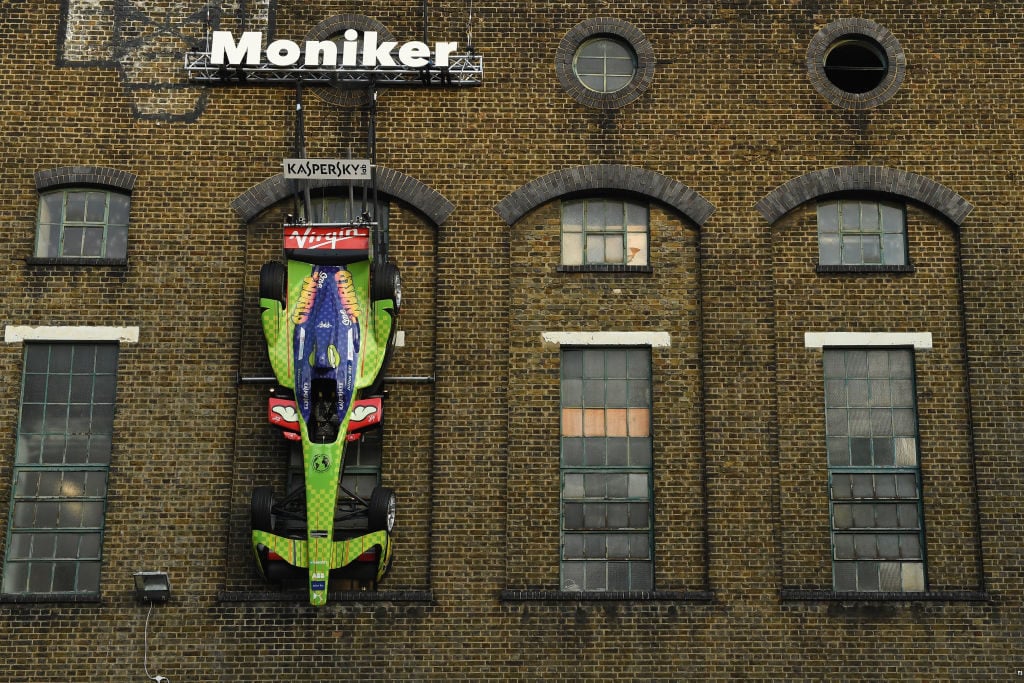
A “Formula art car” by street
artist D*Face for Kaspersky Lab at Moniker Art Fair in East London
on October 4, 2018. Photo by Ian Gavan Getty Images for Kaspersky
Lab.
Indeed, West compares putting a
street artist on a gallery contract to “chaining up a dog.”
Instead, he uses his experience in printmaking to help produce
commercial editions, and offers artists an outlet to sell their
work. That service, he says, has become less necessary now that
social media can do some of the heavy lifting in connecting an
artist to an audience. The fact remains that an established career
path for a street artist to make a living is through selling
multiples to a large audience rather than creating one-of-a-kind
artworks destined for gallery or museum display.
West’s branding agency also
helps street artists recognize commercial opportunities, which he
says often come from companies traditionally thought of as “uncool”
trying to buy some street cred. He has hooked up street artists to
collaborate with luxury brands, including Louis Vuitton as well as
tech giant Microsoft.
Real estate developers are also
interested in commissioning street artists to create murals on
their building sites as a way of “creative placemaking,” and to
boost sales. But it is not just private entities that have grasped
the appeal of street art. Local governments around the world are
increasingly integrating mural programs in their cities as a way to
deter unsanctioned graffiti art.
Early Adopters
The art world establishment was
not always prejudiced against street art. The esteemed curator
Rudi Fuchs included Basquiat (who was just 21), Keith Haring, and
Lee Quiñones in the prestigious documenta 7, in 1982. More than
three decades later, Basquiat and Haring are some of the most
famous artists of the ’80s generation. The Guggenheim New York is
currently presenting a critically acclaimed Basquiat
exhibition, and Haring
is getting a Tate survey in
Liverpool.
But the art world’s ’80s
interest in graffiti was soon displaced by neo-conceptualism, and
many artists central to this early discourse were left
behind. Rammellzee, an artist who worked with Basquiat, was
given the rediscovery
treatment last year at Red Bull Arts in New
York.
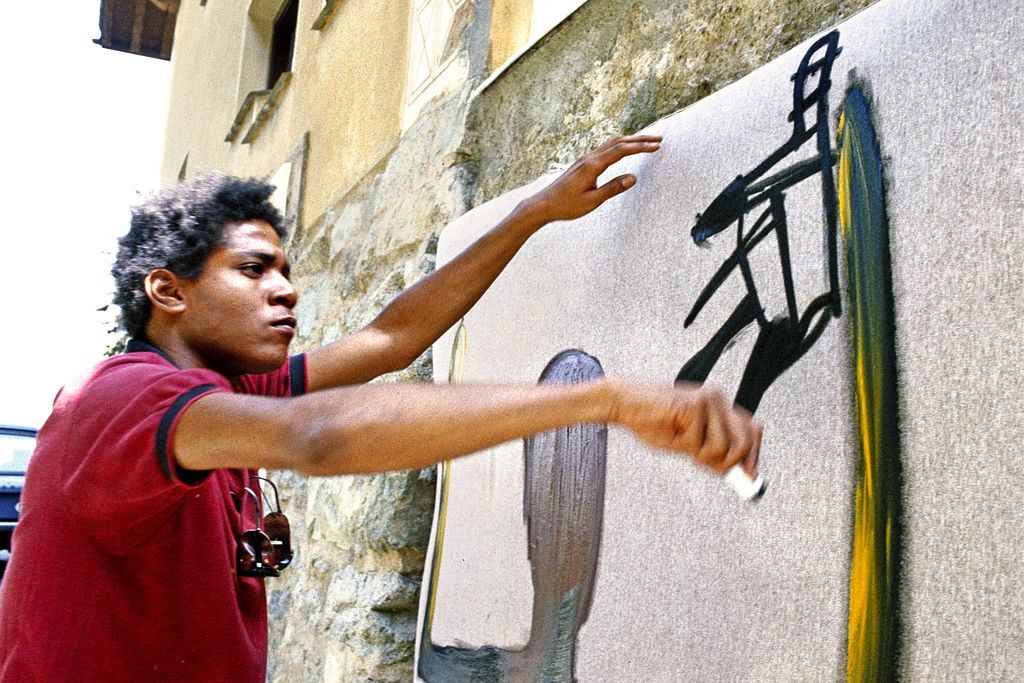
Artist Jean-Michel paints in 1983 in St.
Moritz, Switzerland. Photo by Lee Jaffe/Getty Images.
In 2011, the then director of LA
MOCA, Jeffrey Deitch, together with Robert Gastman, put on “Art in
the Streets” at the Geffen Contemporary in downtown Los Angeles.
The sprawling show included famous and less-well-known street
artists, tracing a global history of graffiti art. In its 113-day
run, it welcomed more than 200,000 visitors, making it the
institution’s best attended exhibition, and showing the drawing
power of the genre.
“It truly was one of the most
thrilling things I’ve ever been involved in,” Deitch tells artnet
News. The art dealer turned museum director recalls the public’s
enthusiastic response, which climaxed on the final day of the show,
when 8,500 people turned out to see it, and the museum reached
maximum capacity. Deitch says the lines were populated by people
from all generations and walks of life. “It was the type of line
you would see for a sports event, or for Disneyland,” he
recalls.
While the show received
attendance figures comparable to the blockbuster shows at the Met,
it also received mixed reactions from the art world. The original
exhibition was meant to travel to the Brooklyn Museum in 2012, but
it had to be canceled, ostensibly due to “financial difficulties.”
Deitch says the real story was that problems arose for the
exhibition after the LAPD vandal squad leaked a report to the press
connecting the exhibition to an uptick in graffiti and vandalism in
Downtown LA.
This points to a very real
association that may explain why museums are slow to embrace the
form. Due to the anti-establishment nature of much street art, the
movement is still often associated with crime. The prejudice runs
so deeply, says Deitch, that he was even forced to intervene when
LA MOCA began to install metal detectors at the door to the show.
He had them removed, and the exhibition proceeded with “zero
incidents” throughout its run.
“The overwhelming response to
the show blew their minds,” Deitch says, accusing its critics
of believing the “false narrative” propagated by the LAPD, which
was soon picked up by the media. A fellow at the Manhattan
Institute, Heather Mac Donald, went as far as to accuse LA MOCA of
“glorifying vandalism.” Eventually a New York City councilman,
Peter F. Vallone Jr., challenged the Brooklyn Museum on its
proposed hosting of the show. In a letter to the then director of
the Brooklyn Museum, Arnold Lehman, Vallone urged him to pull the
exhibition, even threatening to remove the $9 million the museum
then received annually from the city.
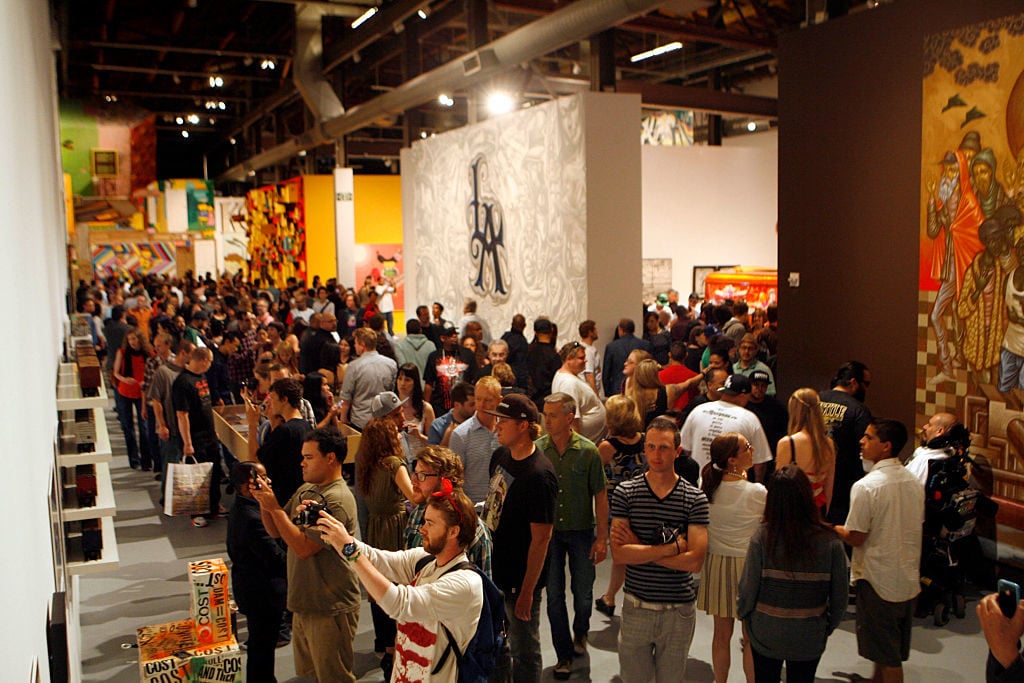
People view art on display during the
member’s reception of “Art in the Streets” at the Geffen
Contemporary at MOCA in Los Angeles, April 16, 2011. Photo by Ann
Johansson/Corbis via Getty Images.
“I don’t blame them for bowing
out,” Deitch says, acknowledging that the Brooklyn Museum went on
to invite the same artists to exhibit on an individual basis in
more low-key shows.
Deitch is confident that the
clear and ongoing interest from the public is going to drive a
change in the establishment. “The same used to apply to Basquiat,”
he observes. “Now his shows are some of the best attended in the
world, but for a long time he was not taken seriously by the museum
establishment.”
Gentrifying Street Art?
For Martyn Reed, an artist,
director of a street art festival, and co-editor of Nuart Journal, an academic journal
devoted to street art, museums’ “archaic structural mechanisms” are
to blame for their resistance to embracing the movement. He argues
that museums are threatened by street art because its practitioners
have found an alternative route to success. After all, Reed asks,
“what is contemporary art without institutional
validation?”
When it comes to curatorial
interest in street art, Reed says there is some interest from
newcomers, but that they soon struggle to be heard in the art
world’s “hermetically sealed
echo chamber” without caving to the already established
hierarchy.
“The exponential expansion of
the culture sector rests entirely on a quite narrow demographic of
white, middle class, educated staff and visitors who have signed a
social contract on what and who constitutes value in the field of
visual art,” Reed says.
“Until there’s radical
change in the makeup of institutional bureaucracies and boards,
that’s unlikely to change.”
Reed has his own thoughts on the
art world’s recent attempts to reclassify the genre. He sees the
excision of “street” from “street art” and the substitution of
“urban” as a gentrifying impulse. Worse still, he says, is the term
“urban contemporary,” which he calls “street art’s cleaned-up
neoliberal cousin.”
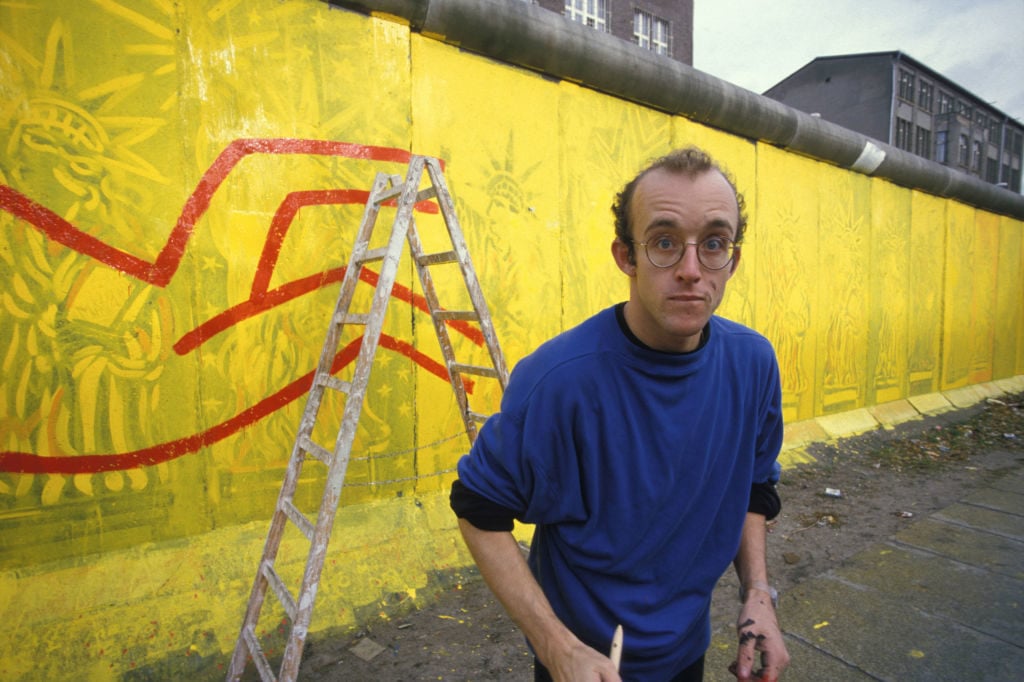
Keith Haring painting on the Berlin Wall
in October 1986. Photo by Patrick PIEL/Gamma-Rapho via Getty
Images.
In this vein, another street art
scholar and Nuart Journal co-editor, Susan
Hansen, warns that it is important for academics to be
critically reflexive about the impact of their scholarship. While
Hansen says it is
“absolutely vital” to look at street art seriously from an academic
perspective, she says that museums and scholars need to be careful.
“Within the subculture, some are wary of the potential influence of
street art research in terms of the institutionalization and
commodification of what has long been perceived as a ‘free’
democratic art form, and of the possibility of our research being
used to justify problematic placemaking projects, and to facilitate
the gentrification of our cities.”
Hansen makes an interesting
point. Street art is clearly having a significant impact on the
contemporary art scene, and there is ample public demand for it in
museums. But how do you commission or collect street art without
transforming it into something else? Are those who attempt to “chain the dog”
betraying the rebellious spirit of the genre? The solution might
lie somewhere between collecting materials, archiving photographs,
and commissioning work, as well as curatorial research into
answering these questions.
The London-based street artist
Endless agrees that museums should preserve
artworks and educate the public on the transformative impact of
street art on society. He sees the increased recognition as taking
a positive turn. “The positioning of street art today is in a good
place, where artists have more opportunities to explore their
practice and follow the path they have chosen,” the artist
says.
He does hasten to add, however,
that “the real value and power lies on the streets, where the
artwork is seen in its most free and raw form.”
The post Street Art Is a Global Commercial Juggernaut With a
Diverse Audience. Why Don’t Museums Know What to Do With It?
appeared first on artnet News.
Read more https://news.artnet.com/art-world/street-art-museums-1617037
Further reading


Leave a comment