
‘Success Seems Based on Sheer Luck’: Galleries and Museums Scramble for Government Relief Funds—Before They Dry Up Again
Ingrid Bromberg Kennedy, a partner in Lower East Side gallery
Klaus Von Nichtssagend, recently checked the gallery’s bank
account—and was surprised by what she found.
Roughly a week after filing for financial relief under the new
US CARES Act, and without any notice of approval or even a response
from the government or her bank, the funds showed up. She’s still
not sure why her gallery—which has three partners and no full-time
employees—was approved.
In some ways, Kennedy’s experience is emblematic of those of
many arts leaders who have applied for the Paycheck Protection
Program (PPP), a loan designed to provide a direct incentive for
small businesses of under 500 employees to keep their workers on
payroll.
By almost all accounts, communication from the government has
been minimal, guidance from many banks (particularly large ones)
has been poor, and it has been difficult to determine why some
applications are approved and others aren’t. But Kennedy’s story
has a happier ending than some of her peers.
Of the 14 institutions we surveyed, eight have been approved for
funding—six museums and two commercial galleries. They
include the Brooklyn Museum,
the Queens Museum, the San Francisco Museum of Modern Art (SFMOMA),
the Fabric Workshop and Museum, the ICA Boston, and
the Leslie-Lohman Museum of Art.
Applicants say the process favored larger businesses with
established relationships to banks—regardless of what industry
they’re operating in—over smaller companies. This dynamic has left
many galleries and some smaller institutions behind, especially
those that applied later in the game, deal with banks less
frequently than museums with significant endowments, and don’t have
dedicated finance teams to assemble the necessary paperwork.
So far, the biggest impact of PPP has been felt in museums that
have been able to take staff off furlough. Last month, SFMOMA laid off
135 on-call staff, furloughed 156 employees, and placed 35
more on a reduced schedule. Its $6.2 million PPP loan will now
enable the museum to lift the furlough and pay staff in full
through June 30—although, notably, the on-call employees will not
be reinstated. The Queens Museum’s loan of $493,000 enables the
museum to bring furloughed staff with reduced hours back to full
time and employ part-time workers. The ICA Boston’s $1.38 million
loan will allow the institution to keep its staff at full pay.
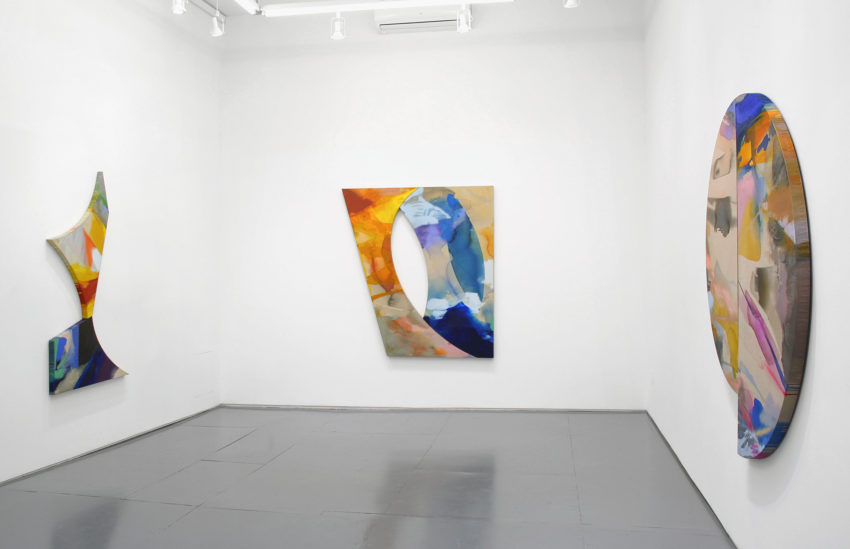
Installation view of “Pamela Jorden:
Reflector” at Klaus von Nichtssagend Gallery.
Behind the Process
Dealers and museum administrators alike describe the program as
a moving target. “There was so much changing guidance,” said
Elizabeth Denny of Denny Dimin Gallery. “We have a lending
relationship and a bank account with Chase but there was no one
there I could call to ask, ‘How do I make sure that this process
goes smoothly?’” An accountant she works with helped prepare the
necessary paperwork, but she says the bank offered little guidance
about filing deadlines.
Then, within days after the PPP program began in early April,
the $342.3 billion in funding ran out.
“We heard absolutely
nothing until whenever it was that they told everybody, ‘If you
don’t have the money yet it’s gone,’” Denny said. She recounted
receiving a decidedly tone-deaf email from Chase informing her that
the gallery was not approved and describing the extraordinary
“popularity” of the PPP among its clients. (A Chase
representative did not immediately respond to a request for
comment.)
Some institutions shut out of the first round found luck with
the second round of $310 billion released this week. Many tried for
funding more than once—often through multiple banks, which is
permitted under the program. Big banks, sources said, tended to be
less helpful than smaller outlets more attuned to the needs of
small businesses.
Indeed, just hours after Fabric Workshop and Museum executive director
Christina Vassallo told Artnet News that the PPP application was
“a deeply frustrating
process,” the Philadelphia institution had an update—it gained
approval for a $300,000 loan for payroll, benefits, and utilities
on Wednesday evening.
The institution initially went through PNC Bank, with which it
has an existing relationship. No luck. Then they tried a different,
smaller bank, Asian Bank, which presented an entirely new set of
rules and red tape to navigate. “We received a call within an hour,
from an actual human,” Vassallo said. The process was more
complicated, taking seven hours to complete, but ultimately, it was
successful. “To be honest, success seems based on sheer
luck,” Vassallo
added.
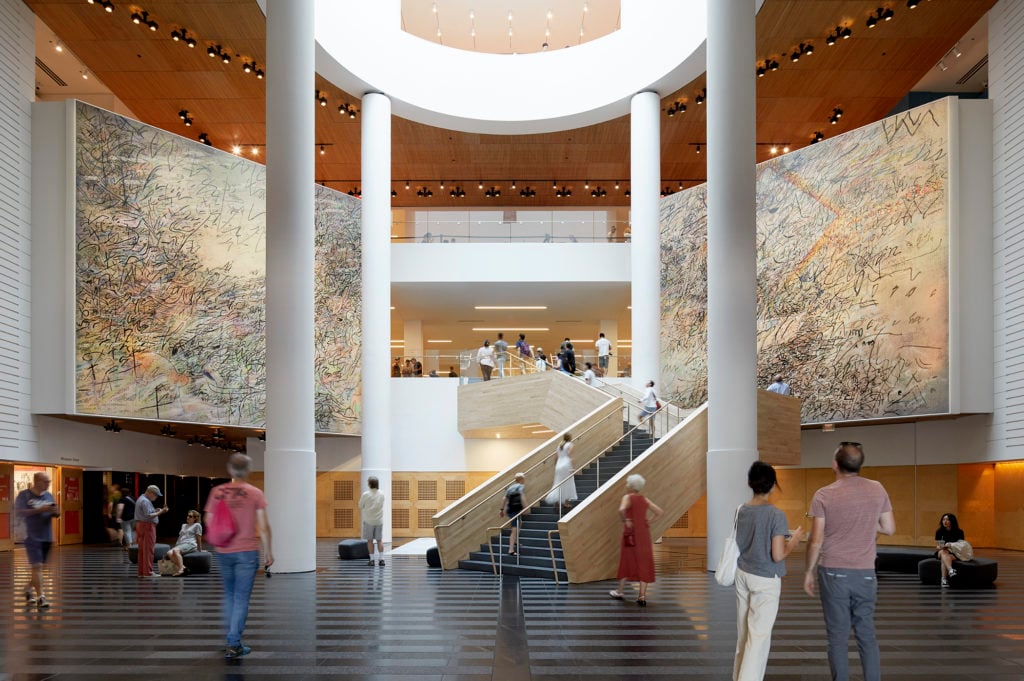
Installation view of Julie Mehretu’s
HOWL eon (I, II) (2017) at SFMOMA. Photo: Matthew Millman
Photography.
Klaus von Nichtssagend director Kennedy also believes a mixture
of sheer luck and perseverance played a role. She initially
believed her business was not eligible for PPP since the gallery
does not have staffers—it has three owners who pay themselves. But
after heeding the warning of a relative in finance (“he warned the
money would run out fast… and it did,” she said) and taking some
Zoom webinars, she learned the gallery model was eligible and won
approval on the first round, working with Chase.
Los Angeles dealer Francois Ghebaly also had better luck with
the second round of the PPP, having applied with a new, smaller
bank, East West Bank, whose head of private banking is a collector
and offered to help. “I think will
be switching banks, as I couldn’t deal with lack of attention and
help we received from Bank of America,” Ghebaly
said.
Some dealers also found success with Square, the company that
allows vendors to accept credit card purchases with small card
readers and recently began to accept PPP applications. “The
experience was so much easier than Chase’s platform, and they have
already been in touch via email with three update emails, whereas
Chase sent me virtually nothing along the way,” one dealer
said.
Signs of Success
Although it remains unclear what makes a successful application,
those who have completed many have pointed to some common threads.
Priority has generally been given to galleries that have W2 or
full-time employees, according to Amy Davila, CEO of Los
Angeles-based Art Smart, a business management firm that caters to
the art world. (This may exclude many small galleries, which have
only one or two full-time staff who are partners in the
business.)
Of the 50 clients for whom her firm has overseen PPP
applications, 11 have been successful so far. Davila says most of
the galleries she works with are still operating remotely with
online exhibitions and selling work, so they need a staff to set up
shipments, send out offers to clients, and coordinate forthcoming
exhibitions.
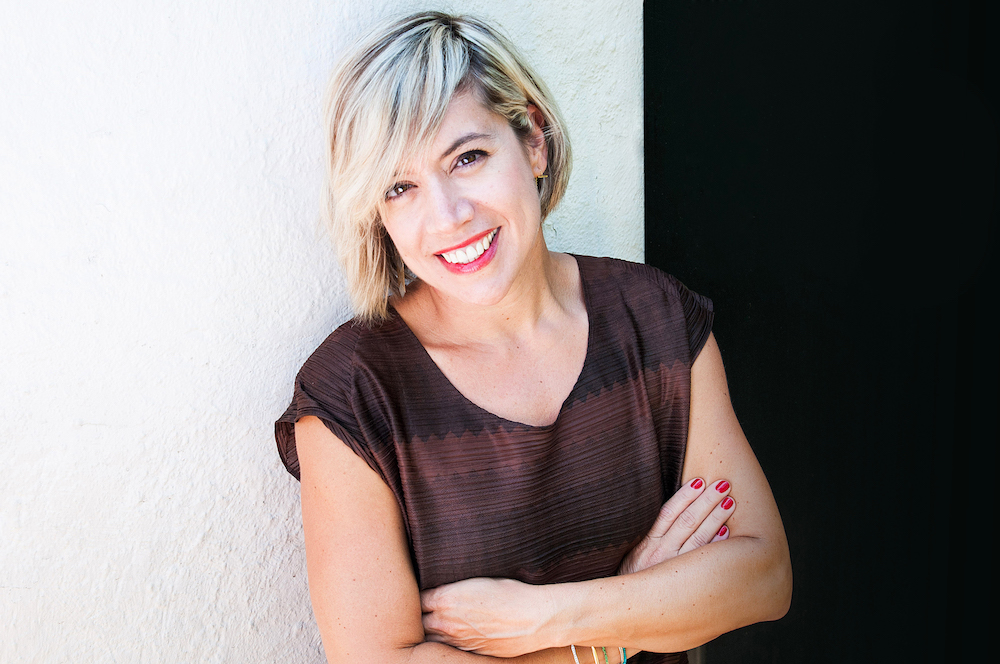
Amy Davila, Founder of ArtSmart Inc. Los
Angeles.
But in order to have the PPP loan forgiven by the government,
Davila notes, the majority of the money must be spent on employees
and within 60 days of receipt. So “for some galleries, it
doesn’t make sense because they don’t have enough work to keep
their people busy because they need them physically there and only
when there is a public to service,” Davila explained.
(The Small Business
Administration offers additional guidelines about loan
forgiveness, including that employees must be retained on the same
salary as before.)
“The past two months has really shown us how important it is to
be organized. This is something we’ve always promoted with our
clients,” Davila said. “Even a two-person operation is still a
business, and having a bookkeeping system, business checking
account, filing taxes on time, having a payroll system—all of this
really matters when you are trying to get a grant or a loan.”
The post ‘Success Seems Based on Sheer Luck’: Galleries and
Museums Scramble for Government Relief Funds—Before They Dry Up
Again appeared first on artnet News.
Read more https://news.artnet.com/art-world/art-paycheck-protection-program-1848351
Further reading


Leave a comment